
银行

Search documents
战略数据研究|专题报告:2026年保险配置展望:资源、AI、消费出海还是金融
Changjiang Securities· 2026-02-28 14:45
Group 1: Insurance Fund Management Overview - As of the end of 2025, the total balance of insurance funds was 38.48 trillion yuan, with life insurance companies holding 34.66 trillion yuan, and stock investments amounting to 3.51 trillion yuan, representing 10.12% of the total[2][15]. - In 2025, the insurance fund management balance increased by approximately 5.2 trillion yuan, with equity holdings growing by about 1.3 trillion yuan, accounting for approximately 25% of the total increase[5][16]. Group 2: Asset Allocation Trends - The survey indicates that over 60% of insurance institutions plan to increase their stock positions in 2026, with 27% of asset management firms and 31% of insurance companies maintaining their equity positions[7][44]. - The predicted increase in stock investments for 2026 is expected to exceed 1.2 trillion yuan, driven by the initiative to allocate 30% of new premiums to A-shares[6][28]. Group 3: Investment Preferences and Focus Areas - Insurance institutions are focusing on sectors such as electronics, non-ferrous metals, power equipment, and AI computing, aligning with the "14th Five-Year Plan" for technological innovation and industrial upgrading[8][47]. - The preference for high-dividend stocks remains strong, with approximately 30% of institutions still focusing on high-dividend strategies, despite a shift towards growth sectors like AI and semiconductors[8][54]. Group 4: Overseas Investment Outlook - Hong Kong stocks are the most favored overseas investment option for 2026, with half of the asset management institutions planning to slightly increase their allocations[9][61]. - Gold investments are also gaining attention, alongside U.S. stocks, indicating a diversified approach to overseas asset allocation[9][61].
【广发金工】OpenClaw多平台部署与投研应用
广发金融工程研究· 2026-02-28 14:41
Core Viewpoint - The article discusses the application of AI in investment research, focusing on the capabilities and deployment of the AI agent OpenClaw, which integrates seamlessly into user workflows and addresses traditional AI assistant limitations in interaction, privacy, and context retention [1][4]. Group 1: OpenClaw Advantages - OpenClaw offers innovative cross-platform interaction, allowing users to control it through popular messaging apps, enhancing remote usability [2][5]. - It possesses strong local execution capabilities, enabling it to perform complex tasks such as code review and file organization autonomously [2][5]. - The architecture prioritizes user privacy by deploying on personal devices, ensuring sensitive information remains secure [2][6]. - OpenClaw features persistent memory, maintaining context over time through local logs and configuration files, providing personalized long-term intelligent services [2][6]. Group 2: Deployment on Multiple Platforms - The article details the deployment process of OpenClaw on Windows, Mac, and cloud platforms, emphasizing the use of the Windows Subsystem for Linux (WSL2) for a stable environment [4][7]. - For Mac, the deployment process is similar to that of WSL, leveraging the Unix-like nature of macOS [30]. - OpenClaw can also be quickly deployed on cloud servers such as Tencent Cloud and Alibaba Cloud, facilitating broader accessibility [34]. Group 3: Investment Research Applications - OpenClaw's framework allows for various investment research applications, including financial data access, conditional stock selection, file management, financial report analysis, and technical analysis [3][36]. - The Stock Watcher skill enables real-time market data access and analysis, allowing users to manage their stock portfolios through natural language commands [46]. - Conditional stock selection can be performed based on specific criteria, such as market capitalization and price-to-earnings ratio, with backtesting capabilities for selected stocks [52][54]. Group 4: File Management and Financial Analysis - OpenClaw can manage files directly within the host environment, allowing for operations like batch file creation and text writing [55]. - It can autonomously read and summarize financial reports, providing key financial metrics and insights without prior tool configuration [56][57]. - The system can also analyze complex code projects, generating structured Python code based on specified requirements [58][60].



农业银行召开2026年服务乡村振兴和“三农”县域业务工作会议
Xin Lang Cai Jing· 2026-02-28 13:28
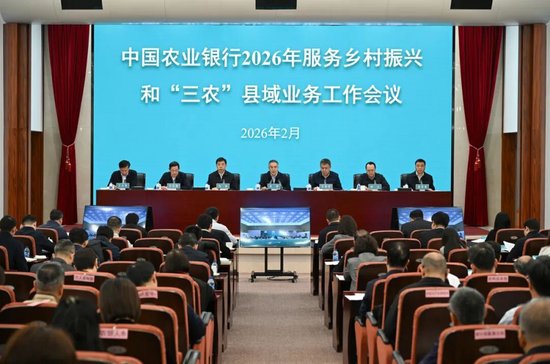
来源:中国农业银行 2月28日,农业银行在京召开2026年服务乡村振兴和"三农"县域业务工作会议。会议深入学习贯彻习近 平总书记关于"三农"工作的重要论述和重要指示批示精神,认真贯彻党的二十大和二十届历次全会以及 中央经济工作会议、中央农村工作会议、中央一号文件要求,总结2025年服务乡村振兴和"三农"县域业 务工作,部署2026年重点任务。 农业银行党委书记、董事长谷澍就2026年服务乡村振兴和"三农"县域业务工作讲话,党委副书记、行长 王志恒主持会议并对相关业务经营工作进行安排,党委委员、副行长孟范君通报2025年乡村振兴综合服 务活动获奖名单以及中国农业银行"服务乡村振兴奖""乡村服务先锋"。农业银行党委成员、董事会和高 管层成员出席会议。 会议指出,2025年,全行坚决扛牢服务乡村全面振兴、助力农业强国建设的职责使命,持续强化涉农金 融供给,"三农"金融服务取得显著成效。坚持以中央巡视整改推动乡村振兴服务走深走实,"三农"重点 领域服务更加有力,过渡期金融帮扶任务圆满完成,农户贷款投放跃上新台阶,"三农"产品服务创新迈 出新步伐,全行联动服务"三农"持续深化,"三农"和县域业务实现稳中有进、稳中向好。 ...

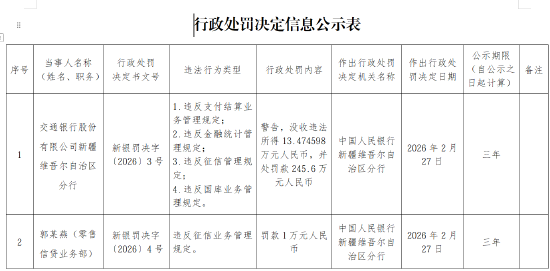
交通银行新疆维吾尔自治区分行被罚45.6万元:违反支付结算业务管理规定等
Xin Lang Cai Jing· 2026-02-28 13:22
2月28日金融一线消息,中国人民银行新疆维吾尔自治区分行行政处罚信息公开表显示,交通银行股份 有限公司新疆维吾尔自治区分行因违反支付结算业务管理规定、违反金融统计管理规定、违反征信管理 规定、违反国库业务管理规定,被警告,没收违法所得13.47万元,并处罚款245.6万元。同时,郭某燕 (时任零售信贷业务部)因违反征信业务管理规定,被罚款1万元。 | = | | | | 行政处罚决定信息公示表 | | | | | --- | --- | --- | --- | --- | --- | --- | --- | | 印波 | 当事人名称 | 行政处罚 | 进发行为类型 | 行政处罚内容 | 作出行政处罚 | 作出行政处 | 公示期限 (自公示之 各注 | | | (姓名、职务) | 决定书文号 | | | 决定机关名称 | 罚决定日期 | 日起十篇) | | | 交通银行股份 | | 1. 通反支付结算业 务管理规定: | 警告,没收违法 | | | | | | | | 2. 违反金融统计管 | 所得 13.474598 | 中国人民银行 | | | | | 有限公司新疆 | 新银罚决学 | 理规定: | 万元人 ...

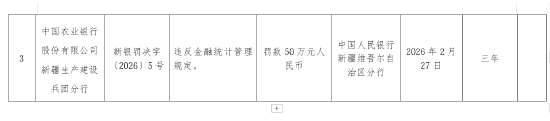
农业银行新疆生产建设兵团分行被罚50万元:违反金融统计管理规定
Xin Lang Cai Jing· 2026-02-28 13:22
责任编辑:王馨茹 责任编辑:王馨茹 2月28日金融一线消息,中国人民银行新疆维吾尔自治区分行行政处罚信息公开表显示,中国农业银行 股份有限公司新疆生产建设兵团分行因违反金融统计管理规定,被罚款50万元。 2月28日金融一线消息,中国人民银行新疆维吾尔自治区分行行政处罚信息公开表显示,中国农业银行 股份有限公司新疆生产建设兵团分行因违反金融统计管理规定,被罚款50万元。 | | 中国农业银行 | | | | | | | --- | --- | --- | --- | --- | --- | --- | | 3 | 股份有限公司 新疆生产建设 | 新望罚决字 (2026) 5 号 | [连反金融统计管理 罚款 50万元人 规定。 民币 | 中国人民银行 新疆维吾尔自 | 2026 年 2月 27 日 | ≥ 夹 | | | | | | 治区分行 | | | | | 兵团分行 | | | | | | | | 中国农业银行 | | | | 中国人民银行 | | | | --- | --- | --- | --- | --- | --- | --- | --- | | 3 | 股份有限公司 新疆生产建设 | 新银罚决字 ...
顶级经济学家警示:美国经济已悄然转向
财富FORTUNE· 2026-02-28 13:08
Core Viewpoint - The article discusses the current state of the U.S. economy, highlighting concerns about labor market dynamics and institutional stability, as well as the potential misalignment of economic policies with underlying structural changes [5][10]. Group 1: Labor Market Dynamics - The U.S. labor market is experiencing a "low hiring, low firing" state, with employers cautious about new hires despite a slight increase in unemployment rates [3][6]. - Claudia Sam's "Sam Rule" indicates that a 0.5 percentage point increase in the three-month moving average of unemployment could signal a recession, a rule that has shown 100% accuracy from 1959 until the pandemic [3][6]. - There is a concern that the current low hiring rates may not indicate a typical recession but rather a deeper structural change in the labor market, influenced by factors such as immigration policies and the rise of artificial intelligence [6][8]. Group 2: Institutional Stability - The stability of U.S. institutions, including the Federal Reserve, is under scrutiny due to political pressures experienced during the Trump administration, which raises concerns about their ability to operate independently [4][9]. - Claudia Sam expresses unease about the potential for institutional drift, suggesting that the current economic policies may not effectively address the evolving challenges in the labor market [10]. - The article notes that while economic factors primarily drive interest rates, ongoing political pressures could undermine the Federal Reserve's independence and effectiveness in managing economic stability [10].
从软件股暴跌到金融踩踏:私人信贷的“影子风险”浮出水面
美股研究社· 2026-02-28 11:38
Core Viewpoint - The recent downturn in the U.S. stock market, particularly in the financial sector, highlights the risks associated with leveraged positions backed by overvalued assets, as evidenced by the bankruptcy of Market Financial Solutions (MFS) [2][4]. Group 1: Market Dynamics - The bankruptcy of MFS, a UK mortgage lender, triggered widespread panic in the financial sector, leading to significant declines in bank ETFs and regional bank stocks [2][4]. - The event is not merely a localized financial issue but serves as a risk transmission test, revealing that substantial financial risks remain hidden within complex credit structures, particularly in the context of the AI bull market and high interest rates [4][8]. Group 2: Private Credit Risks - The private credit market has rapidly expanded in recent years, filling the gap left by traditional banks constrained by capital requirements and regulatory demands. This has led to a proliferation of high-risk loans packaged in private funds and customized structured products [7][10]. - The decline in software stock valuations may trigger a liquidity crisis in private credit, as the value of collateral diminishes, leading to margin calls and potential defaults [6][8]. Group 3: Systemic Risk Assessment - Unlike the 2008 financial crisis, current risks are more concentrated in the non-bank financial system, with private credit markets now valued in the trillions of dollars, posing a significant threat to financial stability [10][11]. - The collective decline in financial stocks reflects investor concerns about the systemic underestimation of risks associated with private credit, as many seemingly stable credit products are tied to volatile tech stocks [8][10]. Group 4: Investment Outlook - The market faces three potential paths regarding the implications of MFS's bankruptcy: a localized liquidity event, a gradual rise in private credit defaults absorbed by profits and capital buffers, or a broader risk asset revaluation triggered by credit risk transmission [12][13]. - Key variables influencing the market include the stability of tech stock valuations and the potential for increased redemption pressures on private credit funds, which could exacerbate liquidity issues [13][14]. Group 5: Conclusion - The situation underscores the need for a fundamental shift in investment logic, emphasizing the health of balance sheets and the stability of liabilities over mere profit growth [14]. - The bankruptcy of MFS may signal the beginning of a broader reassessment of risk in the financial markets, particularly as high valuations become collateral, making volatility a critical concern [14].

——解构宏观流动性系列之一:重构信贷收支表:连接货币政策与银行行为
Huafu Securities· 2026-02-28 11:25
Group 1: Report Industry Investment Rating - Not mentioned in the provided content Group 2: Core Viewpoints of the Report - The research starts with how bank behavior affects M2, aiming to connect monetary policy and bank behavior through reconstructing the credit balance sheet to understand bank behavior and the transmission path of monetary policy [3][29][32] - Reconstructing the credit balance sheet can more comprehensively reflect bank behavior and the orientation of monetary policy, and help investors analyze bank behavior [4][5][136] - The change in bank net lending and non - bank holding of certificates of deposit has a significant impact on M2 growth, and the central bank's regulation of bank liquidity is crucial for achieving the M2 target [9][160][172] - The scale of bank bond investment is mainly determined by government bond supply, and the difference between bank bond purchases and supply can reflect the bank's active allocation willingness and affect the market trend [10][173] Group 3: Summary According to the Table of Contents 1. Introduction - Starting the Research from How Bank Behavior Affects M2 - Bank behavior analysis is important for understanding the bond market and monetary policy. The central bank affects bank behavior through liquidity regulation to achieve monetary policy goals [20][24][29] - The monthly credit balance sheet provides information on the bank's capital sources and uses, and the research starts with how bank behavior affects M2, but the change in M2 is often dominated by other items [25][28][29] 2. Different Levels of the Credit Balance Sheet and Their Underlying Arithmetic Relationships 2.1 Institutions Covered by the Credit Balance Sheet - The credit balance statistics involve banking financial institutions, divided into deposit - taking and non - deposit - taking financial institutions. There are three levels of credit balance sheets with different statistical scopes [33][35][36] 2.2 Classification Criteria for Deposits and Loans in Each Level of the Credit Balance Sheet - There are differences in the deposit and loan items of different levels of credit balance sheets. The total deposits and loans of large and small banks are different from those of deposit - taking financial institutions and financial institutions, mainly due to the different scope of institutions included [47][48][54] 2.3 Arithmetic Relationships in Financial Investments of Each Level of the Credit Balance Sheet - Items such as repurchase, reverse repurchase, and inter - bank transactions are aggregated into the "other" item in the deposit - taking institution's statement after netting [71] - The bond investment and financial bond items of large and small banks are netted and included in the deposit - taking institution's statement [73] - Transactions between large/small banks and the central bank are netted out in the deposit - taking institution's statement [76] 3. Verifying the Connotations of Each Item in the Credit Balance Sheet with Micro - data 3.1 The Bond Investment Item Mainly Includes Government Bonds, Local Bonds, and Credit Bonds Held by Deposit - taking Institutions - The bond investment item in the deposit - taking institution's credit balance sheet mainly includes government bonds, local bonds, and credit bonds, and the data is verified by custody data [83][86] 3.2 Financial Bonds - Non - bank Institutions Hold Policy Financial Bonds and Commercial Bank Bonds - The financial bond item in the credit balance sheet mainly reflects non - bank institutions' holdings of financial bonds, and the data is verified by comparing with non - bank institutions' custody data [90] 3.3 The Netting of Financial Inter - bank Transactions Mainly Includes Non - bank Institutions' Holdings of Certificates of Deposit - The netting of inter - bank transactions mainly reflects non - bank institutions' holdings of certificates of deposit, which can reduce the bank's dependence on deposits and affect M2 [97][100][102] 3.4 The Netting of Repurchase and Reverse Repurchase is Mainly the Difference between Bank Net Lending and the Central Bank's Pledged and Outright Repurchase Balances - The netting of repurchase and reverse repurchase is equivalent to the bank's net lending to non - bank institutions after deducting central bank financing, which can affect M2 [107][117][119] 3.5 Replacing the Relevant Items in the Credit Balance Sheet with the Foreign Net Assets Item in the Deposit - taking Company Overview - The foreign - related items in the credit balance sheet mainly reflect the central bank's foreign assets and liabilities, and the foreign net assets item in the deposit - taking company overview is used to replace them [124] 3.6 The Equity and Other Investment Item Mainly Includes Non - standard and Inter - bank Investments - The equity and other investment item includes non - standard investments and inter - bank assets such as funds, and its scale has changed due to regulatory policies [131] 4. Reconstructing the Credit Balance Sheet - Connecting Monetary Policy and Bank Behavior 4.1 Observing the Reasons for M2 Changes from the Deposit Structure - Analyzing the deposit structure can find that different types of deposits have different impacts on M2, and the so - called "deposit transfer" is a false proposition at the bank system level [137][141][142] 4.2 Inferring M2 Changes from the Perspective of Capital Use - Reconstructing the credit balance sheet by adding some items from large and small banks can more accurately analyze the reasons for M2 changes [149][150][155] - The recent improvement in M2 growth is mainly due to the increase in bank net lending, while the impact of foreign net assets is relatively small [160][161] - The reconstructed credit balance sheet reflects the transmission path of monetary policy, and financial investment - related items can be important tools for the central bank to adjust M2 growth [168][172] - By analyzing the credit balance sheets of large and small banks, the reasons for the changes in their deposit structures can be inferred, and the central bank's policy attitude affects bank behavior [181][183][192]
建设银行山西省分行原党委副书记、副行长斛文锋接受纪律审查和监察调查
Bei Jing Shang Bao· 2026-02-28 10:51
Core Viewpoint - The former Deputy Party Secretary and Vice President of China Construction Bank's Shanxi branch, Hu Wenfeng, is under investigation for serious violations of discipline and law, as reported by the Central Commission for Discipline Inspection and the National Supervisory Commission [1] Group 1 - Hu Wenfeng is currently undergoing disciplinary review by the Central Commission for Discipline Inspection and the National Supervisory Commission [1]

中国建设银行山西省分行原党委副书记、副行长斛文锋接受纪律审查和监察调查
Zhong Yang Ji Wei Guo Jia Jian Wei Wang Zhan· 2026-02-28 10:24
Group 1 - The former Deputy Party Secretary and Vice President of China Construction Bank's Shanxi branch, Hu Wenfeng, is under investigation for serious violations of discipline and law [1] - The investigation is being conducted by the Central Commission for Discipline Inspection and the Shanxi Provincial Supervisory Commission [1]