高耗能行业

Search documents
2025年7月PMI数据解读:7月PMI:增长动能高点或已过去
ZHESHANG SECURITIES· 2025-07-31 12:01
Economic Indicators - The manufacturing PMI for July is at 49.3%, a decrease of 0.4 percentage points from June, indicating a weak recovery and potential peak in economic growth momentum[1] - The new orders index fell to 49.4%, down 0.8 percentage points from the previous month, entering a contraction zone, suggesting tightening market demand[13] - The comprehensive PMI output index is at 50.2%, down 0.5 percentage points from last month, still indicating overall expansion in production activities[27] Sector Performance - The production index for July is at 50.5%, a decline of 0.5 percentage points, but remains in the expansion zone for three consecutive months[3] - Equipment manufacturing PMI is at 50.3% and high-tech manufacturing PMI is at 50.6%, both above the critical point, indicating continued expansion in these sectors[1] - The consumer goods industry PMI is at 49.5%, down 0.9 percentage points, while the high-energy-consuming industries PMI is at 48.0%, up 0.2 percentage points, showing mixed performance across sectors[1] External Trade and Demand - The new export orders index is at 47.1%, down 0.6 percentage points, reflecting cautious attitudes among foreign trade enterprises due to uncertainties in tariffs[16] - Port cargo throughput in July increased by 10.9% year-on-year, indicating some resilience in actual export volumes despite potential sustainability issues[17] Price Trends - The main raw material purchase price index rose to 51.5%, up 3.1 percentage points, marking the first rise above the critical point since March, indicating improved market price levels[18] - The factory price index is at 48.3%, up 2.1 percentage points, suggesting a slight recovery in manufacturing prices[18]
7月PMI:反内卷的“悖论”?
申万宏源宏观· 2025-07-31 10:58
Core Viewpoint - The "anti-involution" policy has boosted prices, but supply and demand performance is counterintuitive [2][7][67] - The manufacturing PMI decreased by 0.4 percentage points to 49.3%, exceeding the average decline since 2017 [2][67] - The increase in commodity prices is reflected in the raw material purchase price index (+3.1 percentage points to 51.5%) and the factory price index (+2.1 percentage points to 48.3%) [2][67] Manufacturing Sector - The manufacturing PMI has marginally declined, with production and new order indices both decreasing [4][70] - The production index fell by 0.5 percentage points to 50.5%, while the new order index dropped by 0.8 percentage points to 49.4% [4][70] - The new export order index decreased by 0.6 percentage points to 47.1%, indicating a slowdown in market demand [4][70][35] Key Industries - High-energy-consuming industries are showing production strength despite price increases, with the steel industry PMI rising by 4.6 percentage points to return to the expansion zone [3][18][69] - The equipment manufacturing and consumer goods industries saw PMIs decline by 1.1 and 0.9 percentage points to 50.3% and 49.5%, respectively [3][18][69] - Investment demand weakened significantly, contrasting with the strong production performance in high-energy-consuming sectors [21][69] Non-Manufacturing Sector - The non-manufacturing PMI decreased by 0.4 percentage points to 50.1%, primarily due to a significant drop in the construction PMI [42][70] - The construction PMI fell by 2.2 percentage points to 50.6%, with the new order index dropping sharply by 2.2 percentage points to 42.7% [5][58][70] - The service sector PMI slightly declined, with the new order index remaining weak at 46.3% [5][46][70] Future Outlook - The political bureau meeting in July emphasized the need for further implementation of the "anti-involution" policy, focusing on the effects in downstream sectors and marginal changes in domestic demand [27][69] - The current situation indicates that the "anti-involution" policy in the upper reaches still requires further advancement, while high-energy-consuming industries are undergoing significant transformations [27][69]

中采PMI点评(25.07):7月PMI:反内卷的“悖论”?
Shenwan Hongyuan Securities· 2025-07-31 10:43
Group 1: PMI Data Overview - In July, the manufacturing PMI decreased by 0.4 percentage points to 49.3%, while the non-manufacturing PMI fell by 0.4 percentage points to 50.1%[6][28] - The decline in manufacturing PMI is greater than the average drop of 0.1 percentage points since 2017[7][28] - The purchasing price index for major raw materials rose by 3.1 percentage points to 51.5%, marking the first increase above the critical point since March[7][18] Group 2: Sector Performance - The production index in July remained in the expansion zone at 50.5%, despite a 0.5 percentage point decline[2][13] - The new orders index fell into the contraction zone, decreasing by 0.8 percentage points to 49.4%[2][14] - High-energy-consuming industries, particularly the steel sector, saw a PMI increase of 4.6 percentage points, returning to the expansion zone at 48%[18][21] Group 3: Investment and Demand Trends - Investment demand weakened significantly in July, contrasting with the strong performance of high-energy-consuming industries[21] - The construction PMI dropped by 2.2 percentage points to 50.6%, with new orders falling sharply to 42.7%[21][42] - The business activity expectation index for the construction sector decreased by 2.3 percentage points to 51.6%[21] Group 4: Future Outlook - The political bureau meeting in July emphasized the need for further implementation of "anti-involution" policies, particularly focusing on mid- and downstream sectors[23] - The report suggests that the effectiveness of "anti-involution" policies in stimulating domestic demand will be crucial for future manufacturing performance[23]
7月PMI数据解读 | 市场需求偏弱带动7月制造业PMI指数下行
Xin Lang Cai Jing· 2025-07-31 09:37
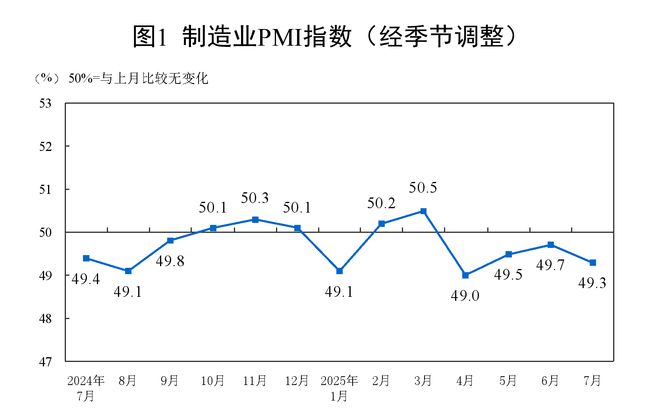
根据国家统计局公布的数据,2025年7月,中国制造业采购经理指数(PMI)为49.3%,比6月下降0.4个 百分点;7月非制造业商务活动指数为50.1%,比6月下降0.4个百分点,其中,建筑业商务活动指数为 50.6%,比6月下降2.2个百分点,服务业PMI指数为50.0%,比6月下降0.1个百分点;7月综合PMI产出指 数为50.2%,比6月下降0.5个百分点。 要点解读如下 7月制造业PMI指数比上月下降0.4个百分点,基本符合市场预期。 主要原因是当月反映市场需求的新订单指数环比回落0.8个百分点至49.4%,再度进入收缩区间。我们分 析,背后可能有两个原因: 其他方面,近期"反内卷"牵动市场预期,国内主导的煤炭、钢铁等大宗商品价格快速上冲。这是当月制 造业PMI指数中两个价格指数快速走高的主要原因。我们预计,7月PPI会环比转正,同比降幅会收窄 至-3.0%左右。不过,当前工业品价格低迷主要是受消费需求不振和房地产投资下滑拖累,"反内卷"对 工业品价格及整体物价的推升作用有待进一步观察。另外值得注意的是,7月中型企业PMI指数继续回 升,而大型、小型企业PMI指数都出现0.9个百分点的回落,其中大型企 ...

7月制造业新动能稳健,高技术PMI持续扩张
2 1 Shi Ji Jing Ji Bao Dao· 2025-07-31 08:53
Core Viewpoint - The manufacturing Purchasing Managers' Index (PMI) in China for July 2025 is reported at 49.3%, indicating a decline of 0.4 percentage points from the previous month, reflecting a downturn in manufacturing activity [1][4]. Manufacturing PMI Overview - The manufacturing PMI has decreased to 49.3%, with production index at 50.5% and new orders index at 49.4%, both showing declines from the previous month [1][4]. - The raw materials inventory index is at 47.7%, indicating a continued reduction in major raw material stocks, while the employment index has slightly increased to 48% [4][5]. - The supplier delivery time index is at 50.3%, suggesting that the delivery times for raw materials are improving [4]. Sector Performance - Key sectors such as railway, shipbuilding, aerospace, and computer communication electronics are showing active production and new orders, while sectors like chemical raw materials and non-metallic mineral products are underperforming [5][6]. - The equipment manufacturing and high-tech manufacturing sectors have PMIs of 50.3% and 50.6%, respectively, remaining above the critical point, indicating ongoing expansion [6][7]. Economic Outlook - There is potential for demand recovery, with expectations that economic stabilization policies may be implemented to boost PMI [5][6]. - The price index for major raw materials has risen, with the purchasing price index at 51.5%, marking the first increase above the critical point since March [6][7]. Inventory and Business Confidence - The finished goods inventory index has decreased to 47.4%, reflecting cautious inventory adjustments by enterprises [7]. - Business confidence is improving, with the production and business activity expectation index rising to 52.6%, indicating a more optimistic outlook among manufacturers [7].
2025年7月PMI数据点评:市场需求偏弱带动7月制造业PMI指数下行
Dong Fang Jin Cheng· 2025-07-31 06:09
Group 1: Manufacturing PMI Insights - In July 2025, China's manufacturing PMI decreased to 49.3%, down 0.4 percentage points from June[1] - The new orders index fell by 0.8 percentage points to 49.4%, indicating a return to contraction territory[2] - The production index was at 50.5%, down 0.5 percentage points, still in the expansion zone but affected by weak demand[2] Group 2: External and Internal Demand Factors - Weak external demand was reflected in the new export orders index, which dropped by 0.6 percentage points[2] - Domestic consumption growth has slowed, influenced by the real estate market adjustments and reduced effectiveness of previous growth-stimulating policies[2] - The service sector PMI was at 50.0%, down 0.1 percentage points, with tourism-related sectors performing well but overall service sector affected by real estate cooling[4] Group 3: Economic Outlook and Policy Implications - The overall economic pressure is increasing, with manufacturing PMI indicating a downturn after two months of recovery[5] - The central political bureau meeting emphasized the need for sustained macroeconomic policy support in the second half of the year[5] - Potential policy measures may include interest rate cuts and increased fiscal spending to boost domestic demand and counteract external demand slowdown[5]
最新PMI数据发布
天天基金网· 2025-07-31 05:33
Core Viewpoint - The manufacturing PMI decreased to 49.3% in July, indicating a slight contraction in the manufacturing sector, while the non-manufacturing business activity index remained above the critical point, suggesting overall economic expansion [1][3][6]. Manufacturing Sector - The manufacturing PMI fell by 0.4 percentage points from the previous month, attributed to seasonal production slowdowns and adverse weather conditions [3][4]. - The production index and new orders index were at 50.5% and 49.4%, respectively, indicating continued expansion in manufacturing activities but a slowdown in market demand [4]. - The manufacturing business activity expectation index rose to 52.6%, reflecting increased confidence among manufacturers regarding market developments [4]. - Key industries such as equipment manufacturing and high-tech manufacturing maintained PMIs above the critical point at 50.3% and 50.6%, respectively, while the consumer goods sector saw a decline to 49.5% [4]. Non-Manufacturing Sector - The non-manufacturing business activity index was reported at 50.1%, down 0.4 percentage points from the previous month, but still above the critical threshold [6]. - The service sector's business activity index remained stable at 50%, with significant growth in transportation and entertainment sectors due to summer holiday effects [7]. - The construction sector's business activity index decreased to 50.6%, influenced by adverse weather conditions, with a corresponding drop in the business activity expectation index to 51.6% [8]. Market Outlook - The overall market expectations in the service sector improved, with a business activity expectation index of 56.6%, indicating optimism among service providers [7]. - Experts suggest that increased government investment in public goods and infrastructure could help boost order volumes and stabilize economic growth in the latter half of the year [4][8].

国家统计局发布重磅数据!
Zheng Quan Ri Bao Wang· 2025-07-31 03:27
Group 1: Manufacturing Sector - The manufacturing Purchasing Managers' Index (PMI) decreased to 49.3% in July, down 0.4 percentage points from the previous month, indicating a decline in manufacturing activity [1][2] - The production index remained in expansion at 50.5%, while the new orders index fell to 49.4%, reflecting a slowdown in market demand [2] - Large enterprises maintained expansion with a PMI of 50.3%, while medium-sized enterprises improved to 49.5%, and small enterprises decreased to 46.4% [3] Group 2: Non-Manufacturing Sector - The non-manufacturing business activity index was 50.1%, down 0.4 percentage points from last month, but still above the critical point [4] - The service sector's business activity index was stable at 50.0%, with strong performance in transportation and tourism-related industries [4] - The construction sector's business activity index fell to 50.6%, influenced by adverse weather conditions [4] Group 3: Price Indices - The price indices for major raw materials increased, with the purchasing price index at 51.5% and the factory price index at 48.3%, indicating an overall improvement in market prices [2] Group 4: Market Expectations - The production and business activity expectations index rose to 52.6%, showing increased confidence among manufacturing enterprises regarding market development [3] - The business activity expectations index for the service sector increased to 56.6%, indicating optimism among service industry enterprises [4]
国家统计局发布重磅数据
Zheng Quan Ri Bao Wang· 2025-07-31 03:03
Group 1: Manufacturing Sector - The manufacturing Purchasing Managers' Index (PMI) decreased to 49.3% in July, down 0.4 percentage points from the previous month, indicating a decline in manufacturing activity [1][2] - The production index remained in expansion at 50.5%, while the new orders index fell to 49.4%, reflecting a slowdown in market demand [2] - Large enterprises maintained expansion with a PMI of 50.3%, while medium-sized enterprises improved to 49.5%, and small enterprises decreased to 46.4% [3] Group 2: Price Indices - The price index for major raw materials increased, with the purchasing price index at 51.5% and the factory price index at 48.3%, indicating an overall improvement in manufacturing market prices [2] - The purchasing price index for major raw materials rose above the critical point for the first time since March, suggesting a recovery in market conditions [2] Group 3: Non-Manufacturing Sector - The non-manufacturing business activity index was 50.1%, down 0.4 percentage points from the previous month, but still above the critical point, indicating continued expansion [1][4] - The service sector's business activity index remained stable at 50.0%, with certain industries like transportation and entertainment showing strong growth due to seasonal effects [4] - The construction sector's business activity index fell to 50.6%, influenced by adverse weather conditions, while the business activity expectation index for the service sector rose to 56.6%, indicating optimism among service enterprises [4] Group 4: Composite PMI - The composite PMI output index was 50.2%, down 0.5 percentage points from the previous month, but still indicating overall expansion in production and business activities [5][6] - The manufacturing production index and non-manufacturing business activity index contributed to the composite PMI, standing at 50.5% and 50.1% respectively [6]
刚刚发布:49.3%
中国基金报· 2025-07-31 02:42
Group 1: Manufacturing PMI Overview - In July, the Manufacturing Purchasing Managers' Index (PMI) was 49.3%, a decrease of 0.4 percentage points from the previous month, indicating a decline in manufacturing activity [2][21][22] - The production index was 50.5%, down 0.5 percentage points, while the new orders index was 49.4%, down 0.8 percentage points, suggesting a slowdown in market demand [6][22] - Large enterprises maintained expansion with a PMI of 50.3%, while medium-sized enterprises improved to 49.5%, and small enterprises decreased to 46.4% [5][23][24] Group 2: Non-Manufacturing PMI Overview - The Non-Manufacturing Business Activity Index was 50.1%, a decrease of 0.4 percentage points, but still above the critical point, indicating continued expansion [11][25] - The service sector's business activity index was stable at 50.0%, while the construction sector's index fell to 50.6%, down 2.2 percentage points due to adverse weather conditions [14][25] - The business activity expectation index for non-manufacturing was 55.8%, indicating optimism among most enterprises regarding market development [17][25] Group 3: Comprehensive PMI Overview - The Comprehensive PMI Output Index was 50.2%, a decrease of 0.5 percentage points, but still indicating overall expansion in production and business activities [20][26] - The manufacturing production index and non-manufacturing business activity index were 50.5% and 50.1%, respectively, contributing to the comprehensive index's performance [26]