
水泥

Search documents
反内卷与供给侧改革有何不同|宏观经济
清华金融评论· 2025-09-13 10:07
Core Viewpoint - The article discusses the concept of "anti-involution" as a new phase of supply-side reform, termed "Supply-Side Reform 2.0," highlighting the structural imbalance between supply and demand as the core contradiction driving economic challenges in China [5]. Group 1: Similarities between Anti-Involution and Supply-Side Reform - Both anti-involution and supply-side reform are characterized by structural imbalances in supply and demand, leading to decreased capacity utilization, falling prices, shrinking corporate profits, and increased economic downward pressure [7]. - Industrial capacity utilization has significantly declined, with a drop from 76.8% in Q4 2013 to 72.9% in 2016 during the supply-side reform, and from 77.4% in Q4 2021 to 74.0% by Q2 2025 in the anti-involution phase [7]. - Industrial prices have seen substantial declines, with the Producer Price Index (PPI) entering negative growth for 54 months during the supply-side reform and continuing negative growth for 34 months since October 2022 in the anti-involution phase [9]. - Corporate profits have decreased, with a 2.3% decline in industrial profits in 2015 during the supply-side reform, and a 1.8% decline in the first seven months of 2025 during the anti-involution phase [12]. - Economic downward pressure has intensified, with GDP growth slowing from 8.1% in Q4 2012 to 6.9% in Q4 2015 during the supply-side reform, and stabilizing around 5% during the anti-involution period [14]. Group 2: Differences between Anti-Involution and Supply-Side Reform - The macroeconomic environment differs, with anti-involution facing more severe demand shortages due to population decline and a downturn in the real estate market, while supply-side reform had resilient demand supported by post-crisis recovery [18][22]. - Industry characteristics vary, as supply-side reform focused on traditional industries like steel and coal, whereas anti-involution encompasses a broader range of sectors, including emerging industries and platform economies [25][27]. - The underlying causes differ, with supply-side reform driven by excess capacity from previous stimulus policies, while anti-involution is influenced by a range of macroeconomic and industry-specific factors, including real estate adjustments and technological shifts [36][37]. - Implementation paths diverge, with supply-side reform relying on administrative measures to cut excess capacity, while anti-involution emphasizes legal and market-based approaches to regulate competition and foster innovation [45][49].

报告显示,2024年我国城镇新建绿色建筑面积16.9亿平方米
Xin Jing Bao· 2025-09-13 08:38
Core Insights - The report presented by the Minister of Ecology and Environment highlights China's commitment to addressing climate change and achieving carbon peak and neutrality goals, with significant advancements in green building and energy transition [1][2][3] Group 1: Green Building Development - In 2024, the area of newly constructed green buildings in urban areas is projected to reach 1.69 billion square meters, accounting for 97.9% of the total new urban construction area [2] - The government is actively promoting high-quality development in green buildings and construction [2] Group 2: Energy Transition - By June 2025, the installed capacity of non-fossil energy is expected to reach 2.22 billion kilowatts, representing 60.9% of the total installed capacity [2] - The government is enhancing the clean and efficient use of fossil energy, implementing coal power reforms, and steadily increasing natural gas production and utilization [2] Group 3: New Energy Production - Since the start of the 14th Five-Year Plan, the production of photovoltaic components and lithium batteries has increased by 3.7 times and 6.4 times, respectively [2] - China has maintained its position as the global leader in the production and sales of new energy vehicles for ten consecutive years [2] Group 4: Carbon Market Development - The national carbon market has been progressively improved, with the inclusion of the steel, cement, and aluminum industries, covering over 60% of national carbon emissions [2] - As of June 2025, the cumulative trading volume of carbon emission allowances in the national carbon market is 670 million tons, with a transaction value of 45.93 billion yuan [2] Group 5: Climate Change Adaptation - The report outlines the implementation of the National Climate Change Adaptation Strategy 2035, focusing on climate-resilient urban development and enhancing disaster prevention and response capabilities [3] - The government aims to integrate climate change adaptation requirements into land use planning at all levels [3] Group 6: Legal and Policy Framework - There is a commitment to improve legal policies to support climate change response, including the development of specialized laws and the revision of energy conservation laws [3][4] - The government plans to enhance carbon emission regulatory enforcement and establish mechanisms to combat data fraud in the carbon market [3]
金隅冀东水泥“绿色+智慧”成果点亮博览会
Bei Jing Ri Bao Ke Hu Duan· 2025-09-12 23:30
Core Viewpoint - The article highlights the advancements and achievements of Jinyu Jidong Cement in the context of green development, innovation, and digital transformation within the cement industry, showcasing its commitment to low-carbon and sustainable practices. Group 1: Product Innovation and Applications - Jinyu Jidong Cement has developed specialized oil well cement that can withstand high temperatures and salinity at depths of 2000 meters, addressing strength challenges in extreme environments [5] - The company has created mining cement with unique properties that prevent subsidence during coal mine backfilling, ensuring safety [5] - A composite admixture for concrete has been developed to enhance workability, increase strength, and reduce carbon emissions, widely applied in flood control and river management projects [5] Group 2: Green and Low-Carbon Development - The company has focused on green, circular, and low-carbon development, achieving a reduction of 30,000 tons of standard coal annually through the use of alternative raw materials and biomass fuels [2] - The integration of photovoltaic systems with production processes has significantly decreased reliance on purchased electricity, generating 17,900 million kWh from waste heat and 10 million kWh from solar power [2] - Jinyu Jidong Cement has received numerous accolades for its green initiatives, including national-level honors for being a "Green Factory" and "High-tech Enterprise" [2] Group 3: Technological Innovation - The region's technological innovation has become a core driver for high-quality development, with over 2,400 intellectual property rights and participation in the formulation of national and industry standards [4] - The establishment of innovation centers and laboratories has led to the development of various low-carbon and high-performance cement products for diverse applications [4] Group 4: Digital Transformation - The company has invested significantly in digital transformation, including a 60 million yuan project for an unmanned mining vehicle system, marking a first in the cement industry [7] - Smart production scheduling systems optimize energy consumption and reduce production fluctuations, while order response platforms enhance customer service efficiency [7] - Overall operational efficiency has improved by 40%, and energy efficiency has been optimized by 15%, with several energy consumption metrics reaching international standards [7] Group 5: Future Outlook - Jinyu Jidong Cement aims to continue its commitment to sustainable practices, innovation, and digitalization, aligning with the broader industry trend towards high-quality development and contributing to carbon neutrality goals [9]

东吴水泥(00695)拟出售东方诚正稀土100%股权
智通财经网· 2025-09-12 13:11
Group 1 - The company, Dongwu Cement, has entered into a sale agreement with Jia Yi Holdings to sell its entire stake in the target company, Dongfang Chengzheng Rare Earth, for HKD 10 million, effective September 12, 2025 [1] - Following the completion of the sale, Dongwu Cement will no longer hold any shares in the target company, which will cease to be a subsidiary, thus its financial performance will not be included in the consolidated financial statements of the group [1] - The target company is involved in the production and sales of magnetic materials and other application products, including high-performance sintered neodymium-iron-boron permanent magnetic materials and permanent motors [1] Group 2 - The group acquired a majority stake in a company engaged in the production and sales of rare earth permanent magnetic materials in 2023, which later became the selling group; however, the selling group's financial performance has been poor over the past two years, with post-tax losses of approximately HKD 9.15 million and HKD 27.77 million for the years ending December 31, 2023, and December 31, 2024, respectively [2] - The losses were primarily due to the downward trend in magnetic material prices and insufficient production scale of the selling group [2] - The company believes that the sale will allow it to concentrate financial resources on its cement business, improve cash flow liquidity and financial flexibility, streamline operations, and enhance overall financial performance [2] - The company will actively explore diverse investment opportunities, closely monitor and seek potential strategic cooperation opportunities, and promote the development of its international trade segment [2] - The company will continue to focus on its existing core business, aiming to improve profitability and operational efficiency through asset structure optimization and capital operations, thereby enhancing overall competitiveness [2]
东吴水泥拟出售东方诚正稀土100%股权
Zhi Tong Cai Jing· 2025-09-12 13:10
Group 1 - The company has entered into a sale agreement with Jia Yi Holdings to sell its entire issued share capital in Dongfang Chengzheng Rare Earth for HKD 10 million, effective September 12, 2025 [1] - Following the completion of the sale, the company will no longer hold any shares in the target company, and the target company will cease to be a subsidiary, meaning its financial performance will not be consolidated into the company's financial statements [1] - The board believes that the sale aligns with the company's long-term goals and current market conditions, allowing for a strategic repositioning to focus on higher-potential businesses [1] Group 2 - The company acquired a majority stake in a rare earth permanent magnet materials producer in 2023, which later became the selling group; however, the selling group has shown poor financial performance over the past two years, with after-tax losses of approximately HKD 9.15 million and HKD 27.77 million for the years ending December 31, 2023, and December 31, 2024, respectively [2] - The losses were primarily due to a downward trend in magnetic material prices and insufficient production scale [2] - The company believes that the sale will allow it to concentrate financial resources on its cement business, improve cash flow liquidity and financial flexibility, streamline operations, and enhance overall financial performance [2]
业绩总结:水泥、玻纤利润同比高增,重视供给变化
Guolian Minsheng Securities· 2025-09-12 13:03
Investment Rating - The report maintains an "Outperform" rating for the building materials sector [7]. Core Insights - The traditional building materials sector is expected to see sustained price improvements due to strong short-term cement peak-shifting collaboration, with long-term supply policies likely to support profit margins. High dividends highlight the long-term investment value, particularly in regional cement leaders [4][12]. - The report emphasizes the importance of focusing on leading companies in the renovation materials sector, as they continue to innovate through channel expansion and product diversification, which may accelerate market share growth amid industry consolidation [4][12]. - There is a notable investment opportunity in electronic fabrics, particularly for leading companies with strong expansion momentum and first-mover advantages, driven by high demand from AI computing needs [4][12]. Summary by Sections 1. Building Materials 2025H1 Performance Summary 1.1 Renovation Materials: Demand Under Pressure, Intense Competition - The renovation materials sector faced weak demand in 2025H1, with total revenue for sample companies at 69.7 billion, down 7% year-on-year, and net profit at 3.9 billion, down 19% year-on-year. The second quarter saw similar trends, with revenue of 40.7 billion, down 7%, and net profit of 2.7 billion, down 22% year-on-year [8][15][18]. 1.2 Cement: Supply-Side Reform Effects Continue to Show - In 2025Q2, most cement companies reported improved year-on-year profits despite some pressure on sales and revenue. The national average cement price was 382 yuan, up 2% year-on-year, while the price difference between cement and coal averaged 328 yuan, up 8% year-on-year [9][25][26]. 1.3 Glass Fiber: Rising Volume and Price for Roving and High-End Electronic Fabrics - The glass fiber sector experienced significant profit improvements due to rising demand for roving and high-end electronic fabrics, driven by wind power and AI computing needs. Major companies reported good revenue and profit growth in 2025Q2 [9][35]. 1.4 Glass: Pharmaceutical Glass Demand Under Pressure - The glass sector faced challenges, with pharmaceutical glass demand under pressure and overall market conditions for float glass and photovoltaic glass continuing to decline. Revenue and profit for leading companies remained under pressure [10]. 1.5 Other New Materials: Explosive Materials Market Upturn - The explosive materials sector saw rapid revenue and profit growth, while other materials like refractory materials faced increasing pressure. The overall demand for glass wool products remained weak [11]. 2. Focus on Cement Value Recovery and New Electronic Fabrics - The report suggests focusing on cement value recovery and the potential of electronic fabrics and corporate transformation opportunities, particularly in traditional building materials driven by asset consolidation [12][23].


东吴水泥(00695.HK)拟1000万港元出售东方诚正稀土所有股份
Ge Long Hui· 2025-09-12 12:58
Core Viewpoint - The company has agreed to sell its subsidiary, Dongfang Chengzheng Rare Earth Co., Ltd., for HKD 10 million, marking a strategic move to refocus on higher-potential businesses and improve financial performance [1][2]. Group 1: Sale Agreement - The company will sell all shares of Dongfang Chengzheng Rare Earth Co., Ltd., and upon completion, will no longer hold any shares in the target company, which will cease to be a subsidiary [1]. - The sale price for the target company is set at HKD 10 million [1]. Group 2: Strategic Rationale - The board believes that the sale aligns with the company's long-term goals and current market conditions, allowing for a repositioning towards more promising business areas [2]. - The company had previously acquired a majority stake in a rare earth permanent magnet materials producer, which has since become the divested group [2]. Group 3: Financial Performance - The divested group has shown poor financial performance over the past two years, with after-tax losses of approximately HKD 9.15 million for the year ending December 31, 2023, and HKD 27.77 million for the year ending December 31, 2024 [2]. - The losses were primarily attributed to declining prices of magnetic materials and insufficient production scale [2]. Group 4: Future Focus - The company aims to concentrate financial resources on its cement business to improve cash flow and financial flexibility, thereby streamlining operations and enhancing overall financial performance [2]. - The company will actively explore diverse investment opportunities and seek potential strategic partnerships while continuing to focus on its core business [2].
房地产及建材行业双周报:建材“防内卷”政策持续落地行业盈利有所改善-20250912
Dongguan Securities· 2025-09-12 11:42
Investment Rating - The report maintains a "Neutral" rating for both the real estate and building materials sectors [2][4]. Core Insights - The "anti-involution" policies in the building materials sector are being implemented, leading to improved industry profitability [2]. - Recent policy adjustments in major cities like Shenzhen are expected to stimulate short-term market activity, although long-term recovery will depend on sales data and corporate performance [2][25]. - The cement industry is showing signs of recovery due to self-regulation and cost optimization, with expectations for further profit increases in the second half of 2025 [2][44]. - The glass and fiberglass sectors are experiencing weak supply-demand balance, but potential improvements in demand could lead to price recovery [2][45]. Summary by Sections Real Estate Sector - As of September 11, 2025, the Shenwan Real Estate Index has increased by 2.86% over the past two weeks, outperforming the CSI 300 Index by 1.72 percentage points [11]. - The average price of new residential properties in 100 cities rose by 0.20% month-on-month and 2.73% year-on-year, while second-hand housing prices fell by 0.76% month-on-month and 7.34% year-on-year [23][25]. - Major real estate companies are facing continued pressure, with mid-year losses widening compared to the previous year [25]. - Recommended companies include Poly Developments (600048), Binjiang Group (002244), and China Merchants Shekou (001979) for their strong performance in first and second-tier cities [2][25]. Building Materials Sector - The Shenwan Building Materials Index has increased by 0.31% over the past two weeks, ranking 23rd among 31 sectors [26]. - The average price of cement is currently at 314 RMB/ton, with a slight decrease of 1 RMB/ton from the previous week [30]. - The glass industry is in a weak supply-demand balance, with limited price rebound potential in the short term, but a possible recovery as construction activity increases [45]. - Recommended companies in the cement sector include Conch Cement (600585), Taipai Group (002233), and Huaxin Cement (600801) for their solid fundamentals and attractive dividend yields [44][46].
水泥板块9月12日涨0.61%,华新水泥领涨,主力资金净流出1.58亿元
Zheng Xing Xing Ye Ri Bao· 2025-09-12 08:38
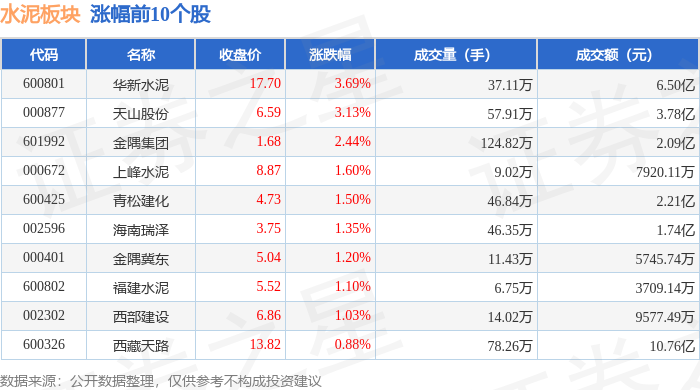
Core Viewpoint - The cement sector experienced a slight increase of 0.61% on September 12, with Huaxin Cement leading the gains [1] Group 1: Market Performance - The Shanghai Composite Index closed at 3883.69, up by 0.22% [1] - The Shenzhen Component Index closed at 12996.38, up by 0.13% [1] Group 2: Individual Stock Performance - Huaxin Cement (600801) closed at 17.70, with a rise of 3.69% and a trading volume of 371,100 shares, totaling a transaction value of 650 million yuan [1] - Tianshan Shares (000877) closed at 6.59, up by 3.13%, with a trading volume of 579,100 shares and a transaction value of 378 million yuan [1] - Quanjing Group (601992) closed at 1.68, increasing by 2.44%, with a trading volume of 1,248,200 shares and a transaction value of 209 million yuan [1] - Other notable performances include: - Shangfeng Cement (000672) at 8.87, up by 1.60% [1] - Qingsong Jianhua (600425) at 4.73, up by 1.50% [1] - Hongzhi House (002596) at 3.75, up by 1.35% [1] Group 3: Capital Flow - The cement sector saw a net outflow of 158 million yuan from main funds, while retail funds experienced a net inflow of 34.59 million yuan [1] - Speculative funds had a net inflow of 124 million yuan [1]



房地产及建材行业双周报(2025、08、29-2025、09、11):建材“防内卷”政策持续落地,行业盈利有所改善-20250912
Dongguan Securities· 2025-09-12 07:00
Investment Rating - The report maintains a "Neutral" rating for both the real estate and building materials sectors [2][4]. Core Insights - The "anti-involution" policies in the building materials sector are being implemented, leading to improved industry profitability [2][4]. - Recent policy adjustments in major cities like Shenzhen are expected to stimulate short-term market activity, although long-term recovery will depend on sales data and corporate performance [2][4][23]. - The cement industry is showing signs of recovery due to self-regulation and cost optimization, with expectations for further profit increases in the second half of the year [2][4][41]. Summary by Sections Real Estate Sector - As of September 11, 2025, the Shenwan Real Estate Index has increased by 2.86% over the past two weeks, outperforming the CSI 300 Index by 1.72 percentage points [11]. - The average price of new residential properties in 100 cities rose by 0.20% month-on-month and 2.73% year-on-year, while second-hand housing prices fell by 0.76% month-on-month and 7.34% year-on-year [21][23]. - The report suggests focusing on stable central state-owned enterprises and regional leaders in first and second-tier cities, such as Poly Developments (600048), Binjiang Group (002244), and China Merchants Shekou (001979) [2][23]. Building Materials Sector - The building materials sector has seen a 0.31% increase over the past two weeks, lagging behind the CSI 300 Index by 0.83 percentage points [24]. - The cement market is currently facing weak demand, with an average price of 314 RMB/ton, down 1 RMB/ton from the previous week [28][30]. - The glass industry is experiencing a weak supply-demand balance, with limited price rebound potential, but there are structural opportunities in the fiberglass sector due to growth in emerging fields like wind power and electric vehicles [42]. - Recommendations for cement companies include Anhui Conch Cement (600585), Taipai Group (002233), and Huaxin Cement (600801) due to their solid fundamentals and attractive dividend yields [41][42].