证券业

Search documents
三维发力 增强资本市场韧性
Qi Huo Ri Bao Wang· 2025-05-09 00:29
Core Viewpoint - The announcement of a comprehensive financial policy package by three major financial regulatory bodies aims to stabilize market expectations and enhance the resilience of the capital market through three dimensions: "stabilizing expectations," "activating funds," and "strengthening foundations" [1] Group 1: Stabilizing Expectations - Economic stability is crucial for maintaining investor confidence in the capital market, with the central bank implementing three types of policies: quantitative policies (0.5% reserve requirement ratio cut, releasing approximately 1 trillion yuan in long-term liquidity), price policies (0.1% reduction in policy interest rates, 0.25% reduction in structural monetary policy tool rates), and structural policies (establishment of 500 billion yuan in re-loans for service consumption and elderly care) [2] - The financial regulatory authority has introduced financing and support policies targeting weak economic sectors such as real estate and small enterprises, including measures to support foreign trade development and assist market entities affected by tariffs [2] - The policy package not only seeks stability but also aims for progress, with an increase of 300 billion yuan in re-loans for technological innovation and the creation of risk-sharing tools for technology innovation bonds [2][3] Group 2: Activating Funds - The capital market in China has historically been dominated by retail investors, leading to high volatility; however, recent reforms aim to attract long-term capital by enhancing the return characteristics of equity investments [4] - The establishment of a "stabilizer" in the form of a quasi-"stabilization fund" is emphasized, which will play a crucial role in mitigating irrational market fluctuations during times of risk [4] - The central bank's decision to merge 500 billion yuan in securities, fund, and insurance company swap facilities with 300 billion yuan in stock repurchase loans is expected to release more long-term capital into the market [4] Group 3: Strengthening Foundations - The implementation of the new "National Nine Articles" has accelerated reforms in the capital market, focusing on serving new productive forces and enhancing investor returns [5] - The regulatory authority plans to expedite the release of revised guidelines for major asset restructuring and other reforms related to the Sci-Tech Innovation Board and Growth Enterprise Market [5] - The introduction of a high-quality development action plan for public funds aims to link fund company revenues with investor returns, establishing mechanisms for performance-based fees and long-term assessments [6]
时报观察|为科创生态蓬勃发展注入强大动力
证券时报· 2025-05-08 23:53
Core Viewpoint - The People's Bank of China and the China Securities Regulatory Commission have jointly announced measures to support the issuance of technology innovation bonds, aiming to enhance the product system and improve supporting mechanisms for these bonds [1][2]. Group 1: Issuance Focus - The new issuance primarily targets three types of entities: financial institutions (such as commercial banks and securities companies), technology enterprises (especially those in growth and maturity stages), and private equity investment institutions [1]. - The policy aims to eliminate barriers between technology and capital, with the introduction of a "technology board" in the bond market [1]. Group 2: Current Challenges - Current technology innovation bonds are predominantly issued by traditional industries like construction, coal, and public utilities, with insufficient direct support for high-tech industries [1]. - The average duration of existing technology innovation bonds is approximately 2.88 years, which limits long-term financing support for enterprises [1]. Group 3: Policy Enhancements - The policy allows issuers to flexibly choose issuance methods and financing terms, and encourages innovative bond terms to better match funding needs [2]. - Local governments may establish risk compensation funds or other supportive policies to provide interest subsidies and government financing guarantees for technology innovation bonds [2]. - Credit rating agencies are encouraged to innovate the credit rating system for technology innovation bonds based on the characteristics of equity investment institutions and technology enterprises [2]. Group 4: Ecosystem Development - The collaboration among commercial banks, securities companies, private equity institutions, and technology enterprises is expected to create a comprehensive support system for technology innovation, integrating debt, loans, equity, and insurance [2].


“增量政策”序幕拉开——稳市场稳预期新闻发布会学习理解
赵伟宏观探索· 2025-05-08 22:44
Core Viewpoint - The article discusses the recent press conference held by the State Council Information Office on May 7, 2025, which introduced a comprehensive financial policy package aimed at stabilizing the market and expectations. The focus is on the implementation of monetary policies and measures to support various sectors, including real estate, capital markets, and private enterprises [1][10]. Summary by Sections Monetary Policy Measures - The central bank introduced three types of monetary policy measures: quantity-based policies, price-based policies, and structural policies. Quantity-based policies include reserve requirement ratio (RRR) cuts to increase long-term liquidity supply. Price-based policies involve lowering policy interest rates and structural monetary policy tool rates, including public housing loan rates. Structural policies aim to improve existing tools and create new ones to support innovation, consumption, and inclusive finance [2][11]. - A comprehensive RRR cut of 0.5 percentage points is expected to provide approximately 1 trillion yuan in long-term liquidity to the market [7]. - The central bank also lowered the interest rates on structural monetary policy tools by 0.25 percentage points, which is projected to save banks approximately 150-200 million yuan annually in funding costs [4][12]. Financial Support for Real Estate and Capital Markets - The Financial Regulatory Bureau announced eight incremental policies to support real estate, capital markets, and private enterprises. These include accelerating the introduction of financing systems compatible with new real estate development models and expanding the scope of long-term investment trials for insurance funds [3][11]. - The demand side of the real estate market will benefit from a 0.25 percentage point reduction in personal housing provident fund loan rates, which is expected to save residents over 200 million yuan in interest payments annually [6][15]. Support for Private Enterprises and Innovation - The conference emphasized strong financial support for private enterprises and technological innovation. The central bank plans to use tools like innovation re-loans to increase credit support for private enterprises in technology sectors [5][14]. - The Financial Regulatory Bureau proposed a comprehensive policy package to support private enterprise financing and provide precise financial services to entities significantly affected by tariffs [3][14]. Market Stability Initiatives - The policies aim to stabilize and activate capital markets through various measures, including enhancing the collaboration between the central bank and the China Investment Corporation to support stock market index funds and providing sufficient re-loan support [5][14]. - The introduction of a new merger and acquisition loan management approach is intended to facilitate industrial transformation and upgrading [8][14]. Overall Economic Context - The recent monetary policy actions are seen as a response to the stable performance of the real estate and stock markets, with the economy showing resilience, as indicated by a 5.4% year-on-year GDP growth in the first quarter [12][13].

科创债“扩容”热潮涌动 机构企业抢滩发行总额超百亿
Zheng Quan Shi Bao· 2025-05-08 17:57
Core Viewpoint - The People's Bank of China and the China Securities Regulatory Commission have announced support for the issuance of technology innovation bonds, expanding the range of issuers to include financial institutions, technology companies, private equity investment institutions, and venture capital institutions [1][2] Group 1: Issuance Plans - Major financial institutions such as the China Development Bank plan to issue up to 200 billion yuan in technology innovation bonds, while Industrial and Commercial Bank of China aims for a base issuance of 100 billion yuan, with a potential excess of 100 billion yuan [2] - Securities firms have also announced plans, with a total proposed issuance of up to 177 billion yuan, including firms like CITIC Securities and Huatai Securities [2] - A total of 36 companies have announced plans to issue technology innovation bonds, with a combined issuance scale of 21 billion yuan as of May 8 [1] Group 2: Funding Utilization - The funds raised from technology innovation bonds will primarily support the development of technology innovation businesses, including investments in national technology innovation demonstration enterprises and manufacturing champions [4] - Some securities firms plan to allocate a portion of the raised funds for market-making and underwriting services related to technology innovation [4] Group 3: Market Impact - The inclusion of financial institutions as issuers of technology innovation bonds is expected to expand the market and enhance the synergy between debt, equity, and loan funding for technology innovation [3][6] - The issuance of technology innovation bonds is projected to exceed 1.2 trillion yuan in 2024, reflecting a year-on-year growth of 59% [5] - The average issuance rate for 5-year AAA-rated technology innovation bonds is expected to remain lower than that of ordinary corporate bonds, indicating a favorable financing environment for technology companies [5]





货币市场质押式回购利率下调但幅度有限 专家:DR007终将稳健回落至OMO利率附近
Mei Ri Jing Ji Xin Wen· 2025-05-08 14:36
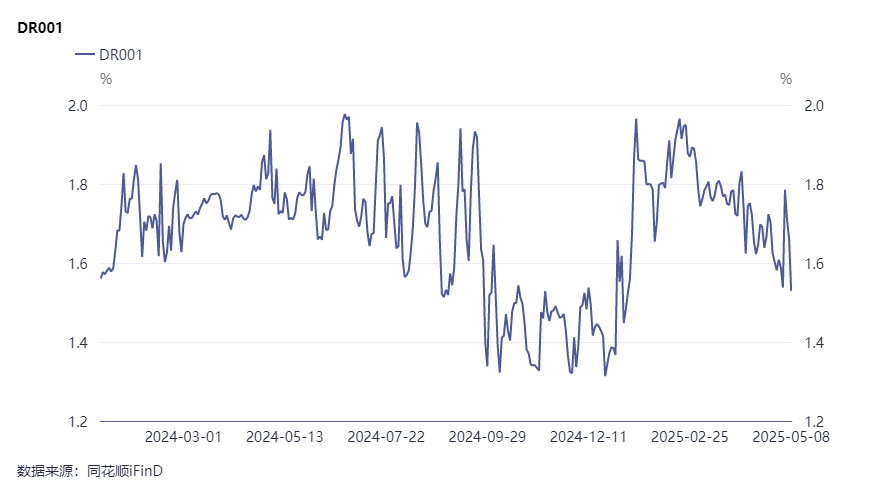
Core Viewpoint - The recent decline in the DR001 (overnight pledged repo weighted average rate) to 1.5294% is a response to the central bank's interest rate cut and broader monetary policy measures, indicating a modest adjustment in the money market rates compared to the policy rate changes [1][2][4]. Group 1: Monetary Market Rates - As of May 8, the DR001 weighted average rate decreased by 0.13 percentage points from the previous day, while the closing rate fell by 0.07 percentage points [4]. - The DR007 weighted average rate also saw a decline, dropping approximately 0.07 percentage points to 1.6112% on May 8, compared to 1.6802% on May 7 [4][5]. - Monthly data shows that the DR007 weighted average rate was 1.7594% in April, highlighting a significant downward trend following the policy rate adjustments [4]. Group 2: Government Bond Yields - Government bond yields across various maturities have also decreased, with the 10-year bond yield falling by 0.0087 percentage points to 1.6331% on May 8 [5]. - The yields for 3-month bonds decreased by 0.0335 percentage points, reflecting a general downward trend in bond yields following the central bank's announcement [5]. Group 3: Market Reactions and Expectations - Analysts suggest that the stable market response indicates that the central bank's policies have effectively stabilized market expectations, despite the potential for the 10-year bond yield to reach 1.5% within the year [6]. - The central bank's approach aims to guide market rates in alignment with policy rates, ensuring that the DR007 remains close to the 7-day reverse repo rate [6][8]. - There is an expectation that the DR007 will eventually return to levels near the OMO rate, although this will not happen immediately, as the central bank employs a gradual strategy to manage interest rates [8].
百万房贷利息较高峰减半,2字头利率让观望买家“动心”
Di Yi Cai Jing Zi Xun· 2025-05-08 13:43
Core Viewpoint - The recent reduction in housing loan interest rates, particularly the public housing fund loan rate, is expected to stimulate the housing market and encourage first-time homebuyers to enter the market [1][3][6]. Group 1: Policy Changes - The central bank announced a reduction in the personal housing provident fund loan rate by 0.25 percentage points, bringing the rate for first-time homebuyers over five years down to 2.6% [2][3]. - Major cities such as Beijing, Shenzhen, and Guangzhou have followed suit, implementing the new lower rates to support homebuyers [3][4]. Group 2: Impact on Loan Costs - For a property priced at 3 million, the interest rate for first-time homebuyers has decreased from 5.74% in 2021 to 3.01%, resulting in a total interest reduction of approximately 50% and a nearly 30% decrease in monthly payments [1][9]. - The average interest rate for new commercial housing loans is projected to drop to around 3.01% following the recent adjustments, which will further alleviate the financial burden on borrowers [7][9]. Group 3: Market Sentiment - The declining interest rates are positively influencing buyer confidence, with many perceiving it as an opportune time to purchase homes [10]. - Despite the favorable loan conditions, buyers are adopting a more rational approach, weighing their financial capabilities against potential future price movements in the housing market [10].
降准降息落地,内需线或仍有可为
Shanxi Securities· 2025-05-08 13:00
Group 1 - The core viewpoint of the report emphasizes the implementation of a comprehensive financial policy aimed at stabilizing the market and expectations, with a focus on "precise drip irrigation" and "quantity-price coordination" to support the real economy and financial markets [3][13]. - The People's Bank of China announced a series of monetary policy tools, including a 0.5% reduction in the reserve requirement ratio, which is expected to release approximately 1 trillion yuan in long-term liquidity, alongside targeted structural tools to support technological innovation and consumption upgrades [17][13]. - The financial regulatory authority proposed policies to stabilize the real estate market and enhance stock market liquidity, including expanding the white list of loans to 6.7 trillion yuan and optimizing insurance fund investment rules [14][17]. Group 2 - The report outlines a strategy of "reform + opening up + attracting long-term capital" to deepen capital market reforms and promote the entry of long-term funds, including the optimization of the registration system and easing merger and acquisition rules [15][16]. - The report suggests that the likelihood of a market rebound similar to the "924" rally is limited, with the current market sentiment and valuations at normal levels, indicating constrained upward potential in the short term [18][19]. - The recommendation includes focusing on low-volatility dividend stocks as a defensive base while targeting domestic demand recovery as an offensive strategy, suggesting a dynamic rebalancing approach to mitigate risks associated with single-style exposure [19].
5月7日“一揽子金融政策”点评:“一行一局一会”再出组合拳,稳预期稳市场
HUAXI Securities· 2025-05-08 12:46
Core Insights - The report discusses a comprehensive set of financial policies announced on May 7, aimed at stabilizing market expectations and supporting economic growth through a series of counter-cyclical measures [1][2][3] Group 1: Financial Policies - The People's Bank of China (PBOC) has implemented a 0.5 percentage point reduction in the reserve requirement ratio, expected to provide approximately 1 trillion yuan in long-term liquidity [5] - A 0.1 percentage point decrease in policy interest rates has been announced, with the 7-day reverse repurchase rate dropping from 1.5% to 1.4%, likely leading to a similar decline in the Loan Prime Rate (LPR) [5] - The PBOC has increased the quota for re-lending aimed at technological innovation and transformation from 5 billion yuan to 8 billion yuan, supporting the implementation of "two new" policies [5] Group 2: Capital Market Support - The report highlights the integration of 500 billion yuan in securities fund swaps with 300 billion yuan in stock repurchase re-lending to enhance the flexibility of fund usage [2] - The insurance sector is encouraged to increase long-term investments, with a planned approval of an additional 60 billion yuan for investment [2] - The establishment of a risk-sharing tool for technology innovation bonds is aimed at facilitating low-cost financing for tech enterprises [5][7] Group 3: Support for Technological Innovation - The PBOC has introduced a 3 billion yuan increase in re-lending for technological innovation, complementing the previous 5 billion yuan allocation [3] - The report emphasizes the importance of developing a supportive regulatory framework for the STAR Market and ChiNext, enhancing the adaptability and inclusiveness of the capital market [7] - The focus on technology innovation is expected to strengthen the growth momentum in sectors such as artificial intelligence, autonomous driving, and robotics [3][7]
民生证券研究院首席经济学家陶川:“双降”之外的政策深意
Zhong Guo Jing Ji Wang· 2025-05-08 11:32
Core Viewpoint - The recent press conference by Chinese financial authorities introduced a comprehensive financial policy package aimed at stabilizing the market and economic expectations, with a focus on the significance of the "double reduction" policy [1] Group 1: Policy Timing and Strategy - The term "early" refers to the successful experience of releasing favorable policies before the market opening last year, indicating that the new financial policy package will have a more stable and lasting impact on the market [2] - The term "timely" highlights the importance of stabilizing market expectations ahead of the upcoming China-U.S. trade negotiations, which is crucial for gaining negotiation leverage [2] Group 2: Monetary Policy Adjustments - The market's initial reaction centered on the unexpected interest rate cut, while the reserve requirement ratio (RRR) reduction was anticipated. The interest rate cut opens up space for monetary policy due to increased economic downward pressure and external changes affecting exports [3] - The adjustment of housing provident fund rates and subsequent policies aimed at stimulating real estate demand signal a proactive approach to meet housing consumption needs, aligning with the directives from the April Politburo meeting [3] Group 3: Structural Monetary Policy - The new round of structural monetary policy tools aims to address challenges such as insufficient domestic demand and export shocks, featuring a "quantity expansion and price reduction" approach [4] - The introduction of multiple relending tools and a general reduction in relending and PSL rates by 0.25 percentage points will further lower financial institutions' funding costs, supporting the real economy [4] Group 4: Financial Policy and Fiscal Support - The establishment of relending tools for service consumption and elderly care represents a significant step in promoting service consumption, with monetary policy leading the way for potential fiscal support [5] - Current fiscal policies, including special bonds, have not been fully implemented, suggesting that new fiscal measures to support service consumption may be released mid-year [5] Group 5: Capital Market Stability and Growth - Capital market policies reflect a dual focus on stability and progress, with support from the Central Huijin Investment Company acting as a stabilizing force for the market [6] - The implementation of the "Action Plan for Promoting the High-Quality Development of Public Funds" will enhance the focus on investor interests, further invigorating market dynamics [6]
重磅发布会之后,股债市场怎么走?
天天基金网· 2025-05-08 11:18
Core Viewpoint - The article discusses a significant financial policy announcement aimed at stabilizing the market and boosting expectations, reflecting a comprehensive approach to address both short-term and long-term economic challenges [2][4]. Group 1: Policy Measures - The central bank has lowered the reserve requirement ratio by 0.5%, expected to release approximately 1 trillion yuan in long-term liquidity [3][10]. - A reduction in the policy interest rate by 0.1% is anticipated to lead to a similar decrease in the Loan Prime Rate (LPR) [3][10]. - The introduction of a 5,000 billion yuan "service consumption and pension re-loan" aims to enhance credit support for service consumption and pension sectors [3][10]. - The expansion of the technology innovation re-loan by 3,000 billion yuan, increasing the total to 8,000 billion yuan, is designed to support technological advancements [3][10]. Group 2: Market Support - Eight new policies from the financial regulatory authority focus on stabilizing the real estate market, supporting small and micro enterprises, and enhancing foreign trade [4][10]. - The insurance sector's long-term investment pilot program is set to expand, with a proposed approval of 60 billion yuan to inject more capital into the market [10]. - The adjustment of regulatory rules aims to lower the investment risk factors for insurance companies, thereby supporting capital market stability [3][10]. Group 3: Capital Market Reforms - The article emphasizes the need for reforms in the Sci-Tech Innovation Board and the Growth Enterprise Market, including the revision of the major asset restructuring management measures for listed companies [5][10]. - The development of technology innovation bonds is highlighted, with efforts to simplify the issuance process and enhance credit support for these bonds [5][10]. - The focus on attracting more medium- and long-term funds into the market is underscored, with initiatives to optimize the market's funding structure [6][10]. Group 4: Future Outlook - The article suggests that the bond market is likely to experience fluctuations due to various factors, including the impact of recent policies on the real economy and potential fiscal policy changes [8][11]. - The stock market is expected to see structural opportunities, particularly in high-dividend stocks and sectors aligned with new productivity, such as artificial intelligence and advanced manufacturing [14][17]. - The overall sentiment indicates that the current policies are aimed at fostering a resilient market ecosystem, balancing risk prevention with the promotion of transformation [18][19].