
公用事业

Search documents
董承非颠覆“董承非”
华尔街见闻· 2025-05-01 11:54
以下文章来源于资事堂 ,作者资事堂 重仓股曝光 根据最新公布的上市公司2024年报和2025年1季报,董承非管理的私募产品至少进入了四家公司的前十大股东名单,其中三家属于芯片行业公司。 资事堂 . 华尔街见闻出品 作者 郑孝杰 编辑袁畅 作为业内最知名的价值派明星基金经理之一,董承非的投资组合在过去几年内凸显了其个人风格。 有限的A股权益"暴露",有效的衍生品应用,以及对于公共事业股等传统价值的布局,都显示了他个人强烈的逆向、价值投资风格。 但就是这样一个价值了一辈子的基金经理,在2024年末组合显示出强烈的"科技"含量。 这不能不让人对之突然感兴趣起来。 在这样百年一遇的时代里,董承非也开始迭代个人的投资组合和选股风格了。 | 股票 | 申万一级行业 | 核心业务属性 | | --- | --- | --- | | 元力股份 | 基础化工 | 新能源材料(跨界成长) | | 芯朋微 | 电子 | 半导体设计(电源管理芯片) | | 神工股份 | 电子 | 半导体材料 (硅片) | | 乐鑫科技 | 电子 | 物联网芯片设计 | 其一是物联网芯片设计公司 乐鑫科技 ,董承非旗下有三只产品进入了这家公司前十大股 ...


主动型债券基金25Q1季报分析:债券持仓规模减少,久期杠杆双回落
EBSCN· 2025-05-01 09:20
2025 年 5 月 1 日 总量研究 债券持仓规模减少,久期杠杆双回落 ——主动型债券基金 25Q1 季报分析 要点 1、 25Q1 主动型债券基金市场总览 市场规模:截至 2025 年一季度末,全市场公募开放式债券型基金共计 3808 只, 较 2024 年四季度末环比增加 41 只/1.1%;市场规模合计 10.07 万亿元,环比减 少 0.48 万亿元/4.6%;基金份额合计 9.03 万亿份,净赎回 4379.80 亿份/4.6%。 纯债基金、被动指数债基表现为净赎回,市场规模收缩;混合债基、可转债基金、 增强指数债基表现为净申购,市场规模放量。 业绩表现:截至 2025 年一季度末,短期纯债基金、中长期纯债基金、混合一级 债基和混合二级债基的单季度加权平均回报率分别为 0.14%、-0.12%、0.20% 和 0.65%,较上季度末环比均有所下滑。杠杆率和久期:短期纯债基金、中长 期纯债基金、混合一级债基和混合二级债基的单季度加权平均杠杆率分别为 111.81%、121.73%、112.93%和 114.32%;重仓债券加权平均久期分别为 0.96 年、2.84 年、3.15 年和 2.76 年, ...
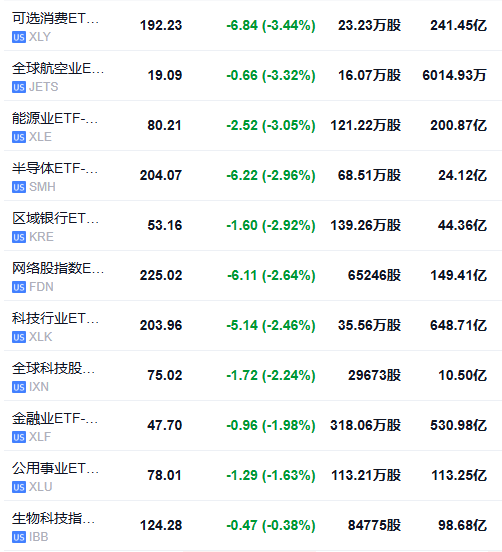
美股盘初,主要行业ETF普跌,可选消费ETF、全球航空业ETF均跌超3%。
news flash· 2025-04-30 13:50
Group 1 - Major industry ETFs in the US experienced a decline, with consumer discretionary and global airline ETFs dropping over 3% [1] - The consumer discretionary ETF (US XLY) fell to 192.23, down 6.84 (-3.44%), with a trading volume of 232,300 shares and a market cap of 24.145 billion [1] - The global airline ETF (US JETS) decreased to 19.09, down 0.66 (-3.32%), with a trading volume of 160,700 shares and a market cap of 601.493 million [1] Group 2 - The energy sector ETF (US XLE) declined to 80.21, down 2.52 (-3.05%), with a trading volume of 1,212,200 shares and a market cap of 20.087 billion [1] - The semiconductor ETF (US SMH) dropped to 204.07, down 6.22 (-2.96%), with a trading volume of 685,100 shares and a market cap of 2.412 billion [1] - The regional bank ETF (US KRE) fell to 53.16, down 1.60 (-2.92%), with a trading volume of 1,392,600 shares and a market cap of 4.436 billion [1] Group 3 - The internet index ETF (US FDN) decreased to 225.02, down 6.11 (-2.64%), with a trading volume of 65,246 shares and a market cap of 14.941 billion [1] - The technology sector ETF (US XLK) fell to 203.96, down 5.14 (-2.46%), with a trading volume of 355,600 shares and a market cap of 64.871 billion [1] - The global technology ETF (US IXN) dropped to 75.02, down 1.72 (-2.24%), with a trading volume of 29,673 shares and a market cap of 1.05 billion [1] Group 4 - The financial sector ETF (US XLF) decreased to 47.70, down 0.96 (-1.98%), with a trading volume of 3,180,600 shares [1] - The utility ETF (US XLU) fell to 78.01, down 1.29 (-1.63%), with a trading volume of 1,132,100 shares and a market cap of 11.325 billion [1] - The biotechnology index ETF (US IBB) decreased to 124.28, down 0.47 (-0.38%), with a trading volume of 84,775 shares and a market cap of 9.868 billion [1]

[4月30日]指数估值数据(财报更新,上市公司盈利增长情况如何?)
银行螺丝钉· 2025-04-30 13:48
Core Viewpoint - The article discusses the current state of the stock market, highlighting the performance of different sectors and the outlook for corporate earnings in the coming years. It emphasizes the importance of valuation and earnings growth as key drivers for market movements. Market Performance - The Shanghai and Shenzhen 300 index saw slight declines, while small-cap stocks experienced gains [2][3] - Value-style stocks, such as banks, faced significant declines, whereas growth-style stocks saw increases [4] - Hong Kong stocks overall rose, with technology stocks leading the gains [5][6] Valuation Insights - After a brief decline in early April, the market has rebounded, returning to a normal valuation range [7] - Many stocks are currently undervalued, suggesting limited downside potential [10] - Institutional investors, including state-owned entities, tend to buy heavily when the market dips, further reducing downside risk [11] Earnings Growth Outlook - For 2024, A-share market earnings are expected to decline slightly by about 2% compared to 2023 [19] - In the first quarter of 2025, earnings are projected to grow by approximately 3-4%, marking the first annual improvement since 2022 [20] - Sectors such as internet and high-end manufacturing are expected to maintain stable earnings growth [21] Sector-Specific Performance - Traditional industries like finance, consumption, and utilities have seen modest earnings growth in recent years [22] - The pharmaceutical sector, which experienced significant growth during the pandemic, is expected to recover in late 2024 and early 2025 [23] - The real estate sector continues to struggle with declining earnings, although the rate of decline is slowing [23] Economic Factors and Market Dynamics - The article notes potential uncertainties, such as the impact of Trump's tariff policies on export-oriented industries [24] - If earnings growth continues in the second and third quarters, the economy may gradually recover from its current low phase, opening up more market upside [24] - Historically, strong economic years have coincided with market peaks, suggesting that low periods may offer better valuation opportunities [24] Investment Tools and Features - A new feature in the "Today Star" mini-program allows users to view real-time star ratings and set custom alerts for specific star levels [25][26][28]
【30日资金路线图】电子板块净流入近65亿元居首 龙虎榜机构抢筹多股
证券时报· 2025-04-30 11:01
4月30日,A股市场整体涨跌互现。 截至收盘,上证指数收报3279.03点,下跌0.23%,深证成指收报9899.82点,上涨0.51%,创业板指数收报1948.03点,上涨0.83%, 北证50指数上涨2.96%。A股市场合计成交11932.82亿元,较上一交易日增加1513.9亿元。 1. A股市场全天主力资金净流出7.13亿元 沪深300今日主力资金净流出26.46亿元,创业板净流入4.09亿元,科创板净流出8.13亿元。 | | 各板块最近五个交易日主力资金净流入数据(亿元) | | | | --- | --- | --- | --- | | 日期 | 沪深300 | 创业板 | 科创板 | | 2025-4-30 | -26. 46 | 4. 09 | -8. 13 | | 2025-4-29 | -19.97 | -4. 91 | -7.54 | | 2025-4-28 | -76. 36 | -84. 04 | -11. 49 | | 2025-4-25 | 35. 72 | 11. 40 | -6. 56 | | 2025-4-24 | -80. 72 | -133.38 | -17.28 | ...
机器学习因子选股月报(2025年5月)-20250430
Southwest Securities· 2025-04-30 08:14
Quantitative Models and Construction Methods GAN_GRU Model - **Model Name**: GAN_GRU - **Model Construction Idea**: The GAN_GRU model utilizes Generative Adversarial Networks (GAN) for processing volume-price time series features and then uses the GRU model for time series feature encoding to derive the stock selection factor[2][9]. - **Model Construction Process**: 1. **GRU Model**: - **Basic Assumptions**: The GRU+MLP neural network stock return prediction model includes 18 volume-price features such as closing price, opening price, trading volume, turnover rate, etc[10][13][15]. - **Training Data and Input Features**: All stocks' past 400 days of 18 volume-price features, sampled every 5 trading days. The feature sampling shape is 40*18, using the past 40 days of volume-price features to predict the cumulative return of the next 20 trading days[14]. - **Training and Validation Set Ratio**: 80%:20%[14]. - **Data Processing**: Extreme value removal and standardization in the time series for each feature within the 40 days, and cross-sectional standardization at the stock level[14]. - **Model Training Method**: Semi-annual rolling training, i.e., training the model every six months and using it to predict the returns for the next six months. Training dates are June 30 and December 31 each year[14]. - **Stock Selection Method**: Select all stocks in the cross-section, excluding ST and stocks listed for less than six months[14]. - **Training Sample Selection Method**: Exclude samples with empty labels[14]. - **Hyperparameters**: batch_size is the number of stocks in the cross-section, optimizer Adam, learning rate 1e-4, loss function IC, early stopping rounds 10, maximum training rounds 50[14]. - **Model Structure**: Two GRU layers (GRU(128, 128)) followed by MLP layers (256, 64, 64). The final output predicted return pRet is used as the stock selection factor[18]. 2. **GAN Model**: - **Introduction**: GANs consist of a generator and a discriminator. The generator aims to generate realistic data, while the discriminator aims to distinguish between real and generated data[19]. - **Generator**: - **Loss Function**: $$L_{G}\,=\,-\mathbb{E}_{z\sim P_{z}(z)}[\log(D(G(z)))]$$ where \(z\) represents random noise (usually Gaussian distributed), \(G(z)\) represents the data generated by the generator, and \(D(G(z))\) represents the probability that the discriminator judges the generated data as real[20][21]. - **Training Process**: Generate noise data, convert noise data to generated data using the generator, calculate generator loss, and update generator parameters through backpropagation[21][22]. - **Discriminator**: - **Loss Function**: $$L_{D}=-\mathbb{E}_{x\sim P_{d a t a}(x)}[\log\!D(x)]-\mathbb{E}_{z\sim P_{z}(z)}[\log(1-D(G(z)))]$$ where \(x\) is real data, \(D(x)\) is the probability that the discriminator judges the real data as real, and \(D(G(z))\) is the probability that the discriminator judges the generated data as real[23]. - **Training Process**: Sample real data, generate fake data, calculate discriminator loss, and update discriminator parameters through backpropagation[24][25]. - **GAN Training Process**: Alternately train the generator and discriminator until convergence[25][26]. 3. **GAN Feature Generation Model Construction**: - **LSTM Generator + CNN Discriminator**: To retain the time series nature of the input features, the LSTM model is used as the generator. The CNN model is used as the discriminator to match the two-dimensional volume-price time series features[29][30][33]. - **Feature Generation Process**: Input original volume-price time series features (Input_Shape=(40,18)), output volume-price time series features processed by LSTM (Input_Shape=(40,18))[33]. Model Evaluation - **Evaluation**: The GAN_GRU model effectively combines GAN and GRU to process and encode volume-price time series features, providing a robust stock selection factor[2][9]. Model Backtest Results - **GAN_GRU Model**: - **IC Mean**: 11.73%[37][38] - **Annualized Excess Return**: 24.89%[37][38] - **Latest IC**: 0.22% (as of April 28, 2025)[37][38] - **IC Mean in the Past Year**: 11.44%[37][38] - **Annualized Return**: 36.06%[38] - **Annualized Volatility**: 23.80%[38] - **Information Ratio (IR)**: 1.66[38] - **Maximum Drawdown**: 27.29%[38] - **Turnover Rate**: 0.83[38] - **ICIR**: 0.90[38] Quantitative Factors and Construction Methods GAN_GRU Factor - **Factor Name**: GAN_GRU - **Factor Construction Idea**: The GAN_GRU factor is derived from the GAN_GRU model, which processes volume-price time series features using GAN and encodes them using GRU[2][9]. - **Factor Construction Process**: The factor is generated by the GAN_GRU model, which includes the steps of feature processing by GAN and encoding by GRU as described in the model construction process[2][9][33]. - **Factor Evaluation**: The GAN_GRU factor shows strong performance in stock selection, with high IC values and significant excess returns[2][9]. Factor Backtest Results - **GAN_GRU Factor**: - **IC Mean**: 11.73%[37][38] - **Annualized Excess Return**: 24.89%[37][38] - **Latest IC**: 0.22% (as of April 28, 2025)[37][38] - **IC Mean in the Past Year**: 11.44%[37][38] - **Annualized Return**: 36.06%[38] - **Annualized Volatility**: 23.80%[38] - **Information Ratio (IR)**: 1.66[38] - **Maximum Drawdown**: 27.29%[38] - **Turnover Rate**: 0.83[38] - **ICIR**: 0.90[38]
每日市场观察-20250430
Caida Securities· 2025-04-30 05:25
Market Overview - On April 29, the Shanghai Composite Index fell by 0.05%, the Shenzhen Component Index also fell by 0.05%, and the ChiNext Index decreased by 0.13%[3]. - The trading volume on April 30 was 1.04 trillion CNY, a decrease of approximately 40 billion CNY compared to the previous trading day[1]. Sector Performance - Industries such as beauty care, machinery, media, and light industry saw significant gains, while public utilities, oil, coal, and social services experienced notable declines[1]. - The majority of sectors showed limited upward movement, indicating a weak market structure with most sectors declining over the past five days[1]. Capital Flow - On April 29, net inflows into the Shanghai Stock Exchange were 4.695 billion CNY, while net inflows into the Shenzhen Stock Exchange were 4.105 billion CNY[4]. - The top three sectors for capital inflow were IT services, general equipment, and automotive parts, while the top three sectors for outflow were electricity, securities, and liquor[4]. Policy and Economic Measures - The National Development and Reform Commission announced an additional 81 billion CNY in special long-term bonds to support the consumption upgrade program[5]. - The construction of the electricity spot market is set to accelerate, with specific deadlines for various regions to transition to formal operations by 2025 and 2026[6][7]. Industry Insights - Canalys predicts that by 2025, the penetration rate of L2 and above functionalities in the Chinese market will reach 62%, a significant increase from 2024[12]. - The issuance of new funds has surpassed 300 billion CNY this year, with nearly half allocated to equity funds, indicating a recovery in the active equity fund issuance market[15].
4月29日医药生物、计算机、机械设备等行业融资净卖出额居前
Zheng Quan Shi Bao Wang· 2025-04-30 02:47
截至4月29日,市场最新融资余额为17913.26亿元,较上个交易日环比减少13.50亿元,分行业统计,申 万所属一级行业有12个行业融资余额增加,公用事业行业融资余额增加最多,较上一日增加3.15亿元; 融资余额增加居前的行业还有汽车、通信、家用电器等,融资余额分别增加2.60亿元、1.06亿元、1.01 亿元;融资余额减少的行业有19个,医药生物、计算机、机械设备等行业融资余额减少较多,分别减少 4.27亿元、2.76亿元、2.35亿元。 以幅度进行统计,纺织服饰行业融资余额增幅最高,最新融资余额为67.95亿元,环比增长1.28%,其次 是公用事业、煤炭、钢铁行业,环比增幅分别为0.73%、0.51%、0.45%;融资余额环比降幅居前的行业 有商贸零售、美容护理、农林牧渔等,最新融资余额分别有214.77亿元、54.29亿元、259.07亿元,分别 下降0.97%、0.83%、0.73%。(数据宝) | 农林牧渔 | 259.07 | -1.90 | -0.73 | | --- | --- | --- | --- | | 商贸零售 | 214.77 | -2.11 | -0.97 | | 国防军工 | ...
险资:看好A股核心资产 谋划加大权益配置
Shang Hai Zheng Quan Bao· 2025-04-30 02:06
Group 1 - The central political bureau meeting emphasized the need for a stable and active capital market, leading insurance companies to plan for increased equity asset allocation [1] - Since the approval of the second batch of long-term stock investment trials by the financial regulatory authority, the scale has reached over 100 billion, with more insurance institutions looking to participate [1][2] - Insurance funds are increasingly focusing on core A-share assets, particularly those close to the Shanghai Stock Exchange 50 Index, while also paying attention to sectors like banking, transportation, public utilities, telecommunications, and pharmaceuticals [1][3] Group 2 - In the first quarter, insurance funds increased their holdings in sectors such as pharmaceuticals, steel, home appliances, and defense, indicating a shift in investment strategy [2] - Insurance institutions maintain an optimistic outlook for the market, with a focus on stable dividend strategies and a continued emphasis on the pharmaceutical sector due to its favorable mid-term performance [3] - The expected influx of several hundred billion yuan in new capital into the market is driven by the need for insurance funds to seek absolute returns in a low-interest-rate environment [3][4] Group 3 - Regulatory measures to raise the equity allocation limits for insurance companies reflect a commitment to stabilize the market and boost confidence [4] - The current environment of low interest rates and asset scarcity makes high-dividend stocks a necessary choice for insurance companies, positioning them as a key focus for future equity allocations [4]
早盘直击 | 今日行情关注
申万宏源证券上海北京西路营业部· 2025-04-30 01:49
周二 A 股窄幅震荡,假日效应导致市场窄幅波动。周二 A 股小幅低开后进入窄幅震荡,全天波幅 有限,中小市值个股表现相对较好。上证指数距离所谓"对等关税"宣布前的跳空缺口 3319 点仅一步之 遥,市场分歧有所加大,追涨意愿下降,但 A 股的修复行情仍然在延续。临近五一长假,市场担心长 假期间出现突发事件影响节后表现,因此总体表现相对谨慎。从中期角度来看,在中央汇金等三家国资 开始增持,叠加多家上市公司宣布回购增持后,市场已经迎来拐点。尽管所谓"对等关税"的后续影响还 存在一定不确定性,但市场交易开始克服恐慌心理,指数在波折中继续修复行情。 后市展望:关税事件的冲击最高峰已经过去,A 股将在波折中继续修复。4 月 7 日的极端下跌是对 近期所谓"对等关税"事件的一次性反映,随着市场情绪逐渐平稳和以中央汇金为代表的国资以及多家上 市公司宣布回购增持后,目前 A 股已经进入修复性回升。但修复过程并非一帆风顺,美国对全球范围 加征所谓"对等关税"的后续变化对中国和全球经济产生的影响目前仍存在较大不确定性,市场预期变化 也存在反复。后市争议较大的仍然是对海外业务依赖性较高的行业,如消费电子、CXO 等会受到"对等 关 ...