债券

Search documents
宏观深度报告:日债利率新高之后:风险与机遇
Ping An Securities· 2025-09-05 12:15
Group 1: Reasons for Rising Japanese Bond Yields - The 10-year Japanese bond yield has reached a new high of 1.63%, the highest since 2008, driven by multiple factors including weak bond auction results and reduced demand from life insurance companies[6][7]. - The bid-to-cover ratio for the 20-year bond auction on May 20 was 2.50, significantly lower than the previous auction's 2.96, indicating waning investor interest[11]. - Japanese life insurance companies, holding 17% of government bonds, are reducing long-term bond allocations due to substantial unrealized losses, with one major insurer reporting a loss of 3.6 trillion yen in FY2024[13]. - Political instability following the ruling party's loss in the July 20 elections has exacerbated bond sell-offs, leading to increased market uncertainty[17]. Group 2: Outlook and Risks - The Japanese bond yield is expected to continue rising over the next six months to a year, primarily driven by domestic inflation and interest rate hike expectations, with potential increases of over 50 basis points if the policy rate reaches 1%[30][36]. - The Japanese government debt-to-GDP ratio is projected to remain high at 237%, raising concerns about fiscal sustainability amid rising interest rates[27]. - Risks include a potential debt spiral as rising yields increase debt servicing costs, and the possibility of a "carry trade" unwind, which could lead to market volatility[6][30]. Group 3: Opportunities in Japanese Bonds - The attractiveness of Japanese bonds is increasing as yields rise, making them a viable investment option amid a backdrop of improving economic fundamentals and fiscal outlook[6][30]. - Japan's economy is on a path to recovery, with stable employment and a positive inflation outlook, which supports the long-term investment case for Japanese bonds[6][30]. - Global diversification needs are rising, positioning Japan's bond market as an attractive alternative for investors seeking options beyond the U.S. and European markets[6][30].
信用债月度观察:信用利差整体走阔,发行规模小幅下降-20250905
EBSCN· 2025-09-05 11:57
1. Report Industry Investment Rating No information provided in the content. 2. Core Views of the Report - Overall, as of the end of August 2025, the balance of outstanding credit bonds in China was 30.35 trillion yuan. In August 2025, the issuance of credit bonds decreased month - on - month, with a net financing of 519.25 billion yuan [1][9]. - In August 2025, the trading volume and turnover rate of both urban investment bonds and industrial bonds decreased both month - on - month and year - on - year, and the credit spreads of all levels of urban investment and industrial bonds widened compared with the previous month [2][36][40]. 3. Summary According to the Directory 3.1 Credit Bond Issuance and Maturity 3.1.1 Credit Bond Issuance - As of the end of August 2025, the balance of outstanding credit bonds was 30.35 trillion yuan. From August 1 to August 31, 2025, the issuance of credit bonds was 1120.493 billion yuan, a month - on - month decrease of 7.94%, with a total repayment of 1068.568 billion yuan and a net financing of 519.25 billion yuan [1][9]. - **Urban Investment Bonds**: As of the end of August 2025, the balance of outstanding urban investment bonds was 15.32 trillion yuan. In August 2025, the issuance was 499.695 billion yuan, a month - on - month increase of 19.14% and a year - on - year decrease of 2.48%, with a net financing of 11.21 billion yuan. Regionally, Jiangsu had the highest issuance, followed by Shandong, Zhejiang, and Chongqing. Ratings - wise, AA + and AAA - rated urban investment bonds accounted for a relatively high proportion [10][13][20]. - **Industrial Bonds**: As of the end of August 2025, the balance of outstanding industrial bonds was 15.03 trillion yuan. In August 2025, the issuance was 620.798 billion yuan, a month - on - month decrease of 22.19% and a year - on - year decrease of 14.51%, with a net financing of 508.05 billion yuan. By industry, the utility sector had the highest issuance, and in terms of net financing, the utility and oil and petrochemical sectors had large negative net financing amounts [21][24][26]. 3.1.2 Credit Bond Maturity - **Urban Investment Bonds**: From September to December 2025, Jiangsu, Shandong, Zhejiang, and Sichuan had relatively large maturity scales of urban investment bonds [27]. - **Industrial Bonds**: From September to December 2025, the utility, non - banking finance, building decoration, transportation, and real estate sectors had relatively large maturity scales of credit bonds [32]. 3.2 Credit Bond Trading and Spreads 3.2.1 Credit Bond Trading - **Urban Investment Bonds**: In August 2025, the trading volume of urban investment bonds was 914.612 billion yuan, with a turnover rate of 5.97%, showing both month - on - month and year - on - year decreases [36]. - **Industrial Bonds**: In August 2025, the trading volume of industrial bonds was 1268.887 billion yuan, with a turnover rate of 8.44%, showing both month - on - month and year - on - year decreases [40]. 3.2.2 Credit Bond Spreads - **Urban Investment Bonds**: In August 2025, the credit spreads of all levels of urban investment bonds widened compared with the previous month. Regionally and by rating, different regions and ratings had different spread levels and changes [42][46]. - **Industrial Bonds**: In August 2025, the credit spreads of all levels of industrial bonds widened compared with the previous month. By industry and rating, different industries and ratings had different spread levels and changes [48][52].
固收周报:债市有望延续“牛陡”行情-20250905
Yong Xing Zheng Quan· 2025-09-05 11:32
1. Report Industry Investment Rating No relevant content provided. 2. Core View of the Report The bond market is expected to continue the "bullish steepening" trend. The current changes in PMI, as a core leading indicator of the economic fundamentals, may reflect "endogenous weak recovery + external pressure transmission". Coupled with the expectations of loose liquidity and policy, the bond market is likely to continue the "bullish steepening" trend. The downward space for interest - rate bond yields has opened up, and the long - end is more cost - effective; for credit bonds, it is necessary to strictly control the risks of low - rated bonds and focus on short - duration high - rated bonds; for convertible bonds, attention should be paid to varieties with strong policy catalysis and underlying stock elasticity [1][69]. 3. Summary According to the Directory 3.1 Interest - rate Bonds - **Liquidity Observation**: From August 22 to August 29, 2025, the central bank conducted a total of 32,343.00 billion yuan in reverse repurchase operations, with 26,150.00 billion yuan in reverse repurchases maturing, resulting in a net injection of 6,193.00 billion yuan. Most inter - bank funding prices increased, with DR001 down 8.27BP to 1.3295% and DR007 up 4.89BP to 1.5158%. Exchange - traded funding prices decreased, with overnight GC001 down 2.50BP to 1.2290% and GC007 down 490BP to 1.4840% [15]. - **Primary Market Issuance**: From August 25 to August 31, 2025, the primary market for interest - rate bonds issued 5,025.97 billion yuan, with a total bond repayment of 5,161.89 billion yuan, resulting in a net financing of - 135.92 billion yuan. There were no treasury bond issuances during the reporting period. Policy - based financial bonds raised 1,510.00 billion yuan, and local government bond issuances decreased compared to the previous period, raising 3,515.97 billion yuan [28]. - **Secondary Market Trading**: Treasury bond spot yields increased at the long - end. From August 22 to August 29, 2025, the yields of 1 - year, 3 - year, 5 - year, and 7 - year treasury bonds decreased by 0.09BP, 2.88BP, 0.02BP, and 2.05BP respectively to 1.3698%, 1.4776%, 1.6322%, and 1.7320%, while the 10 - year treasury bond yield increased by 5.61BP to 1.8379%. The 10Y - 1Y term spread widened from 41.11BP to 46.81BP. The spot yields of policy - bank bonds decreased. During the same period, the yields of 1 - year, 3 - year, 5 - year, 7 - year, and 10 - year policy - bank bonds decreased by 3.09BP, 0.39BP, 0.36BP, 0.21BP, and 0.25BP respectively to 1.5346%, 1.6916%, 1.7685%, 1.8979%, and 1.8756%. The 10Y - 1Y term spread widened from 31.26BP to 34.10BP [34]. 3.2 Credit Bonds - **Primary Market Issuance**: From August 25 to August 31, 2025, the primary market for credit bonds issued 784 new bonds (including inter - bank certificates of deposit), with a total issuance scale of 9,250.64 billion yuan, a decrease of 833.08 billion yuan compared to the previous period, and a net financing of - 2,078.26 billion yuan. Asset - backed securities had the largest proportion in terms of the number of issuances. By rating, AAA - rated bonds were issued at 2,147.94 billion yuan, accounting for 59.51%. In terms of maturity, most bonds had a maturity of less than 1 year. By industry, the financial industry had the largest number of issuances [2][45]. - **Secondary Market Trading**: The yields to maturity of credit bonds showed divergence. From August 22 to August 29, 2025, among urban investment bonds, the 5 - year AA - rated bonds had the largest upward movement of 5.94BP, while the 3 - year AA - rated bonds had the largest downward movement of 3.04BP. Among medium - and short - term notes, the 10 - year AA - rated bonds had the largest upward movement of 4.15BP, while the 1 - year AAA - rated bonds had the largest downward movement of 4.39BP [2][52]. - **One - week Credit Default Event Review**: From August 25 to August 31, 2025, the credit bonds of one enterprise defaulted [56]. 3.3 Observation of Major Asset Classes - **Decline in European and American Stock Indices**: From August 22 to August 29, 2025, the three major US stock indices declined. The Dow Jones Industrial Average fell 0.19% weekly, the S&P 500 index fell 0.10% weekly, and the Nasdaq Composite fell 0.19% weekly, closing at 45544.88, 6460.26, and 21455.55 points respectively. The three major European stock indices also declined. The German DAX index fell 1.89% weekly, the French CAC40 index fell 3.34% weekly, and the UK FTSE 100 index fell 1.44% weekly, closing at 23902.21, 7703.90, and 9187.34 points respectively [57][58]. - **Decline in US Treasury Yields**: From August 22 to August 29, 2025, the yields of 1 - year, 3 - year, 5 - year, 7 - year, and 10 - year US Treasury bonds decreased by 4.00BP, 6.00BP, 8.00BP, 6.00BP, and 3.00BP respectively to 3.83%, 3.58%, 3.68%, 3.92%, and 4.23%. The 10Y - 1Y term spread changed by 1.00BP to 40.00BP [61]. - **Strengthening of the US Dollar Index and Weakening of Most Non - US Currencies**: The US dollar index rose 0.13% weekly, and most non - US currencies weakened. From August 22 to August 29, 2025, the British pound against the US dollar fell 0.16% weekly to 1.3505; the euro against the US dollar fell 0.32% weekly to 1.1686; the US dollar against the Japanese yen rose 0.08% weekly to 147.0540; the US dollar against the Chinese yuan fell 0.41% weekly to 7.1030 [63]. - **Increase in Crude Oil and Gold Prices**: From August 22 to August 29, 2025, the COMEX gold futures price rose 3.02% weekly to 3,475.50 US dollars per ounce, and the London spot gold price rose 2.85% weekly to 3,429.15 US dollars per ounce. The Brent crude oil price rose 0.58% weekly to 68.12 US dollars per barrel, and the WTI crude oil price rose 0.55% weekly to 64.01 US dollars per barrel [67].
【笔记20250905— 反内卷 卷起债心酸】
债券笔记· 2025-09-05 11:18
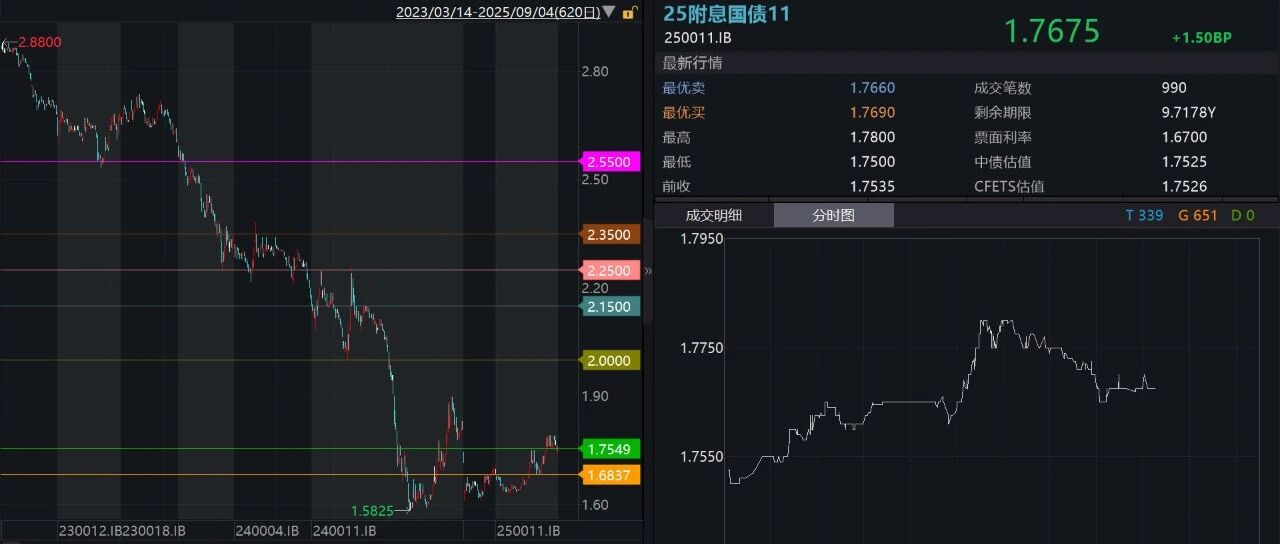
Core Viewpoint - The article discusses the current market dynamics, highlighting a strong rebound in the stock market and the emergence of "anti-involution" trading strategies in commodities, while also noting a slight tightening in the funding environment [3][6]. Group 1: Market Overview - The stock market experienced a strong rebound, attributed to major institutions realizing profits at the end of the quarter [6]. - The funding environment showed slight tightening, with the central bank conducting a 1,883 billion yuan reverse repurchase operation, while 7,829 billion yuan of reverse repos matured, resulting in a net withdrawal of 5,946 billion yuan [3][4]. - The long-term bond yields saw a slight increase, with the 10-year government bond yield fluctuating around 1.7525% to 1.78% during the day [6][7]. Group 2: Interest Rates and Funding Rates - The funding rates remained stable, with DR001 around 1.32% and DR007 at approximately 1.44% [4]. - The weighted rates for repos showed minimal changes, with R001 at 1.36% and R007 at 1.46%, indicating a slight decrease in transaction volumes [5]. - The overall transaction volume in the repo market was 76,332.53 billion yuan, reflecting a decrease of 3,275.32 billion yuan [5]. Group 3: Commodity Market Dynamics - The commodity market saw a resurgence of "anti-involution" trading, with leading stocks like polysilicon hitting the upper limit, while government bond futures experienced a decline [7]. - The market sentiment regarding the "anti-involution" narrative appears mixed, as evidenced by the fluctuating performance of bond funds, with pure bond funds seeing negative net subscriptions after three days of small net purchases [7].

债市日报:9月5日
Xin Hua Cai Jing· 2025-09-05 08:27
Core Viewpoint - The bond market is experiencing fluctuations with a general trend of rising yields, while the liquidity remains ample due to central bank operations [1][5][6] Market Performance - The closing prices for government bond futures showed a decline across all maturities, with the 30-year contract down by 0.89% to 116.350, and the 10-year contract down by 0.30% to 107.950 [2] - The yields on major interbank bonds have generally increased, with the 10-year government bond yield rising by 2.15 basis points to 1.775% [2] International Market Trends - In North America, the 10-year U.S. Treasury yield decreased by 5.6 basis points to 4.1607% [3] - In Asia, the 10-year Japanese bond yield fell by 2.5 basis points to 1.58% [3] - In the Eurozone, the 10-year French bond yield dropped by 5 basis points to 3.489% [3] Primary Market Activity - The China Export-Import Bank's 1-year fixed-rate bond had a winning bid rate of 1.2905%, with a total bid-to-cover ratio of 4.04 [4] - The Ministry of Finance's 1-year and 30-year government bonds had weighted average winning yields of 1.3485% and 2.1139%, respectively [4] Liquidity and Funding - The central bank conducted a reverse repurchase operation of 1,883 billion yuan at a rate of 1.40%, resulting in a net liquidity withdrawal of 5,946 billion yuan for the day [5] - The central bank is expected to continue providing liquidity support in line with the bond issuance schedule [6] Institutional Insights - According to CITIC Securities, there is an anticipated issuance of approximately 4 trillion yuan in interest rate bonds, which is lower than the previous year's figure [6] - Shenwan Hongyuan noted that while there is still demand for credit bonds, the pressure on the liability side may limit support for credit bonds in the short term [6] - Guosheng Securities predicts a gradual recovery in the bond market, with expectations of reduced pressure from the stock market on bonds [6]
中证转债指数收涨2.17%,423只可转债收涨
2 1 Shi Ji Jing Ji Bao Dao· 2025-09-05 08:15
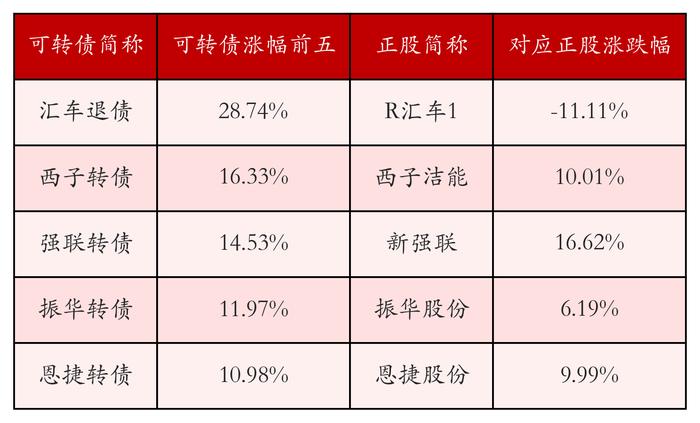
Market Overview - The China Convertible Bond Index rose by 2.17%, closing at 479.0, with a trading volume of 83.321 billion yuan [1] - A total of 436 convertible bonds were traded, with 423 increasing in value, 0 remaining flat, and 13 declining [1] Top Performing Convertible Bonds - The top five performing convertible bonds included: - Huiche Tui Debt (404004) increased by 28.74% - Xizi Convertible Bond (127052) rose by 16.33% - Qianglian Convertible Bond (123161) gained 14.53% - Zhenhua Convertible Bond increased by 11.97% - Enjie Convertible Bond rose by 10.98% [2][5] Underperforming Convertible Bonds - The five convertible bonds with the largest declines were: - Zhonglu Convertible Bond (123155) decreased by 8.00% - Dayuan Convertible Bond (113664) fell by 4.06% - Dongjie Convertible Bond (123162) dropped by 3.51% - Tianlu Convertible Bond declined by 1.01% - Hengshuai Convertible Bond decreased by 0.89% [3][5] Corresponding Stock Performance - Among the convertible bonds, 391 corresponding stocks rose, 7 remained flat, and 38 declined [1] - Notable stock performances included: - New Qianglian stock increased by 16.62%, corresponding to Qianglian Convertible Bond's 14.53% rise - Yiwai Lithium Energy stock rose by 16.59%, corresponding to Yiwai Convertible Bond's 7.04% increase - Zhonghuan Hailu stock dropped by 20.00%, corresponding to Zhonglu Convertible Bond's 8.00% decline [4][6]
地方政府债与城投行业监测周报2025年第32期:宁夏、江西加快推进“退平台”,特殊新增专项债累计发行近万亿-20250905
Zhong Cheng Xin Guo Ji· 2025-09-05 07:45
1. Report Title and Period - The report is the 32nd issue of the Weekly Monitoring Report on Local Government Bonds and Urban Investment Industry in 2025, covering the period from August 25th to August 29th, 2025 [1][4] 2. Core Views - The "Opinions on Promoting High - quality Urban Development" proposes to establish a sustainable urban construction and operation investment and financing system, emphasizing the prevention and resolution of local government debt risks and the transformation of urban investment enterprises [6] - Ningxia and Jiangxi are accelerating the withdrawal of financing platforms, with Ningxia achieving a 76% withdrawal rate in 2024 and Jiangxi having 205 platforms exit in the first half of 2025, completing 62.7% of the annual task [6] - The cumulative issuance of special new special - purpose bonds is approaching one trillion yuan, and some funds may be used to clear up arrears to enterprises [5] 3. Summary by Section 3.1. News Review - **Policy Issuance**: The "Opinions on Promoting High - quality Urban Development" proposes to establish a sustainable urban construction and operation investment and financing system, coordinating multiple funding channels and emphasizing the prevention of new local government hidden debts [6] - **Platform Withdrawal**: Ningxia actively promoted the withdrawal of financing platforms in 2024, with a withdrawal rate of 76%, effectively reducing platform debt risks. In the first half of 2025, Jiangxi innovated the replacement bond mechanism, with a debt resolution progress of over 80%, and 205 platforms completed their withdrawal [6] - **Early Redemption**: 28 urban investment enterprises redeemed bond principal and interest in advance this week, involving 29 bonds with a total scale of 59.64 billion yuan [13] - **Cancellation of Issuance**: Two urban investment bonds were cancelled for issuance this week, with a planned total issuance scale of 6.23 billion yuan [14] 3.2. Issuance of Local Government Bonds and Urban Investment Enterprise Bonds - **Local Government Bonds**: The issuance scale decreased by 4.76% to 351.597 billion yuan, the net financing increased by 16.61% to 234.508 billion yuan, the weighted average issuance interest rate decreased by 7.66BP to 2.05%, and the weighted average issuance spread widened by 1.80BP to 22.03BP. The cumulative issuance of special new special - purpose bonds was 967.654 billion yuan [15] - **Urban Investment Bonds**: The issuance amount increased by 6.60% to 112.781 billion yuan, the net financing turned positive, increasing by 386.26 billion yuan to 19.394 billion yuan. The overall issuance interest rate decreased by 1.25BP to 2.32%, and the issuance spread narrowed by 1.11BP to 79.53BP. Five overseas urban investment bonds were issued, with a total scale of 1.936 billion yuan [18][19] 3.3. Trading of Local Government Bonds and Urban Investment Enterprise Bonds - **Funding Situation**: The central bank conducted 2273.1 billion yuan of reverse repurchase and 600 billion yuan of MLF operations, with a net investment of 496.1 billion yuan. Short - term funding rates mostly declined [22] - **Local Government Bonds**: The spot trading volume was 444.324 billion yuan, an increase of 29.06%. Most of the maturity yields increased, with an average increase of 5.60BP [24] - **Urban Investment Bonds**: The trading volume was 285.544 billion yuan, a decrease of 1.38%. Short - term maturity yields decreased, while long - term yields increased. The spreads of 3 - year and 5 - year AA+ urban investment bonds widened, while the 1 - year AA+ spread narrowed [24] - **Abnormal Trading**: Nine urban investment entities had 10 bonds with 13 abnormal trades, with the number of entities, bonds, and abnormal trades all decreasing compared to last week [24] 3.4. Important Announcements of Urban Investment Enterprises - A total of 125 urban investment enterprises announced changes in senior management, legal representatives, directors, supervisors, etc., including 51 announcements of changes in senior management, 10 announcements of changes in controlling shareholders and actual controllers, 4 announcements of equity/asset transfers, 13 announcements of cumulative new borrowings, 1 announcement of name change, 5 announcements of external guarantees, and 1 announcement of business scope change [27]
信用左侧空间已至,静待右侧信号
Huaan Securities· 2025-09-05 07:31
Group 1: Report Industry Investment Rating - No relevant content provided Group 2: Core Viewpoints of the Report - After the current round of adjustment, credit bonds have certain cost - effectiveness, but the bond market may still be adjusted in the short term, so investors are advised to adopt a defensive strategy. Short - duration bonds have good cost - effectiveness for capital preservation, and for those with yield requirements, short - duration bonds of medium - and low - grade can be further explored, while 3 - year bonds can balance defensive attributes and yield requirements [6] Group 3: Summary According to Relevant Catalogs Current Situation of Credit Bond Spreads - Since August, affected by the capital market and the adjustment of the equity market, credit bonds have shown a volatile market, and credit spreads have continued to widen. The static yield of credit bonds is at a phased high, and the cost - effectiveness of mining income is gradually increasing. However, due to the end - of - quarter factor and the equity market, the bond market is still difficult to stabilize in the short term [1] Yield Changes of Urban Investment Bonds - As of September 4, for 1 - year AAA - rated urban investment bonds, the yield was 1.70%, up about 3.65bp from the previous low, and the 3 - year yield rose from 1.77% to 1.91%, up about 14.33bp. For 1 - year AA - rated bonds, the yield was up about 3.58bp from the previous low, and the 3 - year AA - rated bonds were up about 19.82bp. Short - end credit bond varieties showed better stability during bond market fluctuations [2] Investment Suggestions for Different Institutions - For institutions with stable liability ends, the cost - effectiveness of medium - and long - term credit bonds is relatively significant, and there is a significant riding income around 3 years. The term spreads of 3 - year and 5 - year bonds of each grade are at a high level this year, so relevant assets can be appropriately allocated if the subsequent valuation fluctuation risk can be borne [2] - For valuation - sensitive institutions with unstable liability ends, short - end varieties have sufficient spread protection. It is recommended to maintain a defensive strategy before the right - side signal appears. Short - end varieties still have good cost - effectiveness in terms of defense [3] Spread Protection Analysis - When calculating the maximum spread increase that each implied - rating bond can accept at the break - even point for a 1 - month holding period, the spread protection of 1 - year varieties is significantly higher than that of other terms. Generally, the spread protection increases slightly as the rating decreases [3] - When calculating with the yield of the same - term China Development Bank bonds as the implied minimum yield requirement, the spread protection difference between terms decreases, while the difference between grades increases [6]
信用利差周报2025年第33期:央地政策联动推动债市助力城市建设,银行间通用回购机制迎来优化-20250905
Zhong Cheng Xin Guo Ji· 2025-09-05 07:06
Report Industry Investment Rating No relevant content provided. Core Viewpoints - The combined policies of the central and local governments are expected to expand the scope of credit bond issuers and increase the supply of bonds in areas such as urban renewal and urban village renovation. The optimization of the general repurchase mechanism in the inter - bank bond market will improve the market's overall liquidity and the credit bond collateral financing environment, but also bring some risks [4][5]. - Although the allocation value of short - and medium - term credit bonds is emerging, risks such as long project return cycles, uncertain cash flows, and intensified credit stratification need to be vigilant, and the issue of new implicit debts should be prevented [4]. Summary by Relevant Catalogs Market Hotspots - **Central - local cooperation for urban construction financing**: The central government's "Opinions on Promoting High - quality Urban Development" and Shanghai's "Implementation Opinions on Accelerating the Renovation of Urban Villages in the City" are expected to expand the scope of credit bond issuers and increase bond supply in urban construction. However, risks such as long project return cycles, uncertain cash flows, and intensified credit stratification need to be noted, and new implicit debts should be prevented [4][11][12]. - **Optimization of the inter - bank general repurchase mechanism**: On September 1, the general repurchase business mechanism in the national inter - bank bond market was optimized. The scope of participating institutions was expanded, and the range of eligible collateral bonds was extended. This is expected to improve market liquidity and the credit bond collateral financing environment, but may also intensify the internal differentiation of credit bonds and has limited short - term boosting effects on low - quality bonds [5][14][15]. Macroeconomic Data - In August, the official manufacturing PMI rose slightly by 0.1 percentage points to 49.40% compared with the previous month but remained in the contraction range. The manufacturing production index increased by 0.3 percentage points to 50.8%, and the new export order index continued to contract for 12 months. The PMI of small and medium - sized enterprises was still below the boom - bust line [6][18]. Money Market - Last week, the central bank net - withdrew 40.39 billion yuan through open - market operations. The central bank injected liquidity through over - renewal of MLF and increased reverse repurchase. The overall money market was stable across the month. The pledged repurchase rates of each term fluctuated, and the 3 - month and 1 - year Shibor changed little [7][20]. Primary Market of Credit Bonds - The issuance scale of credit bonds last week was 256.145 billion yuan, an increase of 21.105 billion yuan from the previous period. The cancellation scale of credit bond issuance was 4.71 billion yuan, a decrease of 10.745 billion yuan from the previous period. The average issuance cost of credit bonds fluctuated between 2 - 20bp [23][25]. Secondary Market of Credit Bonds - The trading volume of cash bonds in the secondary market last week was 831.0473 billion yuan, and the average daily trading volume decreased by 7.6835 billion yuan from the previous period. The yields of treasury bonds and policy - bank bonds generally declined by 1 - 3bp, while the yield of 10 - year treasury bonds increased by 6bp to 1.84%. The yields of credit bonds showed long - and short - term differentiation, and the credit spreads and rating spreads fluctuated within a limited range [34][38][42].
信用债ETF规模有所回升,平安公司债ETF回撤可控有溢价
Sou Hu Cai Jing· 2025-09-05 05:59
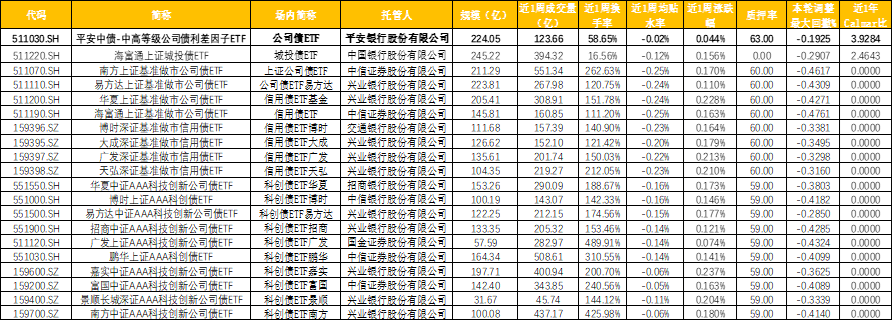
Group 1 - The total scale of credit bond ETFs is 357.7 billion yuan, with a daily increase of 1.85 billion yuan, including a rise of 0.1 billion yuan for benchmark market-making ETFs and 0.88 billion yuan for sci-tech bond ETFs [1] - The median weighted duration is 3.9 years, indicating a moderate interest rate risk exposure [1] - Overall trading volume reached 111.1 billion yuan, with an average single transaction amount of 5.21 million yuan [1] Group 2 - Institutional investors remain optimistic about the bond market despite significant declines in the stock market, recalling the 2015 bull market and its aftermath [2] - The current expectation for the 10-year government bond yield is between 1.6% and 1.8%, with a target of 1.65% [2] - The central bank's continued easing measures suggest a stable liquidity environment, with potential for reserve requirement ratio cuts and interest rate reductions before the Spring Festival [2] Group 3 - The Ping An Company Bond ETF (511030) has the least trading discount in the past week at 2 basis points and has seen a net inflow of 0.052 billion yuan, contrasting with a net redemption of 0.34 billion yuan for the sci-tech bonds [3] - The Ping An Company Bond ETF has ranked first in controlling drawdown during the current bond market adjustment, indicating strong performance relative to peers [3] - The data shows that the Ping An Company Bond ETF has a scale of 22.405 billion yuan and a trading volume of 12.366 billion yuan in the past week [3]