光模块

Search documents
AI产业深度汇报:光模块新潜力者
2025-08-05 15:42
Summary of Key Points from the Conference Call Industry Overview - The conference call focuses on the optical module industry, highlighting key players such as Source Photonics, Cambridge Technology, Hui Green Ecology, and Lian Technology [1][3][4]. Company Highlights Source Photonics - Ranked among the top ten global optical module suppliers, Source Photonics has a comprehensive production capability across the entire industry chain, including optical chip manufacturing and IDM processes [1][5]. - The company reported a revenue of nearly 1 billion yuan and a profit of 500-600 million yuan in Q1 2024, accounting for approximately 40% of its annual profit forecast [1][6]. - Strong demand for 800G products and a shortage of optical chips are driving growth, with significant advancements in data center transmission technologies [5][6]. Cambridge Technology - Entered the North American market by acquiring Lumentum's OCARO optical module product line, achieving over 90% of revenue from overseas markets [1][4]. - The company reported a record quarterly revenue of 90 million yuan, with a gross margin 2-3 percentage points higher than competitors [1][4][7]. - Cambridge Technology employs ODM and JDM models to enhance customer collaboration and expand production capacity globally [3][8]. Hui Green Ecology - Transitioned from a traditional retail background to focus on high-tech sectors, particularly optical communication, through the acquisition of Wuhan Junheng [11][12]. - Set performance targets for Wuhan Junheng, aiming for profits of 45 million, 55 million, and 68 million yuan from 2024 to 2026, with an incentive mechanism linked to actual performance [13][14]. - Plans to expand production capacity in Singapore and Malaysia, with significant investments in new production facilities [15]. Lian Technology - Shifted focus from telecommunications to high-end optical modules, with over 93% of its business now in 10G and above high-speed optical modules [18]. - Achieved significant sales in the optical module market, with 1.6T high-speed modules under development and expected to increase sales volume significantly in the coming years [17][18]. - The company is enhancing its overseas production capacity, particularly in Malaysia, to improve profitability [20]. Market Trends and Future Outlook - The optical module industry is experiencing a surge in demand, particularly for high-speed modules, driven by the growth of data centers and cloud computing [21]. - Emerging companies in the sector are expected to capitalize on opportunities for growth and collaboration, with a positive outlook for both leading and smaller players in the market [21]. - The overall industry is projected to benefit from increased overseas computing power demand, with potential for significant revenue growth across various companies [21].

AI算力研究框架
2025-08-05 03:20
Summary of Key Points from the Conference Call Industry Overview - The AI computing power infrastructure is becoming a new investment driver, with large internet companies actively promoting it, while the industry cycle is still in its early stages [2][3][5] - The 5G industry has entered a mature phase, with capital expenditures stabilizing and declining, leading to limited short-term opportunities [2][3] Core Insights and Arguments - The AI investment boom was ignited by ChatGPT in early 2023, leading to a comprehensive rotation in the tech sector, with optical modules and other segments performing notably well [2][5] - The AI sector and satellite internet themes are showing potential opportunities during the A-share bear market from 2023 to 2024 [2][6] - The AI computing semiconductor industry is expected to experience a global surge in 2024, with significant improvements in performance and orders for the optical module industry, benefiting companies like Huadian [2][7] - The demand for 800G optical modules is expected to increase significantly, with shipments projected to reach 9 million units in 2024 and 35 million units by 2026, with Xuchuang holding about 40% of the global market share [4][18] Market Dynamics - The AI computing sector is currently undergoing a significant transformation, with a notable increase in demand for computing power driven by large model training and inference processes [5][14] - The market is expected to transition from a bear market to a bull market by late 2024 to early 2025, despite facing several negative factors [10][11] - The introduction of new technologies, such as CPO (Co-Packaged Optics), may disrupt traditional optical module forms, but its short-term impact is limited due to slow ramp-up and yield issues [9][22] Financial Performance and Projections - Companies like Shenghong Technology have exceeded expectations since late April 2025, driven by increased orders and Nvidia's financial performance [4][11] - The average price of 800G optical modules is around $500, with a projected decline of 8% to 10% by 2026, despite a significant increase in demand [18] Challenges and Opportunities - The AI industry is still in its early stages, with significant growth in computing power demand, particularly for high-performance computing cards [12][14] - Domestic companies face challenges related to yield and capacity, while international markets are impacted by trade restrictions [13][32] - The liquid cooling technology is expected to become a crucial direction for data centers in the next 5 to 10 years due to increasing power consumption and cooling requirements [28][31] Future Trends - The future of the AI computing power sector appears strong, with ongoing demand for high-performance computing cards and the gradual release of new products like Nvidia's GP300 [12][11] - The optical module industry is expected to see continued growth, driven by demand from major clients like Google and Nvidia [16][18] - New technological directions in the optical module field focus on lower power consumption, higher bandwidth rates, and miniaturization, which will shape future developments [22][17] Conclusion - The AI computing power industry is poised for significant growth, driven by technological advancements and increasing demand from major tech companies, despite facing challenges in supply and market dynamics [32][34]

AI产业深度汇报系列:平台化布局,国内光模块龙头焕新机
2025-08-05 03:16
Summary of Conference Call on AI Industry and Optical Module Market Industry Overview - The conference call focuses on the AI industry and the optical module market, particularly highlighting the performance and prospects of domestic leader, LightSpeed Technology [1][2][3]. Key Points and Arguments Capital Expenditure Trends - Significant growth in capital expenditure from overseas cloud providers, with Meta and Microsoft increasing their budgets, indicating a strong demand for AI-driven computing power in 2025-2026 [1][2]. - Domestic cloud providers' capital expenditure growth is rapid but remains about one-sixth of overseas levels, with Alibaba and Tencent showing fluctuations in their spending [1][4]. Market Demand for Optical Modules - The global optical module market is witnessing a surge, particularly for 800G and 1.6T modules, driven by demand from companies like Meta and Google [1][7]. - By 2025, the demand for 800G modules is expected to reach 20 million units, and for 1.6T modules, around 2 million units [7]. LightSpeed Technology's Position - LightSpeed Technology is a leading player in the domestic optical module market, benefiting from partnerships with major companies like Huawei, ByteDance, Alibaba, and Tencent [1][8]. - The company has a strong vertical integration advantage, covering the entire supply chain from chips to modules, which positions it well to capitalize on the growing demand for optical communication products [2][11][22]. Financial Performance - LightSpeed Technology's revenue and profit have been rapidly increasing, with a projected profit of 330 to 410 million yuan for the first half of 2025, representing a year-on-year growth of 55% to 95% [17][19]. - The gross margin is expected to improve from 22.6% in 2023 to 25.1% in the first quarter of 2025 [17]. Strategic Initiatives - The company has undertaken several strategic initiatives, including multiple rounds of fundraising to enhance R&D and production capabilities, and implementing stock incentive plans to motivate employees [16][14]. - LightSpeed Technology is also expanding its production capacity, with a current monthly output exceeding 1 million units [27][29]. Future Prospects - The domestic market is expected to see increased investment in AI, which will further boost demand for optical modules and benefit companies like LightSpeed Technology [4][9]. - The company is actively pursuing opportunities in emerging fields such as satellite communication and 6G technology, which could provide additional growth avenues [20][21]. Additional Important Insights - The optical chip shortage is a critical issue in the industry, with LightSpeed Technology positioned to leverage its capabilities in this area [25]. - The trend of vertical integration in the industry is becoming more pronounced, with major players acquiring complementary businesses to enhance their competitive edge [24]. - LightSpeed Technology's strong talent pool, cultivated over decades, provides a solid foundation for its future growth [13]. This summary encapsulates the key insights from the conference call, highlighting the dynamics of the optical module market and the strategic positioning of LightSpeed Technology within it.

海外云厂业绩超预期,坚定拥抱光电互联
2025-08-05 03:15
Summary of Conference Call Records Industry Overview - The cloud service industry is experiencing significant capital expenditure (CAPEX) growth, with major players like Meta and Google expected to spend $72 billion and $85 billion respectively in 2023, requiring over 10% quarter-on-quarter growth in the second half of the year [1][2] - The optical module industry saw a quarter-on-quarter growth of 30% in Q2, with leading companies achieving up to 50% growth, indicating a strong demand driven by cloud service investments [1][3] Key Points and Arguments - **CAPEX Growth**: North American cloud providers' total CAPEX reached approximately $95 billion, a year-on-year increase of 66.59% and a quarter-on-quarter increase of over 30% [2] - **Microsoft's Performance**: Microsoft reported a Q2 CAPEX of $24.2 billion, a year-on-year increase of over 50%, with expectations to reach $30 billion in Q3, indicating a robust growth trajectory in cloud services [6] - **Future Industry Outlook**: The industry is expected to maintain a healthy growth rate of around 30% over the next few quarters, with potential for further upward revisions in performance forecasts [7] - **Optical Interconnect Market**: The optical interconnect market is projected to achieve a compound annual growth rate (CAGR) of approximately 20% from 2027 to 2030, driven by the expansion of single-node computing scenarios [8] - **AI Investments**: Google is heavily investing in AI applications, achieving a monthly growth rate of nearly 40% in AI token processing, indicating a closed-loop formation in AI applications that stimulates demand for training and inference computing power [1][13] Additional Important Insights - **Domestic IDC Valuation**: The domestic IDC sector shows reasonable valuations, with companies like Runze and David having price-to-earnings ratios around 25 times, while Data Harbor and Guanghuan Xinwang are around 15-16 times, suggesting opportunities for investment in undervalued companies [3][16] - **Technological Trends**: Key technological directions include GEL up, OIO, and CPU developments, with significant increases in fiber optic connections anticipated in future applications [10][12] - **Investment Opportunities**: The current IDC market presents stable investment opportunities, particularly in companies like Guanghuan and Data Harbor, which have a high safety margin [17] - **Concerns Over PCB Technology**: There are market concerns regarding the impact of orthogonal backplane PCB technology on the copper cable sector, but advancements in high-speed copper AEC are expected to maintain demand in data centers [19] This summary encapsulates the critical insights from the conference call, highlighting the growth trends, investment opportunities, and technological advancements within the cloud and optical interconnect industries.



北美算力PCB-多行业联合人工智能8月报
2025-08-05 03:15
Summary of Key Points from Conference Call Records Industry Overview - The conference call discusses the AI and computing power sectors, particularly focusing on the PCB (Printed Circuit Board) industry and its interrelation with AI development and market dynamics [1][5][7]. Core Insights and Arguments - **Public Fund Holdings**: In Q2, public funds heavily invested in sectors such as applications, robotics, AI PCs, mobile phones, and chips, with holdings ranging from 5% to 10%. The computing power sector saw a significant increase in holdings from approximately 3% to 5% [1][3]. - **Catalysts for AI Industry Growth**: Three main catalysts are identified: 1. Resource feedback from the industry chain, with PCB sector revenue growth of 25% and profit growth of 56% in Q1 [5]. 2. Policy support, including discussions on the "14th Five-Year Plan" and the World Artificial Intelligence Conference [5]. 3. Monetary policy changes, with an 80% expectation of a rate cut by the Federal Reserve, potentially leading to a loosening of monetary policy in China [5]. - **NV Industry Chain**: The NV industry chain is experiencing a short-term pullback due to H20 review issues, but this is viewed as a buying opportunity. The main products, GB200 and GB300, are primarily targeted at North American clients [6]. - **PCB Industry Challenges**: The PCB industry is facing a shakeout, with several companies going bankrupt. The domestic market is becoming a major player due to AI demand, with a projected shortage of VYO cabinets valued at approximately 20 billion RMB [7][8]. - **High-End PTB Market**: The high-end PTB market is expected to grow significantly over the next three years due to technological advancements [7]. Additional Important Content - **AI Infrastructure Investments**: Major tech companies like Google, Meta, and Microsoft are significantly increasing their capital expenditures on AI infrastructure, indicating a developing investment ecosystem in AI [13][14]. - **Light Module Market Demand**: There is a strong upward revision in demand for 800G and 1.6T light modules for 2026 and 2027, indicating robust growth in the overseas computing power chain [15]. - **Humanoid Robot Sector**: The humanoid robot sector has seen a 30% adjustment since March, with upcoming events like the robot conference in Beijing expected to catalyze growth [16]. - **Investment Opportunities**: Recommended companies in the PCB sector include Jingwang Electronics, Dongshan Precision, and Shenghong Technology, with a focus on assembly plants like Industrial Fulian [11]. Conclusion The conference call highlights the interconnectedness of the AI and PCB industries, emphasizing growth opportunities driven by technological advancements, policy support, and increased investments from major tech companies. The current market dynamics present both challenges and opportunities for investors in these sectors.
隔夜英伟达涨超3%,5G通信ETF、创业板人工智能ETF高开
Mei Ri Jing Ji Xin Wen· 2025-08-05 02:07
Core Viewpoint - The A-share computing power sector is experiencing a positive trend, driven by increased capital expenditure from global AI technology giants, indicating a long-term high demand for computing infrastructure [1] Group 1: Market Performance - The A-share computing power sector opened high on August 5, with notable stocks like Taicheng Light, Industrial Fulian, and others showing significant gains [1] - Overnight, US stock indices rose collectively, with AI leader Nvidia increasing by 3.62% to $180 per share [1] Group 2: Capital Expenditure Increases - Major global AI companies have raised their annual capital expenditure forecasts: Google by 13.3% to $85 billion, Meta's lower limit to $66 billion, Microsoft's Q2 expenditure up 27% to $24.2 billion, and Amazon's Q2 expenditure up 90% to $31.4 billion, with an annual guidance of $110 billion to $120 billion [1] Group 3: ETF Insights - The 5G Communication ETF (515050) has a scale exceeding 6 billion yuan, focusing on Nvidia, Apple, and Huawei's supply chains, with over 30% weight in AI computing stocks [2] - The top ten weighted stocks in the 5G Communication ETF include Zhongji Xuchuang, Xinyi Sheng, and others, with significant representation from optical module and PCB circuit board sectors [2] - The Entrepreneurial Board AI ETF (159381) tracks the entrepreneurial board AI index, with a daily fluctuation limit of ±20%, and has over 41% weight in optical modules [2]
英伟达新高催化,A股光模块回暖!太辰光领涨超5%,资金继续抢筹创业板人工智能ETF
Xin Lang Ji Jin· 2025-08-05 01:58
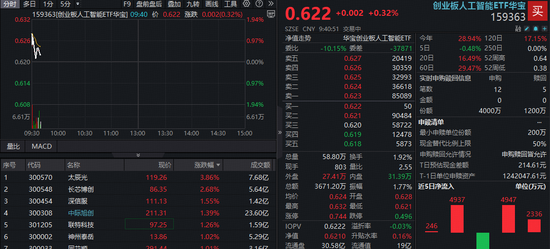
Group 1 - The core viewpoint of the news is that the AI hardware sector, particularly optical modules, is experiencing a positive market response, with significant gains in related stocks and ETFs [1] - The leading stock, Taicheng Technology, rose over 5%, while other companies like Changxin Bochuang and Lian Te Technology saw increases of over 2% [1] - The AI-focused ETF (159363) recorded a trading volume exceeding 32 million yuan, with a net subscription of 28 million units, indicating strong investor interest [1] Group 2 - Galaxy Securities expresses optimism about the sustained high growth of computing power demand driven by AI applications, highlighting that the sector is still in a rapid development phase [2] - The report emphasizes the importance of capturing opportunities in computing power and applications, recommending the AI ETF and focusing on leading companies in the optical module sector [2] - The overseas AI computing infrastructure is transitioning from an "investment phase" to a "harvest phase," with significant long-term growth potential and sustainability in the industry [1][2]

尾盘反弹!新易盛强势翻红,159363成功收涨!海外AI算力基建迈向“收获期”,光模块有望深度受益
Xin Lang Ji Jin· 2025-08-04 11:57
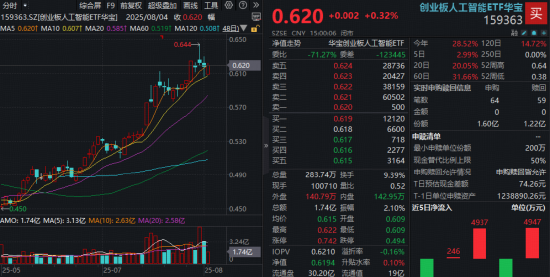
Group 1 - The market experienced a strong rebound on August 4, with AI hardware stocks recovering from early losses, particularly in the ChiNext market where AI-related stocks surged [1] - Key AI-related stocks included ShenZhou TaiYue, which rose over 8%, and DongTu Technology, which increased by over 6% [1] - The ChiNext AI ETF (159363) saw a strong performance, closing up 0.32% with a total trading volume of 174 million yuan and a net subscription of 38 million units throughout the day [1] Group 2 - Leveraged funds have been actively investing in the ChiNext AI ETF (159363), with a total net purchase of 32.24 million yuan over five consecutive days [2] - As of August 1, the financing balance for the ChiNext AI ETF reached a historical high of 79.6972 million yuan [2] - The ChiNext AI index has outperformed other AI indices, with a cumulative increase of over 56% since its low in April [2] Group 3 - North American cloud service providers significantly increased their capital expenditures, with the top four companies (Amazon, Google, Microsoft, Meta) reporting a combined capital expenditure of 95.84 billion dollars in Q2 2025, a 66% year-on-year increase [4] - This increase in capital expenditure indicates a robust growth phase for the AI industry, transitioning from investment to monetization [6] - The overall capital expenditure for these cloud giants is expected to exceed 330 billion dollars in 2025, highlighting the long-term growth potential of the AI infrastructure [6] Group 4 - The ChiNext AI ETF (159363) is the largest in the market, with a total size of 1.871 billion yuan and an average daily trading volume exceeding 150 million yuan [6] - The ETF's portfolio consists of approximately 70% in computing power and 30% in AI applications, effectively capturing the AI thematic market [6] - The focus on leading companies in the optical module sector, such as Yi Zhong Tian, is emphasized as a key investment opportunity [6]

中外资机构:中国权益资产有望跑赢海外市场
天天基金网· 2025-08-04 05:50
Group 1: Global Economic Impact of Tariffs - The average import tariff level in the U.S. has reached 15.6% in 2023, significantly higher than the 2.4% in 2024, which may increase inflation and weaken corporate profitability [3] - The impact of U.S. tariff policies includes a slowdown in global trade flows, reduced investment and consumption growth, and potential restructuring of global supply chains [3] - The legal standing of Trump's tariff policies remains uncertain, pending a final ruling from the Supreme Court [4] Group 2: U.S. Monetary Policy Outlook - The Federal Reserve decided to maintain interest rates in July, with expectations of potential rate cuts in September or October, and a total of four cuts by June 2024, amounting to 100 basis points [6][7] - High tariffs may hinder the Fed's ability to cut rates due to rising inflation and weakening corporate earnings [6] Group 3: Precious Metals and Investment Strategies - Gold prices are expected to rise, with a forecast of $3,700 per ounce by June 2026, driven by geopolitical risks and increased central bank gold reserves [8] - The market may see a correction in gold prices due to reduced uncertainty from tariff policies and a historical high price level [8] Group 4: Global Asset Allocation - U.S. economic and stock market pressures may lead to a decline in trust in dollar assets, while European stocks may attract investment due to lower valuations [10] - A-shares and H-shares are expected to benefit from policy support and improved fundamentals, with a focus on cyclical stocks and technology growth sectors [10] Group 5: Sector Focus in Chinese Market - The market is showing a "high-low" switching characteristic influenced by infrastructure policies and trade risks, with a focus on cyclical stocks and technology sectors [13] - The AI sector is anticipated to remain a core focus, with recommendations to monitor semiconductor and technology index stocks [13][14]

ETF盘中资讯|天孚通信领跌逾5%,资金逢跌布局创业板人工智能!机构:AI商业飞轮提速,海外算力链持续景气
Sou Hu Cai Jing· 2025-08-04 03:43
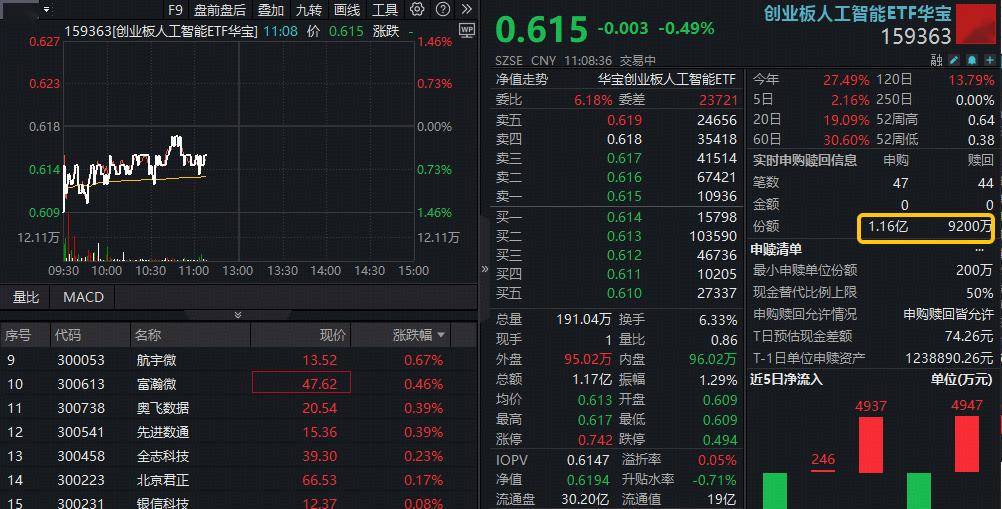
热门ETF方面,同标的指数规模最大、流动性突出的创业板人工智能ETF(159363)场内价格小幅下跌0.65%,实时成交额达1.14亿元,盘中频现溢价交 易,资金继续净申购2400万份。 8月4日早盘,光模块(CPO)等板块继续回调,AI应用逆市活跃,创业板人工智能指数小幅调整。其中,天孚通信下跌5%,中际旭创、长芯博创、联特科 技、新易盛等跌超1%。AI应用则逆市活跃,神州泰岳涨超8%,东土科技涨超6%,汉得信息、易华录等涨逾1%。 长江证券表示,北美四大云商财报与订单表现强劲,资本开支延续高增趋势,AI商业飞轮提速,海外算力链持续景气,建议关注光模块、AI应用等细分机 会。 把握AI核心机会,建议重点关注全市场首只的创业板人工智能ETF华宝(159363)及场外联接(A类023407、C类023408),标的指数约七成仓位布局算 力,三成仓位布局AI应用,高效地捕捉AI主题行情,重点布局光模块龙头"易中天",兼顾IDC算力租赁、云计算等热门赛道。 值得一提的是,杠杆资金近期借道159363踊跃布局创业板人工智能赛道。数据显示,创业板人工智能ETF(159363)上周连续五日均获融资净买入,累计金 额达32 ...