新能源

Search documents
实施节能降碳改造 聚焦重点环节赋能 江苏徐州推动工业增绿添智
Jing Ji Ri Bao· 2026-01-10 21:52
Group 1 - Jiangsu Province's Xuzhou City is focusing on cultivating innovative industrial clusters to accelerate the transformation and upgrading of the manufacturing industry, shifting from resource dependence to innovation-driven development [1] - Greer Digital Technology Co., Ltd. in Xuzhou High-tech Zone has installed photovoltaic power generation equipment on its roof, generating an average of 2.5 million kilowatt-hours annually, which meets over 60% of the plant's electricity needs [1] - The company has improved the efficiency of its new energy power generation system to 98% by integrating advanced artificial intelligence algorithms and blockchain technology, while reducing production energy consumption by over 30% [1] Group 2 - Traditional high-energy-consuming industries in Xuzhou are achieving green and intelligent transformation through technological innovation, with Xuzhou Steel Group reporting a 13.82% reduction in particulate emissions and a 12.98% reduction in sulfur dioxide emissions due to low-emission upgrades [2] - The city has implemented 548 "smart transformation and digital networking" projects and established a dynamic cultivation database for green factories, creating 92 provincial-level green factories and 5 green parks [2] - Xuzhou has also set up an energy-saving and carbon-reduction project database, rolling out hundreds of energy-saving and carbon-reduction projects annually to promote the green transformation of traditional industries and enhance efficiency [2]
乌兰察布市开年首会锚定构建特色现代化产业体系
Xin Lang Cai Jing· 2026-01-10 18:28
Group 1 - Ulanqab City plans to implement 260 projects with government investments over 50 million yuan and corporate investments over 100 million yuan, totaling an investment of 367.3 billion yuan, with a target of completing 70 billion yuan in construction investments this year [1] - The city aims to accelerate the construction of a national important energy and strategic resource base, with plans to add over 4 million kilowatts of installed capacity in renewable energy this year, striving for a total scale of 25 million kilowatts [1][2] - Ulanqab City is focusing on developing a green computing power hub and data industry cluster, targeting a "double hundred growth" in the computing power industry during the 14th Five-Year Plan, with a goal of achieving a computing power breakthrough of 200,000 P this year [2] Group 2 - The city aims to establish the largest green ferroalloy production base in the country, promoting the orderly release of capacity from 32 approved green ferroalloy projects and enhancing the industry's leading position [2] - Ulanqab City is committed to building a modern industrial system with improved structure and stronger development momentum, integrating technological innovation with industrial innovation, and supporting the establishment of innovation platforms for various agricultural and technological sectors [3] - By the end of 2025, Ulanqab City expects to achieve an industrial added value growth of 8.3% year-on-year, fixed asset investment growth of 11.3%, and a general public budget revenue growth of 14.9%, with an overall GDP growth of around 5% [3]
亏损之际,天宜新材陷债务司法漩涡
Shen Zhen Shang Bao· 2026-01-10 15:56
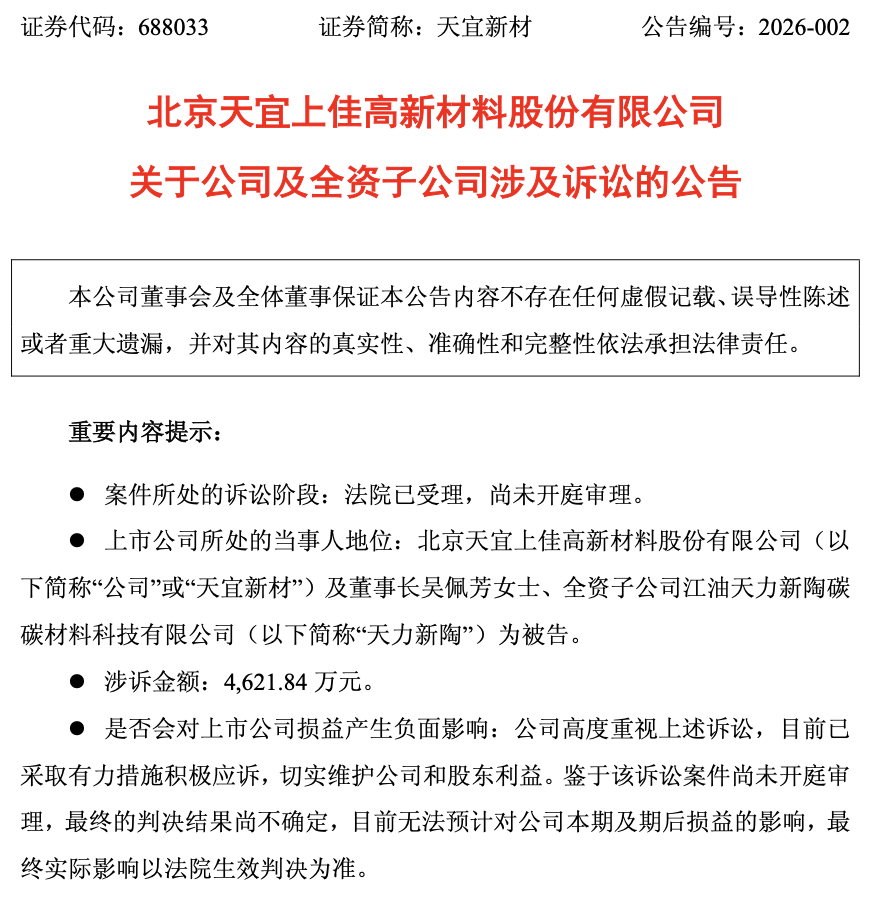
Core Viewpoint - Tianyi New Materials (688033) is facing a lawsuit from Bangyin Financial Leasing Co., Ltd. regarding a financing lease contract dispute, which has led to the freezing of significant bank deposits and poses risks to the company's financial stability [1][5][6]. Group 1: Legal Proceedings - Bangyin Financial filed a lawsuit against Tianyi New Materials and its wholly-owned subsidiary Tianli New Ceramics for breach of a financing lease contract, claiming unpaid rent and other fees totaling approximately RMB 46 million [5][6]. - The court has frozen bank deposits amounting to RMB 46,218,407.07 belonging to the company and its chairman, Wu Peifang, as part of the pre-litigation asset preservation [1][5]. - The company is currently in a pre-restructuring phase, with uncertainty regarding whether it will enter formal restructuring proceedings, which could lead to delisting risks if not managed properly [7]. Group 2: Financial Condition - The company reported a significant decline in revenue, with 2024 revenues at RMB 763 million, a 63.85% decrease year-on-year, and a net loss of RMB 1.495 billion, marking its first annual loss since going public [9]. - For the first three quarters of 2025, the company generated total revenue of RMB 564 million, down 11.69% year-on-year, with a net loss of RMB 371 million [9][10]. - The company's cash flow is severely impacted, with multiple bank accounts frozen due to legal disputes, affecting its operational capabilities and project funding [8][9]. Group 3: Business Operations - The company's photovoltaic new energy business is experiencing a downturn due to industry cyclicality, contributing to the overall revenue decline [10]. - Factors such as low product prices, high depreciation and amortization costs, and elevated financing costs have led to reduced gross margins and continued net losses [10].

稳固国家能源安全的“液态阳光”,醇氢动力或改写运输行业!
第一商用车网· 2026-01-10 13:23
Core Viewpoint - The article emphasizes the strategic importance of methanol as a clean, low-carbon energy source, transitioning from a supplementary to a primary energy role in China's energy landscape, particularly in achieving energy security and supporting the "dual carbon" goals [2][4]. Group 1: Methanol as a Strategic Energy Source - Methanol is recognized as a key player in the new energy system, with its production methods utilizing diverse raw materials, including fossil fuels and carbon dioxide, enabling the creation of "zero-carbon methanol" [2][4]. - The forum highlighted a collective initiative to promote liquid renewable energy development, underscoring methanol's critical position in future energy systems [2][4]. Group 2: Advantages of Methanol in Transportation - Methanol's characteristics, such as high energy density and quick refueling capabilities, make it particularly suitable for commercial vehicles, outperforming pure electric vehicles in long-haul and low-temperature scenarios [5][7]. - The methanol-powered vehicles demonstrate significant environmental benefits, with PM pollutant emissions reduced by 98% and fuel costs lowered by 32%-52% compared to diesel [7][8]. Group 3: Economic Viability and Cost Efficiency - Methanol's production and application across the entire supply chain exhibit notable cost advantages, positioning it as an economic engine for large-scale renewable energy adoption [10][12]. - The potential for utilizing a significant portion of China's annual carbon dioxide emissions for methanol production presents a substantial opportunity for resource utilization [10][12]. Group 4: Future Prospects and Industry Growth - The establishment of a robust methanol infrastructure, alongside ongoing technological advancements and expanding application scenarios, is expected to create a trillion-dollar green methanol industry ecosystem [13]. - The successful hosting of the second Green Methanol Energy Industry Development Forum signifies a pivotal moment for the industry, aligning with national strategies for energy independence and zero-carbon futures [13].

中外资机构:2026年中国将是全球投资者瞩目的市场
中国基金报· 2026-01-10 12:30
Core Viewpoint - China is expected to be a focal market for global investors by 2026, driven by advancements in technology and a robust AI ecosystem, which presents significant opportunities for overseas investors [10][11][25]. Group 1: Market Trends and Predictions - Since April 2025, there has been a trend of global investors reallocating assets outside the US, which is likely to continue into 2026, increasing capital allocation towards Chinese assets [12]. - The Chinese stock market is anticipated to experience a valuation reassessment driven by innovation, with future upward momentum expected to shift from valuation recovery to profit improvement [13]. - A "barbell strategy" is recommended, balancing high-dividend assets with technology stocks that are expected to improve profits due to domestic innovation and international expansion [13][14]. Group 2: Economic Policies and Opportunities - The "14th Five-Year Plan" will focus on modernizing the industrial system and expanding domestic demand, with key investment opportunities in traditional industry upgrades, advanced manufacturing, and emerging sectors like renewable energy and aerospace [15]. - The policy environment is expected to support consumption and investment recovery, particularly in real estate and technology sectors, which will be crucial for future returns [16]. - The anticipated policies will likely enhance corporate profit margins and stimulate economic growth, especially in the context of stable RMB exchange rates and increased household asset reallocation [14][15]. Group 3: Global Economic Context - The Federal Reserve is expected to lower interest rates by 50 to 75 basis points in 2026, which will improve financial conditions and potentially boost risk appetite, although actual growth and profit quality will be critical for market recovery [18][19]. - Japan's monetary policy is projected to continue its gradual normalization, with potential implications for global financial markets, particularly in terms of currency fluctuations and risk asset volatility [20][21][22]. Group 4: Investment Strategies - A diversified investment approach is recommended, focusing on technology sectors related to capital expenditure expansion and energy transition, while also considering emerging markets with strong domestic demand [24][25]. - The Asian markets, particularly China, Hong Kong, Singapore, and South Korea, are viewed as core growth engines, with a strategic shift towards these regions while reducing exposure to US equities [25]. - The use of gold and alternative investment strategies is suggested to enhance portfolio resilience, alongside a barbell approach that combines growth-oriented technology investments with defensive sectors like healthcare and utilities [28].
中信证券:市场向上震荡的概率更高
Xin Lang Cai Jing· 2026-01-10 03:50
Group 1 - The core viewpoint is that the biggest expected divergence in 2026 will stem from the balance between external and internal demand, with a trend towards "taxing" external demand and subsidizing internal demand [1] - The market is expected to have a higher probability of a震荡向上的趋势 after the beginning of the year in a rising sentiment environment [1] - In the medium term, the focus is on sectors with relatively low heat and concentrated positions, but with increasing attention and catalysts, as well as potential long-term improvements in ROE, such as chemicals, engineering machinery, electric equipment, and new energy [1] Group 2 - New industrial themes, such as commercial aerospace, may continue to evolve and present opportunities [1] - There is a heightened focus on the policy logic changes triggered by the continuous appreciation of the RMB, with brokerage firms and insurance companies being considered as strategic choices from this perspective [1]

团美投资(广东)有限公司成立,注册资本10000万人民币
Sou Hu Cai Jing· 2026-01-10 03:01
Core Viewpoint - The establishment of Tuanmei Investment (Guangdong) Co., Ltd. signifies a strategic move into the investment and renewable energy sectors, with a registered capital of 100 million RMB and a focus on various innovative energy technologies [1] Company Overview - Company Name: Tuanmei Investment (Guangdong) Co., Ltd. [1] - Legal Representative: Chen Ruiqin [1] - Registered Capital: 100 million RMB [1] - Company Type: Limited Liability Company [1] - Business Duration: Until January 9, 2026, with no fixed term thereafter [1] - Address: 315A, Building 618, Bagua Industrial Zone, Bagua Road, Yuanshan Community, Futian District, Shenzhen [1] Shareholding Structure - Shareholder 1: Asia Investment (Guangdong) Co., Ltd. - 70% [1] - Shareholder 2: Shenzhen Hexu New Energy Technology Co., Ltd. - 30% [1] Business Scope - General Business Activities: - Venture capital (limited to investments in unlisted companies) [1] - Investment activities using self-owned funds [1] - Research and development in emerging energy technologies [1] - Manufacturing of photovoltaic equipment and components [1] - Energy storage technology services [1] - Manufacturing of new energy prime movers [1] - Energy management services [1] - Carbon reduction, transformation, capture, and storage technology R&D [1] - Import and export of goods and technology [1] - Domestic trade agency [1] - Sales of chemical products (excluding licensed chemical products) [1] - Sales of metal materials [1] - Sales of high-performance non-ferrous metals and alloys [1] - Supply chain management services [1] - Financing consulting services [1] - Business management consulting [1] - Information consulting services (excluding licensed information consulting services) [1] - Engineering and technical research and experimental development [1] - Technical services, development, consulting, exchange, transfer, and promotion [1] - Power generation technology services [1] - Sales of photovoltaic equipment and components [1] - Sales of new energy prime movers [1] - Sales of wind turbine units and components [1] - Sales of offshore wind turbine units [1] - Licensed Business Activities: - Power supply business [1] - Power generation, transmission, and distribution business [1] - (Activities subject to approval by relevant authorities) [1]
从深化提升行动“成绩单”看国企改革攻坚新成效
Xin Lang Cai Jing· 2026-01-10 02:59
Group 1 - The core viewpoint of the news is that the latest round of state-owned enterprise (SOE) reforms has significantly enhanced the core functions and competitiveness of these enterprises, with the main tasks of the reform action being largely completed [1] - The average annual growth of R&D expenditure for central enterprises has been 6.5% since the 14th Five-Year Plan, with R&D spending exceeding 1 trillion yuan for three consecutive years from 2022 to 2024, and basic research investment growing at an average rate of 19% [2] - The establishment of a modern enterprise system with Chinese characteristics is being continuously improved, with a more scientific and efficient operation of boards of directors and a deepening of market-oriented management mechanisms [3] Group 2 - The optimization of the state-owned asset structure is a key focus of the reform, aimed at accelerating the transformation of momentum and enhancing the strategic support role of the state-owned economy [4] - New central enterprises such as China Chang'an Automobile Group have been established, and 116 strategic reorganizations have been carried out to support pillar industries [4] - The China National Offshore Oil Corporation is advancing the development of strategic emerging industries, with revenue from these industries expected to exceed 15% by 2025 [4] Group 3 - The effectiveness of state-owned asset supervision is being continuously improved, with a focus on a matrix-style regulatory model that balances object and behavior supervision [6] - The integration of smart technology and penetrating supervision has become a trend in regulatory reforms, with platforms being developed to enhance oversight capabilities [7] - Despite the completion of the reform action, there is a commitment to continue deepening reforms and solidifying their outcomes [7]
周汉民:中国要在不确定的世界中持续提供确定性
Xin Lang Cai Jing· 2026-01-10 02:28
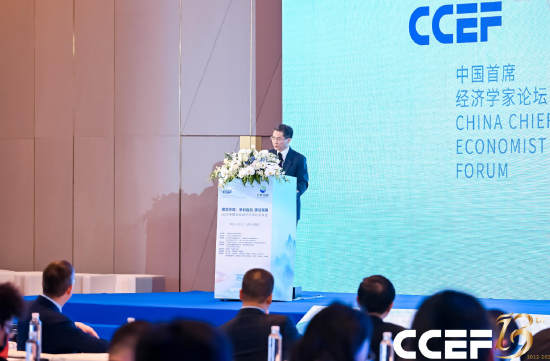
Core Viewpoint - The 2026 China Chief Economist Forum emphasizes the theme "Chess in the Middle Game: Building a Strong Nation," highlighting the need for China to provide certainty in an increasingly unstable global economic environment [1][5]. Group 1: Economic Stability - The current global economy is characterized by a normalization of instability, which is a structural state rather than short-term fluctuations [3][7]. - China's response logic focuses on how to provide certainty in an uncertain world [3][7]. Group 2: Four Levels of Certainty Supply - **Macroeconomic Certainty**: China aims to provide growth certainty by expanding domestic demand, optimizing investment structure, and nurturing new productive forces to maintain a medium-to-high-speed, sustainable, and predictable growth path. China's stable growth is viewed as an important public good for the world [8]. - **Industrial Certainty**: The core advantage of China's future development lies not only in cost but also in a complete industrial system, continuous technological iteration, and scalable application scenarios. This foundation enables China to offer stable and replicable supply capabilities in sectors like new energy, high-end manufacturing, and digital economy [8]. - **Institutional Certainty**: China promotes high-level institutional openness, regional and multilateral cooperation, and aims to reduce institutional friction costs, particularly opposing protectionism disguised as security measures [8]. - **Financial Certainty**: By accelerating the internationalization of the Renminbi, enhancing regional financial cooperation, and coordinating financial regulation, China seeks to provide diverse risk mitigation options for global southern countries [8]. Group 3: Global Economic Responsibility - The world economy in 2026 lacks not capital or technology, but stability, predictability, and reliable institutional supply. China's responsibility is to not only change global uncertainty but also to continuously provide certainty, continuity, and cooperation in an uncertain world. This is essential for China's high-quality development and for helping the global economic system overcome structural challenges [4][8].
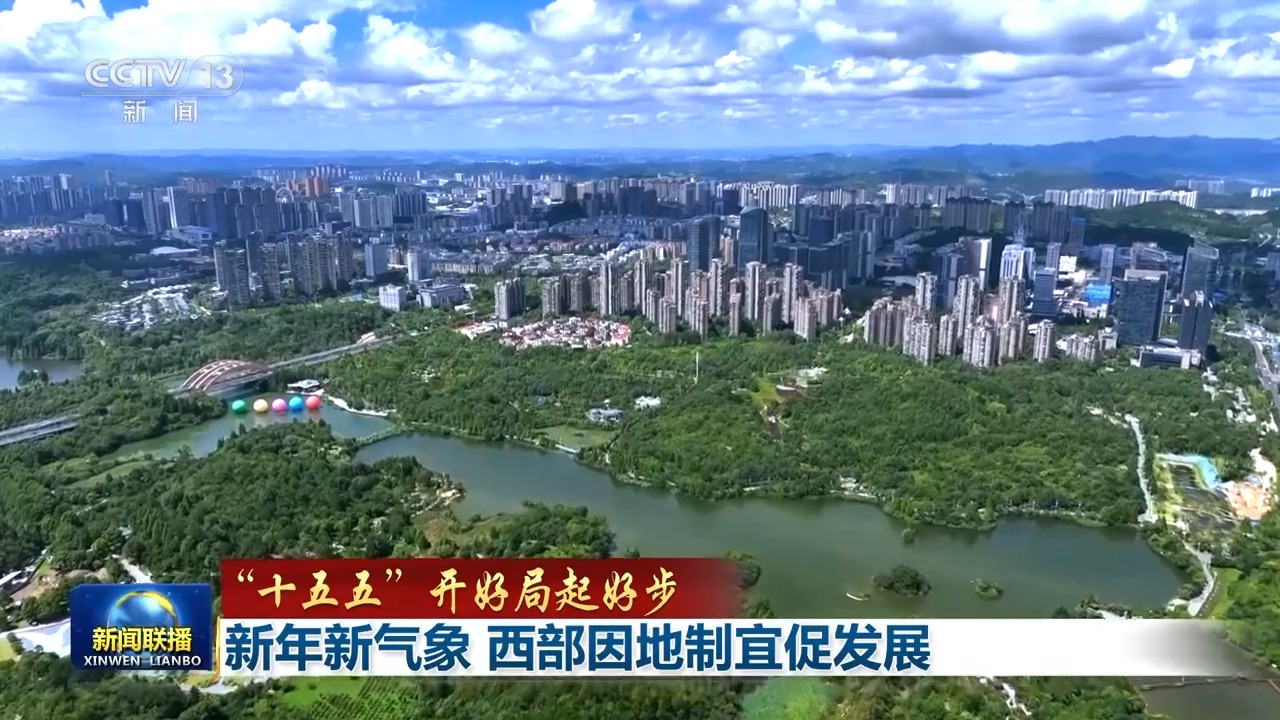
“十五五”开好局起好步丨新年新气象 西部因地制宜促发展
Yang Shi Xin Wen Ke Hu Duan· 2026-01-10 01:19
Group 1: Economic Development Initiatives - The western region is focusing on high-quality development by leveraging local resources and promoting tailored growth strategies [1] - Guizhou plans to enhance the quality of its business entities by utilizing big data to categorize over 4.8 million business entities, with government procurement targeting 40% for small and medium enterprises [3] - Gansu is allocating 120 billion yuan to advance 310 key projects aimed at "intelligent, green, and integrated" transformation to build a modern industrial system [5] Group 2: Energy Sector Developments - Qinghai is prioritizing the development of energy storage technologies and constructing integrated renewable energy bases to establish a global solar thermal center [6] - Xinjiang is focusing on building a new power system centered on renewable energy, accelerating the construction of large wind and solar power bases [7] - Inner Mongolia aims to enhance the resilience of its renewable energy sector, with plans to add 30 million kilowatts of new grid-connected renewable energy capacity this year [7] Group 3: Regional Collaboration and Infrastructure - Chongqing is implementing ten actions to build a modern industrial system, collaborating with Sichuan to develop new trillion-level industrial clusters [8] - Ningxia is emphasizing urban-rural integration and optimizing public resources to advance major projects like underground pipeline upgrades and clean heating [10] - Ningxia's development strategy includes coordinating new industrialization and urbanization efforts to promote common prosperity among its diverse population [12]