
电网

Search documents
欧盟拟强化高排放进口产品碳关税政策 严打避税行为
Xin Lang Cai Jing· 2025-12-17 08:53
Core Viewpoint - The European Union (EU) is expanding the scope of its carbon border tax to include automotive parts and washing machines, aiming to protect local industries from low-priced imports from countries with less stringent climate regulations [1][5][6]. Group 1: Carbon Border Tax Expansion - The carbon border tax will now cover downstream products that heavily use steel and aluminum, such as construction products, grid components, and machinery [2][7]. - The carbon border adjustment mechanism (CBAM) is the world's first carbon border tax, currently taxing the carbon emissions of imported products like steel, aluminum, cement, and fertilizers [1][5]. Group 2: Addressing Compliance and Evasion - The EU plans to implement strict measures against foreign companies that underreport emissions to evade carbon taxes, potentially imposing "default emission values" on products from non-compliant countries [3][8]. - This initiative aims to prevent foreign companies, particularly from China, from strategically exporting low-carbon products to Europe while continuing to produce high-carbon products for other markets [3][8]. Group 3: Implementation Timeline and Subsidies - The carbon border tax will require importers to pay for the emissions of their imported products starting in 2026, with a compliance grace period until September 2027 [4][9]. - The EU plans to allocate 25% of the carbon border tax revenue to subsidize European manufacturers to offset additional costs incurred due to the tax, specifically targeting industries investing in low-carbon manufacturing processes [4][9].
明日四大主题前瞻 | 中央财办强调!扩大内需是明年排在首位的重要任务,商务部对欧盟进口猪肉征收反倾销税
Jin Rong Jie· 2025-12-16 15:38
Group 1: L3 Autonomous Driving and Smart Driving Industry - The Ministry of Industry and Information Technology has officially announced the first batch of L3 conditional autonomous driving vehicle permits, marking a significant step towards commercial application in China [1] - Two models designed for urban congestion and highway conditions will conduct road trials in designated areas of Beijing and Chongqing, indicating a shift from testing to commercial use [1] - The implementation of this policy removes regulatory barriers for high-level autonomous driving technology, accelerating the maturation and cost reduction of the smart driving hardware and software industry [1] - As technology evolves and consumer acceptance increases, smart driving features are gradually penetrating mainstream vehicles, becoming a core driver of the automotive industry's intelligent upgrade [1] Group 2: Domestic Consumption and Economic Strategy - The central government has prioritized the expansion of domestic demand as a key task for 2025, focusing on unleashing consumer potential and implementing special actions to boost consumption [2] - The National Development and Reform Commission has emphasized stabilizing major consumption and promoting policies such as trade-in for consumer goods, enhancing brand leadership, standard upgrades, and new technology applications [2] - Sectors closely related to residents' daily lives, such as retail, e-commerce, cultural tourism, and service consumption, are expected to benefit from increased demand, along with investment growth in consumption infrastructure and supply chain enterprises [2] Group 3: Impact of AI on Power Demand and Grid Investment - The development of AI has led to a surge in electricity demand, with internet data service electricity consumption increasing by 43% year-on-year from January to October this year [3] - The consensus is that "the end of computing power is electricity," highlighting the critical role of electricity in supporting the digital economy [3] - The rapid construction of AI computing centers will significantly drive the demand for stable, efficient, and green electricity, indicating a new golden period for grid investment [3] - Urgent needs for upgrades in the power system will encompass ultra-high voltage transmission, smart distribution networks, energy storage, and virtual power plants [3]
ETF收评 | A股缩量下跌,贵金属回调,黄金股ETF跌4%
Ge Long Hui· 2025-12-16 15:13
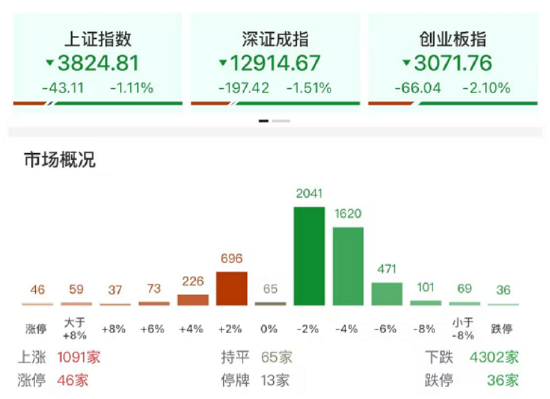
Market Overview - The Shanghai Composite Index fell by 1.11%, the Shenzhen Component Index decreased by 1.51%, and the ChiNext Index dropped by 2.1%, while the North Stock 50 rose by 0.54% [1] - The total market turnover was 1.75 trillion yuan, a decrease of 46.3 billion yuan compared to the previous day [1] Sector Performance - The dairy and retail sectors were active, while the commercial aerospace sector saw a rise in the afternoon [1] - Precious metals, film and television, and photovoltaic sectors experienced adjustments [1] ETF Performance - Some cross-border ETFs strengthened, with the Huaxia Fund Brazil ETF, Invesco Great Wall Fund S&P Consumer ETF, and E Fund Brazil ETF rising by 2.21%, 1.64%, and 1.31% respectively [1] - The fintech sector showed active performance, with the Fintech ETF from Industrial Bank rising by 1.3% [1] - The autonomous driving sector also saw gains, with the Huatai-PB Fund Intelligent Driving ETF and Penghua Fund Intelligent Connected Vehicle ETF increasing by 1.16% and 0.8% respectively [1] Declines in Specific Sectors - Gold stocks faced significant declines, with the Gold Stock ETF, Gold Stocks ETF, and Gold Stocks ETF Fund dropping by 4.16%, 3.91%, and 3.78% respectively [1] - The electric grid sector saw a comprehensive decline, with the Electric Grid ETF falling by 3.48% [1] - The photovoltaic sector also adjusted, with the Photovoltaic ETF Fund and Kexin New Energy ETF both decreasing by 3% [1]
ETF日报:中央经济工作会议定调26年继续推进反内卷,光伏板块依旧值得期待,关注电网ETF
Xin Lang Cai Jing· 2025-12-16 13:29
Market Overview - The market experienced a day of volatility with all three major indices opening lower and closing down. The Shanghai Composite Index fell by 1.11%, the Shenzhen Component by 1.51%, and the ChiNext Index by 2.1% [1][13] - The total trading volume in the Shanghai and Shenzhen markets was 1.72 trillion yuan, a decrease of 49.3 billion yuan from the previous trading day, with over 4,300 stocks declining [1][13] Macro Economic Factors - The Bank of Japan is set to discuss a potential interest rate hike from 0.5% to 0.75% during its monetary policy meeting on December 18-19, which would be the highest rate in 30 years [1][13] - Concerns about tightening liquidity and the ongoing worries regarding an AI bubble in overseas markets have contributed to market sentiment [1][13] AI and Semiconductor Sector - The semiconductor and AI-related sectors saw significant declines, particularly in communication and entrepreneurial AI stocks, likely due to weak overseas AI trading [3][15] - Despite recent downturns, there is a strong expectation for continued growth in capital expenditure in the AI sector next year, with a focus on upstream supply chain stocks in A-shares [3][15] - Communication ETF (515880) and semiconductor equipment ETF (159516) are recommended for investors looking to capitalize on domestic alternatives and AI-related opportunities [3][15][20] Automotive Sector - The smart automotive sector performed relatively well, with the smart automotive ETF (159889) rising by 0.19% [8][21] - The Ministry of Industry and Information Technology has granted approval for the first batch of L3 conditional autonomous driving vehicles, marking a significant step towards commercialization [8][21] - Tesla's advancements in L4 autonomous driving technology may serve as a benchmark for domestic players aiming to initiate similar operations [9][21] New Energy Sector - The new energy sector experienced notable declines, with the electric grid ETF (561380) down 3.13% and the photovoltaic ETF (159864) down 3.05% [11][23] - Factors contributing to this decline include external macroeconomic influences and the approaching sales off-season, leading to concerns about the sustainability of energy storage demand [11][23] - Despite the current downturn, the outlook for energy storage remains positive, with expectations of sustained demand into the first half of next year [11][24]

ETF午评 | A股全线下跌,黄金股遭遇重挫,黄金股ETF跌4%,电网ETF跌3.96%,光伏50ETF、科创新能源ETF均跌3%
Sou Hu Cai Jing· 2025-12-16 03:57
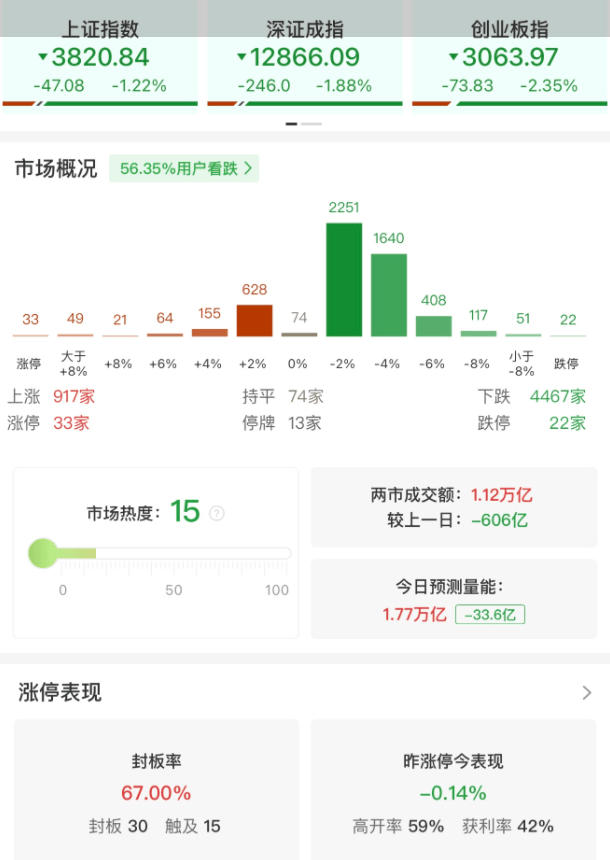
Market Overview - The three major A-share indices collectively declined, with the Shanghai Composite Index down 1.22%, the Shenzhen Component Index down 1.88%, and the ChiNext Index down 2.35% [1] - The Northbound Trading of the Shanghai and Shenzhen Stock Connect saw the Northbound 50 Index increase by 1.10% [1] - Total trading volume in the Shanghai, Shenzhen, and Beijing markets reached 1.1396 trillion yuan, a decrease of 58.9 billion yuan compared to the previous day [1] - Over 4,400 stocks in the market experienced declines [1] Sector Performance - The photovoltaic, superhard materials, rare earth permanent magnets, cross-strait integration, deep-sea technology, semiconductor, and solid-state battery sectors all experienced pullbacks [1] - Conversely, sectors such as intelligent driving, duty-free shops, and stablecoin themes showed resilience and performed well [1] ETF Performance - Some cross-border ETFs showed strength, with Invesco Great Wall Fund's S&P Consumer ETF rising by 2.78%, and both Huaxia Fund's Brazil ETF and E Fund's Brazil ETF increasing by 1.2% and 1% respectively [3] - The autonomous driving sector saw gains, with Penghua Fund's Intelligent Connected Vehicle ETF and GF Fund's Automotive ETF rising by 0.71% and 0.7% respectively [3] - The fintech sector experienced a slight rebound, with the Fintech ETF from Industrial Bank increasing by 0.43% [3] Gold and Energy Sector - Gold stocks faced significant declines, with the Gold Stock ETF, Gold Stocks ETF, and Gold Stocks ETF Fund dropping by 4.16%, 3.97%, and 3.93% respectively [4] - The electric grid sector saw a comprehensive downturn, with the Electric Grid ETF falling by 3.96% [4] - The photovoltaic sector also adjusted, with the Photovoltaic 50 ETF and the Sci-Tech Innovation ETF both declining by 3% [4]
中国银河证券:聚焦新质生产力与反内卷 风光储、锂电、机器人有望全面受益
智通财经网· 2025-12-16 03:55
Core Insights - The Central Economic Work Conference has introduced the "Energy Power Construction Planning Outline," marking a shift from a defensive energy security focus to a proactive energy power leadership strategy [2] - The conference emphasizes the acceleration of new energy systems, green electricity applications, and the importance of new production capacities while addressing issues of "involution" in industries such as wind, solar, and lithium batteries [2][3] Group 1: Energy Strategy and New Energy Focus - The conference's focus on "energy power" alongside manufacturing and technology indicates a significant upgrade in energy strategy [2] - Key areas of focus include fostering new growth drivers, deepening the integration of "AI+", and promoting a comprehensive green transition under the "dual carbon" policy [2] Group 2: Industry Impacts and Opportunities - The introduction of a national unified market construction regulation aims to address "involution" in industries, which has led to widespread losses in sectors like wind, solar, and lithium [3] - The wind power sector is expected to see an increase in new installations, with projections of 120 GW per year during the 14th Five-Year Plan, while solar power may experience a growth inflection point by 2026 [3] - Lithium battery production is anticipated to return to balance, with potential for volume and profit growth as demand increases [3] Group 3: AIDC and Infrastructure Development - The development of AI and the need for energy security are driving modernization in infrastructure, particularly in power supply and distribution systems [4] - The transition to high-voltage direct current (HVDC) systems is expected to accelerate, with significant growth in AI-related power equipment and storage solutions [4] Group 4: Innovation and Future Industries - The conference highlights the importance of innovation, particularly in areas such as embodied intelligence, hydrogen energy, and controllable nuclear fusion, as new economic growth points [5] - Embodied intelligence is projected to be a rapidly growing sector within the next five years, with significant market potential in humanoid robotics and smart driving [5] - The hydrogen energy sector is receiving strong policy support, with initiatives aimed at accelerating the commercialization of green hydrogen and related technologies [5]

券商晨会精华 | 建议重视保险板块业绩增长与估值修复的戴维斯双击投资机会
智通财经网· 2025-12-16 02:03
Market Overview - The market experienced fluctuations yesterday, with the Shanghai and Shenzhen stock exchanges recording a total trading volume of 1.77 trillion, a decrease of 318.8 billion compared to the previous trading day. The Shanghai Composite Index fell by 0.55%, the Shenzhen Component Index dropped by 1.1%, and the ChiNext Index declined by 1.77% [1] Group 1: Solid-State Battery Equipment - Huatai Securities predicts that solid-state battery equipment is expected to achieve mass production between 2027 and 2030, highlighting its disruptive advantages in safety and energy density due to the complete replacement of liquid electrolytes with solid electrolytes. The focus of industrialization has shifted from "material science" to "production engineering," making equipment a key factor in realizing these advantages [2] - The semi-solid battery equipment is anticipated to achieve mass production by 2026, while full solid-state battery equipment is projected for 2027-2030. The process involves new steps and significant performance improvements in existing steps, indicating a high-growth phase for related equipment manufacturers as the 2027-2030 period approaches [2] Group 2: Insurance Sector Investment Opportunities - CITIC Construction Investment suggests focusing on the insurance sector's performance growth and valuation recovery, presenting a "Davis Double-Click" investment opportunity. The stabilization and recovery of interest rates are expected to drive the insurance sector's market performance [3] - Approximately 75%-80% of insurance funds are allocated to fixed-income assets, leading to pessimistic long-term investment return expectations for listed insurance companies during a period of declining long-term interest rates. However, with the recent stabilization of long-term rates, the 10-year government bond yield has risen above 1.8%, which may support valuation recovery for listed insurance companies [3] - Even with conservative long-term interest rate expectations of 1.5%-1.6%, there remains room for valuation recovery. The insurance sector's performance is also supported by anticipated growth in new business for life insurance in 2026 and rapid profit growth in non-auto insurance driven by "reporting and pricing integration" [3] Group 3: Power Grid and Industrial Control Opportunities - CICC emphasizes the structural opportunities in the power grid and industrial control sectors, predicting steady upward performance by 2025. The domestic power grid investment remains robust, with ultra-high voltage projects entering an accelerated approval and bidding phase [4] - The power grid is viewed as a post-cycle investment for renewable energy, with significant investment gaps still to be filled, indicating continued investment attractiveness. In the industrial control sector, the overall cycle remains unchanged, with expectations for sustained demand growth in the coming year [4] - Investors are advised to pay attention to high-elasticity investment directions such as AIDC (Automated Identification and Data Capture) and overseas expansion [4]



A股指数集体低开:沪指跌0.17%,贵金属、白酒等板块跌幅居前
Feng Huang Wang Cai Jing· 2025-12-16 01:36
Market Overview - The three major indices in China opened lower, with the Shanghai Composite Index down 0.17%, the Shenzhen Component Index down 0.21%, and the ChiNext Index down 0.23%. Sectors such as precious metals, liquor, and electronic chemicals saw significant declines [1] - In the external market, U.S. stocks opened high but closed lower, with the Dow Jones down 0.09%, the S&P 500 down 0.16%, and the Nasdaq down 0.59%. Chinese concept stocks also faced declines, with the Nasdaq Golden Dragon China Index down 2.17% [3] Industry Insights - CITIC Securities highlighted that the commercial aerospace sector is entering a new era supported by national policies and technological breakthroughs, suggesting a focus on state-owned enterprises and private companies involved in satellite applications and related technologies [4] - CICC pointed out structural opportunities in the electric grid and industrial control sectors, forecasting steady growth in these areas through 2025, particularly in high-voltage projects and demand recovery in industrial control [5] - Huatai Securities noted that all-solid-state battery equipment is expected to see significant production volume between 2027 and 2030, driven by advancements in production engineering and the transition from liquid to solid electrolytes [6] - CITIC Securities identified a pivotal moment for the lawn mower robot industry, predicting rapid market penetration and growth driven by technological advancements and price reductions, with significant opportunities in the European and American markets [7]

中金:“十五五”景气延续 AIDC助推全球电力超级周期
智通财经网· 2025-12-16 01:24
智通财经APP获悉,中金发布研报称,电网和工控行业2025年整体表现稳健向上,提示投资者重点关注 结构性机遇。电网方面,国内电网投资景气延续,特高压项目自下半年进入核准招标加速期,该行认为 电网是新能源投资的后周期,仍有较大的投资缺口有待补齐,看好电网投资景气延续。工控方面,周期 整体不变,目前仍处于内生修复阶段,展望明年该行认为需求有望持续稳增。此外,该行重点提示关注 AIDC、出海两大高弹性投资方向。 中金主要观点如下: 电网:"十五五"景气度延续 该行认为,在负荷增长、煤电/核电退役、风光占比提升的大背景下,全球多地区缺电风险抬升,全球 迎来电力投资大周期。今年以来中国变压器出口高增,该行持续看好中国电力设备企业海外布局加码, 盈利弹性释放;燃气轮机、SOFC产业链迎来出海突破机遇。 风险 电网投资不及预期;宏观经济波动;新兴行业发展节奏不及预期;国际贸易政策变化和汇率波动风险。 该行预计"十五五"期间全国电网工程投资额年均增速有望达5%以上,看好1)特高压建设有望在风光大 基地及水电外送需求下保持高强度,2)主网投资维持高位;3)配网投资长期看好智能化升级改造方向。 工控:整体需求稳健,仍然看好结构性 ...
中金公司:中金公司:关注电网和工控行业结构性机遇
Di Yi Cai Jing· 2025-12-16 00:19
中金公司指出,电网和工控行业2025年整体表现稳健向上,提示投资者重点关注结构性机遇。电网方 面,国内电网投资景气延续,特高压项目自下半年进入核准招标加速期,我们认为电网是新能源投资的 后周期,仍有较大的投资缺口有待补齐,看好电网投资景气延续。工控方面,周期整体不变,目前仍处 于内生修复阶段,展望明年我们认为需求有望持续稳增。此外,我们重点提示关注AIDC、出海两大高 弹性投资方向。 (本文来自第一财经) ...