
食品

Search documents
加拿大6月CPI温和回升至1.9% 核心通胀走强引发市场关注
Xin Hua Cai Jing· 2025-07-15 14:21
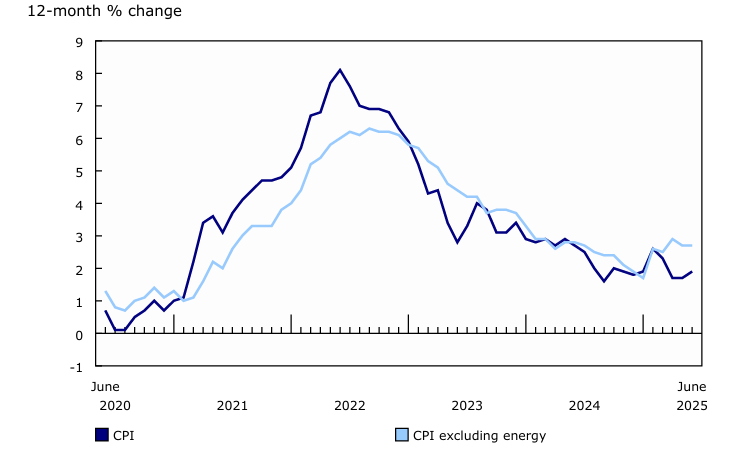
Core Viewpoint - The Canadian Consumer Price Index (CPI) showed a year-on-year increase of 1.9% in June, indicating a moderate recovery in inflation, with a monthly increase of 0.1% unadjusted and 0.2% adjusted for seasonality [1][3]. Inflation Trends - Core inflation, represented by CPI excluding energy, rose by 2.7%, surpassing the overall CPI increase, influenced by the cancellation of consumer carbon pricing in April [3]. - The housing index increased by 2.9% year-on-year, reflecting strong demand in the housing market, which is seen as a hedge against inflation [3]. Sector-Specific Insights - The gasoline prices decreased by 13.4% year-on-year, but the decline was less than the previous month, with geopolitical tensions affecting oil prices [4]. - Food prices rose by 2.8% year-on-year, with fresh vegetable prices declining for the first time since October 2021, indicating a stable market for essential goods [4]. - Durable goods prices increased by 2.7%, with notable price rises in passenger vehicles and furniture, suggesting a recovery in consumer demand [5][6]. Investment Opportunities - Real Estate Investment Trusts (REITs) focusing on rental markets and commercial properties are expected to provide stable returns due to consistent rental income and asset appreciation potential [3]. - Large food distributors with supply chain advantages and companies specializing in high-value products like organic foods are recommended for investment due to their resilience against price fluctuations [4]. - Companies in the automotive and furniture sectors that can quickly respond to market demands are positioned favorably for growth [5][6]. Regional Economic Activity - CPI increases across all eight provinces in Canada indicate heightened regional economic activity, with potential differentiated investment opportunities based on local industry strengths [6].

山东打出“组合拳” 推动外贸企业“精准出海”
Zhong Guo Xin Wen Wang· 2025-07-14 21:25
Group 1 - Shandong Hengfa Hygiene Products Co., Ltd. participated in 7 trade shows this year, achieving a transaction of approximately $100,000 for adult diapers at the International Medical Equipment Exhibition in June [1] - The city of Linqing is actively promoting foreign trade development through a three-tiered mechanism involving government, associations, and enterprises, and has established an overseas warehouse in Djibouti to support over 50 local companies [1] - Shandong's export value is projected to exceed 2 trillion yuan in 2024, with a 7.6% year-on-year growth in imports and exports in the first four months of this year [1] Group 2 - Jianzhen Special Vehicle Manufacturing Co., Ltd. has secured orders exceeding 70 million yuan for the first quarter of 2025, with products being exported to Kazakhstan and Uzbekistan [2] - The economic development zone in Yuncheng provides targeted support for enterprises, facilitating customs clearance and financing to help them navigate international markets [2] - Anqiu City has developed a real-time query platform for international agricultural product standards, covering 53 countries and over 1,300 standards, aiding local companies in exporting to emerging markets [2][3] Group 3 - Huihai Food Company has successfully exported products like ginger and cabbage to Japan, generating over 30 million yuan in annual revenue, thanks to a platform that helps navigate technical trade barriers [3] - The city of Jiyuan has organized participation in international trade fairs to enhance brand visibility and has cultivated over 100 foreign trade enterprises across various sectors [4] - Shandong Huaze Electric Co., Ltd. focuses on high-end precision processing and exports around 200,000 vacuum cleaners annually to markets in Europe, America, and Australia [5][6]
食品饮料周报:业绩窗口期估值切换,关注回调及低估值个股机会-20250714
Tai Ping Yang Zheng Quan· 2025-07-14 14:19
Investment Rating - The report maintains a neutral investment rating for the food and beverage industry, indicating that the overall return is expected to be within -5% to 5% relative to the CSI 300 index over the next six months [24]. Core Views - The food and beverage sector is experiencing a valuation shift during the earnings window, with a focus on opportunities in undervalued stocks and potential rebounds following recent corrections [4][11]. - The SW food and beverage index increased by 0.8%, ranking 26th among 31 sub-industries, with notable gains in the liquor, health products, and beer sectors, while soft drinks and dairy products saw declines [4][11]. - The report highlights the rebound in the liquor sector, particularly the SW liquor index, which rose by 1.41%, suggesting a recovery from previous overly pessimistic expectations [16][20]. Summary by Sections Liquor Sector - The liquor sector is currently in a bottoming phase, with a focus on the upcoming demand during the Mid-Autumn Festival and National Day [20]. - Key brands such as Guizhou Moutai and Luzhou Laojiao are recommended for investment due to their stable pricing and market performance [20][23]. Consumer Goods Sector - The consumer goods sector is facing a correction due to downward adjustments in earnings expectations for leading companies, particularly in soft drinks and snacks [21]. - Innovative product launches in the snack segment are highlighted, with companies like Youyou Foods and Weidong introducing new items to capture market share [21][22]. - The report emphasizes the growth potential in ready-to-drink beverages and the increasing competition in the tea drink market, with a positive outlook for brands like Mixue and Gu Ming [21][22]. Recommended Companies - The report recommends several companies for investment, including: - Luzhou Laojiao: Buy rating with expected EPS growth [23] - Shanxi Fenjiu: Hold rating with stable performance [23] - Dongpeng Beverage: Buy rating with significant revenue growth forecast [22][23] - Youyou Foods: Buy rating with strong market recovery potential [23] - Nongfu Spring: Buy rating with expected market share recovery [23]


中证沪港深互联互通休闲指数报7122.06点,前十大权重包含五粮液等
Jin Rong Jie· 2025-07-14 08:18
据了解,"中证沪港深主题指数系列基于中证沪港深互联互通综合指数样本和中证沪港深 500 指数样 本,同时结合中证行业分类的主题定义,选取相应主题指数样本,从多种主题投资的角度反映了在沪港 深三地上市的互联互通范围内证券的整体表现。"该指数以2004年12月31日为基日,以1000.0点为基 点。 金融界7月14日消息,A股三大指数收盘涨跌不一,中证沪港深互联互通休闲指数 (沪港深通休闲, H30560)报7122.06点。 数据统计显示,中证沪港深互联互通休闲指数近一个月下跌0.16%,近三个月上涨1.62%,年至今上涨 1.65%。 从指数持仓来看,中证沪港深互联互通休闲指数十大权重分别为:贵州茅台(9.61%)、腾讯控股 (9.57%)、美团-W(8.07%)、五粮液(7.18%)、快手-W(5.16%)、百胜中国(3.84%)、泸州老 窖(2.61%)、山西汾酒(2.58%)、银河娱乐(2.29%)、哔哩哔哩-W(1.36%)。 从中证沪港深互联互通休闲指数持仓的市场板块来看,香港证券交易所占比42.95%、深圳证券交易所 占比32.22%、上海证券交易所占比24.83%。 从中证沪港深互联互通休闲指数 ...





食品饮料周观点:中报窗口期,预期回归、分化加剧-20250713
GOLDEN SUN SECURITIES· 2025-07-13 14:28
Investment Rating - The report maintains an "Increase" rating for the food and beverage industry, indicating a positive outlook for selected companies within the sector [4]. Core Insights - The report highlights a significant differentiation within the industry, particularly in the liquor segment, where companies are actively seeking transformation amid market pressures. It emphasizes three main investment themes: leading brands, high-certainty regional brands, and flexible companies benefiting from recovery [1][2]. - In the beer and beverage sector, companies like Yanjing and Zhujiang are expected to show strong profit growth, with Yanjing projected to achieve a net profit of 1.06 to 1.14 billion yuan, reflecting a year-on-year increase of 40% to 50% [3]. Summary by Sections Liquor Industry - The liquor industry is experiencing a challenging half-year, with demand and policy impacts leading to a slowdown in sales. The report anticipates that the performance expectations for the mid-year and the entire year of 2025 have been largely adjusted [2]. - Key players like Kweichow Moutai and Wuliangye are focusing on service enhancement and transformation strategies to navigate the current market conditions. The report suggests that the upcoming month of September will be critical for assessing the impact of policies and consumer demand [2]. Beer and Beverage Sector - Yanjing Beer is expected to achieve a net profit of 1.06 to 1.14 billion yuan for the first half of 2025, marking a year-on-year increase of 40% to 50%. Zhujiang Beer is also projected to see a profit increase of 15% to 25% [3]. - Eastroc Beverage is forecasted to generate revenue of 10.63 to 10.84 billion yuan, with a net profit of 2.31 to 2.45 billion yuan, reflecting a growth of 33% to 42% year-on-year [3]. Consumer Goods - The report notes that companies like Youyou Foods and Miaokelando are expected to report significant profit increases, with Youyou Foods projecting a revenue growth of 40.91% to 50.77% [7]. - The overall consumer goods sector is highlighted as a space to watch for growth, particularly for companies that are innovating and expanding their market reach [7].


90天谈判收效甚微 美国加码关税施压
Bei Jing Shang Bao· 2025-07-13 14:10
Group 1 - The U.S. will impose a 30% tariff on goods imported from the EU and Mexico starting August 1, marking a significant escalation in trade tensions [1][3] - Trump has sent letters to 25 trade partners, with new tariffs ranging from 20% to 50%, creating greater uncertainty in the global economic landscape [1][3] - The EU and Mexico are under pressure to negotiate, but Trump has indicated that tariffs may increase if no agreement is reached [3][4] Group 2 - The EU has suspended plans to impose a digital tax on U.S. tech giants in an effort to reach a compromise, but the U.S. continues to demand high tariffs on key EU exports [4][5] - European leaders, including French President Macron and Spanish Prime Minister Sanchez, have expressed strong opposition to the proposed tariffs and are preparing countermeasures [5][6] Group 3 - The German automotive industry, particularly BMW and Volkswagen, is expected to be severely impacted by the tariffs, along with French luxury goods and Italian machinery [6] - Mexico is seeking diplomatic solutions to the trade disputes and has formed a delegation to negotiate various issues with the U.S. [6][8] Group 4 - The U.S. is also set to impose tariffs of 25% to 40% on imports from Japan and South Korea, further complicating international trade relations [7] - Increased tariffs on imports from Brazil could lead to higher prices for essential goods in the U.S., including coffee and orange juice, affecting consumer costs [7][8] Group 5 - The termination of the "tomato agreement" with Mexico will result in approximately 17% tariffs on Mexican tomatoes, potentially raising prices and impacting employment related to tomato imports in the U.S. [8]

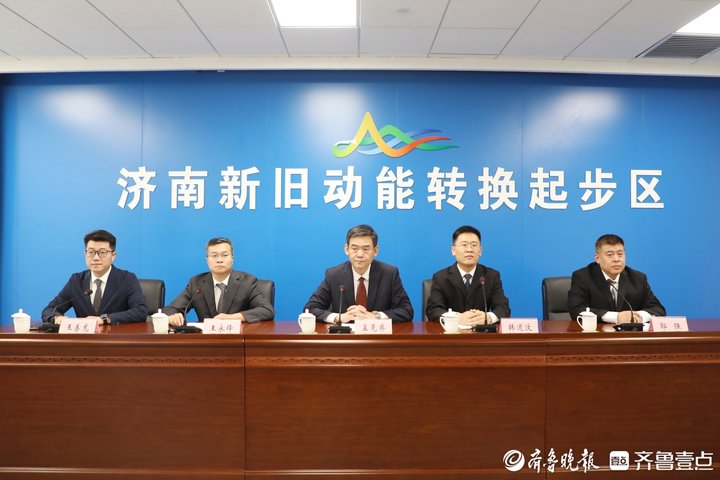
济南起步区目前已建在建绿色建筑约1400万平方米
Qi Lu Wan Bao Wang· 2025-07-12 02:10
Group 1: Environmental Initiatives - The Jinan Starting Area has been recognized as a national pilot for coordinated innovation in pollution reduction and carbon reduction, effective from December 2023 [1] - The area has achieved significant results in clean production audits, with nitrogen oxide emissions reduced by 15.8% and greenhouse gas emissions reduced by 18.6% [3] - The electrification rate of forklifts in the area has reached over 60%, and 77 non-operational vehicles meeting the National III emission standard have been eliminated [3] Group 2: Energy Transition - The total installed capacity of photovoltaic systems in the area has reached 37.1 MW, resulting in an annual reduction of 35,000 tons of greenhouse gases [5] - The "Hydrogen into Thousands of Homes" demonstration project has deployed 40 hydrogen heavy trucks and 16 hydrogen sanitation vehicles, reducing greenhouse gas emissions by 2,600 tons annually [5] - The area has developed a new comprehensive energy station, achieving full green electricity and zero carbon emissions [5] Group 3: Green Building Development - The area has established guidelines for green building design, requiring new constructions to meet at least a two-star green building standard [5] - Approximately 14 million square meters of green buildings are currently under construction, with high-star green buildings accounting for 78% of this total [5] - The Zero Carbon Smart Operation Center has been awarded the "Global Habitat Planning and Design Award" and is expected to generate 950,000 kWh annually upon operation [5] Group 4: Green Industry Growth - The area is actively developing the new energy vehicle industry and has launched a 10 GW high-efficiency solar cell production line [7] - The first pilot production line for perovskite solar cells in the province has been established, contributing to the upgrade of the energy structure [7] - The hydrogen energy industry is also being promoted, with the "Hydrogen Teng" fuel cell produced by Jinan Green Energy Company being utilized in international applications [7]

波黑2025年第一季度出口实现增长
Shang Wu Bu Wang Zhan· 2025-07-11 13:34
Group 1 - Bosnia's total foreign trade in Q1 2025 amounted to 11.3 billion marks, with exports at 4.12 billion marks and imports at 7.18 billion marks, resulting in a trade deficit of 3.07 billion marks [1] - The total foreign trade increased by 5.96% year-on-year, with imports growing by 5.48% and exports by 6.81%, leading to an export-to-import coverage rate of 57.29%, up by 0.71 percentage points [1] - Exports to EU countries reached 3.04 billion marks, a year-on-year increase of 5.18%, while imports from the EU were 4.19 billion marks, up by 3.06%, resulting in a reduced trade deficit of 1.15 billion marks, down by 2.15% [1] Group 2 - The main export destinations for Bosnia in Q1 2025 were Croatia (718 million marks), Germany (612 million marks), and Serbia (455 million marks) [2] - Major import sources included Germany (802 million marks), Italy (778 million marks), and Serbia (765 million marks) [2] - Bosnia's export coverage rates to Austria, Slovenia, and Croatia were 153.5%, 128.88%, and 105.83% respectively [2] Group 3 - The implementation of tariff reduction policies has led to an investment of 16.6 million marks and total revenues of approximately 2 billion marks for related enterprises, with exports increasing by 24.2 million marks [3] - Most enterprises reported growth in production, employment, and income, although the textile, footwear, and furniture sectors faced factory closures and layoffs due to the EU market crisis, while the chemical industry remained stable [3]
氪星晚报|首届“苏宁易购杯”王者荣耀全国超级联赛40城开启;阿里国际D20全球设计院长峰会在杭召开;新增商保创新药目录,2025年医保目录调整正式启动
3 6 Ke· 2025-07-11 10:25
Group 1 - Tesla officially enters the Indian market with the opening of its first experience center in Mumbai on July 15, having imported vehicles and related products worth $1 million [1] - Greenland Group and DeepBlue Technology have established a joint venture, "Greenland DeepBlue AI Medical Technology Company," aimed at promoting the DeepBlue-MR-v1 medical model, which ranks first in complex medical reasoning evaluations [1] Group 2 - Mafengwo's personalized travel planning product "AI Roadbook" is now available to all users, featuring tools for restaurant reservations and real-time translation, enhancing the travel experience from planning to execution [2] - NielsenIQ and Gaode Cloud have signed a strategic cooperation agreement to launch "Channel Cloud Map," a retail intelligence solution that integrates real-time store data and professional verification for comprehensive market coverage [3] Group 3 - The first "Suning.com Cup" Honor of Kings national super league has been launched, with over 2,000 teams competing across 40 cities, aiming to establish 100 e-sports experience zones by 2025 [4] - The D20 Global Design Dean Summit was held in Hangzhou, focusing on the integration of design and technology, and promoting the establishment of AI design talent standards through the "D20 Declaration" [5] Group 4 - LeEco has been ordered to pay over 10.07 million yuan due to enforcement actions, highlighting ongoing financial difficulties faced by the company [6][7] - Nestlé's offices in France were searched as part of an investigation into allegations of using illegal filtration systems in their bottled water products [8] Group 5 - The Shanghai Cooperation Organization signed 12 digital economy cooperation projects, focusing on cross-border e-commerce and smart cities, during the 2025 Digital Economy Forum [9] - Beijing has launched a comprehensive service platform to support enterprises in the "Belt and Road" initiative, providing one-stop services in policy communication, financial connectivity, and talent exchange [10] - The adjustment of the national medical insurance drug list and the commercial health insurance innovative drug list has officially started, aiming to enhance the multi-level medication guarantee system [11] - The Chinese Foreign Ministry announced ongoing simplification of visa application procedures to facilitate smoother travel for foreign visitors to China [12]

济南起步区推进减污降碳协同创新试点工作
Zhong Guo Jin Rong Xin Xi Wang· 2025-07-11 09:56
Group 1: Green Development Initiatives - Jinan is advancing the construction of a green, low-carbon, high-quality development pilot area, with significant progress in the new and old kinetic energy conversion zone [1] - The city has organized over 20 construction material companies to conduct clean production audits, achieving a reduction of nitrogen oxides by 15.8% and greenhouse gases by 18.6% [1] - Key enterprises are enhancing their clean production levels, with Jinan Dali Food replacing gas boilers with green steam and Jinan BYD achieving environmental performance standards [1] Group 2: Energy Transition - The region is focusing on energy transition by developing a low-carbon, efficient energy system, with a photovoltaic installed capacity reaching 37.1 MW, reducing greenhouse gas emissions by 35,000 tons annually [2] - The "Hydrogen into Thousands of Homes" demonstration project has deployed 40 hydrogen heavy trucks and 16 hydrogen sanitation vehicles, contributing to a reduction of 2,600 tons of greenhouse gases each year [2] - Shallow geothermal energy systems are being developed, with annual greenhouse gas reductions of 3,800 tons from the operation of innovative centers [2] Group 3: Green Building Development - Policies have been established to promote green building design and new construction technologies, requiring new buildings to meet at least two-star green building standards [2] - Approximately 14 million square meters of green buildings are currently under construction, with 78% being high-star-rated green buildings [2] - The International Standard Industrial Park's zero-carbon smart operation center has won a global award and is expected to generate 950,000 kWh annually [2] Group 4: Green Low-Carbon Industry - The city is actively developing the new energy vehicle industry, with Jinan BYD's products reaching numerous households [3] - The photovoltaic battery industry is expanding, with the launch of a 10 GW high-efficiency solar cell production line by Aishuo and a pilot production line for perovskite solar cells [3] - The hydrogen energy sector is also growing, with Jinan Green Energy Hydrogen Company producing fuel cells that are operational in remote locations [3]