
水泥

Search documents
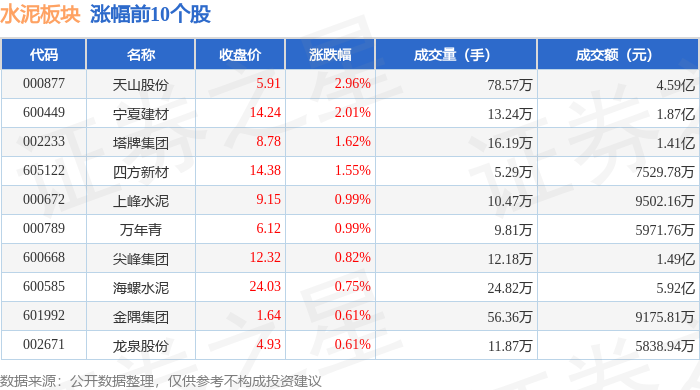
水泥板块8月20日涨0.74%,天山股份领涨,主力资金净流出1.71亿元
Zheng Xing Xing Ye Ri Bao· 2025-08-20 08:44
| 代码 | 名称 | 收盘价 | 涨跌幅 | 成交量(手) | 成交额(元) | | --- | --- | --- | --- | --- | --- | | 600326 | 西藏天路 | 16.09 | -3.01% | 192.40万 | 31.00亿 | | 600678 | 四川金顶 | 10.51 | -0.94% | 39.91万 | 4.17 乙 | | 002205 | 国统股份 | 14.43 | -0.82% | 8.39万 | 1.20亿 | | 603616 | 韩建河山 | 5.88 | 0.17% | 20.52万 | 1.20亿 | | 600802 | 福建水泥 | 5.53 | 0.18% | 10.90万 | 6006.44万 | | 600425 | 青松建化 | 4.36 | 0.23% | 49.07万 | 2.14亿 | | 002302 | 西部建设 | 7.03 | 0.29% | 31.63万 | 2.21亿 | | 000401 | 莫东水泥 | 66.7 | 0.40% | 16.60万 | 8241.80万 | | 003037 | 三和管桩 | ...



“十五五”规划展望系列:反内卷中寻投资机会
Yin He Zheng Quan· 2025-08-20 07:40
Group 1 - The report emphasizes the importance of addressing "involution" in the context of China's economic development, highlighting the negative impacts of disorderly expansion and price competition on high-quality growth [2][4][12] - The report notes that China's industrial capacity utilization has been declining since 2021, with the Producer Price Index (PPI) showing negative year-on-year growth for 34 consecutive months as of July 2025 [2][4][12] - The "15th Five-Year Plan" period is expected to see a continuation and deepening of policies aimed at countering involution, focusing on capacity governance and preventing vicious competition [2][12] Group 2 - The report compares the current "anti-involution" policies with previous supply-side structural reforms, noting that both aim to address structural issues in the economy and enhance long-term competitiveness [2][13] - The previous round of supply-side reforms successfully boosted the coal and steel industries, with significant reductions in excess capacity and improvements in profitability [2][17] - The report outlines that the current anti-involution policies cover a broader range of industries, including both traditional sectors like steel and coal, as well as emerging industries such as photovoltaics and electric vehicles [2][12][10] Group 3 - The report discusses the financial indicators of related industries, indicating that revenue growth rates and profit margins are critical metrics for assessing the impact of anti-involution policies [3][4] - It highlights that since July 2025, many commodities related to anti-involution have seen price increases, driving up the performance of relevant sector indices [2][12] - The report suggests that the anti-involution policies are expected to improve gross margins and capacity utilization, thereby enhancing the long-term investment value of related sectors [2][12]
午评:主要股指调整 白酒及酒店餐饮板块领涨
Xin Hua Cai Jing· 2025-08-20 05:22
Market Overview - The Shanghai and Shenzhen stock markets opened lower on August 20, with the major indices initially dipping before rebounding after testing the 5-day moving average. The Shanghai Composite Index fell slightly, while the Shenzhen Component and ChiNext Index saw significant declines [1] - By midday, the Shanghai Composite Index was at 3725.22 points, down 0.06%, with a trading volume of approximately 623.7 billion yuan. The Shenzhen Component was at 11743.76 points, down 0.66%, with a trading volume of about 884.6 billion yuan. The ChiNext Index was at 2557.14 points, down 1.71%, with a trading volume of around 417 billion yuan [1] Sector Performance - During the opening, sectors such as photovoltaic, smart TVs, and aquaculture showed strong gains, while sectors like CPO, PCB, computing power, and fintech experienced notable declines [1] - After the opening, sectors including rare earth permanent magnets, liquor, and gaming saw significant increases, while warehousing logistics, wireless earphones, MicroLED, AI glasses, and aviation also showed substantial growth [1] - Near the midday close, the hotel and catering, semiconductor, and tourism sectors experienced significant rebounds, with liquor, hotel and catering, and small metals leading the gains during the morning session [1] Institutional Insights - According to Debon Securities, there are concerns about the sustainability of the "liquidity-driven market" and the potential for further movement beyond the 3700-point mark. They highlight three supporting factors for market continuation: 1. The low historical spread between stock and bond yields, combined with declining deposit rates, is driving retail investment, with new accounts in July up 70% year-on-year 2. Based on previous breakouts above 3600 points, projected peak index levels for the next one and three months are 3990 points and 4390 points, respectively 3. A "slow bull" market foundation is supported by a tripartite resonance of capital, fundamentals, and policies [2] - CITIC Securities notes that the rapid iteration of multimodal model technology is prompting film and television companies to enhance their AI technology integration across the content production chain, improving efficiency and reducing costs. Companies involved in micro-short dramas are leveraging these technologies as testing grounds for AI-generated content [2] Industry Recommendations - China Galaxy Securities recommends leading companies in the consumer building materials sector, anticipating demand recovery due to expected policy support, improved channel layouts, and product quality advantages. In the cement sector, they suggest that stricter supply controls may ease supply-demand conflicts, leading to price increases and profit recovery for regional leaders [3] - In the fiberglass sector, they recommend companies benefiting from demand recovery in emerging markets, with expectations for price increases in mid-to-high-end products and overall performance recovery for the year [3]
反内卷全面来袭,到底意味着什么?
Hu Xiu· 2025-08-20 03:16
Group 1 - The core viewpoint of the article highlights a wave of production restrictions across various industries in China, including lithium mining, cement, steel, pork, and automobiles, indicating a broader trend of "anti-involution" [1] Group 2 - The article mentions that the production halt of lithium mines by CATL is just the beginning of this trend, suggesting potential implications for the lithium supply chain and related industries [1]
券商晨会精华 | 旺季来临叠加反内卷催化 关注建材布局机会
智通财经网· 2025-08-20 00:37
Market Overview - The market experienced a slight decline yesterday, with the three major indices showing minor drops. The Shanghai Composite Index fell by 0.02%, the Shenzhen Component Index by 0.12%, and the ChiNext Index by 0.17% [1] - The total trading volume in the Shanghai and Shenzhen markets was 2.59 trillion yuan, a decrease of 175.8 billion yuan compared to the previous trading day, marking the fifth consecutive day with trading volume exceeding 2 trillion yuan [1] - Sectors such as liquor, Huawei HiSilicon, CPO, and humanoid robots saw significant gains, while insurance, military, securities, and gaming sectors experienced notable declines [1] Investment Insights Rare Earths - Huatai Securities emphasizes the strategic importance of rare earths and anticipates a price increase, projecting that the price center for rare earths will continue to rise from 2025 to 2026. The strategic significance of rare earths has become more pronounced in the context of "de-globalization" [2] - The active bidding for praseodymium and neodymium metals that started in July reflects strong market bullish sentiment, suggesting that related companies' performance is expected to improve continuously [2] Solar Thermal Power - CITIC Construction Investment highlights the potential for solar thermal power to undergo a qualitative change in the energy storage era, noting its importance in building a new power system. The installed capacity of solar thermal power in China is projected to reach 838.2 MW by the end of 2024, with an additional 300 MW expected to be added from 2021 to 2024 [3] - The report indicates that the industry still has significant growth potential, despite historical fluctuations in installed capacity due to economic viability and policy uncertainties. Current pricing policies in Qinghai province suggest that solar thermal power is beginning to demonstrate economic feasibility [3] Building Materials - Galaxy Securities recommends focusing on opportunities in the building materials sector, anticipating a recovery in demand due to expected policy support and improved channel layouts. Companies with product quality and brand advantages are highlighted as potential leaders in the consumer building materials industry [4] - In the cement sector, stricter supply controls are expected to ease supply-demand conflicts, leading to a potential increase in cement prices and profitability for regional leaders [4] - For fiberglass, the report suggests that demand recovery driven by emerging markets and price increases for mid-to-high-end products could lead to a full-year performance recovery for leading companies [4]
中国银河证券:旺季来临叠加反内卷催化,关注建材布局机会
Xin Lang Cai Jing· 2025-08-20 00:06
Group 1 - The consumption building materials industry leaders are expected to benefit from improved demand due to anticipated policy support and enhanced channel layout and product expansion [1] - In the cement sector, stricter supply controls are expected to ease supply-demand conflicts, leading to a price increase and potential profit recovery for regional leaders [1] - The fiberglass industry is projected to benefit from demand recovery driven by emerging markets, with expectations for price increases in mid-to-high-end products and overall performance recovery for leading companies [1] Group 2 - In the glass sector, the anticipated increase in cold repair production lines is expected to gradually optimize the supply-demand landscape [1]

“雅江水电牛股”西藏天路上半年经营恶化,题材炒作难掩盈利短板|看财报
Tai Mei Ti A P P· 2025-08-19 12:10
Core Viewpoint - The financial report of Tibet Tianlu (600326.SH) reveals the essence of speculation surrounding the "Yajiang Hydropower" concept, showing a significant disconnect between stock price and fundamental performance, with a net loss of 112 million yuan in the first half of 2025, worsening from the previous year [2][3] Financial Performance - In the first half of 2025, Tibet Tianlu achieved revenue of approximately 1.409 billion yuan, representing a year-on-year growth of 19.88%, but the net loss attributable to shareholders was 112 million yuan, an increase in loss of 45 million yuan compared to the same period last year [3][4] - The company reported a decline in net profit from 2022 to 2024, with losses of 498 million yuan, 532 million yuan, and 104 million yuan respectively, indicating a consistent downward trend in profitability [3][4] Business Segments - The main business of Tibet Tianlu includes engineering contracting, cement production, and sales, with cement and cement products accounting for over 75% of revenue in 2024 [3][4] - The construction segment reported revenue of 334 million yuan in the first half of 2025, but incurred a loss of 56.68 million yuan due to increased bad debt provisions and impairment losses [5][7] Market Conditions - The cement industry is facing significant pressure due to declining demand in the real estate sector and weak infrastructure investment, with over half of the A-share cement companies reporting losses in the first half of 2025 [4][6] - The competitive landscape in Tibet remains challenging, with external cement supplies continuing to flood the market, leading to a decline in cement prices [4][6] Cost Structure - Despite a slight increase in gross margin from 10.48% to 11.63%, the net margin worsened from -7.93% to -9.40%, indicating persistent cost issues [7] - High management and financial costs have significantly eroded profits, with management expenses reaching 40.54 million yuan and financial expenses at 30.68 million yuan in the first half of 2025 [7] Future Prospects - The anticipated "Yajiang Hydropower" project, valued at 1.2 trillion yuan, is expected to boost local cement demand, with an estimated consumption of 30-35 million tons of cement [8] - While Tibet Tianlu has a local advantage, the actual impact on its performance remains uncertain, dependent on the timing of industry demand recovery and the company's ability to capitalize on the hydropower project [8]


股债轮动下的中国市场:资金流向与投资机遇
Zhi Tong Cai Jing· 2025-08-19 11:38
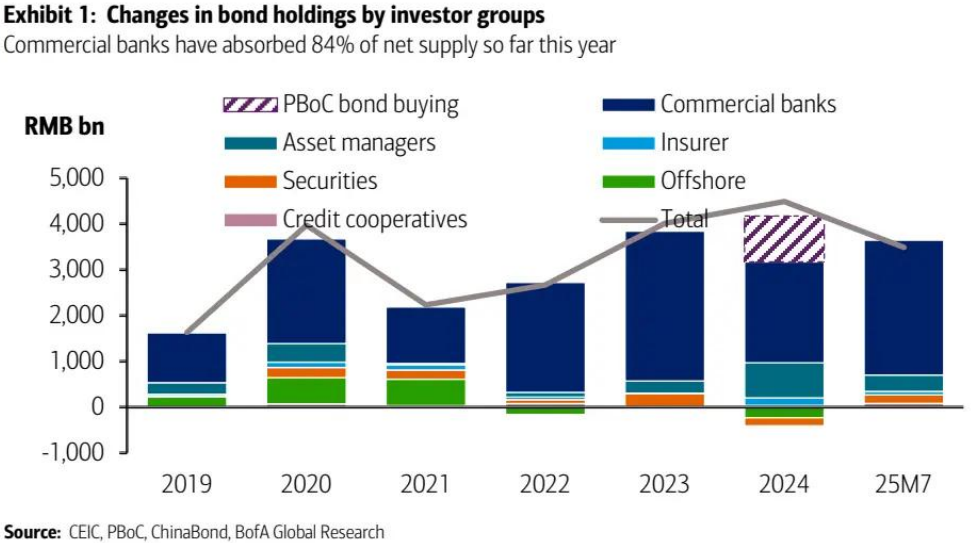
Group 1: Bond Market Dynamics - The demand structure for government bonds reflects the risk appetite of funds, with a net supply of nearly 14 trillion yuan expected in 2025, a 23% year-on-year increase [2] - Commercial banks have become the most stable demand side, holding an additional 2.9 trillion yuan in government bonds in the first seven months of 2025, absorbing 84% of the net supply [2][5] - Insurance companies have shown resilience in bond demand, increasing their holdings by 400 to 600 billion yuan annually over the past five years, despite a shift towards high-dividend stocks [5] - Offshore investors have recently turned into net sellers of bonds, but the outflow of Chinese government bonds is expected to be limited due to high holdings by long-term investors [12] - The central bank may restart bond purchases if there is a lack of demand in the bond market, providing a potential policy buffer [13] Group 2: Stock Market Opportunities - The A-share market is experiencing strong momentum driven by a "debt-to-equity rotation" and "anti-involution" logic, with local participation reaching a new high [14] - The widening yield spread of 10-30 year government bonds is prompting funds to shift from bonds to stocks, particularly as major holders of long-term bonds begin to reduce their positions [14] - High expectations for profit recovery in "involuted" industries could lead to an increase in the MSCI China index EPS growth rate from 10% to 12% between 2025 and 2027 [16] - Goldman Sachs has identified 20 companies with strong potential based on valuation expansion and fundamental improvement, with an average stock price increase of 8% since July [18] Group 3: Market Interactions and Signals - The current market dynamics are characterized by the coexistence of stable demand from banks and insurance companies in the bond market, alongside fluctuating behavior from asset management and offshore investors [21] - The ongoing rotation from bonds to stocks, particularly in anti-involution sectors, is creating structural opportunities driven by profit recovery expectations and fund preferences [21][22] - Investors should closely monitor liquidity changes in the interbank market, the sustainability of stock market profitability, and the central bank's policy signals regarding bond purchases [22]



天山股份(000877):2Q25扭亏为盈,期待反内卷更进一步
HTSC· 2025-08-19 10:44
Investment Rating - The investment rating for the company is maintained as "Buy" with a target price of RMB 8.55 [6][8]. Core Views - The company reported a revenue of RMB 35.98 billion in 1H25, a year-on-year decrease of 9.4%, but achieved a net profit of RMB 0.572 billion in Q2, marking a significant turnaround from a loss of RMB 1.49 billion in the same period last year [1][2]. - The company is expected to benefit from the acceleration of key infrastructure projects and the ongoing "anti-involution" measures in the cement industry, which are anticipated to improve pricing and demand dynamics [1][4]. Summary by Sections Financial Performance - In 1H25, the company's cement clinker sales decreased by 14.6% year-on-year to 90.52 million tons, which is a larger decline than the national average of 4.3% [2]. - The average price per ton of cement clinker was RMB 251, with a gross profit of RMB 48 per ton, reflecting a year-on-year increase of RMB 13 and RMB 27 respectively [2]. - The company achieved a gross profit margin of 39.9% in its overseas business, which is significantly higher than its domestic operations [3]. Market Dynamics - The national cement production in 1H25 was 815 million tons, down 4.3% year-on-year, while the average price increased by 5.4% [4]. - The government has emphasized the need to regulate excessive competition and production in the cement industry, which is expected to lead to improved pricing stability [4]. Future Outlook - The company has announced a dividend policy for 2025-2027, committing to distribute at least 50% of its distributable profits as cash dividends, which is consistent with previous years' payout ratios [3]. - The company is projected to achieve earnings per share (EPS) of RMB 0.25, 0.30, and 0.35 for the years 2025, 2026, and 2027 respectively [5].
天风证券:当前水泥反内卷必要性仍然存在 行业盈利底部有较强支撑
智通财经网· 2025-08-19 09:01
Core Viewpoint - The cement industry is experiencing a significant decline in prices, with a need for "anti-involution" measures to address overcapacity and improve profitability [1][2]. Group 1: Industry Overview - In 2024, the capacity share of central state-owned enterprises in the cement industry is expected to be around 45%, with the top four companies being state-owned, indicating a favorable competitive structure for anti-involution efforts [1]. - The industry's concentration ratios (CR10, CR5, CR2) are projected to reach 57%, 44%, and 31% respectively in 2024, highlighting a high level of market concentration [1]. Group 2: Financial Performance - The cement industry faced a challenging period, with over 55% of companies reporting losses in the worst quarter, but a recovery is expected in Q4 2024, with total profits projected to be between 150-160 billion yuan, reversing a loss of 11 billion yuan in the same period last year [2]. - The average national cement price has decreased by 43.7 yuan/ton year-on-year as of early August, indicating a return to the industry's lowest profitability levels seen in the previous year [2]. Group 3: Supply-Side Reform - Previous supply-side reforms successfully reduced new capacity and improved industry profitability, with profits rising from 518 billion yuan in 2016 to a historical high of 1867 billion yuan in 2019 [3]. - The industry has reached a peak supply level of around 1.8 billion tons, but demand continues to decline, leading to a projected capacity utilization rate of only 53% in 2024 [4]. Group 4: Future Outlook - The anti-involution strategy will involve a combination of market, administrative, and legal measures, with short-term reliance on staggered production to stabilize the market [5]. - In the medium term, administrative measures will likely force companies to reduce capacity, potentially leading to a 19.5% decrease in actual capacity to 1.77 billion tons [5]. - Long-term expectations include stricter carbon emission policies by 2027, which may increase production costs and accelerate the exit of high-emission capacities from the market [5].
