
电子

Search documents
高盛列出2026年推荐股名单 包含联想、华虹半导体等26只股
Ge Long Hui· 2026-01-02 14:19
Group 1 - Major investment banks like Goldman Sachs, Morgan Stanley, and UBS are optimistic about the global stock market outlook for 2026, expecting double-digit gains in both developed and emerging markets due to strong earnings growth, declining interest rates, and reduced policy headwinds [1] - The United States is projected to maintain its position as the global growth engine, driven by a resilient economy and an AI-driven supercycle that is leading to record capital expenditures and rapid earnings expansion [1] - The momentum of the AI industry is spreading globally across various sectors including technology, utilities, banking, healthcare, and logistics, creating both winners and losers amid an already imbalanced K-shaped economy [1] Group 2 - Goldman Sachs has released a list of recommended stocks for investment based on the Earnings Revision Leading Indicator (ERLI), which includes companies such as AIA Group (01299.HK), Xiaomi Group-W (01810.HK), Lenovo Group (00992.HK), and Hong Kong Exchanges and Clearing (00388.HK) [1] - Other notable stocks on the list include China Ping An (02318.HK), Zijin Mining (02899.HK), Techtronic Industries (00669.HK), and China Pacific Insurance (02601.HK) [1] - Additional companies mentioned are ZTO Express-W (02057.HK), Luoyang Molybdenum (03993.HK), Hua Hong Semiconductor (01347.HK), and China Aluminum (02600.HK) [1]



德国企业,正在疯狂涌入中国
创业邦· 2026-01-02 10:09
Core Viewpoint - German companies are increasingly relocating to China, marking a significant industrial migration driven by various economic pressures and strategic advantages [5][10][20]. Group 1: Migration of German Companies - Over 560 German companies have established operations in Taicang, Jiangsu, with more than 60 being "hidden champions" [5][6]. - The time taken for the first 100 German companies to settle in Taicang was 14 years, while the next 100 (from 400 to 500) took only 2 years [6]. - Major investments include Volkswagen's €2.5 billion expansion in Hefei and Bayer's ¥600 million supply center in Jiangsu [8]. Group 2: Economic Pressures in Germany - In 2024, Germany faced a record 22,000 bankruptcies, the highest in a decade, with a 12% year-on-year increase in bankruptcy applications in the first half of 2025 [11][19]. - Rising energy costs, particularly due to policies from the Green Party, have significantly impacted industrial competitiveness, with electricity prices soaring by 148% [14][18]. - The closure of major factories and rising operational costs have forced many German companies to reconsider their business strategies [12][13]. Group 3: Strategic Advantages of Relocation - The migration of German companies to China is not merely a cost-driven decision but a strategic move to integrate into a more dynamic industrial ecosystem [21][34]. - Chinese advantages include lower innovation costs, a robust supply chain, and a favorable environment for technological development [23][25][27]. - Companies like BMW and Bosch are investing heavily in China to stay competitive in future technologies, such as hydrogen energy and autonomous driving [31][33]. Group 4: Future Industrial Landscape - The global industrial landscape is shifting, with developing countries, particularly China, increasing their share of global manufacturing value [28][30]. - German companies view their presence in China as essential for future competitiveness, with many planning further investments [34][35]. - The integration into China's industrial ecosystem is seen as a necessary step for survival and growth in the evolving global market [34].


2026年中小企业的破局之策:借势而上,向精而生
Sou Hu Cai Jing· 2026-01-02 07:13
Core Insights - The article emphasizes the challenges faced by small and medium-sized enterprises (SMEs) in 2026, including financing difficulties, compliance pressures, and competition from larger companies, while highlighting the importance of focusing on core competencies for sustainable development [1][19]. Group 1: Leveraging Policy Benefits - The issuance of long-term special government bonds is expected to reach 1.3 trillion yuan by the end of 2025, providing crucial funding for the real economy [4]. - SMEs must adopt a methodical approach to benefit from policy incentives, focusing on "precise alignment, early preparation, and compliance implementation" to convert policy benefits into tangible assets [5][6]. - Key changes include reduced application thresholds for funding, expanded support areas, and optimized approval processes, allowing more SMEs to participate in significant national projects [5][6]. Group 2: Product Focus - The market has shifted from "growth driven by trends" to "competition based on core capabilities," necessitating SMEs to concentrate on niche markets and build differentiated advantages [7]. - SMEs should avoid blindly chasing trends and instead focus on their strengths, ensuring that product development aligns with market needs [8]. - Successful product strategies involve identifying specific customer needs and establishing rapid iteration mechanisms to respond to market feedback [8][9]. Group 3: Digital Efficiency - Digital transformation is essential for SMEs, focusing on low-cost, high-impact solutions that address core business pain points [9][10]. - Implementing lightweight digital tools can significantly enhance operational efficiency, such as using sensors for equipment management and no-code platforms for production tracking [10][11]. - Marketing strategies should leverage low-cost digital channels and customer relationship management tools to improve customer acquisition and retention [11][12]. Group 4: Embracing AI - SMEs can utilize lightweight AI solutions to enhance efficiency and reduce costs, with applications in customer service, production data integration, and sales analysis [13][14]. - The article advises SMEs to adopt AI incrementally, focusing on specific business areas to validate effectiveness before broader implementation [14]. Group 5: Financing and Risk Management - Financing remains a significant challenge for SMEs, particularly in the tech sector, necessitating the development of diversified financing strategies [14][15]. - Innovative financing options include intellectual property pledges and collaborative financing models that combine equity investment with bank credit [15][16]. - Effective risk management strategies should address labor shortages and supply chain disruptions, emphasizing flexible workforce solutions and diversified supplier relationships [16][17]. Group 6: Building Resilience - SMEs should focus on strengthening their internal capabilities, including cash flow management and talent acquisition, to ensure long-term sustainability [18]. - Establishing a robust cash flow management system and leveraging government support for financing can help mitigate financial risks [18]. - Building resilience in supply chains through collaboration with larger enterprises and optimizing internal processes is crucial for maintaining operational efficiency [18].

A股两大信号警示历史将重演,散户如何避免成为“接盘侠”?
Sou Hu Cai Jing· 2026-01-02 04:26
Core Insights - The A-share market has shown remarkable performance over the past year, with a total market capitalization increase from 70.79 trillion yuan to 103.92 trillion yuan, a growth of 33.13 trillion yuan [1][3] - The core driver of this bull market is the technology sector, with significant gains in electronic, communication, and comprehensive industries, while traditional sectors like oil and coal have seen minimal growth [3][5] - The market structure has shifted from a broad rally to a high-growth rotation model, with funds moving towards sectors with stronger earnings certainty, such as healthcare and biotechnology [7][11] Market Performance - On the anniversary of the "924 market," 4,458 stocks rose, with an average profit of 50,000 yuan per investor, although this figure masks the structural disparities in stock performance [1][8] - Major indices like the ChiNext Index and STAR Market have seen their values double, with nearly 3,000 stocks increasing by over 50% [1][3] - The number of stocks priced over 100 yuan has doubled from 71 to 139 since the beginning of the year, indicating a concentration of market gains in fewer stocks [8] Policy and Economic Environment - The policy environment has shifted from broad easing to targeted measures focusing on weak economic areas, contrasting with last year's comprehensive easing that coincided with unexpected rate cuts by the Federal Reserve [5][12] - The current market is characterized by a structural differentiation in capital flows, with significant net outflows from major funds and inflows into smaller retail investments [5][12] Investment Strategies - Institutional investors have a clear advantage due to in-depth research, with public funds achieving an average return of 12.3%, while retail investors face a 23.6% annualized loss rate [11][12] - The investment strategy divergence is notable, with institutions employing a high-risk-reward approach, while retail investors tend to react more emotionally to market fluctuations [11][12] Sector Focus - Key sectors benefiting from liquidity improvements include communication equipment and semiconductors, while high-end manufacturing and financial services are also seen as areas of structural opportunity [12][13] - The technology sector, particularly AI and semiconductor industries, has attracted significant investment, with domestic firms like DeepSeek driving advancements in related fields [7][12] Market Sentiment and Future Outlook - The market sentiment remains cautious, with a significant portion of new affluent investors unwilling to accept losses exceeding 10%, reflecting a risk-averse attitude [12] - Historical data suggests that the A-share market is unlikely to replicate last year's explosive growth, entering a "slow bull" phase characterized by lower volatility and distinct structural features [12][15]

2025年“百元股”大扩容!“双创”成为新增主力 这些板块占比较高
Zhong Jin Zai Xian· 2026-01-02 02:43
Group 1 - In 2025, the market experienced a structural trend with significant stock price increases, resulting in a total of 191 "hundred-yuan stocks," an increase of 119 stocks from the previous year, representing a growth of nearly 1.7 times [1] - Among the newly added "hundred-yuan stocks," 14 were newly listed, with notable stocks like Moer Thread, Muxi Co., and others exceeding 200 yuan. The majority of these stocks are concentrated in the electronics and power equipment sectors, with electronics accounting for over 60% [1] - Excluding newly listed stocks, there were 110 new "hundred-yuan stocks" in 2025, with electronics making up 34.5%, followed by machinery, computers, automobiles, communications, and power equipment [1] Group 2 - As of December 31, 2025, five previously "hundred-yuan stocks" fell below the 100 yuan mark, including stocks from light industry manufacturing, electronics, machinery, pharmaceuticals, and automobiles. BYD briefly recovered above 100 yuan but fell back below this threshold [2] - The 191 "hundred-yuan stocks" are primarily concentrated in the electronics, machinery, and computer sectors, which together account for 60% of the total, with electronics alone representing 37.7% [2] - The current distribution of "hundred-yuan stocks" includes sectors such as power equipment, communications, automobiles, pharmaceuticals, defense, food and beverage, basic chemicals, home appliances, beauty care, media, and environmental protection [2][3]

2026年初亚太市场涨跌互现 韩国综合股指数创历史新高
Xin Lang Cai Jing· 2026-01-02 02:10
2026年新年伊始,亚太地区股市开盘涨跌不一,韩国综合股价指数(Kospi)于周五盘中触及历史新 高。 韩国综合股价指数最终上涨0.21%,此前曾攀升至4239.88点的历史峰值;代表小盘股的科斯达克指数 (Kosdaq)则上涨1.32%。 三星电子股价一度飙升3.2%,创下历史新高。 此前该公司首席执行官宣扬其HBM4正在赢得客户称赞"三星回来了"。股价连续第四个交易日上涨,首 席执行官Jun Young Hyun在向员工发表的新年致辞中表示,三星的HBM4展示了差异化的竞争力。 包括日本等亚洲市场仍处于节假日休市状态。韩国股市于当地时间上午10点开盘(北京时间早9点), 较常规时间推迟一小时。 澳大利亚标普/澳证200指数小幅下跌。 受10月至12月期间强劲的制造业增长推动,新加坡四季度经济同比扩张5.7%,增速高于上一季度修正 后的4.3%。 美股期货在亚洲早盘时段走高,标普500指数期货上涨0.15%,纳斯达克100指数期货攀升0.12%,道琼 斯工业平均指数期货上涨0.16%。 在周三的美股交易中,标普500指数下跌0.74%,纳斯达克综合指数下跌0.76%,道琼斯工业平均指数下 跌0.63%。 不 ...
不用猜了!2026年A股确定性最高的三大机会与两大雷区,都在这里
Sou Hu Cai Jing· 2026-01-02 00:56
Market Overview - The total trading volume in 2025 exceeded 420 trillion yuan, averaging over 17 trillion yuan daily, indicating a highly active market [1] - The Shanghai Composite Index rose by 18.41% throughout the year, with six instances of surpassing the 4000-point mark, closing at 3968.84 points [1] - The ChiNext Index surged by 49.57%, reflecting a strong growth in the technology sector [1] Sector Performance - The non-ferrous metals sector experienced a remarkable increase of 94.73%, followed by the telecommunications sector with an 84.75% rise [1] - Other sectors such as electronics, power equipment, and machinery also saw gains exceeding 40% [1] - Conversely, the food and beverage sector declined by 9.69%, and the coal sector fell by 5.27% [1] Market Dynamics - The market is transitioning from a reliance on financial and real estate sectors to a focus on technology and high-end manufacturing, driven by a "technology revolution" and "resource revaluation" [1] - The driving forces behind the market include the AI industry chain explosion, improved corporate earnings, and stable investments from state-owned funds and insurance companies [1] 2026 Market Outlook - The market is expected to maintain a "slow bull" trend in 2026, with a shift in focus from "expectations" and "valuations" to "performance" and "profitability" [2] - A projected earnings growth rate for all A-share listed companies is anticipated to rebound to 5%-8% [2] - Key drivers for this growth include a potential global manufacturing cycle recovery and the maturation of emerging industries like AI and commercial aerospace [2] Valuation and Funding - The overall market valuation is around 22 times earnings, which is not considered cheap but is not viewed as a bubble in the context of historical and economic transformation [3] - Continuous inflow of funds is expected as residents shift investments from real estate and savings to the stock market, supported by significant insurance fund allocation and ETF purchases [3] Investment Strategy for 2026 - The market is expected to experience distinct phases throughout 2026, with a focus on technology growth sectors like AI and semiconductors in Q1, followed by performance verification in Q2 [4] - Q3 may see a balanced market style, with stable performance in consumer sectors, while Q4 will likely focus on high dividend stocks and stable earnings [4] Sector Opportunities - Structural opportunities exist in the consumer sector, particularly in essential consumption, which remains stable and offers high dividends [5] - The performance of discretionary consumption sectors will largely depend on supportive policies for real estate [5] Key Investment Themes - The primary investment themes for 2026 include: 1. Technology-driven opportunities, particularly in AI and commercial aerospace [6] 2. High-end manufacturing with a focus on robotics and global expansion [6] 3. Cyclical sectors benefiting from new demand, such as industrial metals and chemicals [6]
一周龙虎榜出炉,9股获机构大手笔净买入!
Zheng Quan Shi Bao Wang· 2026-01-02 00:43
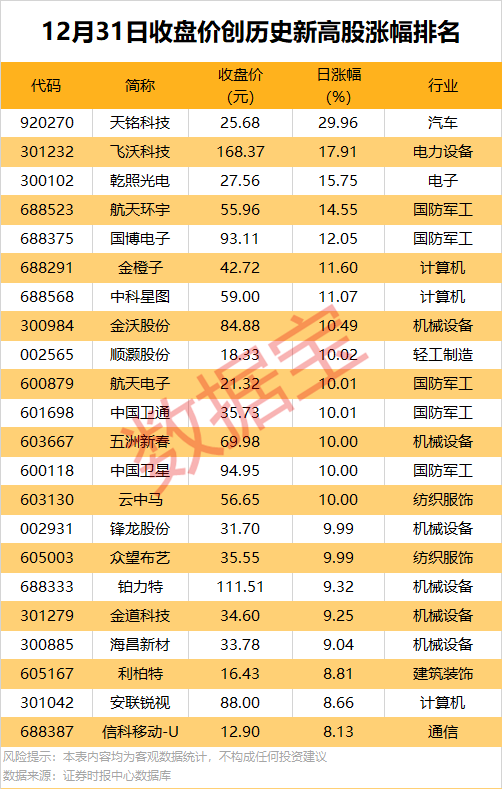
Market Overview - On December 31, A-shares showed mixed performance with the three major indices fluctuating. The total market turnover was 2.07 trillion yuan, a decrease of 956 billion yuan compared to the previous trading day. Over 2,400 stocks closed higher, with 63 stocks hitting the daily limit up [1]. Sector Performance - The Xiaohongshu concept led the market, with stocks like BlueFocus and Wajinke hitting the daily limit up. Other sectors such as military electronics, airport transportation, and Kuaishou also saw gains. In contrast, sectors like chemical fibers, pharmaceutical commerce, and agriculture & forestry experienced significant declines [1]. Historical Highs - A total of 66 stocks reached historical closing highs, excluding newly listed stocks from the past year. The mechanical equipment, defense military, and automotive sectors had a notable concentration of stocks reaching new highs, with 13, 10, and 9 stocks respectively. The average increase for these stocks was 6.51%, with stocks like Tianming Technology and Shunhao Shares hitting the daily limit up [2][3]. Institutional Ratings - Seven stocks received buy ratings from institutions, including Shihai Shares and Guizhou Moutai. The average increase for these rated stocks was 1.62%, outperforming the Shanghai Composite Index. Notably, Baba Foods hit the daily limit up [4][5]. Institutional Trading Activity - This week, institutional trading saw net buying in 38 stocks, with nine stocks having net purchases exceeding 100 million yuan. Wanxiang Qianchao led with a net buy of 289 million yuan, experiencing a 26.19% increase and a turnover rate of 29.81% [6][7]. Net Selling by Institutions - Institutions net sold 48 stocks this week, with Aerospace Development seeing the highest net sell amount of 401 million yuan, despite a 17.22% increase in its stock price [8][9]. Cross-Market Activity - Among the stocks appearing on the institutional trading list, 40 also saw activity from northbound funds. There was a consensus in buying for stocks like Wanxiang Qianchao and China Satellite Communications, while BlueFocus and Shunhao Shares faced net selling from both institutions and northbound funds [10].

内需消费板块或将“结构性崛起”
Sou Hu Cai Jing· 2026-01-02 00:20
Group 1 - The core viewpoint is that the A-share market is expected to continue its upward trend in 2026, shifting from "expected overshoot" to "profit realization" as the main driver of market pricing [2][5] - The investment opportunities are identified in the new productivity sectors (electronics, high-end equipment) and midstream manufacturing and upstream resource products [3][5] - The market structure in 2025 showed a significant divergence, with technology growth stocks leading the way, as the Sci-Tech 50 and ChiNext indices rose nearly 40% and about 50% respectively, outperforming blue-chip indices [4] Group 2 - The investment strategy should focus on sectors with strong profit certainty, moving from a narrative-driven approach to one based on profit verification [5][6] - The consumer sector is expected to experience a "structural rise" rather than a full recovery, with traditional consumption facing challenges despite potential rebounds in valuation [6][7] - The recommendation for asset allocation includes prioritizing new productivity sectors and cyclical products benefiting from PPI recovery, while maintaining low-volatility dividend assets as a base [8]

券商1月金股出炉,科技和周期复苏等受关注
Xin Lang Cai Jing· 2026-01-02 00:12
近期,券商陆续发布1月策略报告,并同步推出1月券商金股。从各大券商的观点来看,大家总体看好 2026年的行情,提示积极布局春季躁动。从板块布局来看,被各大券商提及较多的是科技、消费、周期 复苏和资源板块。券商金股方面,目前有11家券商合计发布了超100多只1月金股,涵盖25个申万行业。 其中,科技股集中营的电子行业,获推荐个股数量最多,达到11只;周期行业的有色金属行业有8只个 股获得推荐;制造行业的机械设备、电力设备行业分别有7只和5只个股。从获推荐次数来看,紫金矿 业、中际旭创、中国中免、中国太保等11只个股获得2家以上券商推荐。紫金矿业、中际旭创最受青 睐,均获得4家券商推荐。以年度涨跌幅、估值统计,有26只金股2025年涨幅低于50%且滚动市盈率低 于30倍。其中,山东路桥、渝农商行、齐鲁银行、中国太保、工商银行、中材国际市盈率较低,均低于 10倍;山东出版、长城汽车、中国广核、海尔智家、中国石化、石头科技2025年股价均收跌。(证券时 报) ...