信息科技

Search documents
AH股市场周度观察(1月第3周)
ZHONGTAI SECURITIES· 2026-01-25 07:55
A-Share Market Insights - The A-share market saw an overall increase, with the CSI 500 and CSI 2000 leading gains at 4.34% and 4.04% respectively, while the Shanghai Composite Index rose by 0.84% and the Shenzhen Component Index by 1.11%[6] - Small-cap value and mid-cap value indices performed well, increasing by 4.43% and 4.36% respectively, while the average daily trading volume was 2.8 trillion yuan, down 19.22% week-on-week[6] - The People's Bank of China announced a 0.25 percentage point cut in relending and rediscount rates effective January 19, 2026, injecting liquidity and lowering financing costs, boosting investor confidence[6] - The first batch of 936 billion yuan in special long-term bonds for equipment upgrades has been allocated, supporting total investments exceeding 460 billion yuan, which is expected to enhance the manufacturing and emerging industries[6] Market Outlook - Despite high market activity, indications of "cooling" suggest a potential for short-term fluctuations, with sectors that have seen significant gains likely facing correction pressures[7] - Industries with improved performance and policy support, such as electricity and equipment upgrades, are expected to continue to outperform[7] Hong Kong Market Insights - The Hong Kong market experienced a downward trend, with the Hang Seng Index falling by 0.36%, the Hang Seng Tech Index by 0.42%, and the Hang Seng China Enterprises Index by 0.65%[8] - The materials, energy, and conglomerates sectors recorded gains of 4.1%, 2.85%, and 2.32% respectively, while the information technology and healthcare sectors faced declines of 2.84% and 2.56%[8] - The market's weakness was influenced by cautious reactions to U.S. tech stocks and profit-taking pressures, alongside geopolitical risks impacting sentiment[8] Future Expectations - The Hong Kong market is expected to experience structural growth supported by expectations of U.S. interest rate cuts and a recovery in A-share sentiment, with AI demand driving tech sector performance[9] - A barbell strategy is recommended for investors, focusing on high-dividend assets to hedge against market volatility while also targeting growth-oriented tech and new consumption sectors[9] Risk Considerations - Risks include potential tightening of global liquidity beyond expectations, increased complexity in market dynamics, and unpredictable policy changes[10]
中采视点 202601222:从顺差看外贸高质量发展
中采咨询· 2026-01-22 08:07
Group 1: Trade Surplus and Economic Transformation - China's trade surplus reached a record high of 1.19 trillion yuan in 2025, a significant increase of 19.8% year-on-year[2] - The manufacturing import-export difference turned positive in 2024, reaching 0.97, while the EPMI index for emerging industries peaked at 5.6[5] - The shift in economic growth drivers is moving from external market reliance to internal innovation and collaboration, enhancing the autonomy and integrity of the industrial chain[1] Group 2: Factors Driving Export Growth - Strong export performance of high-tech and high-value-added products, termed "new quality productivity," is a key driver of external demand competitiveness[6] - Domestic industrial upgrades and accelerated domestic substitution have suppressed some import demand, contributing to the trade surplus[6] - Strategic adjustments in China's export structure have stabilized export shares amidst various pressures[6] Group 3: Emerging Industries and Technological Advancements - Increased investment in basic research and core technology has strengthened the foundation for breakthroughs in emerging industries, enhancing export growth and optimizing export structure[9] - The export profit margins for high-tech products have significantly improved, validating the importance of increasing the value-added rate of exports[7] - The domestic substitution process is accelerating, reducing reliance on foreign technology and equipment, particularly in high-tech sectors[10] Group 4: Export Market Adjustments - China's export share is shifting towards South-South markets, with significant growth in Africa and Latin America since 2020[18] - Despite changes in global trade dynamics, traditional export markets remain crucial, with notable surpluses from Europe and Southeast Asia[20] - The resilience of low-value product exports, supported by flexible export policies, is vital for maintaining market share in developed countries[20]
数智化建“家” 成为职工“幸福密码”
Xin Lang Cai Jing· 2026-01-19 17:09
Core Insights - The article highlights the establishment and success of the "Jianwai i Home" service station, which caters to delivery workers and office employees in the CBD area, providing various amenities and services [4][5]. Group 1: Service Overview - Jianwai i Home is located in a prime area of the Guomao business district, covering an area of 2,000 square meters and offering 24-hour intelligent services through digital technology [5]. - The service station has welcomed over 13,000 visits from workers since its upgrade in July 2024, serving more than 50,000 laborers, including those in new employment forms and outdoor workers [4][5]. Group 2: Features and Offerings - The station features a smart union service that allows members to access services via the Beijing Union 12351 APP, enabling easy entry and service booking [5]. - Jianwai i Home has developed over 20 branded service projects, including AI legal service stations and smart piano rooms, emphasizing public welfare and shared facilities [5]. Group 3: Community Engagement - The station organizes various community activities, such as the "One Hour Lunch Break Energy Station" and festive events, benefiting over 5,000 local workers and fostering a sense of community [5].


FSMOne:港股投资价值吸引 恒指今年目标价30000点
Zhi Tong Cai Jing· 2026-01-07 12:57
Group 1 - The core viewpoint is that the Hang Seng Index's long-term performance will depend on corporate earnings recovery, despite short-term momentum from valuation expansion [1] - The sectors expected to see the highest earnings growth by 2026 are consumer discretionary, materials, and information technology, all of which are above the market average [1] - Liquidity is a crucial factor supporting the performance of Hong Kong stocks, with significant net inflows from mainland investors exceeding HKD 1 trillion last year [1] Group 2 - Despite significant gains in Hong Kong stocks last year, structural investment opportunities remain, particularly driven by the expansion of AI applications and increased market liquidity from northbound capital and IPOs [2] - The target price for the Hang Seng Index in 2026 is projected to be 30,000 points based on a target P/E ratio of 11 times [2] - AI development is expected to continue driving growth in the US stock market, with strong semiconductor sales and high capital expenditure in tech firms supporting overall economic growth [2]
地平线旗下上海科技公司增资至60亿,增幅50%
Sou Hu Cai Jing· 2026-01-05 02:16
Core Insights - Horizon Journey (Shanghai) Technology Co., Ltd. has increased its registered capital from 4 billion RMB to 6 billion RMB, representing a 50% increase [1] Company Overview - The company was established in March 2018 and is legally represented by Yu Kai [1] - Its business scope includes information system integration services, wholesale and retail of computer hardware and software, sales of electronic products, import and export of goods, and technology import and export [1] - The company is wholly owned by Beijing Horizon Robotics Technology Research and Development Co., Ltd. [1]

【金工】核心稳固,边际灵活:增量加速与定价权提升下的南向资金配置格局 ——南向资金跟踪(祁嫣然/陈颖)
光大证券研究· 2025-12-30 23:05
Core Viewpoint - Southbound capital has accelerated its expansion, significantly enhancing market pricing power, with cumulative net inflow exceeding 5 trillion HKD since the launch of the Shanghai-Hong Kong Stock Connect, reaching a record high of 6.27 trillion HKD by November 2025, accounting for 13.05% of the total market capitalization of Hong Kong stocks [4][5]. Group 1: Capital Flow and Market Impact - The pace of capital allocation has notably increased, with net buying in the first three quarters of 2025 surpassing the total for 2024, indicating a rare acceleration in allocation rhythm [4]. - Southbound capital's trading volume has risen to over 50% of the total trading volume in the Hong Kong stock market, reflecting its growing influence [4]. - The behavior of capital allocation has shifted from "sentiment overflow" to "value-driven," with southbound capital transitioning from speculative traders to pricing anchors in the Hong Kong market [4]. Group 2: Long-term Evolution of Southbound Capital Allocation - At the primary industry level, the allocation has evolved from a "finance and real estate-dominated" structure to a diversified structure centered on "finance, technology, and consumption," supplemented by healthcare and utilities [5]. - At the secondary industry level, the investment style has shifted from value-oriented to a growth style dominated by technology and new consumption, incorporating defensive and resource factors [5]. - The consistency between net inflow structure and holding changes reaffirms that southbound capital has matured into a forward-looking and stable long-term allocation force, enhancing its impact on the long-term pricing of Hong Kong stocks [5]. Group 3: Southbound Capital Allocation in 2025 - As of November 30, 2025, cumulative net buying of southbound capital has exceeded 1.38 trillion HKD, with a trading share approaching 50%, becoming a crucial support for liquidity and pricing in the Hong Kong stock market [6]. - Core allocations remain stable, with marginal industry rotations observed; finance and non-essential consumption have been the most stable net inflow lines, while information technology and healthcare have provided flexibility and rebalancing [6]. Group 4: Stock-Level Insights - Incremental capital continues to concentrate on high liquidity and fundamentally sound industry leaders, with a slight decrease in the proportion of the top ten and top fifty holdings, indicating a notable internal rebalancing among core assets [7]. - The annual net inflow reflects a long-term preference for core assets, while monthly levels exhibit tactical flexibility around valuation, events, and sentiment [7]. - In November 2025, despite a mild decline in trading volume, the overall accumulation pace remained high, with a net buying of 121.895 billion HKD, primarily in non-essential consumption and finance [7].

【财经分析】2025年港股市场盘点:IPO募资总额全球第一 估值修复仍有空间
Zhong Guo Jin Rong Xin Xi Wang· 2025-12-29 14:04
Core Viewpoint - The Hong Kong stock market in 2025 has shown a complex picture of capital inflow, sector rotation, and institutional effects, contrasting with previous trends of "valuation collapse and low sentiment" [2] Group 1: IPO Market and Institutional Effects - The IPO market in Hong Kong has significantly rebounded in 2025, with an increase in the proportion of new listings from technology, advanced manufacturing, and biomedicine sectors [3] - Hong Kong's IPO financing amount ranked first globally in 2025, with a total of 274.6 billion HKD raised from 106 companies listed by December 19, showcasing the market's vitality [3] - The implementation of new listing rules and mechanisms has facilitated the listing of 88 biotech and specialized technology companies, reflecting strong investor interest in frontier fields [4] Group 2: Market Dynamics and Valuation Recovery - The Hong Kong stock market has experienced a valuation recovery led by high-growth sectors, with the Hang Seng Index rising approximately 30% in 2025, driven by sentiment and liquidity [5] - The Southbound capital has become the main force in the Hong Kong stock market, with net purchases reaching 1.4 trillion HKD in 2025, surpassing the previous year's total [5][6] - The daily trading volume of Southbound capital has increased from about 25% to around 30% of the main board trading, indicating its growing influence on the market [6] Group 3: Structural Differentiation in Market Performance - The market has shown a structural trend of "new and old momentum switching, and extreme differentiation among industries and stocks," with new economy sectors leading the market [7] - Traditional cyclical industries and high-debt sectors have underperformed, reflecting a defensive rather than growth-oriented nature [8] - The liquidity differentiation between leading and small-cap stocks may lead to rapid valuation recovery for core assets, while small-cap stocks may face liquidity challenges [8] Group 4: Future Outlook and Market Trends - The Hong Kong stock market is expected to continue its structural bull market, transitioning from liquidity-driven valuation recovery to profit improvement and industrial policy resonance [10] - Despite external uncertainties, the market is anticipated to maintain an upward trend, supported by improving corporate earnings and market sentiment [10]

据港交所文件:上海合合信息科技股份有限公司向港交所提交上市申请书。
Xin Lang Cai Jing· 2025-12-29 13:04
Group 1 - The core point of the article is that Shanghai Hehe Information Technology Co., Ltd. has submitted a listing application to the Hong Kong Stock Exchange [1] Group 2 - The company is seeking to go public, indicating potential growth and expansion plans [1] - The submission of the listing application is a significant step in the company's strategy to raise capital [1] - This move may attract investor interest in the technology sector within the Hong Kong market [1]
每日投资策略-20251224
Zhao Yin Guo Ji· 2025-12-24 03:33
Market Performance - Hang Seng Index closed at 25,774, down 0.11% for the day but up 28.49% year-to-date[1] - Shanghai Composite Index closed at 3,920, up 0.07% for the day and 16.95% year-to-date[1] - US Dow Jones closed at 48,442, up 0.16% for the day and 13.86% year-to-date[1] Sector Performance - Hang Seng Financial Index at 49,069, up 0.58% for the day and 39.65% year-to-date[2] - Hang Seng Industrial Index at 13,970, down 0.55% for the day and up 24.18% year-to-date[2] - Hang Seng Real Estate Index at 17,858, up 0.56% for the day and 19.75% year-to-date[2] Capital Flows and Market Trends - Southbound capital net inflow of HKD 611 million, with Alibaba, Meituan, and Zijin Mining as top net buys[3] - A-shares in social services, beauty care, and retail saw the largest declines, while power equipment, building materials, and electronics led gains[3] - Anticipation of a spring market in early 2024, with technology and consumer sectors expected to outperform[3] Economic Indicators - US GDP growth at an annualized rate of 4.3% in Q3, the highest in two years[3] - Core PCE inflation at 2.9%, indicating persistent inflationary pressures[3] - Consumer confidence index declined for the fifth consecutive month, while the job market shows improvement[3]
年终排名进入倒计时!基金冠军提前落定,硬科技成夺冠关键
2 1 Shi Ji Jing Ji Bao Dao· 2025-12-23 11:21
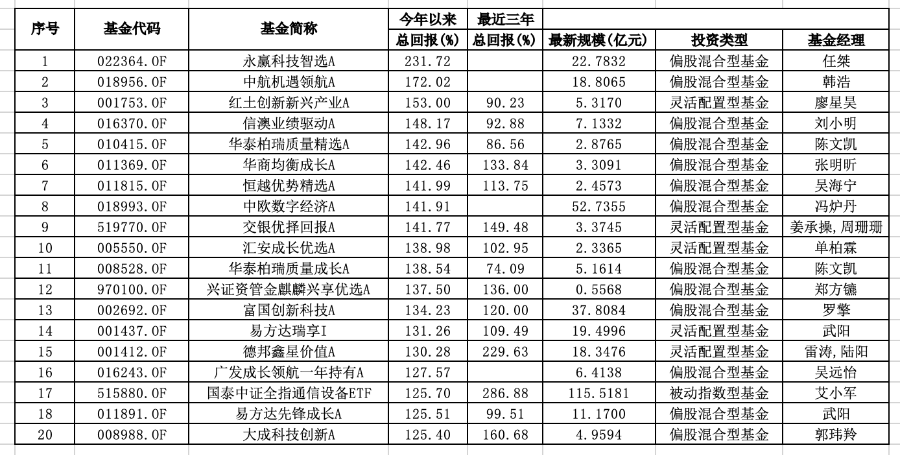
Group 1 - The core viewpoint of the article highlights the strong performance of public funds in the A-share market, particularly in the technology growth sector, driven by advancements in AI and the recovery of the new energy industry [1][3] - Over 90% of actively managed equity funds achieved positive returns this year, with more than 50 funds doubling their net value, led by Yongying Technology Smart A with a remarkable return of 231.72% [1][3] - The market outlook for 2026 remains optimistic, with expectations that AI investment opportunities will continue to expand into new technologies and trends, while the technology sector is anticipated to remain a key market driver [1][7] Group 2 - The top-performing funds this year include Yongying Technology Smart A, which leads with a return of 231.72%, followed by China Aviation Opportunity Leading A at 170.02% and Hongtu Innovation Emerging Industry A at 153.00% [2][3] - The majority of high-performing actively managed equity funds have significant holdings in the technology sector, indicating a strong focus on tech stocks among successful funds [4] - The regulatory framework is shifting towards emphasizing long-term performance, with new guidelines requiring that at least 80% of performance evaluation metrics for fund managers focus on long-term returns [5][6] Group 3 - The market is expected to adopt a more balanced and refined style in 2026, with opportunities in cyclical and consumer sectors as industrial price deflation pressures ease [7][8] - The technology sector is projected to remain a dominant theme, with companies that possess real technological barriers and commercialization capabilities likely to attract market interest [7][8] - The outlook for the bond market suggests narrow fluctuations, with a focus on trading opportunities, while industrial metals and gold are highlighted as key commodities to watch [8]