
钢铁业

Search documents
信用利差周度跟踪20260116:信用债跟随利率下行超长信用二永表现强势-20260117
Huafu Securities· 2026-01-17 14:02
1. Report Industry Investment Rating There is no information provided in the content about the report industry investment rating. 2. Core Viewpoints of the Report - This week, the sentiment of interest - rate bonds was strong with slightly declining yields, and credit bond yields generally followed suit. The 10 - year ultra - long - term credit bonds performed strongly, and the spreads of secondary perpetual (Two - Perpetual, or "Two - Yong") bonds narrowed across the board. The excess spreads of industrial and urban investment perpetual bonds decreased slightly. [3][4] - Vanke's debt extension plan was better than expected, leading to an increase in the secondary prices of its outstanding bonds. However, due to the lack of unexpected industry support policies and the will to ensure rigid payment, the market remains cautious about central and state - owned enterprise real - estate bonds with the "high - debt, high - leverage, and high - turnover" model. It is recommended to maintain a wait - and - see attitude towards real - estate bonds in the short term. [5][40] - After the New Year, the performance of Two - Yong bonds was strong. The growth of dividend - insurance premium income may have increased the demand for ultra - long - term Two - Yong bonds, causing a significant decline in yields. Considering the central bank's strong intention to support the market, there may still be room for the spreads of Two - Yong bonds to compress. [5][40] 3. Summary According to the Table of Contents 3.1 Credit Bonds Follow Interest Rates Downward, Ultra - Long - Term Credit Bonds Perform Strongly - Interest - rate bond yields: The yields of 3Y, 5Y, 7Y, and 10Y China Development Bank bonds decreased by 2BP, 4BP, 3BP, and 1BP respectively, while the 1Y yield increased by 2BP. [3][11] - Credit bond yields: Overall, they followed the decline in interest rates. The yields of 1Y AA+ and above - grade credit bonds remained flat, while those of other grades decreased by 1BP; 3Y AA+ and above - grade yields decreased by 1BP, and other grades decreased by 3 - 4BP; 5Y AA+ grade yields decreased by 5BP, and other grades decreased by 1 - 2BP; 7Y credit bond yields of all grades decreased by 2 - 3BP; 10Y AA+ and above - grade yields decreased by 4 - 5BP, and AA grade decreased by 2BP. [3][11] - Credit spreads: Generally stable, with the 10 - year ultra - long - term credit performing strongly. The spreads of 1Y all grades narrowed by 1 - 2BP; 3Y AA+ and above spreads remained flat, and other grades narrowed by 2 - 3BP; 5Y AA+ spreads narrowed by 2BP, and other grades widened by 1 - 2BP; 7Y AAA spreads remained flat, and other grades widened by 1BP; 10Y AA+ and above spreads narrowed by 3 - 4BP, and AA grade spreads narrowed by 1BP. [3][11] 3.2 Urban Investment Bond Spreads Mostly Decline by 0 - 1BP - By external rating: The credit spreads of external - rated AAA - level urban investment platforms generally remained flat, while those of AA and AA+ levels generally decreased by 1BP. [4][16] - By administrative level: The credit spreads of provincial and municipal - level platforms generally remained flat compared with last week, while those of district - county - level platforms decreased by 1BP. [4][22] 3.3 Industrial Bond Spreads Remain Stable Overall, Vanke's Spreads Compress Significantly - Real - estate bonds: Central - state - owned enterprise real - estate bond spreads widened by 9BP, state - owned enterprise real - estate bond spreads widened by 4BP, mixed - ownership real - estate bond spreads converged significantly by 451BP, and private - enterprise real - estate bond spreads increased by 14BP. Vanke's spreads decreased by 4285BP. [4][27] - Other industrial bonds: AAA - grade coal bond spreads remained flat, and other grades decreased by 1BP; AA+ steel bond spreads decreased by 3BP, and AAA remained flat; the spreads of all grades of chemical bonds remained flat. [4][27] 3.4 Two - Yong Bond Spreads Narrow Across the Board, Yields of Medium - and Long - Term Varieties Decline Significantly - 1Y Two - Yong bonds: Yields of all grades decreased by 1BP, and spreads compressed by 2BP. - 3Y Two - Yong bonds: Yields of all grades decreased by 5 - 6BP, and spreads compressed by 3 - 5BP. - 5Y Two - Yong bonds: Yields of all grades decreased by 5 - 6BP, and spreads compressed by 1 - 2BP. [35] 3.5 Excess Spreads of Industrial and Urban Investment Perpetual Bonds Decrease Slightly - Industrial AAA - grade 3Y perpetual bonds: Excess spreads converged by 0.43BP to 14.41BP, at the 36.98% quantile since 2015. - Industrial 5Y perpetual bonds: Excess spreads remained the same as last week at 13.20BP, at the 32.28% quantile since 2015. - Urban investment AAA - grade 3Y perpetual bonds: Excess spreads decreased by 0.13BP to 4.51BP, at the 3.52% quantile. - Urban investment 5Y perpetual bonds: Excess spreads decreased by 0.79BP to 10.13BP, at the 18.64% quantile. [38] 3.6 Vanke's Extension Plan is Better than Expected, Two - Yong Bond Spreads Still Have Compression Space - Vanke: Its debt extension plan was better than expected, and the secondary prices of its outstanding bonds increased. However, due to the lack of relevant policies, the market is still cautious about central and state - owned enterprise real - estate bonds, and it is recommended to maintain a wait - and - see attitude in the short term. [5][40] - Two - Yong bonds: After the New Year, they performed strongly. The growth of dividend - insurance premium income may have increased the demand for ultra - long - term Two - Yong bonds. Considering the central bank's support, there may still be room for spread compression. [5][40] 3.7 Credit Spread Database Compilation Instructions - Market credit spreads, Two - Yong spreads, and urban investment/industrial perpetual bond spreads are calculated based on ChinaBond medium - and short - term note and ChinaBond perpetual bond data, with historical quantiles starting from the beginning of 2015. - Urban investment and industrial bond - related credit spreads are compiled and statistically analyzed by Huafu Securities Research Institute, with historical quantiles starting from the beginning of 2015. - Sample selection criteria: Industrial and urban investment bonds select medium - term notes and public - offering corporate bonds, excluding guaranteed bonds and perpetual bonds. Bonds with a remaining term of less than 0.5 years or more than 5 years are excluded from the statistical sample. Industrial and urban investment bonds use external entity ratings, while commercial banks use ChinaBond implied debt ratings. [46]

三措并举支持资源型经济转型
Jin Rong Shi Bao· 2026-01-15 02:07
Core Insights - The People's Bank of China, Linfen Branch, focuses on extending the energy industry chain and transforming green transportation, promoting financial resources to empower local economic transformation since 2025 [1] - A total of 103 projects have been pushed to financial institutions, with 23 projects receiving bank credit support amounting to 34.32 billion yuan [1][2] - The initiative includes collaboration between government and financial institutions to enhance communication and support for key projects [2] Group 1: Provincial and Municipal Collaboration - The Linfen Branch of the People's Bank of China, in collaboration with local government offices, has established a working group to analyze the city's industrial transformation and identify financial support directions [1] - Policy briefings and financial demand assessments have been conducted to understand the needs of key projects and enterprises [1][2] - A series of activities have been organized to facilitate communication between government, banks, and enterprises, enhancing collaborative efforts [1] Group 2: Mechanism-Driven Initiatives - An action plan has been developed to support the energy industry chain and green transportation, outlining key support areas and tasks [2] - Two information platforms have been established to maintain a directory of key projects and facilitate financing connections [2] - A credit product library covering the entire industry chain has been created, encouraging financial institutions to innovate and develop tailored financial products [2] Group 3: Enterprise-Specific Policies - Financial institutions are encouraged to follow the financing needs throughout the project lifecycle, providing diverse financing models [3] - Supply chain financing models have been innovated to support small and medium-sized enterprises through credit advantages of core enterprises [3] - Tailored services are provided to address specific financing challenges faced by enterprises, enhancing credit limits and reducing financing costs [3]
年末最后一日,美联储创纪录放水,不到24小时,人民币大涨,压制不住了
Sou Hu Cai Jing· 2026-01-03 16:38
Group 1 - The Federal Reserve injected a historical $74.6 billion into the market, breaking a record set two months prior, yet the dollar weakened instead of strengthening [1] - The offshore RMB exchange rate surpassed 6.97, reaching a nearly 20-month high, while gold prices rose on the first trading day of the new year [1][3] - The market's reaction indicates structural funding pressures within the banking system, as financial institutions faced a market repurchase rate of 3.95% and turned to the Fed's "official pawnshop" for lower-cost funds at 3.75% [3] Group 2 - The RMB's appreciation is supported by a significant current account surplus of $489.8 billion and a goods trade surplus of $726.2 billion in the first three quarters of 2025 [3] - The digital RMB entered its 2.0 era on January 1, 2026, with major state-owned banks offering a 0.05% interest rate on real-name wallet balances, enhancing its savings functionality [5] - The optimization of the CIPS cross-border payment system, with new rules set to be implemented in February 2026, will ease access for foreign institutions, further boosting RMB usage [6] Group 3 - The gold market experienced a historic bull market in 2025, with international gold prices rising over 70% and silver prices increasing by approximately 150% [8] - Central banks globally have purchased over 1,000 tons of gold annually since 2022, making gold the second-largest reserve asset, driven by de-dollarization and geopolitical risk concerns [8] - The Federal Reserve's cumulative rate cuts of 75 basis points in 2025 weakened the dollar's interest rate advantage, directly supporting gold price increases [8] Group 4 - The appreciation of the RMB positively impacted various industries, with the aviation sector benefiting from reduced fuel costs and aircraft leasing expenses, leading to a potential 5% profit increase for major airlines with every 1% RMB appreciation [9] - The paper industry, heavily reliant on imported pulp, could see an 8.8% profit increase with a 2% RMB appreciation [9] - Import-dependent sectors like coal, steel, and chemicals also benefit from lower import costs due to RMB appreciation, with significant savings reported by companies [9] Group 5 - The outbound tourism and high-end consumer markets have rebounded, with outbound travel bookings increasing by 37% week-on-week after the RMB's appreciation, and sales at duty-free shops in Sanya exceeding 420 million yuan during the New Year [11] - A significant portion of the Federal Reserve's $74.6 billion liquidity injection, amounting to $43.1 billion, was directed towards mortgage-backed securities (MBS), indicating short-term financing pressures for MBS holders [11] - Despite the liquidity injection, risk assets like Bitcoin showed muted responses, reflecting the complexity of the current economic cycle [11]

印度出招!对部分钢铁征收最高12%进口税,剑指中国产品
Sou Hu Cai Jing· 2025-12-31 04:22
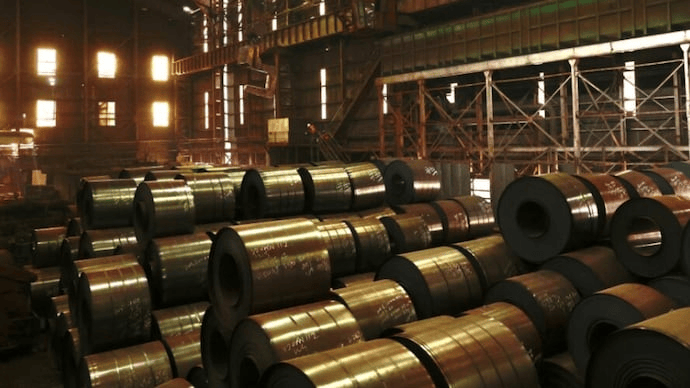
据《今日印度》报道,印度政府周二发布官方公报,宣布对特定钢铁产品征收为期三年的进口关税,首 年税率为12%,第二年降至11.5%,第三年进一步降至11%。该措施主要目的是遏制来自中国的低价钢 铁进口激增,以保护国内钢铁制造业。 印度不锈钢发展协会等行业组织曾多次呼吁政府采取措施。此举也正值全球钢铁贸易紧张之际,美国此 前对进口钢铁加征关税导致部分中国出口转向其他市场,促使包括韩国、越南在内的多个国家加强贸易 防御措施。印度曾在2025年4月至11月间对所有钢铁进口征收12%的临时关税,此次三年期关税可被视 为一项更具针对性和持续性的保护措施。 印度是世界第二大粗钢生产国。印度贸易救济总局在调查后认为,近期来自某些国家的钢铁进口出现 了"突然、急剧且显著"的增长,对国内产业造成并威胁造成严重损害。此次征收的关税适用于来自中 国、越南和尼泊尔的进口,但不包括来自其他一些发展中国家的产品,也不适用于不锈钢等特种钢材。 ...
我国关税调整方案明日起实施 商品影响几何?
Qi Huo Ri Bao· 2025-12-31 00:18
Group 1: Import Tariff Adjustments - The State Council Tariff Commission announced adjustments to import tariffs for steel, coal, non-ferrous metals, cotton, and urea effective January 1, 2026 [1] - The total import quota for cotton in 2026 is set at 894,000 tons, with a low tariff rate of 1% for quota imports [3][4] - The sliding tax mechanism for cotton imports will help stabilize domestic market prices by adjusting costs based on import prices [4] Group 2: Impact on Cotton Industry - The adjustment in cotton planting area in major production regions like Xinjiang is expected to draw significant market attention [4] - The new quota application process allows companies to apply for quotas throughout the year, enhancing flexibility [4] - The focus on stabilizing cotton prices and protecting domestic farmers' interests is emphasized through the sliding tax mechanism [4] Group 3: Steel and Coal Industry - The tariff adjustments for steel and coal products remain largely unchanged from 2025, with zero import tax on recycled steel materials [5][6] - China's crude steel production reached 892 million tons in the first eleven months of the year, accounting for 54% of global output [6] - Steel exports hit a record high of nearly 11 million tons, while imports decreased significantly [6][7] Group 4: Urea and Fertilizer Industry - The import tax rate for urea and other fertilizers remains at 1%, supporting food security and stabilizing agricultural production costs [9][10] - The domestic urea production capacity exceeds 70 million tons, indicating self-sufficiency and minimal reliance on imports [11] - The low tax rate is expected to enhance supply flexibility and stabilize market prices, ensuring agricultural production stability [12] Group 5: Non-Ferrous Metals - The import tariffs for copper and aluminum products remain unchanged, reflecting a strategy to ensure stable raw material supply for domestic industries [14] - The focus is on maintaining supply chain security and supporting high-quality domestic industrial development [14] - The cancellation of temporary tax rates on certain products indicates a shift towards more stable tariff policies [15]
我国关税调整方案明日起实施,影响几何?
Qi Huo Ri Bao· 2025-12-30 23:44
Group 1: Import Tariff Adjustments - The State Council Tariff Commission announced adjustments to import tariffs for steel, coal, non-ferrous metals, cotton, and urea effective January 1, 2026 [1] - The total import quota for cotton in 2026 is set at 894,000 tons, with a general tariff rate of 125% within the quota and a sliding scale tax for imports outside the quota [2][3] - The sliding tax mechanism for cotton aims to stabilize domestic market prices by adjusting import costs based on price fluctuations [3] Group 2: Impact on Cotton Industry - The new cotton import quota system allows for year-round applications, facilitating easier access for companies with previous import records [3] - Adjustments in cotton planting areas in major production regions like Xinjiang are expected to impact market dynamics significantly [3] - The low tariff rate of 1% for urea and other fertilizers is intended to ensure food security and stabilize agricultural production costs [6][7] Group 3: Steel and Coal Market Insights - The tariff adjustments for steel and coal remain largely unchanged from 2025, with zero tariffs on recycled steel materials to encourage imports [4][5] - China's crude steel production reached 892 million tons in the first 11 months of the year, accounting for 54% of global output, with steel exports hitting a record high of nearly 11 million tons [4] - The overall supply-demand balance in the steel market is stable, although there are pressures on raw material supply due to rising iron ore inventories [5] Group 4: Urea and Fertilizer Market Dynamics - The continuation of the 1% low tax rate for urea is seen as a measure to enhance market confidence and prevent price volatility in agricultural inputs [7][9] - Despite the low tax rate, the direct impact on the urea industry is minimal due to sufficient domestic production capacity, with annual output exceeding 70 million tons [8] - The low tax rate policy is expected to improve the supply-demand balance in the urea market, enhancing the industry's resilience to risks [9] Group 5: Non-Ferrous Metals Tariff Stability - The import tariffs for copper and aluminum products remain unchanged, reflecting a strategy focused on stabilizing domestic supply and costs [10] - The unchanged tariffs aim to support domestic smelting and processing enterprises while ensuring supply chain security [10] - The policy shift includes the removal of temporary tariffs on certain products like sulfuric acid, reverting to the most-favored-nation rate [10][11]
碳市场系列研究报告之六:转型金融助力高碳企业低碳发展
Shenwan Hongyuan Securities· 2025-12-30 05:30
Investment Rating - The report does not explicitly state an investment rating for the industry. Core Insights - Transition finance and green finance form an effective complementary structure, with transition finance targeting high carbon-emitting enterprises for their low-carbon transformation through technological upgrades, while green finance focuses on pure green projects [2][9]. - The international development of transition finance is driven by the EU carbon tax policy, entering a rapid development phase since 2023, with a historical progression through three stages: global consensus (2015-2019), framework establishment (2020-2022), and rapid development (2023-present) [2][14]. - China officially proposed the concept of "low-carbon transition" in 2024, with a series of supportive policies following, including the revision of the "Green Industry Guidance Catalog" to focus on low-carbon transition industries [2][17]. - The 14th Five-Year Plan shifts China's energy management from "dual control of energy consumption" to "dual control of carbon emissions," with an estimated demand for green low-carbon investment reaching 487 trillion yuan over the next 30 years, of which 60% is related to low-carbon transition [2][20]. - Mainstream international transition finance products include Sustainable Linked Loans (SLL), Sustainable Linked Bonds (SLB), and transition bonds, with SLL and SLB directly linking financing costs to sustainability goals [2][25]. Summary by Sections Transition Finance vs Green Finance - Transition finance supports high carbon-emitting projects for low-carbon transformation, while green finance supports energy-saving and emission-reducing projects [9][8]. International Development of Transition Finance - The development of international transition finance has progressed through three stages: consensus (2015-2019), framework establishment (2020-2022), and rapid development (2023-present) [14][10]. China's Transition Finance Development - China's transition bonds include transition bonds and low-carbon transition-linked bonds, with the latter dominating in issuance and financing amounts [3][50]. - The issuance of low-carbon transition-linked bonds reached 104, with a net financing amount of 572 billion yuan, while transition bonds totaled 32 with approximately 207 billion yuan [3][50]. - The main issuers of transition bonds have shifted from state-owned enterprises to local state-owned enterprises, with a corresponding decline in credit ratings from AAA to AA [3][72]. Mainstream Products in Transition Finance - The report identifies three main products in transition finance: transition bonds, SLL, and SLB, with specific characteristics and restrictions on fund usage [25][27]. - Transition bonds are specifically allocated for low-carbon transition projects, while SLL and SLB link financing costs to sustainability targets [25][27]. Advantages and Challenges of Transition Bonds - Despite higher costs, transition bonds offer advantages such as expedited review processes, potential government interest subsidies, and flexible interest rate adjustments linked to ESG goals [3][96][94]. - Transition bonds face challenges including higher issuance costs and a shift in issuer credit ratings, impacting their attractiveness compared to traditional corporate bonds [3][84][89].

资讯早班车-2025-12-29-20251229
Bao Cheng Qi Huo· 2025-12-29 02:03
Report Industry Investment Rating No relevant content provided. Core Views of the Report - In 2026, China will continue to implement a more proactive fiscal policy, expand fiscal spending, and optimize the government bond tool portfolio [2][14]. - The profit growth rate of large - scale industrial enterprises from January to November has slowed down, but the growth trend since August continues, and new kinetic energy industries are growing rapidly [2][14]. - The prices of domestic precious metals and base metals have risen collectively, with many varieties hitting new highs, while the price of palladium futures has fallen [3]. - The Baltic countries' natural gas reserves are extremely low, which may lead to supply problems during the cold season [9]. - The acquisition of autumn grains this year is at a record - high level, and the grain output has increased, mainly driven by the increase in corn production [10]. - The bond market is expected to remain volatile by the end of the year, and the direction of the market depends on policies and supply [21][22]. - The A - share market is expected to be a volatile market with structural opportunities, and the cycle sector, especially non - ferrous metals, is expected to continue to rise in 2026 [33][35]. Summary by Directory Macro Data Quick View - In Q3 2025, GDP grew by 4.8% year - on - year, down from 5.2% in the previous quarter [1]. - In November 2025, the manufacturing PMI was 49.2%, up from 49.0% in the previous month but down from 50.3% in the same period last year [1]. - In November 2025, the new social financing scale was 24885.00 billion yuan, compared with 8161.00 billion yuan in the previous month and 23288.00 billion yuan in the same period last year [1]. - In November 2025, CPI increased by 0.7% year - on - year, up from 0.2% in the previous month, and PPI decreased by 2.2% year - on - year, down from - 2.1% in the previous month [1]. - In November 2025, exports increased by 5.9% year - on - year, and imports increased by 1.9% year - on - year [1]. Commodity Investment Reference Comprehensive - The 2026 fiscal work will focus on six key tasks, including boosting consumption, increasing investment in key areas, and promoting employment [2][14]. - From January to November, the total profit of large - scale industrial enterprises was 66268.6 billion yuan, a year - on - year increase of 0.1%, but the profit in November decreased by 13.1% year - on - year [2][14]. - On December 26, 30 domestic commodity varieties had positive basis, and 38 had negative basis [3]. - The prices of domestic precious metals and base metals rose, with platinum futures hitting the daily limit, and palladium futures falling [3]. - The Guangzhou Futures Exchange adjusted the price limit and margin standards for platinum and palladium futures during the New Year's Day holiday [3]. - The London silver market is experiencing a severe physical squeeze, and the silver price may continue to rise [4]. Metals - The price of silver has risen sharply, with the international spot silver price breaking through $82 per ounce [5]. - Gold, silver, and platinum prices hit new highs on December 26, supported by geopolitical risks and a weak dollar [5]. - The price of gold jewelry has exceeded 1400 yuan, and the gold recycling market has shown a "polarized" situation [5]. - Several lithium iron phosphate manufacturers have announced production shutdowns for maintenance due to equipment maintenance and cost pressures [6]. - The CME will raise the margin requirements for gold, silver, and lithium futures after the close on December 29 [6]. - The price of silver has increased by 175% this year, and there are concerns about its impact on industrial development and potential price corrections [6]. - As of December 26, the SPDR Gold Trust's holdings increased by 0.27% to 1071.13 tons [7]. Coal, Coke, Steel, and Minerals - Chile's state - owned copper company and a lithium giant will merge their subsidiaries to develop lithium in the Atacama Salt Flats [8]. Energy and Chemicals - As of December 28, Xinjiang Oilfield's carbon dioxide injection exceeded 1 million tons, marking a key step in the large - scale application of CCUS technology [9]. - The natural gas reserves in the Baltic countries are extremely low, which may cause supply problems during the cold season [9]. Agricultural Products - As of now, the purchase of autumn grains has exceeded 200 million tons, 32 million tons more than the same period last year [10]. - China's grain output in 2025 was 1.43 trillion catties, a year - on - year increase of 1.2%, mainly driven by corn production [10]. - The South American soybean growing area has received good rainfall, which is beneficial to the growth of sown soybeans. The production of Malaysian palm oil from December 1 - 25 decreased by 9.12% month - on - month, and exports increased by 1.6% month - on - month [11]. - The prices of rice and eggs in Japan have reached record highs [11]. Financial News Compilation Open Market - This week, 6227 billion yuan of reverse repurchases will mature in the central bank's open market [12]. - On December 26, the Ministry of Finance and the central bank conducted treasury cash management commercial bank time - deposit tenders, with a total winning amount of 210 billion yuan [12]. - On December 26, the central bank conducted 930 billion yuan of 7 - day reverse repurchase operations, with a net investment of 368 billion yuan [12]. Important News - The 2026 National Two Sessions will be held in March, and the review of the "15th Five - Year Plan" draft is on the agenda of the National People's Congress [13][15]. - The National People's Congress Standing Committee passed a new version of the Foreign Trade Law, which will come into effect on March 1, 2026 [15]. - The central bank released the "China Financial Stability Report (2025)", aiming to maintain financial stability and create a suitable monetary and financial environment [17]. - The central bank will pay close attention to the real estate market and promote its stable and healthy development [18]. - The China National Venture Capital Guidance Fund has been officially launched, focusing on early - stage projects in key areas [18]. - Hainan Free Trade Port has launched the full - island customs closure operation, and relevant policies have achieved initial results [18]. - The central bank and the foreign exchange administration will promote cross - border corporate currency integration funds pool business nationwide [19]. - Hong Kong's economy is expected to maintain a good momentum in 2026 [19]. - The issuance scale of science and technology innovation bonds this year has reached 2.26 trillion yuan [19]. - The first industrial plant REITs project in the inter - institutional market has been listed [19]. - Vanke's second 3.7 billion yuan bond extension plan has not been approved [20]. Bond Market Summary - The inter - bank bond market has warmed up, with most interest - rate bond yields falling and treasury bond futures rising [21]. - In the exchange bond market, Vanke bonds generally rose, while industrial and financial bonds generally fell [22]. - The CSI Convertible Bond Index fell 0.04%, and the Wande Convertible Bond Equal - Weighted Index fell 0.23% [22]. - Most money market interest rates declined, and short - term Shibor rates mostly rose [23]. - Most bank - to - bank repurchase fixed - rate and silver - silver repurchase fixed - rate bonds fell [23][24]. - Most US Treasury yields fell, except for the 30 - year yield [24][25]. Foreign Exchange Market - The on - shore RMB against the US dollar closed at 7.0085, down 19 points from the previous trading day [26]. - The US dollar index rose 0.12%, and major non - US currencies showed mixed performance [26]. Research Report Highlights - In 2025, the bond market was a typical "sideways market", and investors faced challenges in a low - interest - rate environment [27]. - The steel industry may see continued improvement in supply and demand in 2026, and steel bond investment should focus on central and state - owned enterprises [27]. - Since mid - November, long - term bonds, especially ultra - long - term bonds, have been significantly adjusted, possibly due to banks' end - of - year duration constraints [28]. - The risk of systemic default of weak - region urban investment bonds in 2027 is limited, but there are valuation and liquidity risks [29]. - The issuance scale and duration of government bonds have increased this year, and the supply pressure on long - term bonds will remain high in 2026 [29]. - In the medium - to - long - term, the RMB may appreciate moderately in 2026, but one - sided bets should be avoided [29]. - Ultra - long - term bonds have certain allocation value in the long run [30]. Today's Reminders - On December 29, 210 bonds will be listed, 61 bonds will be issued, and 459 bonds will pay principal and interest [31][32]. Stock Market News - In the last three trading days of 2025, the A - share market is expected to be a volatile market with structural opportunities [33]. - In 2025, there were 528 double - digit stocks in the A - share market, mainly AI and merger - concept stocks [33]. - As of December 26, the highest return of public active equity funds reached 236.88%, and 72 funds had returns exceeding 100% [34]. - The A - share private placement market has recovered in 2025, with public and private funds investing over 41 billion yuan and achieving high floating profit ratios [34]. - Since 2025, the enthusiasm of A - share companies to list in Hong Kong has increased, and the "A + H" dual - listing model has seen explosive growth [35]. - The cycle sector, especially non - ferrous metals, has strong growth momentum in 2025 and is expected to continue to rise in 2026 [35].
钼价格|本周钼铁价格涨幅约3%
Xin Lang Cai Jing· 2025-12-26 05:11
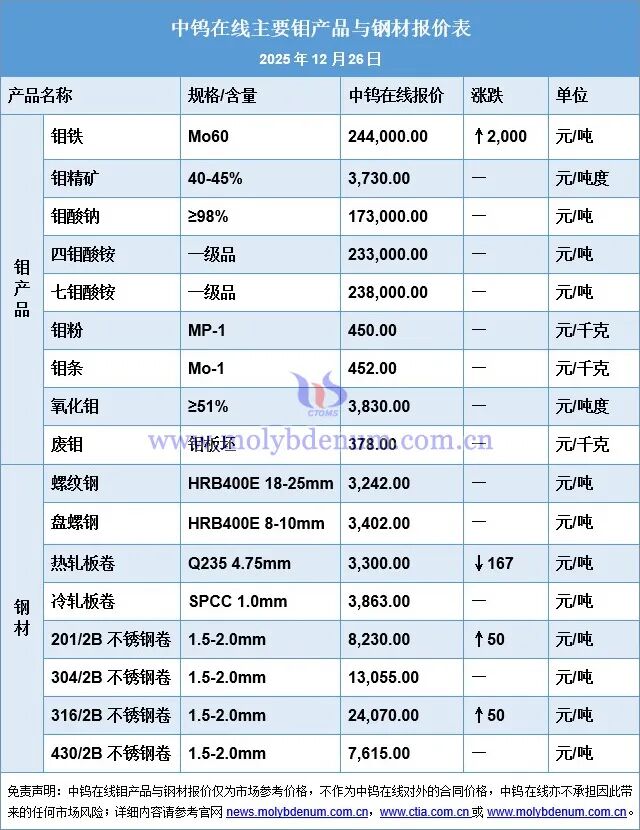
Group 1: Market Overview - The domestic molybdenum market showed a pattern of initial decline followed by recovery during the week, with prices initially continuing the downward trend from the previous week due to a lack of favorable support and a stalemate in negotiations between buyers and sellers [6] - As the weekend approached, rising steel prices, improving international molybdenum market conditions, and a strong willingness among raw material suppliers to hold prices up contributed to increased confidence among intermediate smelting enterprises to raise their quotes [6] Group 2: Price Changes - Molybdenum concentrate prices increased by approximately 10 CNY/ton, reflecting a rise of 0.27%; molybdenum iron prices rose by about 7,000 CNY/ton, with a growth of 2.95%; and molybdenum oxide prices also saw an increase of around 10 CNY/ton, up by 0.26% [2][6] - Molybdenum powder prices decreased by 3 CNY/kg, marking a decline of 0.66%, while prices for sodium molybdate and ammonium heptamolybdate remained stable compared to the previous week [2][6] Group 3: Steel Inventory Data - According to the China Iron and Steel Association, as of mid-December 2025, the inventory of steel products among key statistical steel enterprises reached 16.01 million tons, an increase of 1.26 million tons or 8.6% from the previous period [7] - Compared to the beginning of the year, steel inventory increased by 3.64 million tons, a growth of 29.5%; it also rose by 400,000 tons or 2.6% compared to the same period last month [7] - Year-on-year, the inventory increased by 1.37 million tons, up 9.4%, and compared to the same period two years ago, it rose by 990,000 tons, reflecting a growth of 6.6% [7]
资讯早班车-2025-12-22-20251222
Bao Cheng Qi Huo· 2025-12-22 03:05
1. Report Industry Investment Rating No relevant content provided. 2. Core Views of the Report - The overall operation of China's commodity market in 2025 was stable, with obvious characteristics of new and old kinetic energy conversion. The average value of the China Commodity Price Index was expected to be 112.1 points, a decrease of 0.1% compared to the previous year [4]. - The Chinese bond market showed a positive trend, with the yields of interest - rate bonds declining. The year - end bond market might continue to fluctuate, and the market was cautious about the overall space of the bond market next year [26]. - A - share market entered a critical window for cross - year layout, and structural opportunities would focus on the tracks where policy orientation and industrial prosperity resonated, with the subsequent spring market worth looking forward to [36]. 3. Summary by Directory 3.1 Macro Data Overview - GDP growth in Q3 2025 was 4.8% year - on - year, slightly lower than the previous quarter's 5.2% but higher than the same period last year's 4.6% [1]. - In November 2025, the manufacturing PMI was 49.2%, and the non - manufacturing PMI for business activities was 49.5%, both showing a certain decline [1]. - Social financing scale in November 2025 increased compared to the same period last year, and M0, M1, and M2 growth rates showed different trends [1]. 3.2 Commodity Investment Reference 3.2.1 Comprehensive - Guangzhou Futures Exchange restricted the daily opening volume of lithium carbonate futures contracts [2]. - Dalian Commodity Exchange adjusted the premium and discount of designated delivery warehouses for coking coal futures [2]. - Shanghai International Energy Trading Center planned to revise the standard contract of the Container Shipping Index (European Line) futures [3]. - The Ministry of Commerce launched a final review investigation on anti - dumping measures for imported ethylene - propylene - diene monomer rubber from the US, South Korea, and the EU [3]. 3.2.2 Metals - Platinum prices soared in 2025, with a year - to - date increase of over 110%, far exceeding that of gold [6]. - Gold and silver prices rose under the new round of interest - rate cuts, with silver prices increasing by over 130% this year [6]. - There was an obvious surplus of refined copper in the first ten months of 2025 [6]. 3.2.3 Coal, Coke, Steel, and Minerals - Dalian Commodity Exchange adjusted the premium and discount of designated delivery warehouses for coking coal futures [2][9]. - China's steel consumption in 2025 was expected to be 8.08 billion tons, a year - on - year decrease of 5.4%, and the global steel consumption was expected to be 17.19 billion tons, a year - on - year decrease of 1.8% [9]. - Indonesia proposed to significantly reduce nickel ore production in 2026 [11]. 3.2.4 Energy and Chemicals - Bohai Oilfield's cumulative production of oil and gas equivalent in 2025 exceeded 40 million tons, reaching a record high [12]. - China's energy key projects in 2025 were expected to complete an investment of 3.54 trillion yuan, a year - on - year increase of 11% [12]. - The price of polysilicon increased, but there was a situation of "high price but no market" [13]. 3.2.5 Agricultural Products - Manzhouli Port achieved a "zero breakthrough" in importing Russian agricultural products [15]. - The Philippines extended the import ban on sugar until December 2026 [15]. 3.3 Financial News Compilation 3.3.1 Open Market - This week, 4575 billion yuan of reverse repurchases in the central bank's open market were due, along with 1200 billion yuan of treasury cash fixed - term deposits and 3000 billion yuan of MLF [16]. - On December 19, the central bank conducted 562 billion yuan of 7 - day reverse repurchases and 1000 billion yuan of 14 - day reverse repurchases, with a net investment of 357 billion yuan on that day [16][17]. 3.3.2 Important News and Information - The market generally expected that the LPR in December would remain stable [18]. - The State Council Executive Meeting arranged the implementation of the decisions and deployments of the Central Economic Work Conference [18]. - The General Administration of Market Regulation revised the "Regulations on Prohibiting Monopoly Agreements" [18]. 3.3.3 Bond Market Summary - The yields of interest - rate bonds in the Chinese bond market declined, and the 30 - year active bond "25 Super Long Special Treasury Bond 06" performed prominently [26]. - Most of Vanke's bonds rose in the exchange bond market [26]. 3.3.4 Foreign Exchange Market Express - The on - shore RMB against the US dollar closed at 7.041 on December 22, up 9 basis points from the previous trading day [30]. - The US dollar index rose 0.28% in late New York trading, and most non - US currencies fell [30]. 3.3.5 Research Report Highlights - CITIC Securities believed that the factors driving the RMB appreciation were increasing, and investors should adapt to asset allocation in a RMB - appreciating environment [32]. - CITIC Securities thought that Japan's benign inflation cycle was stable, and the Bank of Japan was about to raise interest rates again [32]. - CITIC Construction Investment considered that the concentrated release of pessimistic sentiment at the end of the year brought potential space for financial bonds [32]. 3.4 Stock Market Important News - A - share market was in a high - level oscillation state near the end of the year, and the Shanghai Composite Index turned positive last week [36]. - As of December 19, the net inflow of subscription and redemption funds of CSI A500 exceeded that of CSI 300 in December, with the net inflow scale exceeding 46 billion yuan [36]. - By December 18, more than 454 listed companies had received institutional research in December, and the hard - tech track became the main focus [37].