
调味品

Search documents
恒顺醋业再跨界,一瓶香醋可乐背后的增长焦虑
Bei Jing Shang Bao· 2026-01-29 12:19
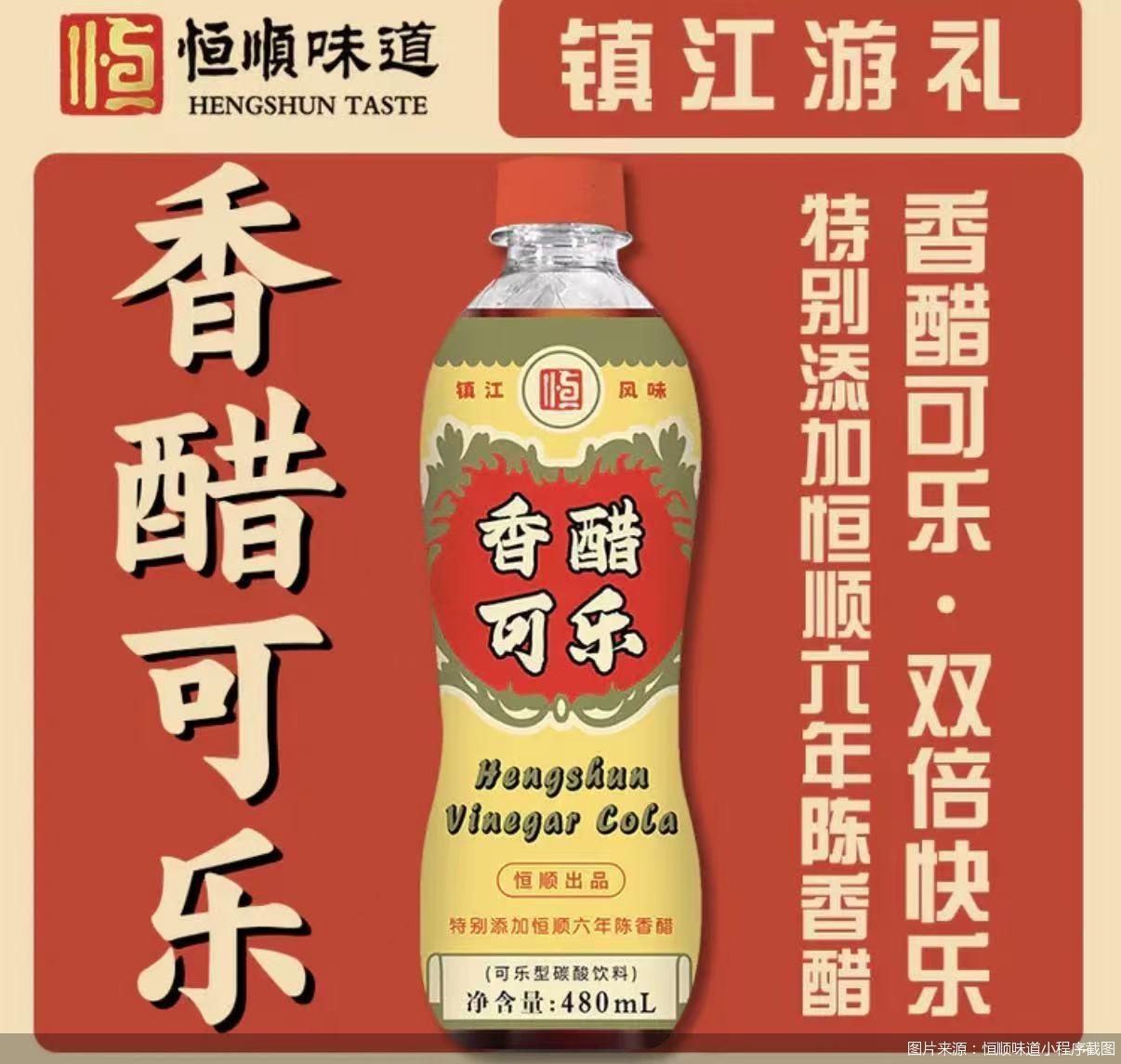
Core Viewpoint - Hengshun Vinegar Industry, known as the "first stock of vinegar," has ventured into the beverage market by launching a vinegar-flavored cola, aiming to attract younger consumers and diversify its product offerings [1][3]. Group 1: Product Launch and Market Reception - The new vinegar cola product is sold in packs of six 480ml bottles for 42 yuan, with 209 units sold as of the report date [3]. - Consumer reactions on social media are mixed, with some finding the taste unusual while others appreciate its uniqueness [3]. - This is not the first time Hengshun has expanded beyond traditional vinegar products; previous launches include a low-calorie sparkling vinegar drink and a series of creative ice creams [3]. Group 2: Company Background and Financial Performance - Hengshun Vinegar Industry, established in 1840 and publicly listed in 2001, primarily focuses on the research, production, and sale of vinegar and other condiments [4]. - The company has experienced fluctuating financial performance, with revenue growth rates of -6.45%, 12.98%, -1.52%, and 4.25% from 2021 to 2024, and net profit growth rates of -62.28%, 16.04%, -37.03%, and 46.54% during the same period [4]. - In the first three quarters of 2025, the company reported revenue of 1.628 billion yuan, a year-on-year increase of 6.3%, and a net profit of 142 million yuan, up 17.98% [4]. Group 3: Market Position and Strategic Direction - Vinegar products consistently account for over 60% of Hengshun's total revenue, but growth in this segment has slowed in recent years [5]. - The company plans to transition from a "vinegar industry" to a "flavor industry," focusing on a comprehensive condiment strategy and developing new products like vinegar beverages and functional products [5]. - The competitive landscape is intensifying, with local brands and major condiment companies increasing their presence in the vinegar market [5]. Group 4: Expert Opinions and Recommendations - Experts suggest that Hengshun's transition to a broader flavor strategy is appropriate, but recommend establishing independent sub-brands for new product categories to maintain the integrity of the main brand [6].


企业要闻丨“相信劲霸,与光同行”2026嘉豪全国销售AP布达会议圆满召开!
Xin Lang Cai Jing· 2026-01-29 12:14
(来源:华宝国际) 以"321战略"为引 以实干为基 春潮涌动处,奋进正当时。日前,"相信劲霸,与光同行"2026嘉豪全国销售AP布达会议在嘉豪中山总部办公大楼五楼会议厅隆重举行。嘉豪食品首席执 行官阙嘉华、首席财务官霍笑翊携销售市场部门管理骨干、中后台关键支持岗位人员齐聚一堂,以"321战略"为引、以实干为基,全面部署新一年发展蓝 图,共商转型攻坚之路,为嘉豪高质量发展凝聚磅礴力量。 阙总强调,过往经验是前行的坚实根基,未知领域更需精进突破,嘉豪将以35个体验中心为重要抓手,携手经销商完成从"卖产品"到"卖解决方案"的转 型,以价值赋能实现共赢发展,秉持"相信劲霸,与光同行"的信念共赴新程! 随后,各部门围绕战略转型目标,依次汇报2025年工作复盘与2026年工作计划,构建起全方位支撑体系。品牌增长部回顾了2025年劲霸市场活动,以借 势"烟火气"行业热潮,通过多元推广实现销量与口碑双丰收。针对2026年行业生态变革,部门将以"用户驱动"为核心,跳出传统竞争模式,通过"用户思 维+共同解决难题"搭建沟通平台,以内容创新打造差异化竞争壁垒。 品类市场部聚焦核心业务,对流通标品、三大服务(机器人酱料、汤底、柔性 ...

中国必选消费品1月价格报告:次高端及以上白酒分化加剧,本期无大众品折扣减小
Haitong Securities International· 2026-01-29 11:28
Investment Rating - The report assigns an "Outperform" rating to multiple companies in the consumer staples sector, including Guizhou Moutai, Wuliangye, Luzhou Laojiao, and others, indicating a positive outlook for these stocks [1]. Core Insights - There is an intensified divergence among mid-to-high-end baijiu products, with no discount contraction observed in food and beverage categories [1]. - The report highlights that the wholesale prices of various baijiu brands have shown stability or slight changes, with some brands experiencing price increases while others remain flat or decrease [3][4][35]. - Discounts on representative products in condiments, liquid milk, and soft drinks have widened compared to the end of December, indicating a shift in pricing strategies [19][32]. Summary by Relevant Sections Baijiu Pricing - Guizhou Moutai's wholesale prices for Feitian (case and single bottle) and Moutai 1935 are reported at 1600, 1580, and 630 yuan respectively, with changes of 0, -10, and -10 yuan compared to last month [35]. - Wuliangye's eighth-generation price is 830 yuan, reflecting a +10 yuan increase from the previous month [35]. - Luzhou Laojiao's Guojiao 1573 remains at 850 yuan, unchanged from last month [35]. Discount Trends - The average discount rate for condiments decreased from 87.1% to 85.0%, while liquid milk discounts fell from 62.8% to 61.4% [19][22]. - In contrast, discounts for beer, infant formula, and convenience foods remained stable, with beer discounts slightly increasing from 80.3% to 80.7% [20][22][32]. Company Ratings - The report lists several companies with an "Outperform" rating, including: - Guizhou Moutai - Wuliangye - Luzhou Laojiao - Qingdao Beer - China Feihe - Others [1].






涪陵榨菜:“菜小智”是由涪陵区主导整合榨菜全产业数据搭建开发的软件平台,非由公司开发
Mei Ri Jing Ji Xin Wen· 2026-01-29 09:08
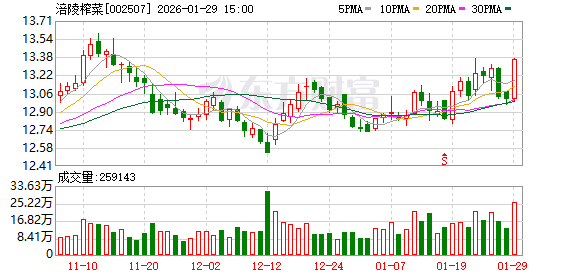
涪陵榨菜(002507.SZ)1月29日在投资者互动平台表示,该智能助手是由涪陵区主导整合榨菜全产业数 据搭建开发的软件平台,非由公司开发。 (文章来源:每日经济新闻) 每经AI快讯,有投资者在投资者互动平台提问:"菜小智"是涪陵榨菜产业大脑的AI助手,是否是贵公司 开发的? ...

ST加加:2025年预计净亏损1.1亿-2亿元,亏损幅度收窄
Xin Lang Cai Jing· 2026-01-29 08:55
Core Viewpoint - ST Jiajia announced an expected net profit attributable to shareholders for the year 2025 ranging from -200 million to -110 million yuan, an improvement from -242.87 million yuan in the same period last year [1] Financial Performance - The expected net profit after deducting non-recurring gains and losses is projected to be between -210 million and -120 million yuan, compared to -265.80 million yuan in the previous year [1] - The reduction in losses is attributed to the company's focus on its core business, market expansion, improved governance, and a decrease in offline advertising expenses, along with a reduction in impairment provisions compared to the previous year [1]

春节旺季备货将成为白酒板块业绩核心催化,消费ETF嘉实(512600)一键囊括消费龙头
Xin Lang Cai Jing· 2026-01-29 05:07
Group 1 - The liquor industry is experiencing a strong rebound, with the major consumption index rising by 1.21% as of 11:24 AM on January 29, 2026, driven by stocks like Hainan Rubber hitting the daily limit and notable increases in Luzhou Laojiao (5.06%) and Gujing Gongjiu (4.06%) [1] - The State Council has initiated measures to boost consumption, emphasizing the implementation of special actions to stimulate consumption and cultivate new growth points in service consumption [1] - According to Kaiyuan Securities, the food and beverage sector is currently at a low point in both fundamentals and valuations, presenting significant investment opportunities [1] Group 2 - The Consumer Price Index (CPI) rose by 0.8% year-on-year in December 2025, indicating a mild recovery trend [1] - The current valuation of the liquor sector is at a low point historically, with market expectations being pessimistic and a favorable chip structure, suggesting a good entry point for investments [1] - The upcoming Spring Festival is expected to catalyze performance in the sector, with particular focus on investment opportunities in the dairy, snacks, and catering supply chain segments [1] Group 3 - The CSI Major Consumption Index includes leading consumer stocks across various sectors, with the top ten stocks accounting for 68.63% of the index, including Yili, Kweichow Moutai, and Wuliangye [1] - The consumption ETF managed by Harvest (512600) tracks the CSI Major Consumption Index, which encompasses essential consumer leaders from various sectors, with liquor being the largest segment at nearly 38% weight [2] - Investors can also access the consumption recovery trend through the consumption ETF linked fund (009180) [3]
一碗糟粕醋,三地共作答:同酿海南“国民味道”
Hai Nan Ri Bao· 2026-01-29 02:42
Core Viewpoint - The Hainan Provincial Two Sessions have initiated a public suggestion collection activity, highlighting the community's enthusiasm for the development of the Hainan Free Trade Port, particularly focusing on the "Wenchang Zhaocai Vinegar" industry [1][2]. Industry Development - The "Wenchang Zhaocai Vinegar" has gained recognition, being included in the government work report for the first time, indicating its growing importance in local culture and economy [1][3]. - The vinegar industry in Wenchang is becoming a significant economic driver, with 98 related restaurants and 9 production enterprises, aiming for an annual production capacity of 30,000 tons and a value of 130 million yuan by 2025 [3][5]. Cultural and Economic Integration - The local government is focusing on cultural excavation and experience upgrades to enhance the vinegar's market appeal, including the establishment of a cultural experience center [4]. - The industry is expected to benefit from standardization and scale, with projections of over 4,000 tons of production and a value of approximately 50 million yuan in Ding'an County by 2025 [5][6]. Collaborative Efforts - There is a push for collaboration among different regions to avoid homogenization and to create a unified brand for the vinegar, with proposals for a provincial-level mechanism to coordinate efforts [8][9]. - The successful application for the "Hainan Zhaocai Vinegar" regional brand demonstrates early collaboration results and sets a precedent for future joint efforts [8]. Expert Recommendations - Experts suggest that Zhaocai Vinegar has the potential to become a cultural symbol for Hainan, advocating for systematic branding and storytelling to enhance its market presence [10][11]. - Recommendations include developing immersive experiences, connecting local culture with global consumers, and creating a narrative that highlights the vinegar's historical and cultural significance [11].
莲花控股股份有限公司 关于2023年股票期权与限制性股票激励计划首次授予部分第二个行权期行权结果暨股份过户登记的公告
Zhong Guo Zheng Quan Bao - Zhong Zheng Wang· 2026-01-28 23:13
Core Viewpoint - The company has approved the conditions for the second exercise period and the second release period of the stock option and restricted stock incentive plan during the board meeting held on October 30, 2025 [11]. Group 1: Decision-Making Process and Disclosure - The company held its ninth board meeting on August 10, 2023, where it approved the draft of the stock option and restricted stock incentive plan, along with related proposals [2]. - The independent directors expressed that the implementation of the incentive plan would enhance corporate governance and employee responsibility, benefiting the company's sustainable development [2]. - The supervisory board also approved the incentive plan, confirming that it would not harm the interests of the company and its shareholders [3]. Group 2: Incentive Plan Details - On September 25, 2023, the company granted 7.95 million stock options and 7.95 million restricted stocks to 74 incentive objects [5]. - The first exercise date for the stock options is set for January 26, 2026, with a total of 1,552,500 shares available for exercise [5][24]. - The second exercise period for the stock options is from September 25, 2025, to September 25, 2026, while the second release period for the restricted stocks is from October 25, 2025, to October 25, 2026 [14]. Group 3: Performance Conditions - The incentive plan includes performance conditions that must be met for the stock options to be exercised, including no adverse audit opinions and meeting specific financial performance targets [15][16]. - The company achieved a revenue of approximately 2.65 billion yuan in 2024, representing a growth rate of 56.73% compared to 2022, allowing for a 100% exercise/release ratio [19]. Group 4: Stock Structure and Financial Impact - The stock used for the exercise comes from shares repurchased by the company, ensuring that the total number of unrestricted shares remains unchanged [23]. - The company received a total of 5,247,450 yuan from 58 incentive objects for the stock option exercise, with no changes to the registered capital or paid-in capital [25].

涪陵榨菜:当前正值青菜头集中采收期,已全面启动收购工作
Cai Jing Wang· 2026-01-28 15:05
Core Viewpoint - Fuling Zhacai (002507) is actively engaging in the procurement of green vegetable heads during the peak harvesting season, aiming to enhance product visibility and strengthen brand image through social media platforms [1] Group 1 - The company has fully initiated its acquisition work for green vegetable heads [1] - Fuling Zhacai is utilizing platforms like Douyin and WeChat to document and showcase the harvesting process through images and short videos [1] - The initiative aims to educate consumers about the entire process from field to product, thereby increasing product exposure [1]
涪陵榨菜:目前建有智能化脆口榨菜生产线
Cai Jing Wang· 2026-01-28 15:05
Core Viewpoint - Fuling Zhacai (002507) is enhancing its production capabilities through the establishment of an intelligent production line and plans to complete a green intelligent production base to ensure standardized product quality [1] Group 1 - The company currently operates an intelligent production line for crispy pickled vegetables [1] - Future completion of the green intelligent production base will significantly improve the overall level of intelligent production [1] - The initiative aims to guarantee standardized quality for its products [1]