
工业

Search documents
元旦新年伊始,无锡市召开新型工业化暨特色优势产业发展大会
Yang Zi Wan Bao Wang· 2026-01-05 05:46
四要以"育"蓄势能,壮大未来产业。编制特色优势产业目录和产业规划,完善针对商业航天、量子科 技、具身智能、脑机接口等"5+X"未来产业的培育推进机制。系统构建先进技术瞭望与培育体系,更好 发挥专业基金对未来产业的比选寻优功能,更好释放优质场景对优质项目的吸引作用,全力争创未来产 业先导区。 会议强调,无锡各级各部门要进一步强化市区联动、部门协同,持续迭代奖补政策"免申即享"等营商环 境政策体系,扎实开展"换位跑一次"活动,全力解决企业经营、产业发展的急难愁盼问题。同时,要更 加尊重保护企业家权益,更加细致关爱企业家健康,丰富优化对企业家的"城市礼遇",让广大企业家在 无锡投资安心、创业顺心、生活舒心。希望广大企业家继续弘扬新时代锡商精神,坚定投资无锡、深耕 无锡、赢在无锡的信心决心。 擦亮新时代工商名城品牌,奏响建设产业科创名城强音。1月4日,2026年第一个工作日,无锡市召开新 型工业化暨特色优势产业发展大会。无锡市委书记杜小刚讲话,市长蒋锋主持并提出具体要求。市领导 许峰、陆志坚等出席。 会议回顾总结了"十四五"以来无锡全市推进新型工业化取得的积极成效和实践认识,明确了今年及未来 五年的工作目标,提出到2 ...
关注新兴成长板块投资机会,成长ETF易方达(159259)标的指数早盘涨超2%
Sou Hu Cai Jing· 2026-01-05 05:11
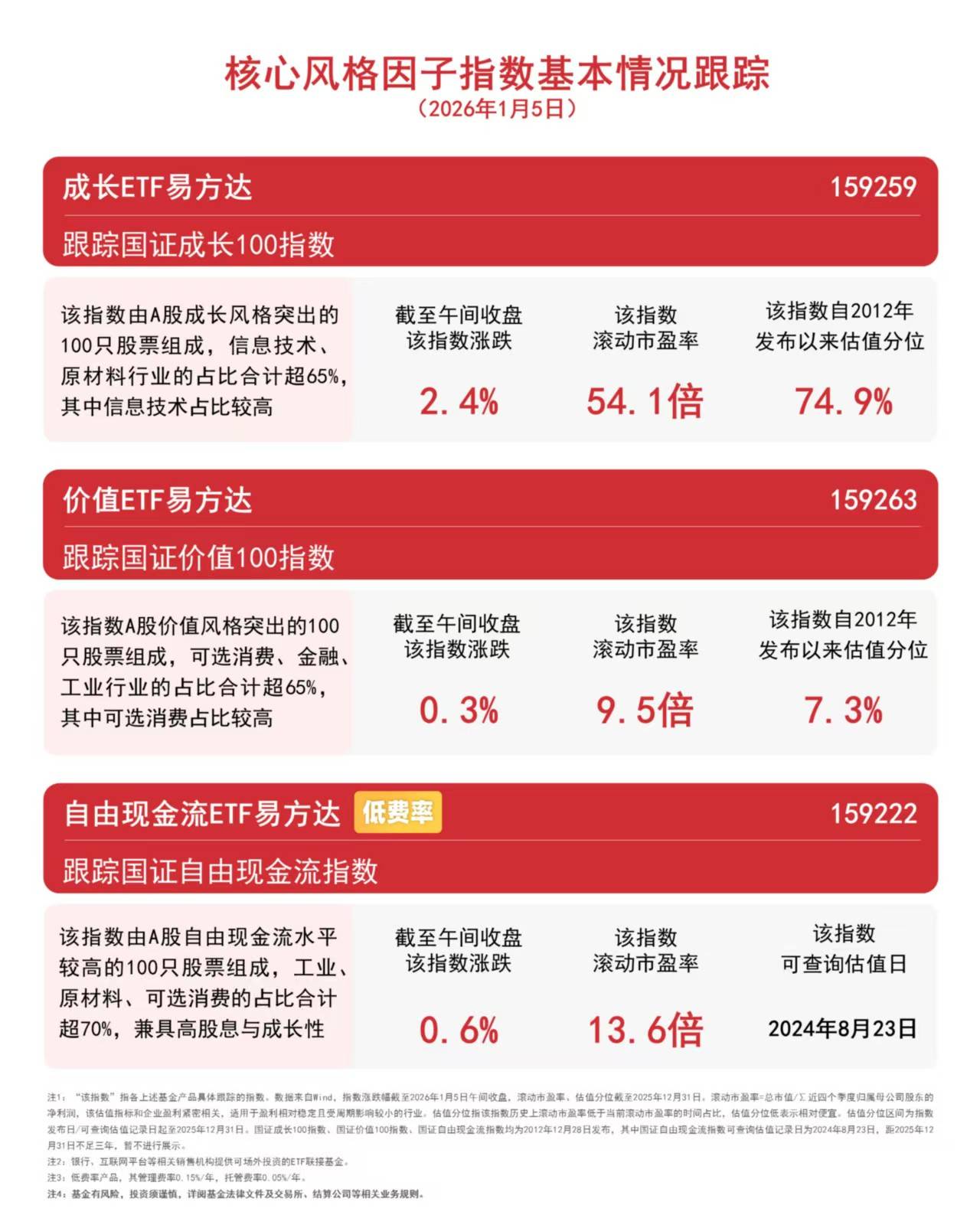
Group 1 - The technology growth sector showed strong performance, with the Guozheng Growth 100 Index rising by 2.4%, the Guozheng Free Cash Flow Index increasing by 0.6%, and the Guozheng Value 100 Index up by 0.3% as of midday close [1] - Huaxi Securities predicts that 2026 will be a significant year due to multiple positive factors, indicating a solid foundation for a bull market, with early signs of spring rally already observed [1] Group 2 - The Guozheng Growth 100 Index consists of 100 stocks with a strong growth style in the A-share market, with over 65% of its composition in the information technology and materials sectors, and a rolling P/E ratio of 54.1 times [3] - The Guozheng Value 100 Index is made up of 100 stocks with a strong value style, with over 65% in consumer discretionary and financial sectors, and a rolling P/E ratio of 9.5 times [3] - The Guozheng Free Cash Flow Index includes 100 stocks with high free cash flow levels, with over 70% in industrial, materials, and consumer discretionary sectors, and a rolling P/E ratio of 13.6 times [4]

“A股四大指数”要来了?
第一财经· 2026-01-05 02:05
Core Viewpoint - The launch of the Sci-Tech Innovation Board Composite Index (Sci-Tech Index) marks a significant development in the A-share market, with the index being considered for inclusion as one of the "four major indices" alongside the Shanghai Composite Index, Shenzhen Component Index, and ChiNext Index, reflecting the growing importance of the Sci-Tech sector in China's economy [3][4][5]. Group 1: Importance of the Sci-Tech Index - The Sci-Tech Index has shown a growth of approximately 48% since its launch on January 20, 2025, and a cumulative increase of 115% since September 24, 2024, indicating strong market performance [3]. - The index has attracted significant interest, with 46 fund managers launching 78 index funds related to the Sci-Tech Index, accumulating a total scale of 27.4 billion yuan [3][12]. - Experts believe that the inclusion of the Sci-Tech Index will enhance the A-share market's index system, providing a comprehensive representation of the technology sector and filling a critical gap in the existing index framework [4][9]. Group 2: Structural Differences and Complementarity - The Sci-Tech Index covers 576 stocks, achieving a coverage rate of 96% within the Sci-Tech Board, while the other major indices have different coverage and industry weightings, creating a complementary relationship among them [7][9]. - The industry weightings reveal that the Sci-Tech Index has a dominant focus on information technology (54.63%), contrasting with the other indices that emphasize traditional sectors or different technology applications [7][8]. - The four indices together create a multi-layered, differentiated core index system for the A-share market, each serving distinct functions and contributing to a collaborative ecosystem [8][9]. Group 3: Investment Logic Shift - The investment logic is shifting from a "profit-oriented" approach to an "innovation-driven" model, reflecting the unique characteristics of hard technology assets that require a different valuation paradigm [10][12]. - Investors are encouraged to focus on long-term growth potential and technological breakthroughs for hard technology assets, while traditional assets should emphasize stable cash flows and dividend capabilities [12][13]. - The Sci-Tech Index's high valuation compared to other indices is not seen as a bubble but rather a reflection of the unique attributes of hard technology investments, which involve high R&D costs and long-term returns [11][12]. Group 4: Future Outlook and Development - The Sci-Tech Index is expected to continue gaining attention and importance in the capital market over the next 3-5 years, with potential to become a global benchmark for China's technological innovation [19]. - Enhancements in the index's composition and governance will be crucial for its global recognition and influence, as well as attracting domestic and international long-term investors [19]. - The index's ability to represent China's "new quality productivity" and its alignment with national strategic directions will further solidify its role as a core asset allocation tool for technology investments [16][18].

国电南自(600268):中标中国水利水电第十六工程局有限公司采购项目,中标金额为168.95万元
Xin Lang Cai Jing· 2026-01-04 13:37
Core Viewpoint - The company Guodian Nanjing Automation Co., Ltd. has won a procurement project from China Water Resources and Hydropower Engineering No. 16 Bureau, with a bid amount of 1.6895 million yuan [1][2]. Group 1: Company Financials - In 2024, Guodian Nanjing Automation's revenue is projected to be 9.03 billion yuan, with a revenue growth rate of 18.46% [3]. - The net profit attributable to the parent company for 2024 is expected to be 341 million yuan, reflecting a net profit growth rate of 50.14% [3]. - The return on equity (ROE) is estimated at 10.50% for 2024 [3]. - For the first half of 2025, the company reported a revenue of 4.282 billion yuan, with a revenue growth rate of 25.23% [3]. - The net profit attributable to the parent company for the first half of 2025 is projected to be 159 million yuan, showing a significant net profit growth rate of 197.03% [3]. Group 2: Product Composition - The company operates in the industrial sector, primarily focusing on relay protection and dispatch automation [3]. - The main product composition for 2024 includes: - Power grid protection and automation products: 42.37% - System integration center business: 22.19% - Power plant automation products: 13.04% - Information technology business: 6.37% - Railway automation protection products: 4.3% - Hydropower automation products: 3.75% - Intelligent primary equipment products: 2.87% - Information security products: 2.71% - Energy-saving and emission reduction products: 1.92% - Other businesses: 0.38% - Others: 0.1% [2][3].

昆明工业“标准地”出让率超七成
Xin Lang Cai Jing· 2026-01-03 22:20
企业竞得土地后,与属地政府或管委会签订"标准地"投资建设监管协议,明确各项指标与履约责任。在 此基础上,实行承诺制审批,企业签订"标准地"使用承诺书并公开后,审批部门即予办理,推动管理 从"重审批"向"重服务、重监管"转变。昆明高新区、安宁产业园区实践显示,该模式可为企业缩短约15 —30个工作日的审批时间,实现"拿地即交证"。 本报讯 记者徐晓俊报道 据昆明市自然资源和规划局最新数据,2025年1月至11月,全市工业用地出让 中"标准地"出让49宗,面积2545.369亩,出让比率达74%。 2023年,昆明市自然资源和规划局会同有关部门印发《昆明市工业项目"标准地"改革实施方案》,在全 市19个省级以上工业园区全面推行工业"标准地"改革,旨在加快项目落地、实现"早开工、早建成、早 投产"。改革通过流程再造与机制创新,构建了贯穿项目全周期的服务体系,昆明市工业用地"标准 地"出让数量和面积连续三年居全省前列。 在土地出让前,政府统一组织开展地质灾害危险性评估、环境影响评价等11项区域性评估,变"企业单 个项目付费"为"政府统一打包买单"。符合区域产业定位的项目可直接应用评估成果,实现"一次评估、 成果共享" ...
厦门最新出台!25条措施真金白银助企惠民
Xin Lang Cai Jing· 2026-01-02 05:02
Group 1: Core Initiatives - Xiamen has launched a series of measures to boost economic growth in the first quarter of 2026, focusing on consumption, investment, and support for various sectors [1][2] - The measures include 25 specific actions aimed at stabilizing and improving the economy, aligning with national and local economic policies [2][4] Group 2: Consumer Promotion - A total of 10 million yuan will be allocated for consumer promotion activities in the first quarter, including over 100 events focused on automobiles, home appliances, and clothing [5] - The city plans to implement a consumption upgrade program, encouraging the replacement of old consumer goods with new ones, and optimizing subsidy processes to enhance consumer experience [5] Group 3: Support for the Real Economy - Financial incentives will be provided to districts that excel in industrial electricity consumption, investment, and value-added output, with rewards of up to 400,000 yuan [6][7] - The government aims to enhance the development of the wholesale and retail sectors through financial support and incentives for businesses transitioning to higher operational standards [7] Group 4: Investment Expansion - The scale of the technology innovation fund will increase from 50 billion yuan to 60 billion yuan starting in 2026, broadening the scope of supported industrial projects [10] - Key infrastructure projects, including the Xiamen-Zhangzhou-Quanzhou intercity railway and Xiamen Xiang'an International Airport, are prioritized for expedited implementation [10][11] Group 5: Foreign Trade and Investment - Measures to support foreign trade enterprises include financial assistance for market expansion in emerging markets and incentives for cross-border e-commerce [11][12] - The city aims to simplify foreign debt registration processes and enhance financing options for high-tech and specialized small and medium-sized enterprises [12] Group 6: Agricultural Production and Employment - The government has set a target for spring grain planting across 16,200 acres and aims to stabilize production of key agricultural products [12] - Employment services will be strengthened, with plans for over 200 recruitment events and financial incentives for companies hiring new workers [13]

2025年度创业板排行榜
Wind万得· 2026-01-01 22:38
1.2 总市值变动 2025年 度 末, 创业板总市值为17.83万亿元,较2024年末增长43.0%,增幅高于沪深证主板。 1.3 成交额对比 2 025年 度 创业板总成交额达114.22万亿元,单只个股平均成交额819.97亿元,高于上证主板、科创板和北证A股。 | | | 各板块平均成交额对比 | | | --- | --- | --- | --- | | 板块 | 个股数量 | 期间总成交额 (万亿元) | 平均成交额 (亿元) | | 深证主板 | 1490 | 127.09 | 852.93 | | 创业板 | 1393 | 114.22 | 819.97 | | 上证主板 | 1699 | 134.28 | 790.33 | | 科创板 | 600 | 37.79 | 629.82 | | 北证A股 | 288 | 6.49 | 225.23 | | 数据来源: Wind | | | | 1.4 日均换手率对比 市场板块篇 1.1 50指数涨跌对比 2025年 度创业板50指数大涨57.45%,强于各板块50指数。 1.6 市净率对比 2 025年 度 末, 创业板市净率为4.35倍,高于沪深 ...

中山交出“十四五”发展答卷 预计2025年GDP将突破4200亿元
Xin Lang Cai Jing· 2026-01-01 00:18
Core Insights - The "14th Five-Year Plan" period has seen significant economic and social development in Zhongshan, with GDP expected to exceed 420 billion yuan by 2025, and a total of 740,000 business entities, marking a 60% increase over five years [2][3] - Zhongshan is actively integrating into the Guangdong-Hong Kong-Macao Greater Bay Area, enhancing its strategic advantages and infrastructure [3][4] Economic Development - Zhongshan's GDP has crossed the thresholds of 350 billion and 400 billion yuan, with a projected growth to over 420 billion yuan by 2025 [2] - The number of business entities has increased to 740,000, reflecting a 60% growth over five years [2] - The total scale of the ten major industrial clusters has surpassed 700 billion yuan, with industrial investment expected to double by 2024 compared to 2021 [2] Infrastructure and Transportation - The completion of the Shenzhen-Zhongshan Link has resulted in an average daily traffic of 88,000 vehicles and over 200,000 passengers, facilitating regional connectivity [4] - Zhongshan has established five new air and cross-city bus routes, serving over 4.8 million passengers [4] - The city has constructed seven expressways and 21 trunk roads, achieving a road network density of over 18 kilometers per 100 square kilometers, ranking among the top in the province [4] Industrial Transformation - Zhongshan has launched 87 new policies since 2022 to address land inefficiencies, resulting in the reclamation of over 52,000 acres of low-efficiency industrial land [5] - The city has built over 23 million square meters of factory space, with a utilization rate exceeding 83%, and attracted investments exceeding 200 billion yuan [5] - R&D expenditure has consistently exceeded 10 billion yuan for three consecutive years, with a growth rate of over 20% for two years [6] Social Development - Zhongshan has implemented the "High-Quality Development Project" to enhance urban-rural coordination, with 12 towns ranked among the top 500 in national economic performance [7] - The income disparity between urban and rural areas has narrowed to a ratio of 1.4:1, maintaining the best record in the province for 11 consecutive years [7] - The city has improved living conditions by renovating over 60,000 rural houses and achieving 100% compliance with provincial standards for beautiful and livable villages [7] Public Services and Safety - Zhongshan has developed a comprehensive social governance system, successfully creating a modernized city governance model [8] - The city has added 289,000 urban jobs and introduced the "Mom Job" employment model, which has been promoted nationwide [8] - Educational and healthcare services have been enhanced, with the addition of 120,000 public school places and several new hospitals [8]

2025年度中资企业IPO排行榜
Wind万得· 2025-12-31 22:50
2025年,中资企业全球IPO市场显著回暖,发行数量与募资规模双双实现大幅增长。全年共有290家中资企业在全球主要资本市场完成上市,较2024年增 加61家;累计募资规模达3663.55亿元,同比大幅增长123.04%。从市场结构看,港股已成为中资企业最主要的融资平台,募资规模显著领先;A股市场 IPO节奏回暖,融资功能明显修复;海外市场发行数量保持稳定,但募资规模有所回落。整体来看,2025年中资企业IPO呈现数量回升、结构优化、港股 领跑的显著特征。 中资企业上市全景 1.1 中资企业全球IPO数量 Wind数据显示,2025年,中资企业全球市场共完成IPO上市290起(A股按网上发行日期,港股及美股市场按首发上市日期,下同),数量较2024年上升 61起。 1.2 中资企业全球IPO募资金额 2025年,中资企业全球IPO募资规模合计约3663.55亿元(人民币,下同),较2024年回升123.04%。 1.3 中资企业分市场 IPO 数量 2025 年,具体到各市场来看, A 股市场 IPO 上市 112 起,较 2024 年上升 10 起;港股市场 IPO 上市 110 起,较 2024 年上升 4 ...

智利希望将印度拓展为仅次于中国和美国的第三大贸易伙伴
Shang Wu Bu Wang Zhan· 2025-12-30 17:25
Core Viewpoint - Chile aims to expand India as its third-largest trading partner, following China and the United States, through enhanced economic cooperation and negotiations on the Comprehensive Economic Partnership Agreement (CEPA) [1] Group 1: Economic Cooperation - The recent fourth round of CEPA negotiations between Chile and India highlights both countries' commitment to deepening economic integration [1] - Future collaboration is expected to focus on sustainable development, food security, health, and energy sectors [1] Group 2: Challenges in Market Entry - Chilean fruits face three main challenges in entering the Indian market: 1. India does not automatically adopt international food safety standards, and its maximum residue limits are significantly low [1] 2. India does not accept Chilean phytosanitary technologies [1] 3. There is insufficient cold chain logistics for air and sea transport, necessitating the establishment of an efficient cold chain system within India [1]