锂电

Search documents
2026年第7周:跨境出海周度市场观察
艾瑞咨询· 2026-02-24 00:01
Industry Environment - The automotive industry is entering a new phase of "systematic overseas expansion," with the release of the "Automotive Data Export Security Guidelines (2026 Edition)" aimed at establishing a convenient mechanism for cross-border data flow and reducing risks [3][4] - China's gaming industry is experiencing significant growth in overseas revenue, projected to reach $20.455 billion by 2025, driven by cultural empowerment and the success of traditional cultural IPs [5] - The lithium battery industry is showing signs of recovery, with technological innovations and overseas expansion driving growth, as companies like CATL explore new applications and markets [6] - Uzbekistan is emerging as an attractive investment destination for Chinese companies due to its rich natural resources and favorable economic policies, with a projected GDP growth rate of 7.7% by 2025 [7] - The Chinese energy storage battery sector is seeing a surge in overseas orders, particularly in Africa, where demand for renewable energy solutions is high [9] - Chinese humanoid robot companies are accelerating their global expansion, leveraging a mature domestic supply chain and exploring various international markets [10] - The Chinese film and television industry is transitioning from "single hit" productions to a more systematic approach, with significant growth in international viewership [11] - The global Z generation is expected to become the largest consumer group by 2026, influencing the overseas strategies of Chinese brands [12][13] - The cross-border e-commerce sector is facing challenges such as tariff impacts and rising costs, with a projected growth rate of 8.8% in 2025 [14] Key Brand Dynamics - JD.com is testing its European online retail brand Joybuy in the UK, focusing on categories like baby products and toys, while enhancing its logistics network [15] - Airwallex has completed a $330 million Series G funding round, enhancing its capabilities in cross-border payments and financial services [16] - Chinese beauty brand Maogeping is looking to replicate the success of Pop Mart in the Hong Kong market, focusing on cultural uniqueness and high-end positioning [17] - Southeast Asia's market is shifting towards brand value, with TikTok Shop showing significant growth, prompting brands to adapt their strategies [18] - Chinese consumer brands are rapidly expanding overseas, with KKV and others opening numerous stores in Singapore, emphasizing quality and experience [20] - Anta Sports has acquired a 29.06% stake in PUMA for approximately $12.278 billion, aiming to revitalize the brand amid its recent struggles [21] - The integration of traditional Chinese medicine with technology is driving new paradigms for cultural export, as seen in the global tour of the "Early Sleep Doll" IP [22] - Mixue Ice Cream is expanding internationally with a low-price strategy, significantly increasing its overseas store count and outperforming competitors [23][24] - Xiangpiaopiao is undergoing a strategic transformation to address declining profits, focusing on ready-to-drink products and international expansion [25] - Chengdu's humanoid robot "Deng Ba" is set to enter the global market, showcasing advanced technology and a comprehensive ecosystem [26] - The outdoor equipment market is growing, with Le Xin Outdoor planning to list on the Hong Kong Stock Exchange, capitalizing on the rising male consumer segment [27]


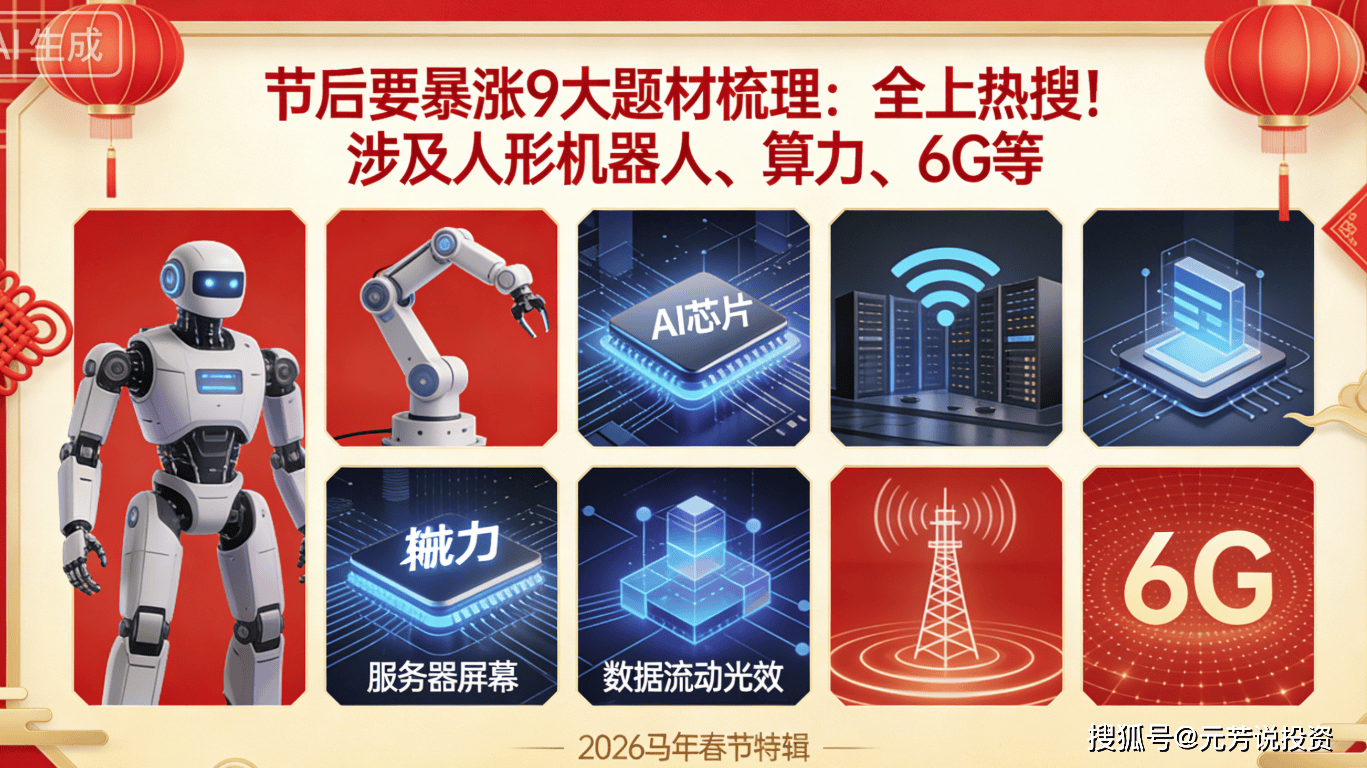
节后要暴涨9大题材梳理:全上热搜!涉及人形机器人、算力、6G
Sou Hu Cai Jing· 2026-02-23 16:20
Group 1: Market Overview - The first trading day of the A-share market in the Year of the Horse is expected to open high, supported by overseas market performance and major themes such as humanoid robots and AI models [2][4] - During the Spring Festival, the Hong Kong stock market rose nearly 1%, and the FTSE A50 index increased by 1.6% [2] Group 2: Humanoid Robots - Humanoid robots made a significant appearance during the Spring Festival Gala, showcasing their capabilities and benefiting the related industry chain [4][5] - Notable companies include Magic Atom, Galaxy General, and Yushu Robotics, which demonstrated advanced robotic performances [4][5] - The demand for these robots surged, with products selling out quickly on platforms like JD.com [6] Group 3: AI Models - The stocks of AI model companies such as Zhipu and MiniMax saw significant increases, with Zhipu's stock price rising nearly 43% and MiniMax's by about 15% [7][9] - Zhipu's new flagship model GLM-5 has achieved high performance in programming tasks, leading to increased user demand and computational power needs [11] Group 4: Autonomous Driving - Tesla's Cybercab, a fully autonomous electric vehicle, has begun production, marking a significant step in the commercialization of autonomous driving [12][13] - Data shows that Tesla's Full Self-Driving (FSD) system has a significantly higher mileage before accidents compared to other driving modes [13] Group 5: 6G Technology - Chinese scientists have made breakthroughs in optical communication and 6G technology, achieving record data transmission rates [14][15] - This advancement is expected to enhance China's capabilities in the semiconductor field and reduce reliance on foreign technology [15] Group 6: Lithium Industry - UBS has expressed a bullish outlook on the lithium market, predicting a 14% increase in global lithium demand by 2026, driven by electric vehicle sales and energy storage systems [16][17] - The report indicates a significant price increase for lithium products, forecasting a new super cycle in lithium prices [16] Group 7: Alcohol Industry - The Chinese government aims to cultivate at least 10 billion-level specialty brewing industrial parks by 2028, promoting growth in the alcohol industry [19][20] - This initiative is expected to benefit related listed companies in the alcohol sector [21][22] Group 8: AI in Healthcare - A research team has developed an AI system capable of diagnosing rare diseases, showing improved accuracy compared to previous models [23][24] - This innovation is anticipated to benefit companies involved in AI and healthcare [24] Group 9: AI Hardware - Companies in the AI hardware sector, particularly those producing AI optical modules, are experiencing high demand, with orders extending into 2026 [25][26] - The growth in AI capital expenditure from major tech companies is expected to benefit these hardware manufacturers [27][28]

锂电需求爆发,瑞银唱多:市场已进入第三次锂价超级周期
DT新材料· 2026-02-23 16:05
Group 1 - UBS reports that the electric vehicle (EV) industry is nearing a "triple balance" in terms of cost, range, and charging time, indicating a significant turning point for the sector [1] - The total cost of a single battery has decreased to $55 per kWh, nearly a 50% reduction since 2020, with manufacturing costs expected to decline by about 10% annually [1] - UBS predicts that by 2030, Chinese automakers could capture approximately 35% of the global EV market share due to lower battery costs [1] Group 2 - Global lithium demand is expected to grow by 14% in 2026 and 16% in 2027, driven by a rebound in EV sales and accelerated investment in battery energy storage systems (BESS) [2] - UBS has significantly raised its lithium price forecasts, with spodumene prices increased by 74% to $3,131 per ton and lithium carbonate to $26,000 per ton, predicting global lithium demand will double to 3.4 million tons by 2030 [2] - The lithium industry is entering a third super cycle, with 51 out of 71 A-share lithium companies reporting year-on-year profit growth [2][3] Group 3 - Major lithium companies like Tianqi Lithium and Ganfeng Lithium are expected to return to profitability in 2025, with Ganfeng projected to earn between 1.1 billion to 1.65 billion yuan [3] - The global energy storage sector is entering a new growth cycle, with an expected 62% increase in new installations to 438 GWh by 2026 [3] - Supply-side dynamics indicate that global lithium resource increments are characterized by frequent short-term disruptions and limited long-term growth [3]




锂电1月洞察:动储收官迎新高,碳酸锂趋势反转
SINOLINK SECURITIES· 2026-02-23 10:45
Investment Rating - The report maintains a "Buy" rating for the electric power equipment and new energy industry [1] Core Insights - The lithium battery sector is experiencing a price surge, with lithium carbonate prices rising to 170,000 CNY/ton, a 42% increase from the previous month, and lithium hydroxide prices increasing by 62% to 165,000 CNY/ton [1] - In December, the wholesale sales of domestic new energy passenger vehicles reached 1.42 million units, with a year-on-year increase of 26% for the entire year [1] - The report highlights a reversal in the lithium carbonate cycle, driven by domestic energy storage capacity subsidy policies and the explosive growth of global new energy demand [3][32] Summary by Sections Section 1: Research Insights - The lithium carbonate market is at a cyclical turning point, with prices expected to rise significantly, impacting the entire lithium battery supply chain [14][15] - Sodium batteries are emerging as a cost-effective alternative, with a clear long-term cost advantage over lithium iron phosphate batteries [26][30] Section 2: Industry Tracking and Review - The global new energy vehicle market showed strong growth in December, particularly in China and Europe, while the U.S. market faced challenges [34][36] - In December, domestic energy storage installations reached 63 GWh, a 95% year-on-year increase, indicating a shift towards market-driven growth [40] Section 3: Investment Recommendations - The report recommends focusing on companies involved in lithium carbonate, separators, and solid-state battery technologies, including Ningde Times, Yiwei Lithium Energy, and others [7][32]




港股收盘 | 三大指数集体回暖均涨超2% AI主线出现分化行情
Xin Lang Cai Jing· 2026-02-23 09:41
Market Performance - The Hong Kong stock market showed a positive sentiment today, with all three major indices rising collectively. The Hang Seng Index increased by 2.53% to close at 27,081.91 points, the Hang Seng Tech Index rose by 3.34% to 5,385.35 points, and the China Enterprises Index gained 2.65% to finish at 9,197.38 points [2] - During the Spring Festival period, the Hang Seng Index accumulated a nearly 2% increase over three trading days [3] Sector Performance - In terms of sector performance, gold, non-ferrous metals, lithium batteries, and computing hardware concepts saw significant gains, while tourism, film, and paper stocks declined [3] - Notable stocks in the computing hardware sector included Changfei Optical Fiber, which surged over 14%, InnoCare, which rose by over 10%, and SMIC, which increased by approximately 5% [3] Gold Stocks - Gold stocks experienced a boost due to geopolitical risks, with Tongguan Gold rising by 12.58%, Chifeng Gold increasing by 7.96%, and Zijin Gold International gaining 6.82% [5] - The price of gold has surged, with spot and futures prices rising significantly, and gold prices have surpassed $5,100 [6] Lithium Battery Sector - The lithium battery sector received positive outlooks from institutions, with Ruipu Lanjun rising by 15.42%, Zhongchuang Innovation rising by 7.35%, and Zhengli New Energy increasing by 4.52% [7] - Reports from major investment research institutions highlighted a strong demand for lithium driven by the electric vehicle market and global energy storage needs, leading to an upward revision of expectations for key Chinese lithium companies [7] Individual Stock Movements - Zhihui experienced a significant decline of 22.76% following an apology letter regarding a revision of its GLM Coding Plan [8] - Zhejiang Shibao saw a rise of nearly 20% amid speculation in the autonomous driving sector, following Tesla's announcement of the first Cybercab rolling off the production line [8]


港股收评:恒指涨2.53% 科技股、芯片股全天强势 机器人、AI概念回落 有色金属走强
Jin Rong Jie· 2026-02-23 09:04
Market Performance - The three major indices experienced significant gains, with the Hang Seng Index rising by 2.53%, the Hang Seng China Enterprises Index increasing by 2.65%, and the Hang Seng Tech Index climbing by 3.34% [1] - A total of 83 stocks in the Hang Seng Index rose, while only 5 declined, indicating a strong market performance [2] Sector Highlights - Technology stocks saw widespread gains, with Meituan up over 5%, Alibaba and Xiaomi rising over 3%, and Tencent and JD.com increasing over 2% [1] - Semiconductor and AI chip stocks performed well, with InnoLight Technology and Wall Street Technology both rising over 9%, and Huahong Semiconductor and SMIC increasing by more than 4% [1] - The optical communication sector also showed strength, with Longi Green Energy rising by 14% and Cambridge Technology increasing by over 5% [1] Resource and Automotive Stocks - Gold, resource, and non-ferrous metal stocks gained traction, with Tongguan Gold rising over 12%, Ganfeng Lithium increasing by over 8%, and Zijin Mining rising over 5% [1] - Autonomous driving stocks surged, with Zhejiang Shibao increasing nearly 20%, and automotive stocks also performed well, with NIO rising over 5%, BYD increasing over 3%, and Li Auto rising over 4% [1] Declines in Specific Sectors - AI large model and robotics stocks faced declines, with Zhipu Technology dropping over 22%, Haizhi Technology Group falling over 21%, and MINIMAX-WP decreasing over 13% [1] - Consumer stocks showed weakness, with leading duty-free retailer China Duty Free Group declining over 8% and Mixue Group falling over 1% [1] Trading Volume - Tencent Holdings had a trading volume of HKD 11.883 billion, rising by 3.1%; Alibaba-W had a trading volume of HKD 6.820 billion, increasing by 3.5%; and Meituan-W had a trading volume of HKD 5.571 billion, rising by 5.3% [3] - Zhipu's trading volume was HKD 3.170 billion, with a significant drop of 22.8% due to a company apology regarding a version update and support for user refunds [3]
大幅上调!锂电,突传利好!
新浪财经· 2026-02-23 08:14AI Processing
瑞银在最新发布的报告中,旗帜鲜明看好"中国锂",大幅上调锂辉石、碳酸锂价格预测, 并指出,市场已进入第三次锂价超级周期。报告认为,电动汽车"三重平衡"逐步落地、储 能需求全球爆发将推动锂需求持续增长。 从业绩表现来看,随着行业供需面逐步改善,锂电产业链企业的盈利水平正全面回暖。据 Wind数据,71家已披露业绩预告或快报的A股锂电上市公司中,51家实现净利润同比增长 (包含减亏),19家扭亏为盈。 2月22日,据每日经济新闻,今年2月初以及春节假期,瑞银接连发布报告,旗帜鲜明看 好"中国锂"。 瑞银在最新发布的分析报告中指出,电动汽车已接近实现业内所说的"三重平衡"。 据报告,瑞银电动汽车团队近期拆解了五款下一代电池单元,以此研判电动汽车行业的发展 速度。 分析结果显示,行业正迎来关键转折点:电动汽车与传统汽车在成本、续航里程及充电时间 上的差距正持续缩小,备受期待的"三重平衡"已触手可及。 数据显示,当前单一电池的总成本已降至每千瓦时55美元,较2020年瑞银分析的电池成本 下降近50%;且电池制造成本仍保持每年约10%的降幅。 瑞银预计,这一趋势不仅将推动乘用车行业变革,还将促使卡车、固定式储能等领域迎来 ...

港股异动 | 锂电概念股涨幅扩大 瑞浦兰钧(00666)涨超12% 中创新航(03931)涨超7%
智通财经网· 2026-02-23 06:06
Core Viewpoint - Lithium battery concept stocks have seen significant price increases, driven by strong market demand and favorable industry conditions [1] Group 1: Stock Performance - Ruipu Lanjun (00666) increased by 12.17%, trading at 15.49 HKD [1] - Zhongchuang Xinhang (03931) rose by 7.58%, trading at 28.4 HKD [1] - Longpan Technology (02465) gained 3.21%, trading at 10.92 HKD [1] - CATL (03750) saw a rise of 2.28%, trading at 538 HKD [1] Group 2: Industry Insights - The China Nonferrous Metals Industry Association's lithium division reported a significant increase in lithium carbonate prices in January 2026, with an active market and widening basis [1] - On the supply side, lithium carbonate production remains stable, although some cathode material companies are undergoing maintenance [1] - On the demand side, national subsidies continue to enhance expectations for the new energy vehicle market, while a decrease in lithium battery export tax has boosted first-quarter export demand [1] Group 3: Future Outlook - Aijian Securities suggests that the implementation of an independent new energy storage capacity pricing mechanism may further drive storage installation demand, promoting growth in the lithium battery industry [1] - Guojin Securities believes that lithium supply has confirmed a transition through the oversupply cycle, with the inventory cycle officially entering a "proactive restocking" phase of prosperity [1]
(新春走基层)福建东侨:从异乡客到“新宁德人”的“年味”
Zhong Guo Xin Wen Wang· 2026-02-20 07:11
Group 1 - The East Qiao Economic and Technological Development Zone has successfully cultivated a trillion-level lithium battery industry cluster centered around leading companies like CATL and New Energy Technology, establishing itself as a core area for China's new energy battery industry [2] - The development zone has attracted over 100 upstream and downstream lithium battery industry chain enterprises, which have rapidly evolved into leading companies in the domestic industry [2] - The development zone emphasizes the concept that "talent is the primary resource," focusing on a "talent strong zone" strategy to optimize talent acquisition, development, retention, and utilization [3] Group 2 - The company organizes annual gatherings for employees during the Spring Festival, fostering a sense of community and belonging among workers from various regions [1][2] - Employees like Gao Kaifeng and Li Ruxia have expressed their growing attachment to Ningde, viewing it as their second hometown, which reflects the successful integration of talent into the local community [1][3] - The unique local culture, such as the abundance of seafood during festive gatherings, highlights the distinctiveness of Ningde as a coastal city [2]
飞哥携手锂电产业链企业领袖恭贺新春③
高工锂电· 2026-02-19 12:24
Core Viewpoint - The lithium battery industry is experiencing a dual trend of rapid growth in energy storage and a shift towards solid-state technology for power batteries, leading to increased production capacity and rising material prices, which may impact profit margins for battery manufacturers [2]. Group 1 - The energy storage sector is thriving, with major battery manufacturers receiving numerous orders and calling for expansion [2]. - The transition towards solid-state technology is becoming a focal point for leading manufacturers, while the global pace of electrification is slowing down, creating a cautious atmosphere in the industry [2]. - The rebound in upstream material prices is causing profit growth for battery companies to lag behind the increase in shipment volumes [2]. Group 2 - The new year is seen as a pivotal moment for the lithium battery industry, with expectations for technological advancements and a focus on high-quality manufacturing [4][12]. - Companies are emphasizing the importance of innovation and collaboration to navigate the challenges and opportunities presented by the evolving market landscape [8][20]. - The industry is poised for a significant transformation, with a collective goal of achieving high-quality development and contributing to global energy transition efforts [18][59].