
农林牧渔

Search documents
国泰海通|策略:12月金股策略:做多跨年行情
国泰海通证券研究· 2025-12-02 09:55
报告导读: 中国股市进入击球区, 2025 年 12 月 -2026 年 2 月是中国政策、流动性、 基本面向上共振的窗口期。布出先手棋,增持中国市场,做多跨年行情。看好科技 / 券商 / 消费。 市场风险已大幅释放,中国股市进入击球区。 与当下谨慎共识不同的是,国泰海通策略坚决看好中国市场前景,股指进入击球区: 1 )市场调整的时间和空 间已与历次牛市主线回调相当,恐慌抛售杀出交易风险释放。 2 )市场对年末经济工作会议讨论不多,考虑眼下走弱的增长现实和十五五开年经济增速的重 要性,政策窗口期临近市场有望建立新预期。 3 )中金公司合并标志资本市场改革加快纵深, 11 月 21 日 16 只硬科技 ETF 迅速获批隐含监管层稳定市场 的决心与行动部署。机会总在恐慌中出现,我们认为,中国股市将逐步企稳与展开跨年攻势,上升的空间还很大,眼下是增持的良机。 中国资本市场处于大发展的周期,股指向上还有很大空间。 过去造成股市估值折价的因素已消解(担忧中美冲突 / 经济能见度下降 / 资产负债收缩), 2025 年以来对外更自信 / 对内更稳定、尾部风险下降 / 人民币资产逐步企稳,意味着中国资本市场处于估值回升和大 ...


547家公司公布最新股东户数
Zheng Quan Shi Bao Wang· 2025-12-02 09:06
Summary of Key Points Core Viewpoint - A total of 547 stocks reported their latest shareholder numbers as of November 30, with 275 stocks showing a decline in shareholder numbers compared to the previous period, indicating a trend of decreasing investor interest in certain companies [1][3]. Group 1: Shareholder Changes - Among the 547 stocks, 13 stocks experienced a decline in shareholder numbers exceeding 10%, with Huaying Agriculture showing the largest drop of 25.80%, bringing its total to 50,981 shareholders [3]. - Haima Automobile followed with a 19.43% decrease in shareholder numbers, totaling 200,890 [3]. - Other notable declines include Hangzhou High-tech (-18.01%), Xinlong Holdings (-18.00%), and Sanbian Technology (-16.67%) [3]. Group 2: Market Performance - The average decline for concentrated stocks from November 21 was 1.02%, with 41% of these stocks outperforming the Shanghai Composite Index, which fell by 3.01% during the same period [2]. - Green Island Wind recorded the highest increase among stocks with declining shareholder numbers, rising by 31.98% since November 11 [2]. - Other stocks with significant gains include Changshan Pharmaceutical (12.30%) and Xinkai Technology (16.71%) [2]. Group 3: Industry Concentration - The concentrated stocks are primarily found in the machinery equipment, pharmaceutical biology, and electric equipment sectors, with 41, 26, and 25 stocks respectively [3]. - The data indicates a trend where certain industries are experiencing more significant changes in shareholder numbers, reflecting potential shifts in investor sentiment [3].


5.85亿元资金今日流入农林牧渔股
Zheng Quan Shi Bao Wang· 2025-12-02 09:03
Market Overview - The Shanghai Composite Index fell by 0.42% on December 2, with seven industries experiencing gains, led by the oil and petrochemical sector with a rise of 0.71% and light industry manufacturing at 0.55% [1] - The media and non-ferrous metals sectors saw the largest declines, with drops of 1.75% and 1.36%, respectively [1] - The agricultural, forestry, animal husbandry, and fishery sector decreased by 0.34% [1] Capital Flow Analysis - The main capital outflow from the two markets totaled 46.499 billion yuan, with seven industries seeing net inflows [1] - The light industry manufacturing sector had the highest net inflow of 679 million yuan, while the agricultural, forestry, animal husbandry, and fishery sector had a net inflow of 585 million yuan despite its decline [1] Agricultural, Forestry, Animal Husbandry, and Fishery Sector - The sector experienced a decline of 0.34%, with 105 stocks in total; 47 stocks rose, including 2 that hit the daily limit, while 57 stocks fell [2] - Notable inflows included Pingtan Development with a net inflow of 758 million yuan, followed by Luoniushan and Shennong Seed with inflows of 130 million yuan and 89.381 million yuan, respectively [2] - Major outflows were seen in Muyuan Foods, Zhengbang Technology, and COFCO Sugar, with net outflows of 1.02 billion yuan, 730.564 million yuan, and 455.241 million yuan, respectively [2][4] Top Stocks by Capital Inflow - Pingtan Development: +10.03% with a turnover rate of 16.30% and a capital flow of 757.98 million yuan [2] - Luoniushan: +10.04% with a turnover rate of 10.12% and a capital flow of 130.15 million yuan [2] - Shennong Seed: +5.66% with a turnover rate of 29.61% and a capital flow of 89.381 million yuan [2] Top Stocks by Capital Outflow - Muyuan Foods: -1.15% with a turnover rate of 0.46% and a capital flow of -1.021573 billion yuan [4] - Zhengbang Technology: -3.12% with a turnover rate of 3.28% and a capital flow of -730.564 million yuan [4] - COFCO Sugar: -2.25% with a turnover rate of 1.03% and a capital flow of -455.241 million yuan [4]


A股市场大势研判:A股全天震荡拉升,沪指重返3900点
Dongguan Securities· 2025-12-02 02:36
Market Overview - The A-share market experienced a rally, with the Shanghai Composite Index returning above 3900 points, closing at 3914.01, up 0.65% [1] - The Shenzhen Component Index and the ChiNext Index also saw significant gains, closing at 13146.72 (up 1.25%) and 3092.50 (up 1.31%) respectively [1] Sector Performance - The top-performing sectors included non-ferrous metals (up 2.85%), communication (up 2.81%), and electronics (up 1.58%) [2] - Conversely, the weakest sectors were agriculture, forestry, animal husbandry, and fishery (down 0.43%) and environmental protection (down 0.23%) [2] Concept Indexes - Notable concept indexes that performed well included smart speakers (up 3.71%) and AI mobile phones (up 3.39%) [2] - Underperforming concepts included horse racing (down 0.92%) and digital watermarking (down 0.75%) [2] Economic Indicators - The manufacturing PMI for November was reported at 49.2%, a slight increase of 0.2 percentage points from the previous month, indicating a modest improvement but still below the expansion threshold [4] - The non-manufacturing business activity index fell to 49.5%, marking the first contraction in three years, primarily due to seasonal effects and diminishing impacts from policy measures [4] Market Outlook - The report suggests that the domestic economic fundamentals are expected to gradually improve under a backdrop of policy support, aiming for a growth target of around 5% for the year [5] - Key upcoming events include the political bureau meeting and the central economic work conference in December, which will set the policy direction for 2026 [5] - A balanced allocation strategy is recommended, focusing on sectors such as non-ferrous metals, new energy, technology growth, and dividend stocks [5]
112只北交所股票获融资净买入
Zheng Quan Shi Bao Wang· 2025-12-02 01:43
截至12月1日,北交所融资融券余额合计75.69亿元,较前一交易日增加4194.95万元,其中,融资余额 75.69亿元,较前一交易日增加4184.58万元,为连续3个交易日增加;融券余额为60.17万元,较前一交 易日增加10.36万元。 | 代码 | 简称 | 12月1日涨跌幅 | 最新融资余额 | 较上一日增加 | 占流通市值比例 | 所属行 | | --- | --- | --- | --- | --- | --- | --- | | | | (%) | (万元) | (万元) | (%) | 业 | | 920640 | 富士达 | 3.84 | 8768.74 | 1857.51 | 1.47 | 通信 | | 920522 | 纳科诺 | -4.47 | 18602.66 | 1454.39 | 2.47 | 电力设 | | | 尔 | | | | | 备 | | 920116 | 星图测 控 | 8.22 | 8102.84 | 799.85 | 2.53 | 计算机 | | 920405 | 海希通 | 4.28 | 9624.42 | 720.66 | 3.23 | 机械设 | | | 讯 ...
中银晨会聚焦-20251202
Bank of China Securities· 2025-12-02 01:27
Core Insights - The manufacturing PMI index for November is at 49.2%, showing a slight month-on-month increase of 0.2 percentage points, indicating a minor recovery within the contraction zone [6][7] - The new orders index for November is also at 49.2%, with a month-on-month increase of 0.4 percentage points, while the new export orders index rose by 1.7 percentage points to 47.6%, likely driven by the upcoming holiday shopping season [6][7] - The production index stands at 50.0%, reflecting a month-on-month increase of 0.3 percentage points, indicating stability at the threshold level [6][7] Macroeconomic Overview - Manufacturing purchasing and inventory intentions are still in the contraction zone, suggesting a need for further improvement in procurement sentiment [6][7] - Fixed asset investment projects, particularly in infrastructure and affordable housing, are expected to gain momentum towards the end of the year and the beginning of the next [6][7] Market Performance - The Shanghai Composite Index closed at 3914.01, up by 0.65%, while the Shenzhen Component Index rose by 1.25% to 13146.72 [3] - The performance of various industry indices shows that non-ferrous metals and telecommunications sectors led with increases of 2.85% and 2.81%, respectively, while agriculture and forestry sectors saw declines [4] Sector Analysis - The manufacturing sector's price index showed a recovery in November, with the main raw material purchase price index rising by 1.1 percentage points to 53.6%, indicating a high level of activity [7] - The equipment manufacturing and raw materials industries are sensitive to downstream fixed asset investments, with some signs of demand recovery in November [8]




万联晨会-20251202
Wanlian Securities· 2025-12-02 01:05
Core Insights - The A-share market saw a collective rise in the three major indices on Monday, with the Shanghai Composite Index increasing by 0.65% to 3,914.01 points, the Shenzhen Component Index rising by 1.25% to 13,146.72 points, and the ChiNext Index up by 1.31% to 3,092.50 points. The total trading volume in the A-share market reached 1.87 trillion RMB, with net purchases from southbound funds amounting to 2.148 billion HKD. Over 3,100 stocks in the A-share market experienced gains [2][7] - In terms of industry performance, the non-ferrous metals, communication, and electronics sectors led the gains, while the agriculture, forestry, animal husbandry, fishery, and environmental protection sectors lagged behind. Among concept sectors, the smart speaker and AI mobile phone indices showed the highest increases, while the horse racing and DRG/DIP concept indices recorded declines [2][7] - The Hang Seng Index rose by 0.67%, and the Hang Seng Technology Index increased by 0.82%. In contrast, the three major US stock indices closed lower, with the Dow Jones down by 0.9% to 47,289.33 points, the S&P 500 down by 0.53% to 6,812.63 points, and the Nasdaq down by 0.38% to 23,275.92 points. European and Asia-Pacific stock indices generally declined [2][7] Important News - The US ISM Manufacturing Index for November fell to 48.2, down 0.5 points from the previous value of 48.7. This marks the ninth consecutive month below the neutral level of 50, indicating the largest contraction in four months. The new orders index dropped to its fastest contraction rate since July, while the backlog of orders saw its largest decline in seven months [3][8]
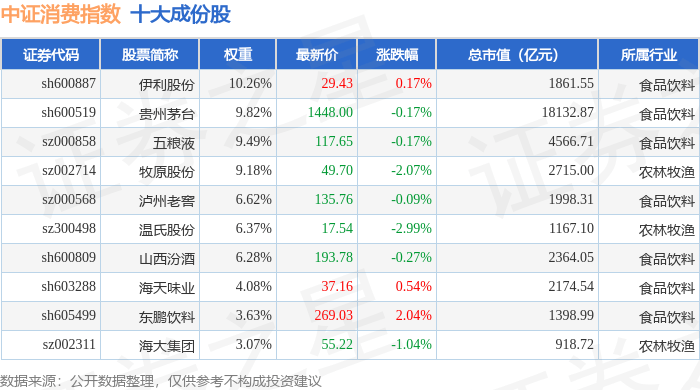
12月1日中证消费(399932)指数跌0.22%,成份股温氏股份(300498)领跌
Sou Hu Cai Jing· 2025-12-01 15:35
Core Viewpoint - The China Securities Consumer Index (399932) closed at 16047.2 points on December 1, with a slight decline of 0.22%, indicating a mixed performance among its constituent stocks [1]. Group 1: Index Performance - The total trading volume for the index was 19.806 billion yuan, with a turnover rate of 0.76% [1]. - Among the constituent stocks, 23 companies saw an increase, with COFCO Sugar leading with a rise of 3.38%, while 15 companies experienced a decline, with Wens Foodstuffs leading the drop at 2.99% [1]. Group 2: Top Constituents - The top ten constituents of the index include: - Yili Group (10.26% weight) at 29.43 yuan, up 0.17% - Kweichow Moutai (9.82% weight) at 1448.00 yuan, down 0.17% - Wuliangye (9.49% weight) at 117.65 yuan, down 0.17% - Muyuan Foods (9.18% weight) at 49.70 yuan, down 2.07% - Luzhou Laojiao (6.62% weight) at 135.76 yuan, down 0.09% - Wens Foodstuffs (6.37% weight) at 17.54 yuan, down 2.99% - Shanxi Fenjiu (6.28% weight) at 193.78 yuan, down 0.27% - Haitian Flavoring (4.08% weight) at 37.16 yuan, up 0.54% - Dongpeng Beverage (3.63% weight) at 269.03 yuan, up 2.04% - Haida Group (3.07% weight) at 55.22 yuan, down 1.04% [1]. Group 3: Capital Flow - On the same day, the net outflow of main funds from the index constituents totaled 968 million yuan, while speculative funds saw a net inflow of 1.063 billion yuan, and retail investors experienced a net outflow of 95.5649 million yuan [3]. - Notable capital flows included: - COFCO Sugar with a net inflow of 68.7449 million yuan from main funds and 29.1858 million yuan from speculative funds - Yili Group with a net inflow of 64.4441 million yuan from main funds but a net outflow of 61.2934 million yuan from retail investors [3]. Group 4: Index Adjustments - Recent adjustments to the index included the addition of one stock and the removal of three stocks, effective December 15, 2025 [4]. - The newly added stock is Zhengbang Technology (002157) from the agriculture and forestry sector, with a total market value of 28.12 billion yuan [4].




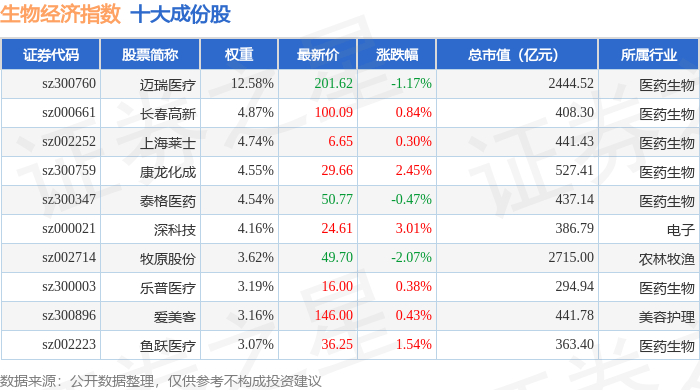
12月1日生物经济(970038)指数涨0.36%,成份股九强生物(300406)领涨
Sou Hu Cai Jing· 2025-12-01 11:39
Core Viewpoint - The Biotech Economy Index (970038) closed at 2159.74 points on December 1, with a slight increase of 0.36%, indicating a stable performance in the biotech sector [1]. Group 1: Index Performance - The trading volume for the Biotech Economy Index was 14.616 billion yuan, with a turnover rate of 1.03% [1]. - Among the index constituents, 38 stocks rose, with Nine Strong Bio leading with a 4.43% increase, while 10 stocks fell, with Wens Foodstuffs leading the decline at 2.99% [1]. Group 2: Top Constituents - The top ten constituents of the Biotech Economy Index include: - Mindray Medical (sz300760) with a weight of 12.58%, latest price of 201.62 yuan, and a market cap of 244.45 billion yuan [1]. - Changchun High-tech (sz000661) with a weight of 4.87%, latest price of 100.09 yuan, and a market cap of 40.83 billion yuan [1]. - Other notable constituents include Kanglong Chemical (sz300759) and Muping Co. (sz002714) with respective weights of 4.55% and 3.62% [1]. Group 3: Capital Flow - On the same day, the net outflow of main funds from the index constituents totaled 18.3835 million yuan, while retail investors saw a net outflow of 66.8875 million yuan [3]. - Notable capital flows included: - Deep Technology (000021) with a net inflow of 16.216 million yuan from main funds [3]. - Wens Foodstuffs (300498) experienced a net outflow of 50.9861 million yuan from retail investors [3]. Group 4: Index Adjustments - Recent adjustments to the Biotech Economy Index included the addition of 9 new stocks and the removal of 9 stocks [3]. - New additions include: - Super Research Co. (301602) with a market cap of 9.783 billion yuan [4]. - Kanghua Bio (300841) with a market cap of 10.631 billion yuan [4]. - Stocks removed from the index include Wens Foodstuffs (300498) and Jingxin Pharmaceutical (002020) [4].

新鲜出炉!30位中国行研“第一人”最新观点汇总:金股名单、投资图谱、产业解读……一应俱全!
Xin Lang Zheng Quan· 2025-12-01 09:32
Core Insights - The 2025 Analyst Conference, known as the "Oscars" of the capital market, will unveil the results of the 7th Sina Finance "Golden Unicorn" Best Analyst Awards on November 28, 2025, highlighting the top analysts across 30 industries [1] Group 1: Macro and Strategy Insights - The top macro research analyst, Li Chao from Zheshang Securities, presents a 2026 macro annual outlook emphasizing a positive trajectory [2] - Liu Chenming from GF Securities, the best strategy analyst, notes that the continuous recovery of A-share ROE is a significant support for the ongoing bull market [2] Group 2: Sector-Specific Insights - Liang Fengjie from Zheshang Securities, the best banking analyst, recommends stable high-dividend large banks as Q4 presents a buying opportunity [2] - Liu Xinqi from Guotai Junan Securities, the best non-bank financial analyst, believes the impact of real estate on insurance companies is limited, indicating a potential for the non-bank sector [2] - Guo Zhen from GF Securities, the best real estate analyst, states that the burden rate for home purchases has entered a reasonable range [2] - Kuang Shi from GF Securities, the best media analyst, highlights the rapid growth of animated dramas and AI animations, entering a phase of intense competition [2] - Wu Bohua from Changjiang Securities, the best analyst in new energy equipment, discusses the current status and future of new energy as a new growth driver [2] - Dai Chuan from GF Securities, the best analyst in robotics and high-end manufacturing, reflects on the implications of the 14th Five-Year Plan for the machinery industry [2] - Zhang Weihua from Changjiang Securities, the best public utilities analyst, suggests that the industry investment landscape will improve under the resonance of three bottoming signals in new energy [2] Group 3: Additional Sector Insights - Zhang Yidong from Industrial Securities, the best overseas market research analyst, outlines three investment strategies for high-dividend assets in the Hong Kong stock market [2] - Guo Peng from GF Securities, the best environmental protection analyst, is optimistic about two major areas in the low-carbon era of the 14th Five-Year Plan [2] - Liu Gaochang from Guosen Securities, the best computer industry analyst, anticipates that space computing may open a new era [2] - Guan Quansen from Guolian Minsheng Securities, the best home appliance analyst, notes that "new" home appliances are gradually breaking into new markets [2] - Fan Chao from Changjiang Securities, the best analyst in construction and building materials, highlights the warming expectations for real estate policies and suggests focusing on leading consumer building materials companies [2] - Han Yichao from Changjiang Securities, the best analyst in transportation and logistics, discusses the outlook for shipping after a decline [2] - Meng Xiangjie from GF Securities, the best military industry analyst, identifies three major directions for industry expansion during the 14th Five-Year Plan [2] - Zhao Gang from Changjiang Securities, the best analyst in retail and social services, outlines investment opportunities across six sub-sectors [2] - Xiao Yong from Changjiang Securities, the best coal industry analyst, emphasizes the significance of new highs in silver prices [2] - Chen Jia from Changjiang Securities, the best analyst in agriculture, forestry, animal husbandry, and fishery, recommends four leading companies with strong competitive advantages [2] - Yu Xuhui from Changjiang Securities, the best analyst in light industry and textile apparel, raises the annual revenue guidance due to better-than-expected industry performance [2]