证券业

Search documents
50万亿定存到期,理财保险基金谁能接住“泼天流量”
Bei Jing Shang Bao· 2026-01-20 14:11
Core Viewpoint - A significant wave of "high-interest fixed deposit maturities" is expected in 2026, with approximately 50 trillion yuan of funds set to be released, reshaping the asset allocation landscape for residents [1][6][7]. Group 1: Background and Causes - The upcoming maturity wave is a result of two overlapping funding cycles: high-interest fixed deposits from 2020-2021 and passive savings due to market pressures in 2022-2023 [1][5]. - In 2020-2021, banks initiated a high-interest deposit campaign, with five-year fixed deposit rates reaching as high as 5%, leading to a significant accumulation of funds maturing in 2026 [4][6]. - The passive savings trend emerged in 2022-2023 due to market volatility, prompting many investors to redeem their investments and seek safety in fixed deposits [5][7]. Group 2: Current Market Conditions - Current fixed deposit rates have significantly decreased, with major banks offering rates around 1.2% for three-year deposits, down from previous highs [8][9]. - Despite the decline in interest rates, many conservative investors are likely to continue renewing their fixed deposits due to a low tolerance for risk and a preference for capital preservation [9][10]. Group 3: Investment Alternatives - The market is witnessing a competition among various financial products, including fixed deposits, wealth management products, insurance, and funds, to attract the migrating capital [1][11]. - "Stable" wealth management products have gained popularity as they offer better returns than current fixed deposit rates, with some achieving annual yields above 3% [11][12]. - Insurance products are also becoming a favored option, with long-term stable returns appealing to investors seeking safety and growth [14][16]. Group 4: Fund Management and Future Outlook - Fund management companies are expected to enhance their asset management capabilities to effectively attract and manage the incoming funds from maturing deposits [20]. - The shift in investor sentiment towards diversified financial products indicates a potential for sustained growth in the insurance and fund sectors, particularly for products that offer a balance of safety and returns [17][18].


攻破4700美元关口!现货黄金再创新高,5000美元不是梦?
2 1 Shi Ji Jing Ji Bao Dao· 2026-01-20 11:59
Core Viewpoint - The geopolitical tensions surrounding Greenland have led to a surge in gold prices, with both spot gold and New York futures surpassing $4,700 per ounce, marking a historical high [1] Group 1: Gold Market Dynamics - The trend of "de-dollarization" is accelerating, with multiple central banks significantly increasing their gold reserves to diversify foreign exchange risks and reduce reliance on the US dollar [3] - Concerns over the long-term purchasing power of the dollar are driving demand for gold, especially as the US federal debt exceeds $37 trillion and continues to grow rapidly [3] - The expectation of rising gold prices is attracting strong inflows of private capital into gold through ETFs and bullion, further supporting the market [3] Group 2: Geopolitical and Economic Influences - The recent threats from the US government, including tariffs on European goods, have prompted European investors to reduce their dollar exposure and sell off dollar-denominated assets [2] - The potential for increased geopolitical risks and the rightward political shift in many countries are contributing to a heightened demand for gold as a safe-haven asset [5] - The ongoing global debt issues and the lack of effective solutions for major economies' debt problems are expected to continue undermining the credibility of fiat currencies, thereby reinforcing gold's monetary attributes [5] Group 3: Future Outlook - Despite the current high gold prices, there are concerns about potential short-term corrections if the Federal Reserve slows its rate cuts due to inflationary pressures [4] - Long-term projections suggest that gold prices could exceed $5,000 per ounce by 2026, reflecting a growing market focus on tail risks rather than traditional interest rate-driven narratives [4] - The structural demand for gold as a hedge against the weakening of sovereign currency credit is likely to persist, driven by geopolitical tensions and inflation concerns [5]
ETF日报:建材ETF的投资标的包含水泥、玻璃、陶瓷、新型建材等领域的上市公司
Xin Lang Cai Jing· 2026-01-20 11:44
Market Overview - The three major indices collectively declined, with the ChiNext Index dropping over 2% at one point. The Shanghai Composite Index fell by 0.01%, the Shenzhen Component Index by 0.97%, and the ChiNext Index by 1.79% [1][14] - The total trading volume in the Shanghai and Shenzhen markets reached 2.78 trillion yuan, an increase of 69.4 billion yuan compared to the previous trading day [1][14] Gold Market - Gold-related ETFs saw gains, with the Gold Stock ETF rising by 2.45% and the Gold Fund ETF by 0.72%. The spot price of gold in London surpassed $4,700 per ounce, driven by geopolitical tensions [6][19] - The ongoing liquidity easing and de-dollarization trends are expected to provide stable support for gold prices. A recent report indicated that global central bank gold reserves have surpassed U.S. Treasury holdings for the first time since 1996 [7][20] Real Estate and Building Materials - The building materials sector performed well, with the Building Materials ETF increasing by 3.88%. The second-hand housing market is showing signs of recovery, with significant week-on-week increases in transaction prices in key cities [8][22] - Policies aimed at stabilizing the real estate market, such as lowering loan rates and adjusting down payment ratios, are expected to support the building materials sector. The total transaction volume for new and second-hand homes is projected to remain strong at 1.2 to 1.3 billion square meters [8][22] Communication Sector - The communication sector experienced a pullback, with the Communication ETF declining by 3.14%. This was attributed to recent fund outflows and disappointing earnings forecasts from some companies [10][23] - Looking ahead, demand for optical modules is expected to surge, driven by major tech companies. The supply side is anticipated to face shortages, particularly in laser components, which could enhance profitability in the sector [12][24][25]
【笔记20260120— 今日大寒,债市乍暖】
债券笔记· 2026-01-20 10:33
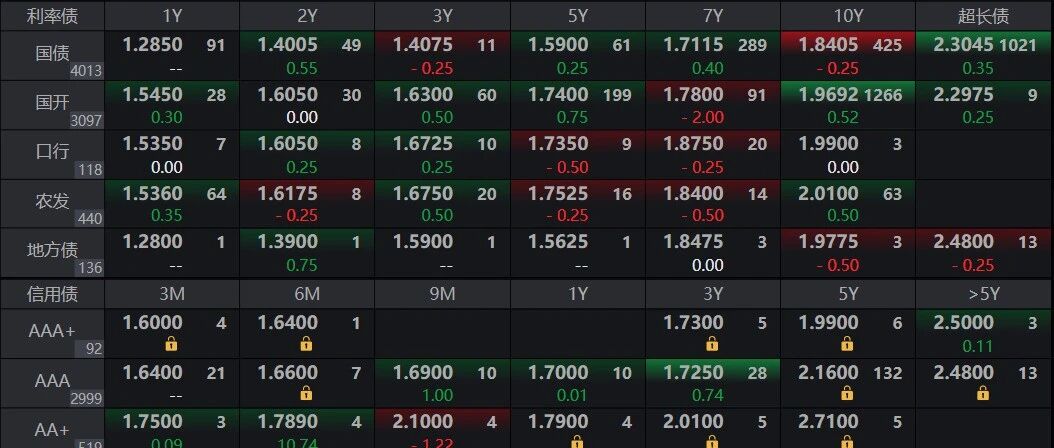
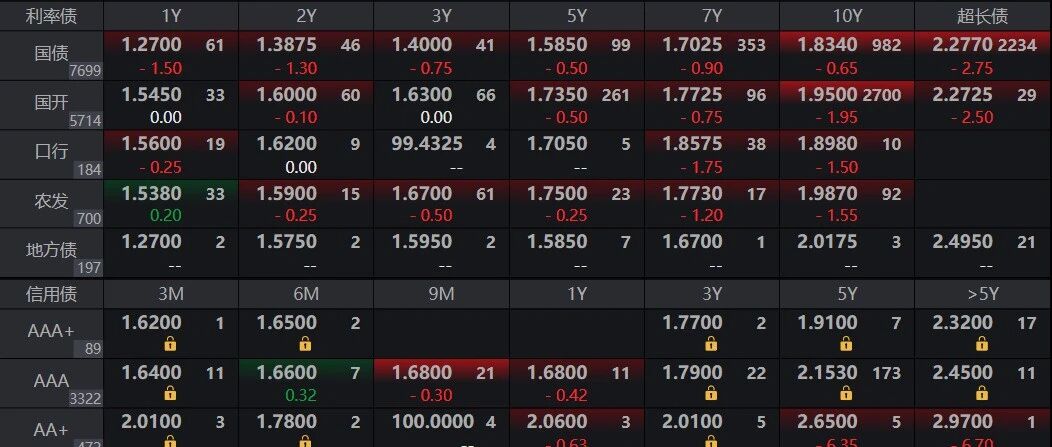
Core Viewpoint - The market is perceived as the true intelligence, and it is essential to follow its direction rather than attempt to predict outcomes independently [1]. Group 1: Market Conditions - The bond market shows signs of warming, with long-term bonds being particularly attractive. The concentration of borrowing for 30-year bonds reached 30%, and the yield spread between 30-year and 10-year bonds is at 50 basis points, a level not seen since the introduction of 30-year bond futures [6]. - The interbank funding market is balanced and slightly loose, with a significant drop in long bond yields. The central bank conducted a 3.24 billion yuan reverse repurchase operation, with 3.586 billion yuan maturing, resulting in a net withdrawal of 346 million yuan [3]. - The stock market is experiencing fluctuations, with no unexpected information from the National Development and Reform Commission and the Ministry of Finance. The 10-year government bond yield opened at 1.8325% and fluctuated, reaching a low of 1.815% before recovering to 1.825% [5]. Group 2: Interest Rates and Trading Data - The weighted average rates for various interbank funding instruments are as follows: RO1 at 1.42%, R007 at 1.54%, R014 at 1.63%, and R1M at 1.63%. The trading volume for RO1 was approximately 78.17 billion yuan, while R007 had a volume of about 7.44 billion yuan [4]. - The financing balance in the stock market has decreased, indicating a cooling effect on the market. The dynamics between large-cap and small-cap stocks are shifting, with large-cap stocks struggling to outperform small-cap stocks [9].
在牛市里,如何吃到熊市级别的跌幅?
表舅是养基大户· 2026-01-20 07:23
Core Viewpoint - The article discusses the recent market trends in A-shares, highlighting significant sell-offs in growth sectors and the implications of financing regulations on market behavior [5][6][8]. Group 1: Market Trends - A-shares experienced a notable index-level pullback, primarily affecting growth sectors [5]. - Financing positions recorded their first net sell-off in 26 years, indicating a shift in market sentiment [6]. - The recent financing regulations, which increased margin requirements from 80% to 100%, may have contributed to this sell-off [6]. Group 2: ETF Activity - Broad-based ETFs saw substantial net sell-offs, with over 58 billion sold in a single day, and a total of over 240 billion in three days [8]. - The trading volume of major ETFs has decreased compared to previous days, suggesting a cooling off in market enthusiasm [8][10]. Group 3: Sector Performance - The satellite and commercial aerospace sectors have experienced significant declines, with the satellite industry index dropping over 20% from its peak [11]. - The article attributes this decline to speculative trading and the influence of e-commerce and content platforms promoting high-risk investments [14]. Group 4: Investment Platforms - WeBank, a leading internet bank, offers advantages for personal investors, including T+0.5 redemption for funds, enhancing capital efficiency [19][20]. - New users of WeBank can benefit from discounted fund purchases by completing a financial literacy course [21]. - WeBank's stringent volatility control for financial products is seen as beneficial for clients [22].

资讯早班车-2026-01-20-20260120
Bao Cheng Qi Huo· 2026-01-20 02:36
1. Report Industry Investment Rating No relevant content provided. 2. Core Viewpoints of the Report - The IMF has raised the global economic growth forecast for 2026 by 0.2 percentage points to 3.3%, and also increased the growth forecasts for China, the US, the Eurozone, and Japan. AI - driven IT investment growth is becoming an important driver for the global economy [2][16]. - The Chinese economy's 2025 "report card" shows that GDP grew by 5% year - on - year, reaching 140.19 trillion yuan, with the service industry's share in GDP rising to 57.7%, and final consumption contributing 52% to economic growth, while fixed - asset investment declined by 3.8% [2][13]. - In the stock market, on Monday, A - shares had a shrinking - volume oscillation with major indices showing different trends. A - share listed companies' 2025 annual report performance pre - announcements are accelerating, and AI is a strong driver for corporate performance growth [32]. 3. Summary by Relevant Catalogs 3.1 Macro Data - In December 2025, GDP at constant prices had a quarterly - on - quarterly growth of 4.5%, down from 4.8% in the previous period and 5.4% in the same period last year. The manufacturing PMI was 50.1%, slightly up from 49.8% in the previous period, and the non - manufacturing PMI for business activities was 50.2%, up from 50.0% in the previous period [1]. - Social financing scale in December 2025 was 2207.5 billion yuan, down from 3529.9 billion yuan in the previous month and 2853.7 billion yuan in the same period last year. M0, M1, and M2 growth rates showed different trends compared to the previous period and the same period last year [1]. - In December 2025, CPI increased by 0.8% year - on - year, up from - 0.3% in the previous period, and PPI decreased by 1.9% year - on - year, an improvement from - 2.3% in the previous period and the same period last year [1]. 3.2 Commodity Investment Reference 3.2.1 Comprehensive - China's 2025 economic data shows overall growth in multiple sectors, with a decline in fixed - asset investment, especially in real - estate development investment [2]. - The EU will hold an emergency summit on January 22 to discuss Trump's tariff threat and consider counter - measures, and is preparing to impose retaliatory tariffs on $93 billion worth of US goods [2]. - The Guangzhou Futures Exchange will adjust the daily price limit and margin standards for lithium carbonate futures contracts starting from January 21 [3]. 3.2.2 Metals - COMEX gold futures' February contract reached a record high of $4698 per ounce on January 19, approaching the $4700 mark, driven by geopolitical risks and expectations of a decline in the US dollar's credit. Gold ETFs and futures are more suitable for short - term investment [4]. - Japan will use 39 billion yen in reserve funds to ensure rare - earth supply [5]. - The Shanghai Futures Exchange has approved an increase in tin futures delivery warehouses and their approved storage capacities in Guangdong [6]. 3.2.3 Coal, Coke, Steel, and Minerals - In early January, key steel enterprises' daily crude - steel output was 1.997 million tons, a 10.51% increase from the previous period but a 3.29% decrease year - on - year. Pig - iron and steel production also showed different trends compared to the previous period and the same period last year [7]. - The first shipment of nearly 200,000 tons of Simandou iron ore arrived in China on January 17, which will enhance the global iron - ore supply [7]. - Shanxi produced over 13 billion tons of coal in 2025, and 65 billion tons during the 14th Five - Year Plan period, an increase of 19 billion tons compared to the 13th Five - Year Plan [7]. - Coking coal options were listed on the Dalian Commodity Exchange, enriching the risk - management tools for the coal - coke - steel industry chain [8]. 3.2.4 Energy and Chemicals - Goldman Sachs has raised its 2026 price forecast for TTF natural gas to 36 euros [9]. - Venezuela has officially launched the export of liquefied petroleum gas [9]. - After Maduro's downfall, many trade and oil companies are competing for the deal to export Venezuelan crude oil to the US [9][10]. - China National Coal Group will promote the clean and efficient use of coal, transforming it from a fuel to "raw material + material" [10]. 3.2.5 Agricultural Products - The average price of live pigs rebounded this week. On January 16, the average wholesale price of pork was 18.07 yuan per kilogram, up 0.6% from January 9, and the average price this week was 18 yuan per kilogram, up 0.3% from last week [11]. 3.3 Financial News Compilation 3.3.1 Open Market - On January 19, the central bank conducted 158.3 billion yuan of 7 - day reverse - repurchase operations at a fixed interest rate of 1.40%, with a net injection of 72.2 billion yuan after 86.1 billion yuan of reverse - repurchases matured [12]. 3.3.2 Important News - China's 2025 economic data, including population changes, shows a decrease in the population by 339,000 [13][14]. - In December 2025, housing prices in major Chinese cities showed different trends, with some cities' price declines narrowing and Shanghai's new - home prices rising [14]. - The NDRC and the Ministry of Finance will hold press conferences to introduce relevant economic policies [14]. - Premier Li Qiang emphasized high - quality development, calling for more active fiscal policies and moderately loose monetary policies [15]. - The central bank will announce the January LPR on January 20 [15]. - The Supreme People's Procuratorate has made arrangements to use legal power to serve high - quality development, including cracking down on economic crimes and safeguarding the capital market [17]. - The CSRC's 2026 system work meeting has outlined a clear path for capital - market reform [18]. - In 2025, the number and scale of registered insurance asset - management products decreased [18]. - There is a heated discussion about the "2026 time - deposit maturity wave", with different views on the scale, but most banks are not worried [19]. - There are several bond - related events, such as bond rating changes and early redemptions [20]. 3.3.3 Bond Market Review - The bond market showed an overall weak and oscillating trend, with most Treasury - bond futures closing down, and the yields of major interest - rate bonds in the inter - bank market mostly rising slightly. Some bonds like Vanke and AVIC Industry Finance bonds rose [21]. - The money - market interest rates showed different trends, with some rising and some falling [22][23]. - The yields of some financial bonds were determined in the bidding process, and European bond yields mostly increased [24]. 3.3.4 Foreign Exchange Market - The on - shore RMB against the US dollar closed at 6.9636 on January 20, up 54 basis points from the previous trading day, and the central parity rate was 7.0051, up 27 basis points [25]. - The US dollar index fell by 0.32% in New York's late trading, and most non - US currencies rose [25]. 3.3.5 Research Report Highlights - Shenwan Fixed - Income states that the issuance of new special bonds this year is faster than in previous years but has not significantly accelerated. The planned issuance of local bonds in Q1 2026 is 2.1179 trillion yuan, similar to the same period in 2025 [27]. - CICC Fixed - Income suggests that in the current fluctuating interest - rate bond yield environment, credit - bond yields may follow the fluctuations, especially for Tier 2 and perpetual bonds. It also recommends paying attention to short - term trading opportunities and non - financial credit bonds with a remaining term of about 5 years. The future spread of science - and - technology innovation bonds depends on the change in the scale of science - and - technology innovation bond ETFs [27]. - CITIC Securities believes that Trump's tariff threat is a means to test the EU's attitude, and the change of Greenland's territory is difficult to achieve. If the US takes real actions, gold may benefit, the US dollar's credit may be damaged, and European assets may be under pressure [28]. 3.4 Stock Market - On Monday, A - shares had a shrinking - volume oscillation. The Shanghai Composite Index rose 0.29% to 4114 points, the Shenzhen Component Index rose 0.09%, the ChiNext Index fell 0.7%, and the total market turnover was 2.73 trillion yuan, down from 3.06 trillion yuan the previous day. Power - infrastructure, AVIC - related, and Hainan Free - Trade - Port concepts led the gains, while semiconductors and consumer electronics led the losses [32]. - The Hong Kong Hang Seng Index fell 1.05% to 26563.9 points, with pharmaceutical stocks leading the decline and aviation stocks rising. South - bound funds had a net purchase of nearly HK$2.3 billion [32]. - A - share listed companies' 2025 annual report performance pre - announcements are accelerating, with 156 out of 451 companies reporting positive pre - announcements, and 42 companies expecting a net - profit increase of over 100% year - on - year [32].
从央行报告看居民“钱包”变化,2025年更热衷于存还是贷?
Xin Lang Cai Jing· 2026-01-20 00:13
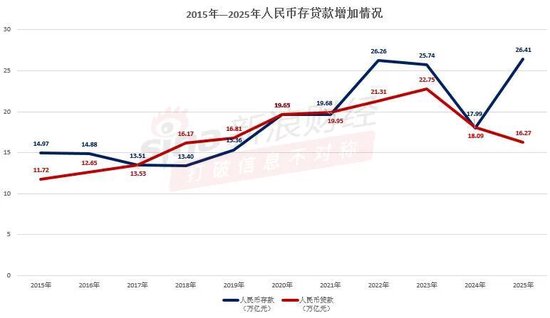
Core Viewpoint - The People's Bank of China (PBOC) reported that in 2025, the total increase in RMB deposits reached 26.41 trillion yuan, which is 8.42 trillion yuan more than the previous year, indicating a strong deposit growth despite a significant decline in household loan growth compared to previous years [1][2][5]. Group 1: Deposit Growth - The total RMB deposits increased by 26.41 trillion yuan in 2025, with a year-on-year increase of 8.42 trillion yuan [1][2]. - Household deposits rose by 14.64 trillion yuan, remaining stable compared to the previous year, while the increase is lower than the peak in 2022 [1][5]. - Non-bank financial institutions saw a deposit increase of 6.41 trillion yuan, marking the highest growth since 2015, with a year-on-year increase of 3.82 trillion yuan [1][8]. Group 2: Loan Growth - In 2025, RMB loans increased by 16.27 trillion yuan, which is approximately 1.82 trillion yuan less than the previous year, indicating a slowdown in loan growth [4][5]. - Household loans only increased by 441.7 billion yuan, significantly lower than the nearly 8 trillion yuan peak in 2021, reflecting weak demand in the housing market [4][5]. - The increase in loans in December 2025 was approximately 910 billion yuan, which is significantly higher than November's 390 billion yuan, suggesting a year-end push for credit [4]. Group 3: Monetary Supply - By the end of December 2025, M2 (broad money) reached 340.29 trillion yuan, growing by 8.5% year-on-year, while M1 (narrow money) grew by 3.8% [12][14]. - The M2-M1 gap expanded to 4.7%, the highest level since June 2025, indicating a slowdown in the conversion of funds into demand deposits [12][14]. - The increase in M2 is supported by government bond financing and the introduction of new policy financial tools, which have contributed to deposit growth [13][14].
全球央行抢金潮,如何重塑国际储备格局
3 6 Ke· 2026-01-19 13:46
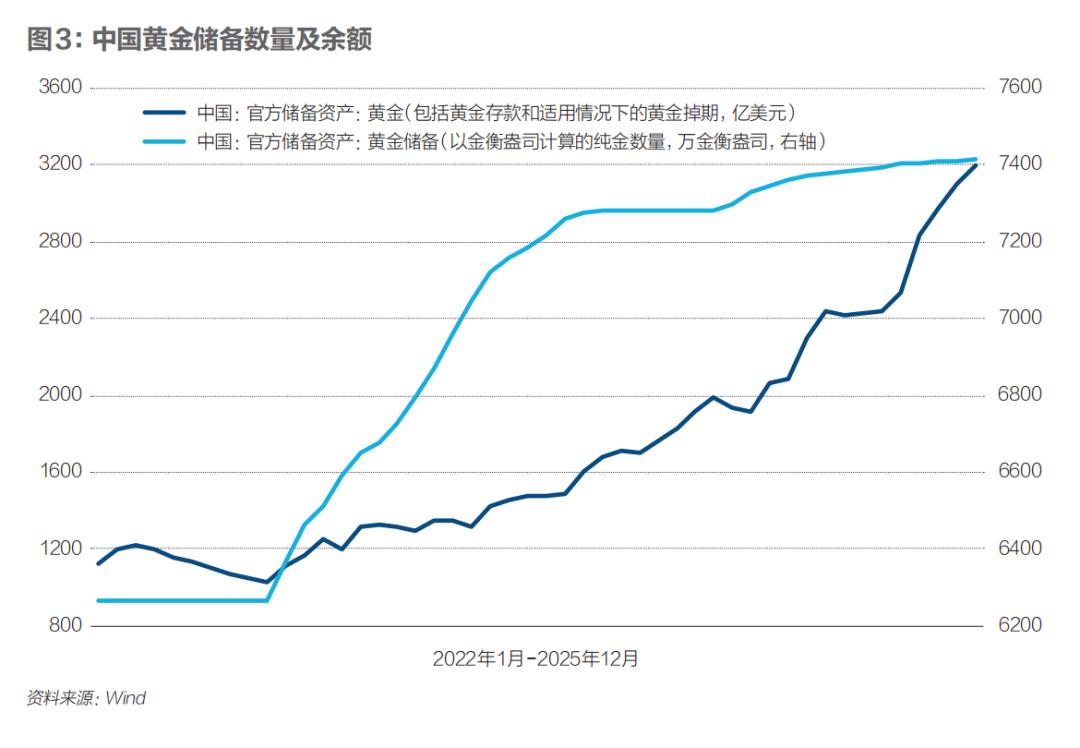
Group 1 - As of the end of Q3 2025, global official gold reserves reached approximately $3.69 trillion, accounting for 28.9% of total official reserves, marking a new high since 2000 [4][10][33] - The International Monetary Fund (IMF) reported that the share of the US dollar in global foreign exchange reserves fell to 56.92% in Q3 2025, the lowest level since 1995, continuing a trend of being below 60% for over ten consecutive quarters [10][33] - The People's Bank of China (PBOC) has been increasing its gold reserves consistently, with a total increase of 1,151 million ounces (approximately 358 tons) since November 2022 [2][12][16] Group 2 - The trend of central banks increasing gold reserves has been ongoing for 15 years, with net purchases exceeding 1,000 tons annually from 2022 to 2024 [24][26] - In 2025, central banks added 634 tons of gold, maintaining a high level compared to the average of 473 tons from 2010 to 2021 [8][24] - Emerging market central banks, particularly Turkey and China, have been significant contributors to gold purchases, with China being the largest buyer in 2023 [7][27] Group 3 - The World Gold Council's report indicates that the demand for gold from central banks is expected to remain strong, with over 90% of surveyed central banks anticipating an increase in gold reserves by 2026 [43] - The ongoing geopolitical tensions and the desire for diversified reserve assets are driving central banks to favor gold over traditional assets like US Treasury bonds [9][36] - The trend of "de-dollarization" is influencing central banks to increase their gold holdings as a hedge against the risks associated with US dollar assets [36][43]
(经济观察)中国经济总量五年“四连跳”现三大趋势
Zhong Guo Xin Wen Wang· 2026-01-19 11:07
Group 1 - The core viewpoint of the article highlights that China's economy has achieved significant growth, surpassing four major milestones in GDP over five years, with a projected GDP exceeding 140 trillion yuan by 2025 [1] Group 2 - The stability of the economic foundation has improved, enhancing the ability to withstand risks. China's grain production has stabilized at 1.4 trillion jin for two consecutive years, and the manufacturing value added has remained the highest globally for 16 years. By 2025, the service sector's contribution to GDP is expected to rise to 57.7% [3][2] - Domestic consumption is projected to exceed 50 trillion yuan in retail sales by 2025, with final consumption contributing 52% to economic growth, an increase of 5 percentage points from the previous year [3] Group 3 - The quality of development has improved, with a greater emphasis on innovation. China's innovation index has entered the global top ten, and the value added of high-tech manufacturing has grown at an average rate of 9.2% annually [5] - By 2025, the proportion of high-tech manufacturing value added in total industrial value added is expected to reach 17.1%, with high-tech product exports increasing by 13.2% [5] Group 4 - The expanding Chinese economy is creating more opportunities and broader cooperation space. China is expected to import a record 18.5 trillion yuan worth of goods by 2025, providing vast market opportunities for other countries [7] - By 2025, the number of countries and regions trading with China is projected to reach 249, with significant trade volumes across various categories [8]
【笔记20260119— 今天有两个数,一个是-17%,另一个也是-17%】
债券笔记· 2026-01-19 10:14
Group 1 - The investment environment is characterized by trial and error, with few guaranteed opportunities for significant profits, which reflects the market's normal state [1] - The financial market shows a balanced and slightly loose liquidity, with the central bank conducting a 7-day reverse repurchase operation of 158.3 billion yuan, resulting in a net injection of 72.2 billion yuan [3] - Economic data for December indicates strong production but weak demand, with a slight increase in the stock market and a subdued bond market [5] Group 2 - The bond market is experiencing low trading volumes, with the most active 10-year government bonds trading less than 600 times, indicating a lack of investor engagement [5] - Recent economic indicators show a 17% decline in real estate investment and a 17% drop in the birth rate, highlighting significant demographic and economic challenges [5] - The current interest rates for various financial instruments are as follows: R001 at 1.38%, R007 at 1.53%, and R014 at 1.62%, with varying changes in transaction volumes [4]