证券业

Search documents
2026年利率年度策略:市场锚点与多空潮汐
Southwest Securities· 2026-01-19 07:13
Core Insights - The report indicates that the bond market will enter a "game" era in 2025, driven by increased fiscal policy and a focus on "debt reduction + development," with the deficit rate expected to rise to 4% [5][12] - The "15th Five-Year Plan" aims for a nominal GDP growth rate of around 5.5% to achieve a per capita GDP of $20,000 to $30,000 by 2035, necessitating a compound annual growth rate (CAGR) of 3.6%-7.5% from 2026 to 2035 [31][32] - The report emphasizes the need for a shift in investment strategies towards a focus on "coupon and leverage" rather than solely capital gains, as the market lacks clear trends [5][21] Group 1: Supply and Monetary Policy - The fiscal policy will continue to expand, with a focus on "debt reduction + development," leading to a significant increase in special bond issuance [7][12] - The monetary policy will maintain a cautious approach, with expectations of 1-2 rate cuts in 2026 to support fiscal efforts and alleviate bank liabilities [5][13] - The bond market is expected to face challenges due to a high supply of government bonds in the second and third quarters of 2026, which may test market sentiment [5][12] Group 2: Economic Growth and Internal Demand - The report highlights a shift in global monetary policy towards differentiation, with domestic growth needing to focus more on internal demand expansion [32][40] - The "15th Five-Year Plan" emphasizes the importance of innovation-driven growth and the establishment of a unified national market to enhance economic efficiency [31][32] - The expected economic growth will require a stable inflation rate and a focus on enhancing internal growth dynamics to recover from the impacts of previous economic models [31][32] Group 3: Investment Strategy and Market Dynamics - The report suggests prioritizing duration control in investment strategies for 2026, focusing on capturing short-term opportunities and structural adjustments in bond types [5][21] - The changing landscape of asset pricing and institutional demand may lead to differentiated investment behaviors among banks, insurance companies, and funds [5][12] - The report warns against a mechanical extension of duration for capital gains, advocating for a more active management approach to enhance returns [5][21]
债市周周谈-12月金融数据解读及未来展望
2026-01-19 02:29
Summary of Key Points from the Conference Call Industry Overview - The conference call discusses the financial market trends in China, particularly focusing on the credit demand, social financing, and government bond market for the year 2026. [1][2][3] Key Insights and Arguments - **Weak Credit Demand**: Overall credit demand in China is weak, influenced by manufacturing overcapacity and the impact of local government debt on financing needs. [3][6] - **Loan Structure**: In December 2025, new loans amounted to 910 billion yuan, with a significant portion being short-term corporate loans and bill discounts, indicating banks' aggressive lending strategies at the end of the quarter. [2][4] - **Personal Loans Decline**: Personal loans have been in continuous negative growth since August 2025, reflecting low consumer credit demand despite a strong stock market performance. This trend is expected to persist into 2026. [2][3] - **Social Financing Trends**: Social financing growth is projected to decrease, with an expected total of approximately 3.5 trillion yuan for 2026, slightly lower than the previous year. [6][9] - **Government Bond Issuance**: The issuance of government bonds is expected to increase, with a stable credit growth forecast for 2026, as the issuance schedule is front-loaded. [9][19] Important but Overlooked Content - **M1 Growth Rate**: The M1 growth rate fell to 3.8% by the end of 2025, with expectations of maintaining around 3% in the second half of 2026. [5] - **Insurance Sector Impact**: The nearing conclusion of a 6 trillion yuan special bond debt plan may improve the supply of long-term bonds, which is crucial for the investment strategies of the insurance sector. [7][8] - **Bank Wealth Management Trends**: Bank wealth management products are expected to see significant growth in the second and third quarters of 2026, while the first quarter typically shows a decline due to banks focusing on loan growth. [11][12] - **Long-term Bond Demand**: There is a notable increase in demand for long-term government bonds from rural commercial banks due to a decrease in their funding costs, with expectations of a significant rise in their holdings of 15 to 30-year bonds. [17] - **Stock Market Regulation**: The regulatory body is actively preventing excessive volatility in the stock market, with recent actions indicating a desire to control overheating in the market. [18] Investment Recommendations - It is suggested to consider investing in secondary capital bonds or perpetual bonds for yield, while also exploring opportunities in 30-year government bonds for potential price movements. [20]
每日债市速递 | 本周央行公开市场将有9515亿元逆回购到期
Sou Hu Cai Jing· 2026-01-19 00:00
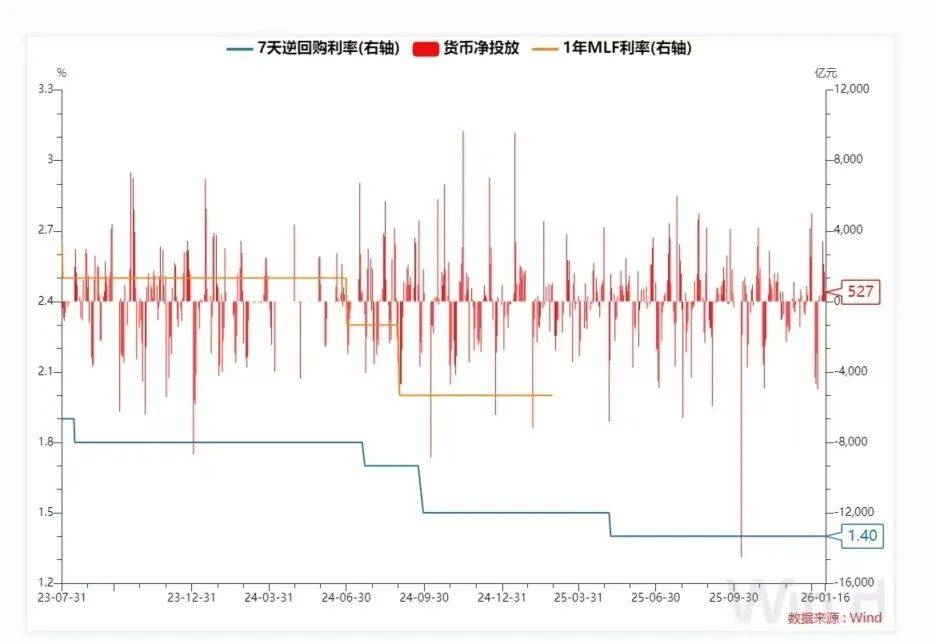
// 债市综述 // 1. 公开市场操作 央行公告称,1月16日以固定利率、数量招标方式开展了867亿元7天期逆回购操作,操作利率1.40%,投标量867亿元,中标量867亿 元。Wind数据显示,当日340亿元逆回购到期,据此计算,单日净投放527亿元。当周实现净投放8128亿元。 Wind数据显示,1月19日至23日当周,央行公开市场将有9515亿元逆回购到期。此外,23日还将有1500亿元国库现金定存到期。 (*数据来源:Wind-央行动态PBOC) 2. 资金面 银行间市场资金面逐渐恢复宽松,DR001加权平均利率降超4bp至1.32%附近。匿名点击(X-repo)系统上,隔夜报价也滑至1.30%, 供给在千亿元左右;非银机构质押信用债借入隔夜,最新报价集中在1.45%附近。 海外方面,最新美国隔夜融资担保利率为3.64%。 (IMM) (*数据来源:Wind-国际货币资金情绪指数、资金综合屏) 3. 同业存单 全国和主要股份制银行一年期同业存单最新成交在1.63%附近,较上日小幅下行。 (*数据来源:Wind-同业存单-发行结果) 4. 银行间主要利率债收益率普遍下行 (*数据来源:Wind-成交统 ...



国联民生:流动性交易会如何变盘?
Xin Lang Cai Jing· 2026-01-18 15:03
Core Viewpoint - The article discusses the contrasting performance of global markets in early 2023, highlighting a broad rise in international stock markets while the U.S. market, particularly large-cap stocks, lagged behind, indicating a preference for small-cap stocks amidst a backdrop of liquidity and sentiment recovery [3][20]. Group 1: Market Trends - Global stock markets, including Japan, South Korea, and Singapore, have reached historical highs, while the Shanghai Composite Index has hit a 10-year peak [3][20]. - The U.S. market has shown a notable divergence, with large-cap stocks underperforming compared to small-cap stocks, suggesting a selective investment approach despite overall liquidity [3][20]. Group 2: Liquidity and Sentiment - The article emphasizes the importance of distinguishing between "big expectations" and "small certainties" regarding market liquidity and sentiment recovery [5][22]. - A significant drop in market trading activity was observed after the "Quadruple Witching Day" in December, marking the fastest decline in five years, which coincided with liquidity risk events [5][22]. - Following the year-end holidays, trading activity rebounded, leading to a notable market recovery [23]. Group 3: Fiscal and Monetary Policy - Fiscal expansion remains a key theme across major economies, driven by election-year dynamics in the U.S. and new leadership in Japan, alongside a revival in European fiscal efforts [7][25]. - The Federal Reserve's monetary policy adjustments, including the initiation of Reserve Management Purchases (RMP), are expected to enhance liquidity in the market [9][27]. - The anticipated scale of net purchases by the Federal Reserve over the next 12 months is projected to be $220 billion, with a monthly average of around $40 billion from January to April [9][27][28]. Group 4: Market Expectations and Risks - The market's expectations for fiscal and monetary stimulus are likely to be a significant source of volatility throughout the year [12][32]. - There is a cautious outlook on unconventional fiscal policies, such as direct payments to residents, due to potential legislative hurdles [12][32]. - The article outlines four potential scenarios for market dynamics based on the interplay of Federal Reserve policies and the strength of the U.S. dollar, indicating varying impacts on global assets [14][34].


结构性货币政策加码——政策周观察第64期
一瑜中的· 2026-01-18 14:59
Core Viewpoint - The article emphasizes the importance of anti-corruption measures and structural monetary policies in China, highlighting the need for strict political discipline and the promotion of economic growth through targeted financial support [2][3][4]. Group 1: Anti-Corruption Focus - The Central Commission for Discipline Inspection (CCDI) meeting underscored the need for strict adherence to political and election discipline, aiming to eliminate individuals with dual loyalties and inconsistent actions [2][9]. - Key sectors targeted for corruption eradication include finance, state-owned enterprises, energy, education, and public bidding, with a focus on new forms of corruption and hidden issues [2][14]. Group 2: Monetary Policy Adjustments - The People's Bank of China announced a 0.25 percentage point reduction in various structural monetary policy tool rates, aiming to support small and private enterprises [3][15]. - New measures include increasing the quota for agricultural and small enterprise loans by 500 billion yuan and establishing a separate quota of 1 trillion yuan for private enterprise loans [15][16]. Group 3: Financial and Capital Market Developments - The National Financial Regulatory Administration emphasized the need to improve the quality of small financial institutions and regulate industry order, while the China Securities Regulatory Commission focused on enhancing market monitoring and preventing excessive speculation [4][17]. - The minimum margin requirement for financing on three exchanges was raised from 80% to 100%, indicating a tightening of market conditions [4][11]. Group 4: Industry Initiatives - The Ministry of Industry and Information Technology outlined plans for the development of the new energy vehicle sector, including the acceleration of solid-state battery technology and advanced autonomous driving [4][12]. - A plan for the high-quality development of industrial internet platforms was introduced, aiming for over 450 influential platforms and a connection of more than 120 million industrial devices by 2028 [4][12]. Group 5: National Reserve Law - The National Development and Reform Commission released a draft for the National Reserve Security Law, which includes provisions for the storage of essential agricultural products, energy, and emergency supplies [5][19].

固定收益定期:开年这几周,债市有哪些变化?
GOLDEN SUN SECURITIES· 2026-01-18 13:07
1. Report Industry Investment Rating No information provided in the content. 2. Core View of the Report - The bond market has generally recovered this week, with short - term and credit bonds performing stronger. The short - term and credit interest rates have declined significantly, while the long - term recovery is relatively mild [1][8]. - Although there were concerns about bond supply and bank deposit outflows at the beginning of the year, the actual situation shows that the supply of government bonds is not fast, and banks do not have obvious liability gaps. The current trading structure shows that non - banks are reducing their positions, while banks and insurance companies are increasing their allocations [1][5][8]. - The short - term bond market may fluctuate, and the space for further adjustment is limited. It is advisable to wait for opportunities to increase allocations, which may occur in late January or later. As the market develops, the bond market may start to recover in the middle and later stages of the first quarter, and at that time, it is possible to consider gradually lengthening the duration [5][21]. 3. Summary by Related Catalogs Supply Level - The supply rhythm of government bonds at the beginning of the year is not fast. In the first three weeks, the total net financing of government bonds was 886.5 billion yuan, slightly lower than 970.3 billion yuan in the same period last year. The net financing of local bonds was 386.4 billion yuan, also lower than 472.1 billion yuan in the same period in 2025 [1][8]. - The term structure of bond issuance remains long. Among the 424.1 billion yuan of local bonds issued in the first three weeks of this year, bonds with a term of more than 10 years accounted for 58%, and the proportion of 30 - year bonds was 33.8%, higher than 21.0% last year [1][8]. Demand Level - The market was once worried that bank deposit outflows would lead to insufficient allocation power. Due to the maturity of high - interest time deposits and the strong performance of the stock market, there were concerns about deposit outflows to non - banks, time deposit current - account conversion, and non - bank conversion [2][11]. - However, from the perspective of certificates of deposit (CDs), banks have not shown obvious liability shortages or liquidity indicator pressures. In the past four weeks, banks have had a net repayment of 885.5 billion yuan of CDs, and they have been increasing their allocation of CDs since the beginning of the year [3][14]. - The repurchase volume and interest rates also show that there is no large gap in bank liabilities. Although the recent capital price has risen slightly from the low at the beginning of the year, it is still at a low level. The overnight interest rate of 1.3% - 1.4% and the 7 - day inter - bank lending rate of 1.4% - 1.5% are significantly lower than previous years, and the seasonal increase is weaker. The inter - bank pledged repurchase trading volume is 8.76 trillion yuan, significantly higher than previous years, indicating that the capital supply in the market is more abundant [4][15]. Trading Structure - Currently, non - banks are reducing their positions, while banks and insurance companies are increasing their allocations. Non - banks are shifting their positions from long - term bonds to credit bonds, which has promoted the strength of secondary capital bonds (Second - tier and Perpetual bonds, "二永") and credit bonds [5][17]. - The credit spreads have been compressed to a relatively low level. The spreads between 5 - year AAA - second - tier capital bonds, AAA urban investment bonds, and treasury bonds are only 56bps and 39bps respectively, both at relatively low levels in the past few years. The spread between 30 - year and 1 - year treasury bonds has reached a high of 106bps, and the space for further compression of credit spreads may be limited [5][17].
海外利率周报20260118:Fed收到传票的多重信号-20260118
Guolian Minsheng Securities· 2026-01-18 12:27
1. Report Industry Investment Rating No information about the report industry investment rating is provided in the content. 2. Report's Core View The report analyzes the trends of the US Treasury bond market, US macro - economic indicators, and major asset classes. It shows that the US Treasury bond yields fluctuated this week due to economic data, geopolitical issues, and concerns about the Fed's independence. The US macro - economy shows mixed signals in different sectors, with some indicators improving while others still showing weakness. Major asset classes also have diverse performances across different regions and types [1][3][4]. 3. Summary by Relevant Catalogs 3.1 美债利率本周回顾 - This week (January 9 - January 16, 2026), US Treasury bond yields generally increased, with the curve rising. Except for the ultra - long - term bonds, interest rates rose significantly. In the first half of the week, yields declined due to economic data and moderate CPI. In the second half, housing sales, unemployment data, geopolitical issues, and concerns about the Fed's independence pushed yields up again [1][11]. - After the Fed received a subpoena from Trump, Powell countered, and the Fed's tough attitude eased investors' panic. The market doesn't think Trump will substantially undermine the current Fed. Trump's "pressure" is more likely a warning for the next - term chairman. However, this move may have the opposite effect, and there are also divisions within the Republican Party [2][12]. - The 3 - year US Treasury bill auction was robust, with a bid - to - cover ratio higher than the previous value. The 10 - year and 30 - year auctions were relatively weak [17]. 3.2 美国宏观经济指标点评 - **景气指数**: In 2025, the US new home sales market showed signs of recovery, but there were regional disparities and inventory pressures. The existing home sales in December 2025 reached a three - year high. Retail sales in November 2025 rebounded, mainly driven by holiday consumption. The Philadelphia Fed Manufacturing Index in January 2026 reached a new high since September last year, indicating a marginal improvement in regional manufacturing demand [3][23]. - **就业**: As of the week of January 10, 2026, the number of initial jobless claims decreased, reaching the second - lowest level in two years. However, the labor market shows a weak balance of "low lay - offs and low hiring", and the employment growth remains sluggish [24][25]. - **通胀**: In 2025, the US PPI and CPI showed different trends. The PPI was affected by energy prices and service - end price dynamics. The CPI showed a stage of stability in December 2025, with some categories' price increases slowing down and others accelerating [26]. 3.3 大类资产点评 - **债券**: German bond yields declined, while Japanese bond yields remained high due to market expectations of an interest - rate hike [4][28]. - **权益**: Asian stock markets generally strengthened, while European and American markets were under pressure [4][29]. - **大宗**: Metals and digital assets led the gains, while agricultural products and some industrial raw materials faced pressure [4][30]. - **外汇**: Asian currencies were generally under pressure, while the Russian ruble rose [4][32]. 3.4 市场跟踪 The report provides various charts to track the performance of global major economies' government bond interest rates, stock indices, commodities, and foreign exchange rates, as well as the latest economic data panels of the US, Japan, and the Eurozone [33][44][51][56].
宏观与大类资产周报:汇率强则港股强-20260118
CMS· 2026-01-18 12:03
证券研究报告 | 宏观点评报告 2026 年 1 月 18 日 汇率强则港股强 ——宏观与大类资产周报 频率:每周 国内方面,12 月出口增速录得 6.6%,显著好于我们此前的预期,"一带一路" 出口红利延续,我们预计下半年到明年或为出口转弱的窗口期,届时,决策层 大概率出台大规模扩大内需特别是地产相关政策。 海外方面,1)鲍威尔被传讯令美联储独立性受到质疑,但暂不影响降息节 奏,1 月大概率不降息。2)美国 12 月 CPI 与核心 CPI 低于预期,但伊朗问题 对油价形成支撑。 资产方面,1)央行对汇率的态度有所转变,中间价最快本月破 7。央行选择 "结构性降息"而非全面降息,此外表态不会为了出口压制汇率,表明央行对汇 率升值容忍度提升。2)11 月下旬离岸人民币加速升值令恒生止跌,若美元再 度转弱或离岸人民币进一步升值,港股上行趋势将被彻底打开。 货币流动性跟踪(1 月 12 日——1 月 16 日) 央行维持净投放,但资金价格整体上行 ❑ 流动性复盘: 公开市场操作方面,1 月 12 日—1 月 16 日期间,7 天逆回购投放 9515 亿元, 到期 1387 亿元,净投放 8128 亿元;央行进行 ...
明起,央行“降息”!
证券时报· 2026-01-18 11:48
Macro - Key Points - The central bank will lower the re-lending and rediscount rates by 0.25 percentage points starting January 19, 2026, with new rates set at 0.95%, 1.15%, and 1.25% for 3-month, 6-month, and 1-year re-lending respectively, and a rediscount rate of 1.5% [5] - The financing margin ratio for securities trading will increase from 80% to 100% starting January 19, 2026, while existing contracts will maintain the previous 80% requirement [6] - The China Securities Regulatory Commission (CSRC) is investigating Rongbai Technology for misleading statements in a major contract announcement [12] Industry - Key Points - Shenghong Technology expects a net profit increase of 260% to 295% for 2025, projecting profits between 4.16 billion and 4.56 billion yuan, driven by advancements in AI computing technology [13] - Longi Green Energy anticipates a net loss of 6 billion to 6.5 billion yuan for 2025, citing ongoing challenges in the photovoltaic industry due to supply-demand mismatches and intense competition [14] - Tongwei Co. predicts a net loss of approximately 9 billion to 10 billion yuan for 2025, facing significant operational pressures from industry oversupply and rising raw material costs [15] - Zhongke Aerospace has completed its IPO guidance, marking progress for commercial aerospace companies in the capital market [16]




盘中,大跳水!摩根大通最新警告:这个热门品种回调风险大!
Xin Lang Cai Jing· 2026-01-18 07:07
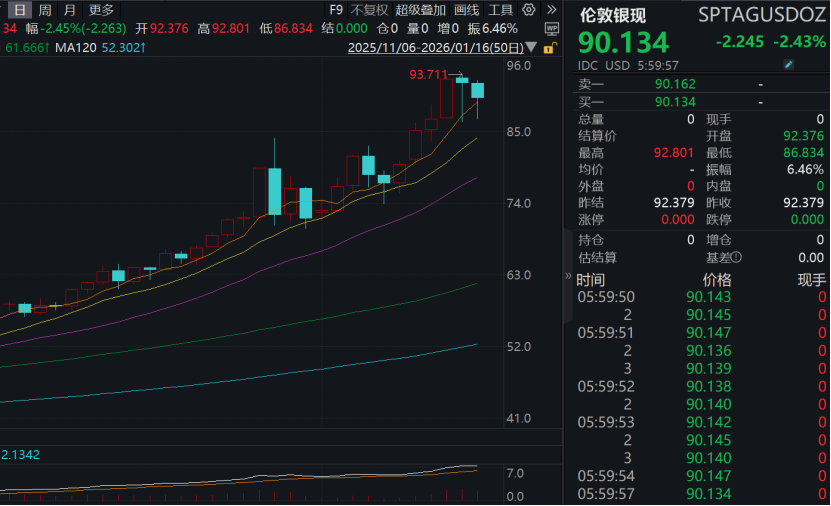
白银价格剧烈波动! 在经历了前期的疯狂上涨后,最近两个交易日,白银价格大幅波动。周四(1月15日)盘中,现货白银一度触及93.71 美元/盎司的历史新高,但随后大幅跳水,盘中跌幅一度超过7%,当天收盘时跌幅收窄至0.65%;周五(1月16日), 现货白银再度出现跳水行情,盘中跌幅一度超过6%,收盘时下跌2.43%,险守90美元/盎司关口。 对于白银接下来的走势,摩根大通表示,白银面临多重风险,其中包括工业需求受高价抑制、ETF资金持续流出等。 该行表示,白银市场回调风险较大,但黄金依然看涨。 不过,也有机构认为,长期以来,金银价格走势具备高度相关性。长期的避险情绪以及白银市场供应端的紧张状态不 会改变,白银价格上涨逻辑依然稳固。 白银价格盘中跳水 1月15日,白银价格一度下跌7.3%,随后收复大部分失地。此前四个交易日,白银暴涨超20%;1月16日,白银价格再 度剧烈波动,现货白银盘中跌幅一度超过6%,收盘时险守90美元/盎司。 彭博社称,美国总统特朗普未对包括白银和铂金在内的关键矿物进口全面加征关税,他表示将转而寻求双边谈判,并 提出了设定价格底线的构想。这一决定是在进行了长达数月的审查后作出的,旨在评估外 ...