采矿业

Search documents
中游一枝独秀——11月工业企业利润点评
一瑜中的· 2025-12-28 13:45
Core Viewpoint - The article emphasizes that the midstream sector is currently the standout performer in terms of profit growth and revenue, contrasting with the overall decline in industrial profits [4][5][24]. Group 1: Midstream Sector Performance - In November, the midstream sector showed a profit growth of 6.77%, the only sector with a positive growth rate among five sectors, while upstream and downstream sectors experienced declines of -9.52% and -48.04% respectively [5][13]. - The revenue growth for the midstream sector in November was 4.66%, outperforming other sectors [5][13]. - The equipment manufacturing sector, particularly in electronics, aerospace, and smart devices, significantly contributed to the midstream sector's profit growth, with specific industries seeing profits increase by 57.4% and 54.0% respectively [5][29]. Group 2: Overall Industrial Profit Data - In November, the overall profit of industrial enterprises decreased by 13.1%, a decline from the previous value of -5.5% [24]. - The inventory level as of November showed a year-on-year increase of 4.6%, up from 3.7% [24]. - The profit growth rates for state-owned enterprises, private enterprises, and foreign enterprises were -17.0%, -12.6%, and -7.3% respectively [24]. Group 3: Quantity and Price Analysis - The midstream sector's value-added growth rate in November was 7.36%, higher than the overall industrial growth rate of 4.8% [6][15]. - The Producer Price Index (PPI) for the midstream sector turned positive in November, marking the first month of positive growth since June 2024, with a month-on-month increase of 0.04% [7][18]. - The profit margin for the midstream sector in November was 5.7%, which is an improvement compared to the same period last year [7][18]. Group 4: Supply and Demand Dynamics - The supply-demand dynamics for the midstream sector have been improving, with a favorable difference between demand and investment growth rates compared to upstream and downstream sectors [8][22]. - The article predicts that midstream prices are likely to continue to recover, leading to further profit increases in the sector [8][22].


去库信号仍待观察
CAITONG SECURITIES· 2025-12-28 13:21
Profit Trends - In November, the profit of industrial enterprises decreased by 13.1% year-on-year, a significant drop from the previous value of -5.5%[5] - The profit margin for industrial enterprises in November was approximately 5.7%, which is significantly lower than seasonal levels[12] - The total profit for industrial enterprises in November was 676.6 billion yuan, marking the lowest level for the same period since 2021[12] Price and Cost Dynamics - The Producer Price Index (PPI) in November fell by 2.2% year-on-year, widening from a decline of 2.1% in October[9] - The cost per 100 yuan of revenue for industrial enterprises increased to 85.5 yuan, up by 0.16 yuan year-on-year[29] - The unit revenue expense for the first eleven months was 8.39 yuan, a slight decrease of 0.01 yuan year-on-year[32] Inventory Insights - As of the end of November, the inventory of finished products for industrial enterprises increased by 4.6% year-on-year, with a 0.9 percentage point rise from October[33] - The actual inventory growth rate, excluding PPI effects, was 6.8%, slightly up from 5.8% in October[33] - The PMI data indicated a divergence, showing a decrease in inventory while actual inventory levels were still rising, suggesting unclear signals regarding destocking[33] Sector Performance - The upstream mining sector showed significant improvement with revenue growth of 5.3% and profit growth of 24.4% in November[23] - The midstream intermediate goods manufacturing sector faced challenges, with revenue and profit growth rates of -10.7% and -21.2%, respectively[26] - The downstream consumer goods manufacturing sector reported a profit margin of 11.7%, but revenue and profit growth were both negative at -12.2% and -22.6%[27]
力量发展(01277.HK):附属公司与Minenet就金红石项目订立合作协议
Ge Long Hui· 2025-12-28 10:56
Core Viewpoint - The company has established a partnership for a titanium ore project in Sierra Leone, which is expected to enhance its competitive position in supplying high-quality raw materials to global industrial clients [1][2]. Group 1: Partnership and Project Details - The company’s subsidiary, Kinetic Development Metal Mining (SL) Limited, has signed a cooperation agreement with Minenet Company Limited for a titanium ore project in Sierra Leone [1]. - The project covers an area of approximately 117 square kilometers and has a mining license valid until February 25, 2049 [1]. - Metal Mining will invest and operate within a designated 50 square kilometer area, holding exclusive rights for exploration, mining, processing, and sales [1]. Group 2: Production Capacity and Investment - In the first phase, three production lines will be constructed, each with an annual processing capacity of over 2 million tons of raw ore, with an estimated investment of approximately $18 million [2]. - The expected annual output from these three lines is around 280,000 tons of heavy mineral sand, with a product distribution of 80% to Metal Mining and 20% to Minenet [2]. - If the initial production lines operate successfully, two additional lines will be constructed within twelve months, bringing the total to five lines [2]. Group 3: Market and Financial Projections - The heavy mineral sand is expected to contain 30%-45% titanium dioxide and is projected to be sold primarily to customers in China, with potential global sales depending on market conditions [3]. - The indicative average prices for the products are $410 per ton for heavy mineral sand, $960 per ton for titanium ore, $251 per ton for ilmenite, and $1,456 per ton for zircon [3]. - The estimated production cost for heavy mineral sand is approximately $200 per ton, with the project expected to commence production by September 2026 [3].
工业利润大幅下跌,产成品库存维持高增
Hua Lian Qi Huo· 2025-12-28 07:59
Report Summary 1. Report Industry Investment Rating No industry investment rating is provided in the report. 2. Core Views - **Industrial Sector**: In November 2025, industrial profit declined significantly, with a 13.1% year - on - year drop in the profits of large - scale industrial enterprises, mainly due to low PPI, cost pressure, weak demand in some industries, and high inventory pressure. There is a significant industry differentiation, with new kinetic energy industries such as equipment manufacturing and high - tech manufacturing growing rapidly, while traditional industries like upstream resource extraction and some mid - stream raw material manufacturing are under pressure [8]. - **Consumption and Real Estate**: In November 2025, the year - on - year increase in social retail总额 was 1.3%, with service and online consumption as the main growth drivers. The real estate market was under pressure, with both new and second - hand housing prices showing a downward trend in most cities [10]. - **Macroeconomic Indicators**: GDP growth showed certain fluctuations, and different industries had different contributions to GDP growth. Industrial added value, power consumption, and foreign trade also had their own characteristics and trends [13][38][92]. 3. Summary by Directory National Economic Accounting - **GDP Growth**: From 2023 to 2025, GDP quarterly year - on - year growth rates fluctuated. Different industries such as agriculture, forestry, animal husbandry, and fishery, industry, and services had different growth trends. For example, the service industry had a relatively high growth rate in some quarters [13]. - **Contribution to GDP**: Different industries had different contributions to the year - on - year growth of constant - price GDP. The industrial sector generally had a relatively large contribution [18]. Industry - **Industrial Growth**: In November 2025, the added value of large - scale industrial enterprises increased by 4.8% year - on - year and 0.44% month - on - month, with new kinetic energy industries growing significantly faster than the overall level [8]. - **Industrial Production Volume**: The production volumes of major industrial products such as crude oil, coal, and steel showed different trends. For example, in November 2025, the steel output decreased by 2.6% year - on - year [8]. - **Industrial Profit**: From January to November 2025, the total profit of large - scale industrial enterprises was 66268.6 billion yuan, a year - on - year increase of 0.1%. Different industries had different profit situations, with some industries like computer, communication, and other electronic equipment manufacturing showing growth, while others like coal mining and washing showed a decline [8][42]. - **Industrial Inventory**: As of the end of October 2025, the finished - product inventory of large - scale industrial enterprises reached 6.82 trillion yuan, a year - on - year increase of 3.7%. The inventory levels of different industries varied, with the inventory of the mining industry decreasing significantly and that of the mid - and downstream manufacturing industries increasing slightly [8][53]. Price Index - **CPI**: In November 2025, the national consumer price index increased by 0.7% year - on - year. Food prices increased by 0.2%, and non - food prices increased by 0.8% [60]. - **PPI**: In November 2025, the national industrial producer price index decreased by 2.2% year - on - year, with a month - on - month increase of 0.1%. Production material prices decreased by 2.4%, and living material prices decreased by 1.5% [68]. Real Estate - **New Residential Prices**: In November 2025, new residential prices in first - tier cities decreased by 1.2% year - on - year, with significant differentiation among cities. Second - and third - tier cities also saw price declines [78]. - **Second - hand Residential Prices**: In November 2025, second - hand residential prices in first - tier cities decreased by 5.8% year - on - year, and second - and third - tier cities also showed year - on - year declines [83]. Foreign Trade and Investment - **Import and Export**: In November 2025, China's total import and export value was 520.63 billion US dollars, a year - on - year decrease of 0.3%. Exports were 305.35 billion US dollars, a year - on - year decrease of 1.1%, and imports were 215.28 billion US dollars, a year - on - year increase of 1.0% [92]. - **Key Commodity Trade**: The export and import volumes of key commodities such as agricultural products, industrial raw materials, and mechanical and electrical products showed different trends [100][101]. Fixed - Asset Investment - **Overall Investment**: From January to November 2025, the national fixed - asset investment (excluding rural households) was 44403.5 billion yuan, a year - on - year decrease of 2.6%. There were differences in investment among different industries, with the first industry showing growth, the second industry having a certain increase, and the third industry showing a decline [115]. - **Real Estate Investment**: From January to November 2025, real estate development investment was 7859.1 billion yuan, a year - on - year decrease of 15.9%. The construction, new construction, completion, and sales areas of real estate also showed downward trends [123]. Domestic Trade - **Retail Sales**: The growth rate of social consumer goods retail总额 and service retail sales showed certain trends, with service and online consumption driving growth. The retail sales of different categories of products also had different performance [157][164]. Transportation - **Freight and Passenger Transport**: The freight and passenger transport volumes of different transportation modes such as rail, road, water, and air showed different trends. The freight rates of shipping also had fluctuations [167][178]. Banking and Currency - **Social Financing**: The new social financing scale and its components, as well as the year - on - year growth rate of social financing stock, showed different trends. The growth rates of M1 and M2 also changed, with the M1 - M2 scissors - difference showing a certain trend [182][198]. - **Interest Rates and Exchange Rates**: The central bank emphasized reasonable interest rate control to promote a stable decline in the financing cost of the real economy. The exchange rate of the RMB against the US dollar and the US dollar index also showed certain trends [207][217]. Fiscal and Employment - **Fiscal Revenue and Expenditure**: The general public fiscal revenue and expenditure of the central and local governments showed different trends. Fiscal revenue included tax and non - tax revenues, and fiscal expenditure included infrastructure and people's livelihood - related expenditures [232][233]. - **Employment**: The urban surveyed unemployment rate and the number of new urban employment showed certain trends [238]. Business Surveys - **Global Manufacturing PMI**: The global manufacturing PMI showed certain fluctuations, with different countries and regions having different performance [241]. - **China's Manufacturing and Non - Manufacturing PMI**: In November 2025, China's manufacturing PMI was 49.2%, showing a slight recovery but still in the contraction range. The non - manufacturing business activity index was 49.5%, in the contraction range [244][252]. US Macroeconomy - **GDP Growth**: The US real GDP showed different growth rates in different quarters, with private consumption, investment, and net exports having different contributions [259]. - **Employment**: The US new non - farm employment and unemployment rate showed certain trends [262]. - **Treasury Yields**: The yields of US Treasury bonds of different maturities and their yield curve inversion degree showed certain trends [267]. - **Retail Sales**: The year - on - year growth rate of US retail and food service sales showed certain trends, with different categories of products having different performance [270].
中游一枝独秀——11月工业企业利润点评
Huachuang Securities· 2025-12-28 04:14
Group 1: Overall Industrial Profit Trends - In November, the profit growth rate of industrial enterprises decreased to -13.1%, down from -5.5% in the previous month[2] - As of November, inventory increased by 4.6% year-on-year, compared to 3.7% in the previous month[2] - State-owned industrial enterprises saw a profit growth rate of -17.0%, while private enterprises had -12.6%, and foreign and Hong Kong, Macao, and Taiwan enterprises reported -7.3%[2] Group 2: Midstream Sector Performance - The midstream sector showed a profit growth rate of 6.77% in November, the only sector with positive growth, compared to -3.85% previously[5] - Midstream revenue growth was 4.66% in November, outperforming other sectors[5] - The midstream PPI turned positive for the first time since June 2024, with a month-on-month increase of 0.04%[19] Group 3: Industry-Specific Insights - The electronic equipment manufacturing industry saw a profit increase of 57.4%, driven by rapid development in aerospace and intelligent products[5] - The mining sector's profit growth was -21.16%, while manufacturing and electric heat, gas, and water sectors reported -13.54% and -1.59%, respectively[31] - The midstream sector's profit margin in November was 5.7%, higher than the previous year's 5.5%[19]
2025年11月工业企业盈利数据点评:盈利承压,分化加剧
EBSCN· 2025-12-27 12:07
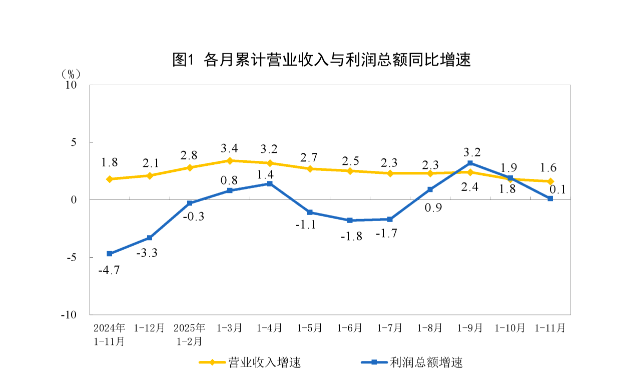
Profit Trends - In November 2025, industrial enterprise profits fell by 13.1% year-on-year, worsening from a decline of 5.5% in October 2025[4] - Cumulative profit growth for industrial enterprises from January to November 2025 was 0.1%, down from 1.9% for the first ten months[2] - Cumulative revenue growth for industrial enterprises from January to November 2025 was 1.6%, slightly down from 1.8% for the first ten months[2] Structural Analysis - Only the midstream equipment manufacturing sector showed stable profit growth, while upstream and downstream sectors experienced varying degrees of decline[3] - Cumulative profit growth for the mining sector from January to November 2025 was -27.2%, while manufacturing sector profit growth dropped to 5.0%[13] - The cumulative profit margin for the manufacturing sector was 4.62%, an increase of 0.08 percentage points compared to the previous year[13] Market Dynamics - The profit margin for industrial enterprises in November 2025 was 5.65%, a decrease of 0.73 percentage points year-on-year[5] - The cost per 100 yuan of revenue for large industrial enterprises increased by 0.18 yuan from January to November 2025[5] - The PPI (Producer Price Index) year-on-year growth rate in November 2025 was -2.2%, slightly down from -2.1% in October 2025[5] Future Outlook - Industrial profits are expected to remain under pressure in December 2025 due to high year-on-year comparisons[3] - The implementation of new policies in 2026 is anticipated to stimulate demand and support profit recovery for enterprises[29] - The midstream sector is projected to continue its positive profit trend, benefiting from "anti-involution" policies[3]
1-11 月工业企业利润点评:当出口链回暖遭遇利润率回落
Changjiang Securities· 2025-12-27 12:04
Group 1: Profit Trends - In November, the profit growth rate of industrial enterprises fell to -13.1% year-on-year, marking the weakest level since September 2024[5] - Revenue growth for the same month showed a slight improvement, decreasing by only -0.3% year-on-year[5] - The decline in profit growth is primarily attributed to a significant drop in profit margins, despite a recovery in volume growth[6] Group 2: Export and Industry Performance - While profits in export-related industries showed improvement, they did not offset the overall decline in profits across sectors[6] - The mining industry experienced a profit decline of -21.2%, while the manufacturing sector's profit growth rate fell to -13.5%[6] - The recovery in exports, particularly in electronics, automotive, and pharmaceuticals, contributed to a 5.9% year-on-year increase in exports, boosting overall profits by 4.98 percentage points[6] Group 3: Inventory and Operational Pressure - By the end of November, the nominal year-on-year growth rate of finished goods inventory rose to 4.6%, indicating a passive accumulation of inventory due to weak demand[6] - The turnover days for finished goods increased to 20.5 days, reflecting worsening operational pressures on enterprises[6] - The overall business pressure is expected to continue accumulating, with potential implications for the employment market[6] Group 4: Future Outlook - There is a significant possibility that policy measures will be implemented in early 2026 to stimulate growth and stabilize profits amid weakening external demand[6] - The upcoming national development and reform meeting emphasizes the need for proactive policy measures to ensure a strong start in 2026[6]
潮涌俄罗斯远东最小州
Xin Lang Cai Jing· 2025-12-27 04:16
Group 1: Infrastructure and Trade - The Sino-Russian cross-river railway bridge, located between China's Tongjiang and Russia's Nizhneleninskoye, spans approximately 2,200 meters and has been operational since November 2022 [1] - The bridge has an annual cargo capacity of about 21 million tons, with current annual import and export freight volume exceeding 5 million tons, primarily consisting of coal, iron ore, and consumer goods [1] - The Russian side is modernizing the railway port, planning to construct three new freight stations to enhance transportation capacity and promote trade growth between Russia and China [1] Group 2: Regional Development and Cooperation - The Jewish Autonomous Oblast, the smallest region in Russia's Far East, is leveraging its proximity to China and connection to the Trans-Siberian Railway to enhance its logistics potential [2] - The region's key industries include logistics, agriculture, mineral development, and tourism, with increasing cooperation and exchanges with China [2] - Recent visa-free policies for Chinese citizens traveling to Russia have led to a noticeable increase in Chinese tourists, contributing to local tourism and hospitality sectors [2] - The region is also fostering cultural cooperation with China, including hosting an international education forum and planning a skills competition for students [2]
重磅数据发布,连续四个月保持增长!
Zheng Quan Ri Bao Wang· 2025-12-27 04:14
Core Insights - The profit of industrial enterprises above designated size increased by 0.1% year-on-year in the first 11 months, maintaining a growth trend for four consecutive months since August [1] - The manufacturing sector grew by 5.0%, while the electricity, heat, gas, and water production and supply sector grew by 8.4%. However, the mining sector saw a decline of 27.2% [1] - The revenue of industrial enterprises above designated size increased by 1.6% year-on-year [1] Group 1: Equipment Manufacturing - The profit of the equipment manufacturing sector increased by 7.7% year-on-year, contributing 2.8 percentage points to the overall profit growth of industrial enterprises [2] - Seven out of eight major categories in the equipment manufacturing sector reported profit growth, with the railway, shipbuilding, and aerospace industries seeing profits grow by 27.8% and 15.0% respectively [2] - The automotive industry experienced a profit increase of 7.5%, accelerating by 3.1 percentage points compared to the previous ten months [2] Group 2: High-Tech Manufacturing - The profit of high-tech manufacturing increased by 10.0% year-on-year, outpacing the average growth of all industrial enterprises by 9.9 percentage points [3] - The "Artificial Intelligence+" initiative positively impacted related equipment manufacturing, with profits in the semiconductor equipment sector growing by 97.2% and electronic components by 46.0% [3] - The aerospace industry also saw significant profit growth, with aerospace equipment manufacturing profits increasing by 13.3%, including a 192.9% increase in space-related equipment manufacturing [3] Group 3: Raw Materials Manufacturing - The profit of the raw materials manufacturing sector grew by 16.6% year-on-year, contributing 2.0 percentage points to the overall profit growth of industrial enterprises [4] - The steel industry showed significant improvement in profitability, aided by low base effects, while the non-ferrous metals sector maintained double-digit profit growth due to increased market demand [4] - Overall, the profit growth trend of industrial enterprises is supported by new industrial dynamics, although challenges remain in the transition from old to new growth drivers [4]
工业利润累计增速连续4个月增长,装备制造业带动明显
Di Yi Cai Jing· 2025-12-27 02:34
Core Insights - In November, profits of industrial enterprises above designated size decreased by 13.1% year-on-year, with the decline expanding by 7.6 percentage points compared to the previous month [1] - From January to November, profits of industrial enterprises above designated size grew by 0.1%, maintaining a growth trend for four consecutive months since August [1] Group 1: Profit Trends - In the manufacturing sector, profits increased by 5.0% from January to November, while the electricity, heat, gas, and water production and supply sector saw an 8.4% profit growth [3] - The mining industry experienced a profit decline of 27.2%, although the decline was narrowed by 0.6 percentage points compared to the first ten months of the year [3] Group 2: Sector Performance - The equipment manufacturing sector significantly contributed to profit growth, with a 7.7% increase in profits from January to November, accounting for a 2.8 percentage point increase in overall industrial profits [3] - High-tech manufacturing profits accelerated, with a 10.0% year-on-year increase, surpassing the average growth rate of all industrial enterprises by 9.9 percentage points [3] - The raw materials manufacturing sector also saw a robust profit growth of 16.6%, contributing 2.0 percentage points to the overall industrial profit growth [4] Group 3: Future Outlook - The overall profit growth of industrial enterprises indicates a continued upward trend, supported by new industrial dynamics, although challenges remain due to international uncertainties and structural adjustments [5] - The Ministry of Industry and Information Technology has set goals for 2026, prioritizing the stabilization of the industrial economy, with an expected 5.9% year-on-year growth in industrial added value for the year [5] - Analysts predict that industrial profits may recover from low levels, potentially achieving around 10% growth by the end of 2026, indicating a shift from policy-driven to profit-driven market dynamics [5]