外汇

Search documents
日本长期债券遭抛售
第一财经· 2025-11-20 09:44
基准10年期日本国债收益率19日一度攀升0.04个百分点至1.78%,为2008年6月全球金融危机以来 的最高水平。20年期日本国债收益率升至2.795%,为1999年以来最高。30年期日本国债收益率盘 中甚至升至3.35%的历史新高。 2025.11. 20 本文字数:2516,阅读时长大约4分钟 作者 | 第一财经 后歆桐 封面图来源 | 新华社 随着日本政府公布1100亿美元规模的财政刺激计划,"高市交易"升级,日本长期债券遭抛售,10年 期日债收益率飙升至2008年金融危机以来最高水平,30年期日债收益率更创盘中历史新高。 这可能再次引发约20万亿美元的日元套利交易反转,威胁全球风险资产。 日本长债收益率升至数十年高位 分析师表示,推动日本国债收益率飙升的根本原因在于高市政府的财政刺激政策。18日,一个由与 高市关系密切的议员组成的日本执政党委员会小组提议编制一项超过25万亿日元(约合1610亿美 元)的补充预算,以资助高市计划推出的刺激方案。该提案称,政府"应当毫不犹豫地发行更多债 券",以资助在经济增长领域和危机管理方面的投资。该提议的金额将远远超过去年额外预算的13.9 万亿日元。一些日本官员随 ...


日本长期债券遭抛售,日元套利交易若反转,恐殃及全球流动性
Di Yi Cai Jing· 2025-11-20 09:33
Group 1 - The Japanese government has announced a $110 billion fiscal stimulus plan, leading to a sell-off of long-term Japanese bonds and a surge in yields, with the 10-year bond yield reaching its highest level since the 2008 financial crisis [1][4] - The proposed supplementary budget of over 25 trillion yen (approximately $161 billion) aims to fund the stimulus plan, significantly exceeding last year's additional budget of 13.9 trillion yen [4] - Analysts express concerns that the rising bond yields reflect a lack of confidence in Japan's sovereign debt sustainability, as the country's debt burden is about 250% of its GDP [5] Group 2 - The depreciation of the yen and rising bond yields may trigger a reversal of approximately $20 trillion in yen carry trades, posing a threat to global risk assets [3][7] - The yen has weakened against the dollar, falling below 155 yen for the first time since February, while the Nikkei 225 index experienced its largest single-day drop since April [5][6] - The Bank of Japan's potential delay in interest rate hikes, combined with fiscal expansion, could further pressure the yen and increase import costs, complicating the government's efforts to manage inflation [6][7] Group 3 - The rise in long-term Japanese bond yields could lead to forced liquidation of yen carry trades, which may impact global liquidity and risk assets [7][8] - Historical correlations suggest that unwinding yen carry trades could lead to declines in the S&P 500 and emerging market currencies, with potential drops of 1% to 3% in the latter within 30 days [8] - The tightening of liquidity may adversely affect all risk assets, including technology stocks and cryptocurrencies, as investors begin to hedge risks [8]

10月外汇市场分析报告:美元反弹无碍人民币升值,“双节”扰动消退
Bank of China Securities· 2025-11-20 08:47
Exchange Rate Trends - In October, the USD index rose by 2.1% to 99.8, influenced by the depreciation of major non-USD currencies and hawkish Fed rate cut expectations[3] - The RMB central parity rate appreciated by 175 basis points to 7.0880 against the USD, with onshore and offshore rates fluctuating around 7.1135 and 7.1224 respectively by month-end[4] - The CFETS RMB exchange rate index, BIS currency basket, and SDR currency basket indices increased by 0.9%, 1.2%, and 1.1% respectively, indicating a continued strengthening of the RMB against a basket of currencies[5] Cross-Border Capital Flows - In October, cross-border capital flows shifted from a small net outflow to a significant net inflow of $511 billion, marking a new high for the year[10] - The foreign exchange income and expenditure of banks decreased by $581 billion and $1,123 billion respectively, reflecting seasonal effects from the "Double Festival" holidays[10] - The RMB's foreign exchange payment returned to a surplus of $16 billion, with a significant increase of $414 billion from the previous month[10] Foreign Investment Dynamics - Foreign investment in RMB-denominated bonds decreased for the sixth consecutive month, with a reduction of 542 billion yuan, indicating a cautious approach from foreign investors[11] - In October, foreign capital inflow into the Chinese stock market slowed to $22 billion, down from previous months' higher inflows[12] - The net inflow of foreign securities investment in emerging markets was $269 billion, with $94 billion flowing into markets outside of China, highlighting a shift in investor focus[12] Market Sentiment and Risks - The market sentiment showed increased risk aversion due to geopolitical tensions and uncertainties in monetary policy adjustments by major central banks[2] - The report warns of potential risks from geopolitical factors, unexpected changes in central bank policies, and domestic economic recovery falling short of expectations[40]
美联储降息预期生变,美元兑印度卢比为何应声跳涨?
Sou Hu Cai Jing· 2025-11-20 06:45
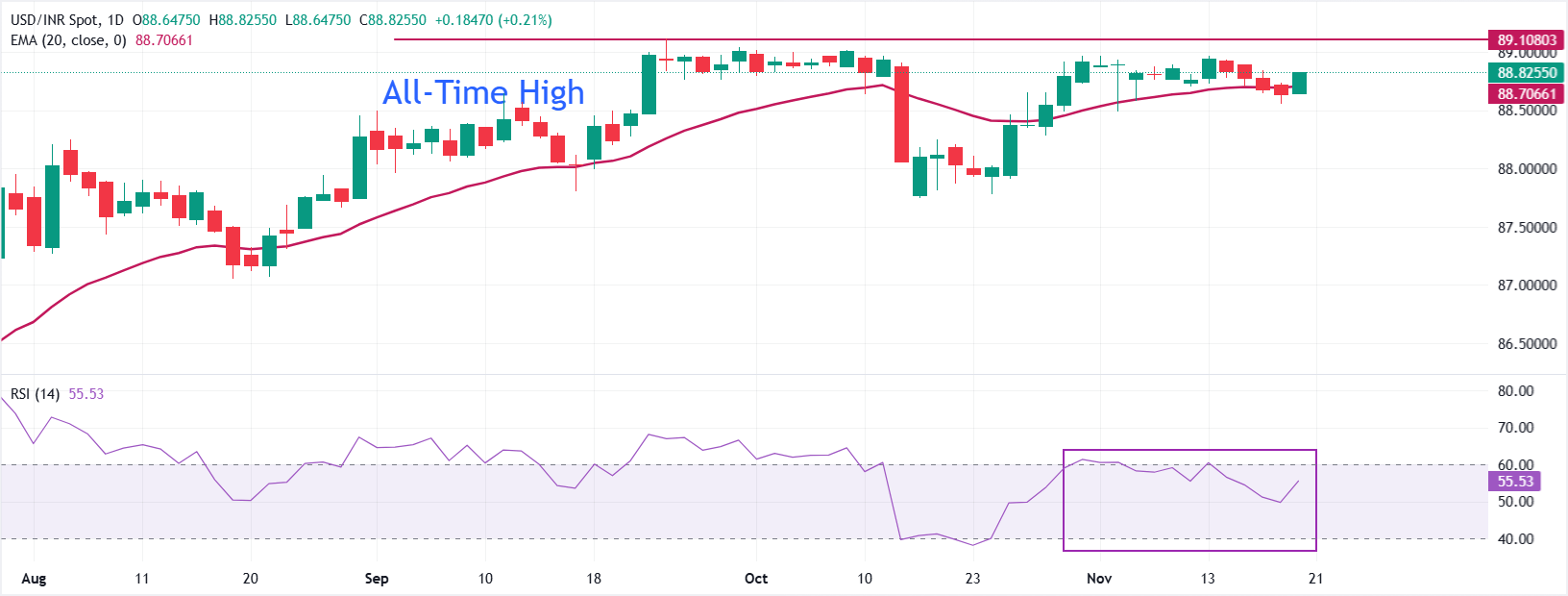
Core Insights - The recent surge in the exchange rate, approaching 88.80, is primarily influenced by the overall strength of the US dollar and market adjustments to Federal Reserve monetary policy expectations [1][2]. Policy Background and Market Expectations - In October, the Federal Reserve lowered interest rates by 25 basis points to a range of 3.75%-4.00%, with most policymakers favoring rate stability to avoid hindering inflation's return to the 2% target [2]. - Disagreements emerged among officials regarding further rate cuts during the December meeting, with some arguing that continued easing could elevate inflation expectations and undermine public confidence in achieving inflation targets [2]. - Market tools indicate that the probability of a 25 basis point cut to 3.50%-3.75% in December dropped from 50.1% to 32.8%, reflecting a significant re-evaluation of monetary policy expectations [2]. Dollar Index and Exchange Rate Dynamics - The dollar index recently reached a five-month high of approximately 100.40, indicating the dollar's strength against a basket of currencies, which has supported the rise of the dollar against the Indian rupee [3]. - The dollar's strength is attributed to market expectations of sustained high interest rates by the Federal Reserve and uncertainties in the global economic environment [3]. Technical Analysis Perspective - Technically, the dollar-rupee exchange rate found support near the 20-day exponential moving average, ending a four-day decline, with the average positioned around 88.70 [5]. - Momentum indicators show the 14-day Relative Strength Index (RSI) has rebounded to around 60.00, suggesting potential bullish momentum if it remains above this level [5]. - Key support is identified at the August 21 low of 87.07, while the historical high of 89.12 is noted as a critical resistance level to watch [5].
美联储鹰派托底震荡上行
Jin Tou Wang· 2025-11-20 03:06
Core Viewpoint - The fluctuations in the US Dollar Index are primarily driven by the Federal Reserve's policy direction, the relative resilience of the US economy, and the divergence in non-USD currencies [2]. Group 1: Economic Indicators - The October core PCE inflation rate fell to 3.5%, which was below expectations, leading multiple Federal Reserve officials to emphasize the need to maintain restrictive interest rates to solidify anti-inflation achievements [2]. - The annualized GDP growth for Q3 was reported at 2.9%, indicating a relatively strong economic resilience, which further enhances the attractiveness of the US dollar [2]. Group 2: Currency Dynamics - The Eurozone faces rising risks of economic stagnation, while the Bank of Japan continues its accommodative stance, and the British pound is pressured by the weakness of the UK economy, collectively exerting downward pressure on non-USD currencies [2]. - The overall weakness in non-USD currencies indirectly supports the upward movement of the US Dollar Index [2]. Group 3: Technical Analysis - The US Dollar Index has entered a bullish channel after rebounding from a low of 99.50, currently stabilizing above the key support level of 100.20, with the latest quote at 100.246 [3]. - Key support levels are identified at 100.20, 100.10, and the 50-hour moving average around 100.05, while resistance is concentrated at 100.30, 100.40, and the previous upper boundary of 100.50 [3]. - Technical indicators suggest a strengthening upward trend for the index, with MACD showing a slight increase in bullish momentum and the average directional index rising to around 22 [3].
日本遭遇股债汇“三杀”
Xin Hua She· 2025-11-19 11:52
在东京债券市场,日本长期国债普遍因遭到抛售而价格下跌,导致收益率不断上扬,接连突破历史高 点。19日,由于投资者购债意欲低下,作为长期利率指标的新发行10年期国债收益率一度升至 1.775%,为2008年6月以来最高。 在东京外汇市场,自高市当选日本自民党总裁进而当选日本首相后,日元重新进入下降通道,不断走 软。近日,由于媒体纷纷报道日本政府拟推出大规模财政刺激计划,日元贬值势头再度加剧,日元对美 元汇率下探至1美元兑换155日元左右。(完) 新华社东京11月19日电(记者刘春燕)由于日本首相高市早苗力推积极财政政策并主张保持宽松货币政 策等多重因素,投资者对日本政府财政状况恶化的忧虑不断上升,日本金融市场连日来遭遇股债汇"三 杀"。 截至19日,东京股市两大股指连续4个交易日下跌,日经股指累计下跌2700多点。投资者担心高市早苗 日前发表的涉台严重错误言论导致日中关系持续恶化,不仅百货、运输、酒店等与入境消费关系密切的 行业股票大跌,一些倚重中国市场的公司股票也因业绩前景难料遭到投资者抛售。此外,由于纽约股市 近日频繁调整,三大股指多次全面下跌,日本股市很多投资者选择获利了结、离场观望。 责任编辑:刘万里 ...
英经济数据真空期 美元波动成主导
Jin Tou Wang· 2025-11-19 02:36
Group 1 - The core viewpoint of the articles indicates that the GBP/USD exchange rate is experiencing a weak market consolidation, trading at 1.3130, down 0.11% from the previous day's close, with a narrow trading range of 1.3125-1.3150 [1] - The upcoming UK October CPI data is expected to significantly influence the Bank of England's future monetary policy path, as current UK economic data is in a phase of stagnation [1] - The fluctuations in the US dollar index are identified as a key variable affecting the short-term movements of the GBP, with ongoing divisions within the Federal Reserve regarding interest rate cuts impacting market expectations [1] Group 2 - Technical analysis shows that GBP/USD has been trading within a narrow range of 1.3125-1.3160 for three consecutive days, indicating a stalemate between bulls and bears [2] - The primary resistance level is set at 1.3150, and a breakthrough could open up upward movement towards 1.3180, while support is focused on 1.3125, with a potential drop to 1.3100 if breached [2] - The daily chart indicates that the exchange rate is still in a correction phase following a previous rebound, with bearish momentum showing signs of weakening but not fully dissipated [2]
大类资产早报-20251119
Yong An Qi Huo· 2025-11-19 01:39
Global Asset Market Performance - The latest yields of 10 - year government bonds in major economies: US 4.114, UK 4.553, France 3.457, Germany 2.706, Italy 3.456, Spain 3.208, Switzerland 0.138, Greece 3.332, Japan 1.739, Brazil 6.245, China 1.805, Australia 4.441, New Zealand 4.150 [2] - The latest yields of 2 - year government bonds in major economies: US 3.574, UK 3.795, Germany 2.017, Japan 0.918, Italy 2.214, China (1Y yield) 1.410, Australia 3.668 [2] - The latest exchange rates of the US dollar against major emerging - economy currencies: Brazil 5.324, South Africa zar 17.185, South Korean won 1462.250, Thai baht 32.440, Malaysian ringgit 4.163 [2] - The latest values of on - shore RMB 7.109, off - shore RMB 7.111, RMB central parity rate 7.086, RMB 12 - month NDF 6.967 [2] - The latest values of major economies' stock indices: S&P 500 6617.320, Dow Jones Industrial Average 46091.740, NASDAQ 22432.850, Mexican stock index 61984.450, UK stock index 9552.300, French CAC 7967.930, German DAX 23180.530, Spanish stock index 15827.000, Japanese Nikkei 48702.980, Hong Kong Hang Seng Index 25930.030, Shanghai Composite Index 3939.813, Taiwan stock index 26756.120, South Korean stock index 3953.620, Indian stock index 8361.926, Thai stock index 1270.040, Malaysian stock index 1614.060, Australian stock index 8738.270, emerging - economy stock index 1361.750 [2] - The latest values of credit - bond indices: Eurozone investment - grade credit - bond index 265.631, Eurozone high - yield credit - bond index 406.730 [2] Stock Index Futures Trading Data - Index performance: A - share closing price 3939.81 (down 0.81%), CSI 300 closing price 4568.19 (down 0.65%), SSE 50 closing price 3003.02 (down 0.30%), ChiNext closing price 3069.22 (down 1.16%), CSI 500 closing price 7151.02 (down 1.17%) [3] - Valuation: PE (TTM) of CSI 300 14.06 (down 0.08), SSE 50 11.90 (down 0.03), CSI 500 32.57 (down 0.41), S&P 500 27.51 (down 0.23), German DAX 17.98 (down 0.32) [3] - Risk premium: 1/PE - 10 - year interest rate of S&P 500 - 0.48 (up 0.06), German DAX 2.86 (up 0.11) [3] - Fund flow: Latest A - share fund flow - 1462.75, motherboard - 1190.40, ChiNext - 214.75, CSI 300 - 225.97; 5 - day average A - share fund flow - 712.73, motherboard - 585.51, ChiNext - 90.24, CSI 300 - 119.58 [3] - Transaction amount: Latest transaction amount of Shanghai and Shenzhen stock markets 19260.68 (up 152.77), CSI 300 4201.50 (down 187.90), SSE 50 1062.01 (down 56.04), SME board 4127.54 (up 19.72), ChiNext 5015.67 (up 149.23) [4] - Main contract basis: IF basis - 13.19 (down 0.29%), IH basis - 5.42 (down 0.18%), IC basis - 71.22 (down 1.00%) [4] Treasury Bond Futures Trading Data - Closing prices of treasury bond futures: T2303 108.50 (up 0.01%), TF2303 105.92 (up 0.01%), T2306 108.25 (up 0.01%), TF2306 105.89 (unchanged) [4] - Fund interest rates: R001 1.5711% (up 4.00 BP), R007 1.5294% (unchanged), SHIBOR - 3M 1.5800% (unchanged) [4]
大类资产早报-20251118
Yong An Qi Huo· 2025-11-18 01:38
Global Asset Market Performance - On November 17, 2025, the 10 - year treasury bond yields of major economies varied, with the US at 4.140%, UK at 4.534%, etc. The latest changes, weekly, monthly, and yearly changes also differed among countries. For example, the US 10 - year treasury bond yield had a latest change of - 0.009, a weekly change of 0.023, a monthly change of 0.159, and a yearly change of - 0.188 [3] - The 2 - year treasury bond yields also showed different trends. For instance, China (1Y) was 3.580% on November 17, 2025, with corresponding changes over different time periods [3] - The exchange rates of the US dollar against major emerging economies' currencies had various changes. For example, against the South African zar, the latest change was 0.58%, and the yearly change was - 6.37% [3] - The performance of major economies' stock indices on November 17, 2025, showed declines in most cases. For example, the Dow Jones had a latest change of - 0.92%, and a weekly change of - 2.34% [3] - The credit bond indices of different types (emerging economies' investment - grade, high - yield, etc.) had different values and changes on November 17, 2025. For example, the emerging economies' investment - grade credit bond index was 3516.030, with a latest change of 0.05% [3] Stock Index Futures Trading Data - On November 17, 2025, the closing prices of A - shares, CSI 300, SSE 50, ChiNext, and CSI 500 were 3972.03, 4598.05, 3012.07, 3105.20, and 7235.35 respectively, with corresponding percentage changes [4] - The PE (TTM) values of CSI 300, SSE 50, CSI 500, S&P 500, and German DAX were 14.14, 11.93, 32.98, 27.74, and 18.30 respectively, with环比 changes [4] - The risk premiums and their环比 changes of S&P 500 and German DAX were - 0.54 and 2.75 respectively, with环比 changes of 0.04 and 0.07 [4] - The latest values and 5 - day average values of capital flows in A - shares, main boards, etc., showed different trends. For example, the latest value of A - share capital flow was - 543.55, and the 5 - day average was - 629.80 [4] - The latest trading volumes and环比 changes of Shanghai and Shenzhen stock markets, CSI 300, etc., were provided. For example, the latest trading volume of Shanghai and Shenzhen stock markets was 19107.91, with a环比 change of - 472.88 [4] - The basis and amplitude of the main contracts of stock index futures (IF, IH, IC) were - 16.65, - 2.87, - 91.95 and - 0.36%, - 0.10%, - 1.27% respectively [4] Treasury Bond Futures Trading Data - On November 17, 2025, the closing prices of treasury bond futures T00, TF00, T01, TF01 were 108.485, 105.905, 108.240, 105.885 respectively, with no percentage changes [5] - The capital interest rates (R001, R007, SHIBOR - 3M) were 1.5596%, 1.5321%, 1.5800% respectively, with daily changes (BP) of 7.00, 4.00, 0.00 [5]
投资总失败?昂首资本教你像聪明投资者一样,先考虑如何不赔钱
Sou Hu Cai Jing· 2025-11-18 00:28
Core Insights - The principle of prioritizing loss prevention over profit generation is crucial for successful investing, particularly for investors using platforms like Ango Capital [1][3] - Successful investors differ significantly from poor investors in their mindset, focusing on retaining profits rather than chasing quick gains [3] Investment Principles - Many investors fail due to a lack of a disciplined decision-making framework, often driven by the desire for rapid wealth accumulation [3] - The misconception that economic improvement or bull markets will resolve financial issues leads to misguided investment strategies [3] - Investors should focus on proven investment facts and principles rather than emotional reactions to losses [3] Behavioral Insights - The tendency to rush back into the market after losses, driven by the fear of missing out on potential profits, is a common pitfall among investors [3] - The article emphasizes that understanding the importance of loss prevention is essential for achieving long-term success in investing [1][3]