工业金属

Search documents
宏观经济专题研究:张图看大宗品开年狂欢
Guoxin Securities· 2026-01-09 07:35
Group 1: Market Trends - The global commodity market has entered a structural uptrend since late 2025, led by industrial and precious metals, while traditional cyclical products have shown lackluster performance[1] - LME copper prices surged from under $8,000/ton to over $13,000/ton, a cumulative increase of over 60%, despite the US manufacturing PMI remaining in a contraction zone of 48.2%-48.3%[2] - The divergence between commodity prices and manufacturing demand indicates a decoupling from traditional manufacturing cycles, driven by geopolitical uncertainties and supply chain security concerns[16] Group 2: Demand Dynamics - The current market features extreme differentiation among commodities, with indicators like the copper-oil ratio exceeding two standard deviations, reflecting a fundamental shift in global economic growth models[3] - The transition from a traditional growth model centered on real estate and infrastructure to a digital economy model focused on "computing power + electricity" is creating new demand chains for commodities[3] - Major tech companies are expected to maintain over 20% capital expenditure growth in AI infrastructure, significantly impacting demand for conductive materials like copper and silver[31] Group 3: Future Outlook and Risks - The commodity market is entering a new paradigm driven by "computing power + security," where geopolitical risks create a safety premium, enhancing the financial attributes of commodities[4] - Short-term risks include potential price corrections for certain commodities that have surged too quickly, possibly overextending future demand expectations[4] - Economic indicators show a decline in fixed asset investment at -2.6% year-on-year, while retail sales and exports have shown modest growth of 1.3% and 5.9% respectively[7]
宜安科技涨2.29%,成交额5.53亿元,主力资金净流出4359.64万元
Xin Lang Cai Jing· 2026-01-09 06:48
Group 1 - The core viewpoint of the news is that Yian Technology's stock has shown a positive trend in recent trading sessions, with a notable increase in share price and trading volume [1] - As of January 9, Yian Technology's stock price increased by 2.29% to 17.83 CNY per share, with a total market capitalization of 12.31 billion CNY [1] - The company has experienced a year-to-date stock price increase of 4.45%, with a 10.75% increase over the past 20 days and a 14.44% increase over the past 60 days [1] Group 2 - For the period from January to September 2025, Yian Technology reported a revenue of 1.164 billion CNY, reflecting a year-on-year decrease of 1.75%, and a net profit attributable to shareholders of 343,000 CNY, down 86.02% year-on-year [2] - The company has a total of 57,200 shareholders as of September 30, 2025, which is an increase of 33.81% from the previous period, while the average number of circulating shares per shareholder decreased by 25.19% to 12,016 shares [2] - Yian Technology has distributed a total of 158 million CNY in dividends since its A-share listing, with 2.071 million CNY distributed over the past three years [3]

ETF盘中资讯|受益于商业航天热潮,小金属大涨!有色ETF华宝(159876)大涨3.5%创新高!厦门钨业等3股涨停!
Sou Hu Cai Jing· 2026-01-09 06:27
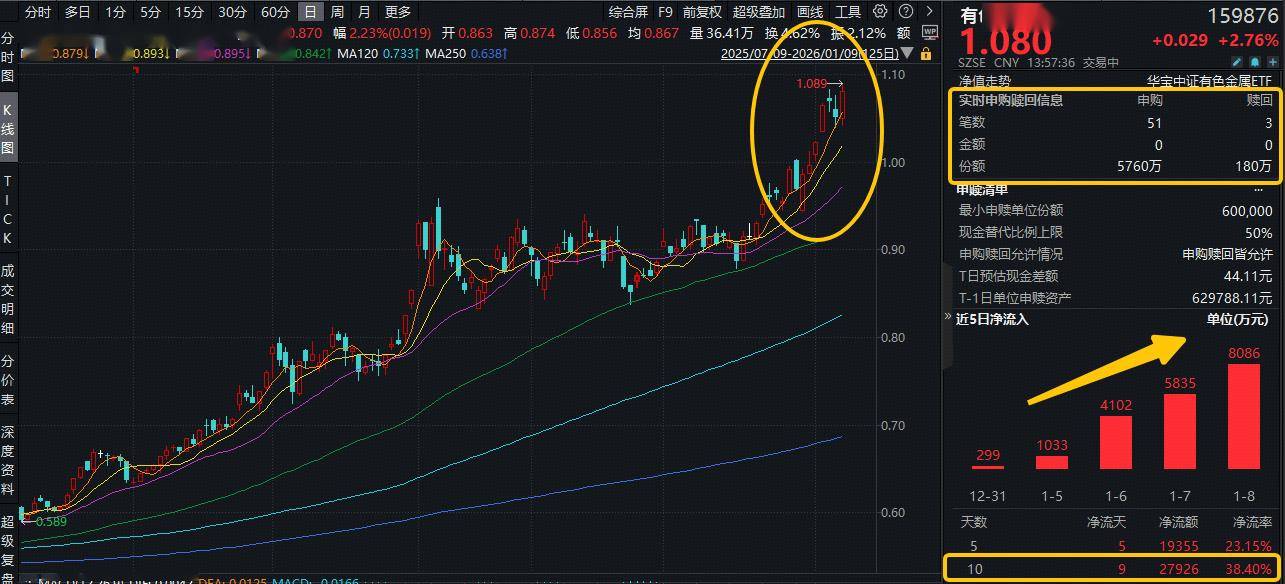
Core Viewpoint - The non-ferrous metal sector is experiencing a significant surge, with the Huabao Non-Ferrous ETF (159876) reaching a historical high and attracting substantial capital inflows [1] Group 1: Market Performance - On January 9, the Huabao Non-Ferrous ETF saw an intraday price increase of over 3.5%, setting a new historical high [1] - The ETF has received a net subscription of 55.8 million units, with a total capital inflow of 194 million yuan over the past five days, and 279 million yuan over the last ten days [1] - The top-performing stocks within the ETF include Hai Liang Co. (10.02% increase), Xiamen Tungsten (10.00% increase), and Yunnan Pig Industry (10.01% increase) [2] Group 2: Commodity Price Trends - Recent price increases have been noted in various minor metal products, particularly tungsten, with black tungsten concentrate (≥65%) priced at 485,000 yuan/ton, a 5.4% increase week-on-week, and tungsten powder at 1,130 yuan/kg, a 6.5% increase week-on-week [2] - Analysts indicate that the tungsten market is supported by supply constraints due to lower ore grades, controlled mining volumes, and sellers' reluctance to sell, alongside global demand for strategic resources [3] Group 3: Economic Outlook - Current market conditions are characterized by a "slump phase" in the fifth Kondratiev wave cycle, with expectations that commodities will benefit as the previous technology cycle peaks and a new one is still developing [3] - The U.S. economy faces recession pressures, which may lead to a reevaluation of commodities like gold and copper as global assets, potentially increasing their valuations [3] - In a context of loose liquidity and frequent supply disruptions, copper, aluminum, gold, and strategic metals are expected to maintain upward trends through 2026 [3] Group 4: Investment Opportunities - The Huabao Non-Ferrous ETF and its linked funds cover a wide range of sectors including copper, aluminum, gold, rare earths, and lithium, allowing investors to capture the overall sector's beta performance [4] - Notable stocks in the commercial aerospace sector, such as Hai Liang Co., Yunnan Zhiye, and Xiamen Tungsten, have shown significant gains, with some reaching their daily limit [5]


受益于商业航天热潮,小金属大涨!有色ETF华宝(159876)大涨3.5%创新高!厦门钨业等3股涨停!
Xin Lang Cai Jing· 2026-01-09 06:09
Group 1 - The non-ferrous metal sector is experiencing significant growth, with the Huabao Non-ferrous ETF (159876) rising over 3.5% on January 9, reaching a historical high [1][8] - The ETF has attracted a net subscription of 55.8 million units, with a total inflow of 194 million yuan over the past five days and 279 million yuan over the last ten days [1][8] - Prices for tungsten have notably increased, with black tungsten concentrate (≥65%) priced at 485,000 yuan/ton, up 5.4% week-on-week, and tungsten powder at 1,130 yuan/kg, up 6.5% week-on-week, both reaching historical highs [1][10] Group 2 - Analysts indicate that the entire tungsten product line is expected to rebound after a brief correction by the end of 2025, driven by supply constraints and global demand for strategic resources [12] - The current economic cycle is characterized as a "slump phase" within the fifth Kondratiev wave, where traditional tech benefits are peaking and new technologies like AI are still emerging, suggesting that commodity assets may benefit [12] - The U.S. faces recession pressures, with high sovereign debt and trade deficits weakening the dollar's credibility, leading to increased interest in gold as a global standard, which may also positively impact the valuation of other commodities like copper [12] Group 3 - Concept stocks providing non-ferrous metals for commercial aerospace have significantly outperformed, with HaiLiang Co., Yunnan Zhenye, and Xiamen Tungsten all hitting the daily limit [3][10] - Major stocks such as Shandong Gold and Luoyang Molybdenum have also shown strong performance, with increases of over 5% and 4% respectively [3][10] Group 4 - The Huabao Non-ferrous ETF and its linked funds comprehensively cover various sectors including copper, aluminum, gold, rare earths, and lithium, allowing for better capture of the sector's beta trends [5][13] - The ETF's index includes precious metals (for hedging), strategic metals (for growth), and industrial metals (for recovery), catering to different economic cycles [5][13]
紫金矿业涨2.01%,成交额21.73亿元,主力资金净流入1.63亿元
Xin Lang Cai Jing· 2026-01-09 02:10
Core Viewpoint - Zijin Mining has shown a significant increase in stock price and financial performance, indicating strong market interest and operational growth [1][2]. Group 1: Stock Performance - On January 9, Zijin Mining's stock price rose by 2.01%, reaching 37.03 CNY per share, with a trading volume of 2.173 billion CNY and a turnover rate of 0.29%, resulting in a total market capitalization of 984.618 billion CNY [1]. - Year-to-date, Zijin Mining's stock has increased by 7.43%, with a 7.43% rise over the last five trading days, a 20.42% increase over the last 20 days, and a 19.53% increase over the last 60 days [1]. Group 2: Financial Performance - For the period from January to September 2025, Zijin Mining reported a revenue of 254.2 billion CNY, reflecting a year-on-year growth of 10.33%, and a net profit attributable to shareholders of 37.864 billion CNY, which is a 55.45% increase compared to the previous year [2]. Group 3: Shareholder Information - As of September 30, 2025, Zijin Mining had 529,800 shareholders, an increase of 57.83% from the previous period, with an average of 0 circulating shares per shareholder [2]. - The company has distributed a total of 59.277 billion CNY in dividends since its A-share listing, with 27.772 billion CNY distributed over the last three years [3]. - Major shareholders include Hong Kong Central Clearing Limited, holding 1.354 billion shares (a decrease of 235 million shares), and China Securities Finance Corporation, holding 691 million shares (unchanged) [3].

大类资产配置月报:攻防兼备,择机布局-20260108
Guo Yuan Qi Huo· 2026-01-08 13:12
Report Industry Investment Rating No relevant content provided. Core Viewpoints of the Report - In 2026, the equity market is expected to start a new upward wave in Q1, with a long - position overweight strategy for the stock index. The bond market may continue its weak performance at the beginning of 2026 but could have a rebound after the Spring Festival, with a short - position hedge before the Spring Festival and a long - position underweight after. Commodities should be structurally allocated, with long - position overweight on precious metals, non - ferrous metals, and new energy commodities, long - position standard allocation (timing) on black building materials and agricultural products, and short - position standard allocation on crude oil [4]. Summary by Relevant Catalogs 1. Review of the Performance of Major Asset Classes - **Equity Market**: In December 2025, the A - share market oscillated upward, switching back to the growth - oriented style. Most primary industry indices rose, with national defense, communications, non - ferrous metals, non - bank finance, and machinery leading the monthly gains [8][10]. - **Bond Market**: The performance of short - and long - term bonds diverged. Short - term Treasury yields declined while long - term yields increased, and the Treasury term spread widened significantly. By December 31, 2025, the 2 - year and 5 - year Treasury yields dropped to 1.3605% and 1.3830% respectively, while the 10 - year and 30 - year yields rose to 1.8473% and 2.2674% [13]. - **Commodities**: The prices of domestic commodity futures were differentiated, with precious metals leading the gains. As of December 28, 2025, the precious metals index soared 14.38%, the metal index rose 6.18%, the industrial products index increased 1.44%, and the agricultural products index slightly declined 0.59% [17]. 2. Outlook and Analysis of Major Asset Classes - **Macroeconomic Aspect**: Abroad, the probability of further interest rate cuts by the Fed may decrease. Domestically, the probability of interest rate cuts in Q1 2026 is low, but a reserve requirement ratio cut is still expected [19][28]. - **Equity Assets**: In the short - to - medium term, the cross - year market has started, and the equity market is expected to start a new upward wave in Q1 2026. In the long - term, the policy and liquidity environment in 2026 are favorable to the market [31][32]. - **Bond Assets**: The bond market may continue its weak performance at the beginning of 2026, with the upper limit of the 10 - year Treasury yield before the Spring Festival likely between 1.90% - 1.95%. After the Spring Festival, there may be an oversold rebound opportunity [35][36]. - **Commodities**: The differentiation pattern of commodities will continue. Crude oil may remain weak after a short - term rebound. Industrial metals may face supply - demand imbalance, and agricultural product prices may fluctuate more due to various factors. Precious metals may experience significant short - term fluctuations but maintain an upward long - term trend [37][38]. 3. Allocation Strategies for Major Asset Classes - **Domestic Stock Index**: In 2026, the equity market should be strategically allocated, with a long - position overweight in January. Focus on industries such as the AI industry chain, leading companies going global, industries with improved supply - demand relationships, and the industrialization of cutting - edge technologies [40]. - **Commodities**: Increase the weight of commodities in the asset allocation. Overweight precious metals, non - ferrous metals, and new energy commodities; standard - allocate black building materials and agricultural products (timing); and short - allocate crude oil [41][42]. - **Treasury Bonds**: Hedge with short positions before the Spring Festival and underweight long positions after the Spring Festival. The bond market will remain volatile in 2026 and should be under - allocated [43].
Radex Markets 瑞德克斯:金属价格反弹市场观察
Xin Lang Cai Jing· 2026-01-08 10:51
Group 1: Precious Metals Market - The precious metals sector has shown strong bullish momentum at the beginning of the year, with gold making a significant upward gap that has not been filled, serving as a springboard for further price increases [1][4] - Spot gold is making a strong push towards the psychological barrier of $4500 per ounce, driven by sudden fluctuations in geopolitical situations that have led to a surge in safe-haven investments in the commodity market [1][4] - Silver has outperformed gold, with a cumulative increase of over 10% since the beginning of the week, closing above the important level of $80 per ounce [4] Group 2: Industrial Metals - Industrial metals are also participating in the upward trend, with platinum and palladium rising in high correlation with silver [4] - Copper futures have reached a historical peak of $6 per pound, supported by expectations of global infrastructure and industrial recovery [4] Group 3: Energy Market - The energy market is experiencing a divergence in price trends, with Brent crude oil falling to around $60 per barrel, influenced by unexpected supply increases from Venezuela [2][4] - Major energy companies like Chevron have seen their stock prices quickly retreat after initial surges, indicating a cautious attitude from investors towards the oil sector [2][4] Group 4: Equity Market - The U.S. stock market shows high risk appetite, with the Dow Jones Industrial Average reaching historical highs and closing above 49,000 points [2][5] - The S&P 500 index has also set new records, while the semiconductor sector, particularly companies like SanDisk and Micron Technology, has seen significant gains of 28% and 10% respectively, indicating positive changes in demand within the semiconductor cycle [5] Group 5: Market Outlook - The market is closely monitoring upcoming economic data, including December ADP employment figures and ISM services PMI, to assess whether the U.S. economy can support current high valuations [3][5] - The current market environment is characterized by a coexistence of high returns and high volatility, prompting the need for strict risk control measures while pursuing opportunities in metal price rebounds and U.S. stock trends [3][5]

白银提前大跳水?一文了解将发生什么
Feng Huang Wang· 2026-01-08 10:01
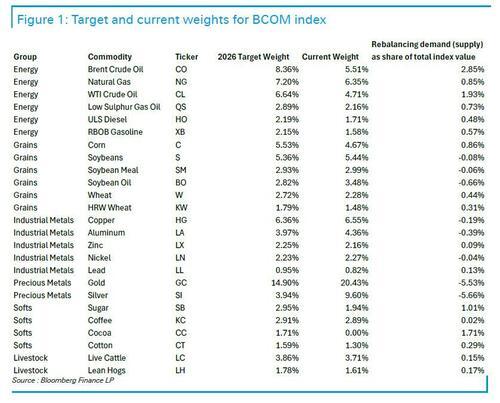
Core Viewpoint - The upcoming rebalancing of the Bloomberg Commodity Index (BCOM) is expected to negatively impact precious metals like gold and silver, while benefiting crude oil and other energy commodities [2][4]. Group 1: Market Predictions - Daniel Ghali from TD Securities predicted a potential 13% sell-off of open contracts in the COMEX silver market, leading to a significant drop in silver prices and ongoing liquidity issues [1]. - Hsueh from Deutsche Bank indicated that the rebalancing could result in a downward adjustment of gold's weight from 20.4% to 14.9%, and silver's weight from 9.6% to 3.94% [2][3]. Group 2: Rebalancing Details - The BCOM rebalancing will occur from January 9 to January 15, 2024, and will not be completed in a single day [5]. - The largest supply impact from the rebalancing is expected to come from silver, aluminum, and gold, while the largest demand impact will be seen in WTI crude oil, natural gas, and low-sulfur diesel [5]. Group 3: Historical Context - Historical data shows that significant weight changes in the BCOM have generally correlated with price movements of the respective commodities, with the exception of gold in the previous year [8]. - The estimated impact of a 2.4 million ounces gold sell-off could lead to a price decrease of 2.5% to 3.0%, depending on the analysis method used [7].
天弘基金策略会:AI投资正向应用端扩散;把握再工业化下的“铜锂”机遇
Sou Hu Cai Jing· 2026-01-08 07:52
Group 1 - The global economy is experiencing a "divergence" and "restructuring," with AI transitioning from capital expenditure to application implementation, driven by large-scale fiscal investments and manufacturing return [2] - The U.S. has positioned AI as a strategic core for scientific breakthroughs and national security, focusing on advanced manufacturing, quantum technology, biomanufacturing, chips, new materials, and nuclear fusion, which align with China's "14th Five-Year Plan" priorities [2] - Global industrial chains are undergoing profound restructuring due to geopolitical changes, technological transformations driven by AI, and sustainable development initiatives [2] Group 2 - China's outbound investment process shows similarities to Japan's in the late 1980s, indicating significant potential for further expansion [3] - In 2025, various funding channels are expected to support the A-share market, with structural highlights in China's economy benefiting public and private fund holdings [3] - Investment focus is shifting from "hard" AI to "soft" applications, with current emphasis on computing chips and infrastructure, and future expansion into AI software and green energy sectors [3] Group 3 - AI investment is moving from hardware to demand-side validation and domestic breakthroughs, with three key areas to watch: performance improvement of domestic computing chips, fundamentals of semiconductor equipment manufacturers, and the emergence of popular domestic AI applications [4] - Global re-industrialization is driving demand across the entire advanced manufacturing supply chain, particularly for industrial metals like copper, lithium, cobalt, aluminum, and nickel, making certain Chinese industries attractive for investment [4] - In 2026, opportunities in cyclical commodities and service consumption investments are expected to become more apparent compared to 2025 [5]

收评:沪指微跌 军工股领涨
Zhong Guo Jing Ji Wang· 2026-01-08 07:19
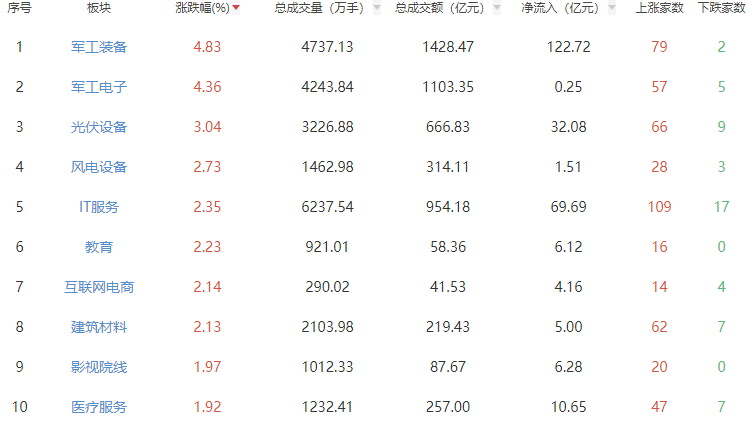
Market Overview - The Shanghai Composite Index closed at 4082.98 points, down 0.07% with a trading volume of 1183.19 billion yuan [1] - The Shenzhen Component Index closed at 13959.48 points, down 0.51% with a trading volume of 1617.08 billion yuan [1] - The ChiNext Index closed at 3302.31 points, down 0.82% with a trading volume of 750.34 billion yuan [1] Sector Performance Top Performing Sectors - Military equipment, military electronics, and photovoltaic equipment showed significant gains, with military equipment leading at a rise of 4.83% [2] - Other notable sectors include wind power equipment (up 2.73%) and IT services (up 2.35%) [2] Underperforming Sectors - The insurance sector declined by 2.17%, while the securities sector fell by 2.06% [2] - Energy metals and industrial metals also experienced declines of 1.41% and 0.87% respectively [2]