建筑业

Search documents
国家统计局关于2024年国内生产总值最终核实的公告
Guo Jia Tong Ji Ju· 2025-12-26 01:30
Core Points - The final verified GDP for 2024 is 13,480.66 billion yuan, which is a decrease of 10.18 billion yuan compared to the preliminary estimate, while the year-on-year growth rate at constant prices remains at 5.0% [1][4]. Group 1: GDP Overview - The GDP at current prices for 2024 is 1,348,066 million yuan, reflecting a reduction from the preliminary figure [1][4]. - The GDP growth rate at constant prices is confirmed at 5.0%, consistent with the preliminary estimate [1][4]. Group 2: Sector Contributions - The primary industry contributed 91,636 million yuan with a growth rate of 3.7%, accounting for 6.8% of GDP [4]. - The secondary industry, including manufacturing, contributed 490,305 million yuan with a growth rate of 5.0%, representing 36.4% of GDP [4]. - The tertiary industry showed the highest growth rate at 5.1%, contributing 766,125 million yuan, which is 56.8% of GDP [4]. Group 3: Industry-Specific Data - The manufacturing sector grew by 5.8%, contributing 334,881 million yuan [4]. - The construction industry experienced a slower growth rate of 2.9%, contributing 88,863 million yuan [4]. - The information transmission, software, and IT services sector had a significant growth rate of 11.7%, contributing 63,958 million yuan [4]. - The real estate sector faced a decline of 2.2%, contributing 84,047 million yuan [4].
2024年上市公司内部控制质量进一步提高
Shang Hai Zheng Quan Bao· 2025-12-25 19:11
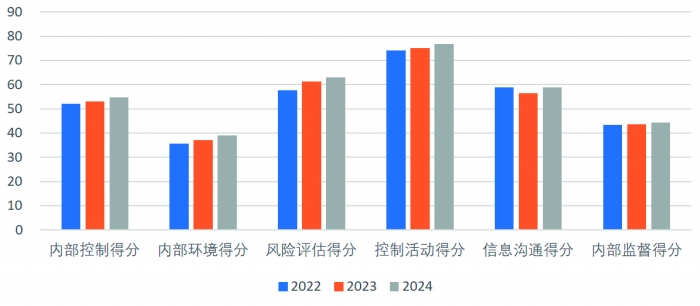
Core Insights - The internal control quality of listed companies in 2024 has improved compared to 2023, with internal environment remaining the weakest aspect that requires further enhancement [4][19] - Companies with financial shared centers, high digital transformation levels, and high-quality new productivity show better internal control levels, while those facing penalties, restatements, or receiving non-standard audit opinions exhibit lower internal control levels [20] Group 1: Overall Internal Control Status - The overall internal control level of listed companies has shown a steady increase from 52.47 in 2022 to 54.75 in 2024 [7] - The distribution of listed companies is concentrated in economically developed regions, with Guangdong, Zhejiang, and Jiangsu having the highest number of listed companies [8] Group 2: Regional Analysis - Internal control index averages vary by region, with Yunnan (58.49), Beijing (56.25), and Hebei (56.60) showing higher scores, while Qinghai (50.42), Hainan (50.33), and Heilongjiang (51.64) are lower [8] - The internal control quality is more balanced in economically developed areas like Beijing, Shanghai, and Guangdong, indicating a mature governance structure [8] Group 3: Industry Analysis - The financial industry maintains a significantly higher internal control quality compared to other sectors, attributed to stringent government regulations [9] - Some service and public sectors have shown notable improvements in internal control levels from 2022 to 2024, while education, construction, and comprehensive industries remain at lower levels [9] Group 4: Financial Shared Services and Digital Transformation - Companies utilizing financial shared services have an internal control index average of 57.76, compared to 54.36 for non-financial shared companies, indicating a clear advantage [10] - Companies with high digital transformation levels have an internal control index average of 55.54, outperforming those with lower levels at 53.98, highlighting the positive impact of digital transformation on internal control quality [11] Group 5: ESG and New Productivity - Companies with high ESG levels have an internal control index that is 4.51 points higher than those with lower ESG levels, particularly in the internal environment dimension [13] - Companies with high new productivity levels demonstrate superior internal control quality across various dimensions compared to those with lower levels [14] Group 6: Penalties and Audit Opinions - Companies that have faced penalties have an internal control index average of 44.45, significantly lower than the 55.06 average of non-penalized companies, with the internal environment being the most affected area [15] - Companies receiving non-standard audit opinions have a notably lower internal control index, with a score of 34.76 in 2024, indicating serious deficiencies in internal control execution [18]

1-11月阿塞拜疆GDP同比增长1.6%
Shang Wu Bu Wang Zhan· 2025-12-25 02:26
Core Insights - Azerbaijan's GDP for January to November 2025 reached 116.3 billion manats (approximately 68.4 billion USD), reflecting a year-on-year growth of 1.6% [1] - The oil and gas sector experienced a decline of 1.8%, while the non-oil sector grew by 3.2% [1] Sector Contributions - The industrial sector accounted for 34% of GDP [1] - Vehicle trade and repair contributed 10.6% [1] - Transportation and warehousing made up 7.2% [1] - Construction represented 6.5% [1] - Agriculture, forestry, and fishing accounted for 6.4% [1] - Accommodation and food services contributed 2.8% [1] - Information and communication made up 1.9% [1] - Other industries accounted for 21.1% [1] Per Capita GDP - The per capita GDP in Azerbaijan reached 11,356.4 manats (approximately 6,680.2 USD) for the same period [1]
全球人工智能投资增长带动韩半导体与显示设备出口
Shang Wu Bu Wang Zhan· 2025-12-24 16:27
Core Insights - The global investment in artificial intelligence (AI) is expected to significantly benefit South Korea's semiconductor and display equipment exports in the coming year [2] Semiconductor Industry - The semiconductor sector is projected to see a 9.1% year-on-year increase in export value, reaching approximately 265 trillion Korean Won, driven by companies like Microsoft and Amazon accelerating AI infrastructure development [2] Display Equipment - The display equipment sector is anticipated to grow by 3.9% due to rising demand for high-efficiency OLED panels [2] Battery Industry - The battery industry is expected to experience a 2.9% increase in exports, influenced by the rising electricity demand from AI data centers and the expansion of electric vehicle deployments [2] Other Industries - The biopharmaceutical industry is expected to grow through CDMO capacity expansion and technology licensing [2] - The automotive sector is projected to see slight growth in production and exports due to the launch of new electric vehicle factories [2] - The shipbuilding industry is forecasted to grow by 8.6% in exports, supported by orders for LNG carriers and container ships [2] Challenges - The steel and machinery industries are expected to decline due to rising protectionism, while the construction sector will continue to face pressure from high interest rates and tightened financing [2] Strategic Recommendations - The industry believes that South Korea needs to focus on AI-driven innovation and implement more groundbreaking regulatory reforms and incentive policies to enhance competitiveness against China's manufacturing capabilities [2]
稳中求进、行稳致远的中国宏观经济
2025-12-24 12:57
Summary of Key Points from Conference Call Records Industry Overview - The macroeconomic environment in China for 2025 shows a mix of supply-side strengths and weak domestic demand, with industrial value added expected to grow by 6.0% and retail sales by 4.0%, while fixed asset investment is projected to decline by 2.6% [1][17] - The GDP growth rate for the fourth quarter is anticipated to be 4.4%, leading to an annual GDP growth of 4.9%, slightly below the target of 5% [1][17] - Inflation is expected to be around -1% [1][17] Key Economic Indicators - In November, the total social financing increased by 416.9 billion yuan, driven mainly by corporate bond issuance, while government bond issuance decreased [1][8] - The Consumer Price Index (CPI) rose by 0.7% year-on-year, marking the highest increase of the year, primarily due to rising food prices [1][8] - The Producer Price Index (PPI) fell by 2.2% year-on-year, influenced by a high base from the previous year [1][8] Industrial Performance - In November, industrial production showed a year-on-year increase of 4.8%, with mining, manufacturing, and utilities growing by 6.3%, 4.6%, and 4.3% respectively [2][3] - The manufacturing PMI slightly rebounded to 49.2, indicating a modest recovery in manufacturing activity [11] Investment Trends - Fixed asset investment continued to decline, with a 2.6% year-on-year drop for the first ten months of 2025 [4] - Infrastructure investment saw a slight increase of 0.13%, while real estate investment faced a significant decline of 15.9% [4] Consumer Market Insights - Retail sales in November grew by 1.3% year-on-year, but the growth rate decreased by 1.6 percentage points [5][6] - Online retail sales increased by 9% year-on-year, indicating a shift towards e-commerce [6] Trade Performance - In October, China's total imports and exports reached $549 billion, with exports growing by 5% and imports by 19% [7] - Exports to ASEAN countries surged by 82%, while exports to the U.S. declined by 18% [7] Macroeconomic Challenges - Key challenges include insufficient domestic demand, declining optimism regarding income, and the impact of new consumption policies on prices [14][20] - The government is advised to focus on enhancing traditional industries, expanding effective investment, and improving consumer capacity [15][20] Policy Recommendations - Emphasis on optimizing traditional industries and fostering emerging sectors to enhance industrial quality [15] - Recommendations for fiscal policy include maintaining a reasonable deficit and optimizing expenditure structures to stimulate economic growth [21][40] Future Economic Outlook - The global economic growth rate for 2026 is expected to remain stable at 3.4%, with potential risks from geopolitical tensions and trade uncertainties [18] - The Chinese economy is projected to grow between 4.5% and 5.0% in 2026, with a focus on innovation and deep integration of technology and industry [20][27] Conclusion - The current economic landscape in China reflects a complex interplay of growth opportunities and challenges, necessitating targeted policy interventions to stimulate demand and investment while navigating external uncertainties.
城楼网|全国住房城乡建设工作会议:着力稳定房地产市场 加快构建发展新模式
Xin Lang Cai Jing· 2025-12-24 09:46
Core Viewpoint - The 2026 National Housing and Urban-Rural Construction Work Conference emphasized stabilizing the real estate market as a priority for the upcoming year [1][3]. Group 1: Real Estate Market Stabilization - The conference outlined four key tasks for the next year, with a focus on stabilizing the real estate market [1][3]. - Policies will be adjusted and optimized to meet the housing needs of residents, including both rigid and improved housing demands [1][3]. - Strategies will include controlling new supply, reducing inventory, and enhancing supply through various measures such as revitalizing existing land and acquiring unsold properties for affordable housing [1][3]. Group 2: New Development Model - A new development model for real estate will be established, which includes implementing a main bank system in financing and promoting the sale of existing homes [1][3]. - The conference highlighted the importance of regulating pre-sale fund supervision to mitigate risks and protect buyers' rights [1][3]. Group 3: Urban Modernization - The conference addressed the modernization of urban construction, emphasizing meticulous efforts in urban renewal, renovation of old communities, and the establishment of complete communities [1][3]. - Continuous improvement of urban infrastructure, such as gas pipelines and underground networks, was also prioritized [1][3]. Group 4: Construction Industry Upgrade - There is a call to accelerate the quality upgrade of the construction industry by promoting smart and green construction, as well as regulating market order [1][3]. - The foundation for high-quality industry development will be strengthened through improved legal frameworks, standards, and technological talent support [1][3].

阿坝明确目标,如何让更多人才心安高原? 力争用三年时间引育万名人才
Si Chuan Ri Bao· 2025-12-24 07:27
Core Viewpoint - The article emphasizes the importance of talent development in Aba Prefecture, highlighting a series of initiatives aimed at attracting and nurturing various types of talent to support local economic and social development [6][7][9]. Group 1: Talent Development Initiatives - Aba Prefecture is implementing the "Pomegranate Together: Wisdom Gathering Aba" three-year talent cultivation action plan, focusing on enhancing local talent, specialized skills, and attracting high-end talent [6][9]. - The region aims to cultivate 10,000 various talents within three years through financial incentives, including subsidies ranging from 200,000 to 500,000 yuan for top talents and 10,000 to 40,000 yuan for urgently needed professionals [7][8]. Group 2: Key Areas of Focus - The talent development strategy targets nine key sectors: party and government, education, healthcare, tourism, arts, agriculture, manufacturing, construction, and finance [8][9]. - Aba Prefecture is also expanding the age limit for recruiting high-level talent to 45 years and establishing a talent pool of 300 positions to meet urgent needs [9]. Group 3: Talent Retention and Support - The region plans to build 1,500 new or renovated talent apartments within three years and provide monthly housing subsidies of up to 1,500 yuan for new recruits [14]. - In 2022, Aba Prefecture successfully attracted 3,700 talents, a 78.4% increase from the previous year, through various talent projects and initiatives [12][13].

欧盟服务业持续增长,显著高于其他主要行业
Shang Wu Bu Wang Zhan· 2025-12-23 16:39
Core Insights - The EU service sector has shown a significant recovery, with production levels increasing by 16.4% compared to February 2020, outperforming industrial production growth of only 2.3% [1] - Trade (+0.1%) and construction (+0.2%) have nearly returned to pre-pandemic levels, but their growth remains weak [1] Economic Impact - The EU economy faced severe disruptions during the COVID-19 pandemic, with historical declines in various sectors: industrial production fell by 27.3%, construction by 26.7%, trade by 22.3%, and services by 17.0% from February to April 2020 [1] - Following the initial downturn, the EU economy entered a recovery phase, with major economic sectors generally returning to pre-pandemic production levels about a year later [1] Sectoral Divergence - Since early 2022, a trend of divergence among sectors has emerged, with industrial, construction, and trade sectors stagnating or slightly declining, while the service sector continues to grow, becoming the main support for the EU's economic recovery [1]
2026年住房城乡建设路线明确 发力点在于推动房地产高质量发展
Zheng Quan Ri Bao· 2025-12-23 16:18
12月22日至23日,全国住房城乡建设工作会议(以下简称"会议")在北京召开。会议全面盘点2025年工 作,系统总结"十四五"时期住房城乡建设事业发展成就,研究部署"十五五"时期和2026年重点任务。 会议强调,2026年是"十五五"开局之年,做好住房城乡建设工作意义重大。坚持因地制宜、分类指导, 更好统筹投资于物和投资于人,更好统筹惠民生和稳增长,更好统筹防风险和促转型,大力实施城市更 新,着力提升城市治理水平,推动房地产高质量发展。 广东省住房政策研究中心首席研究员李宇嘉在接受《证券日报》记者采访时表示,2025年是房地产新旧 模式、新旧动力转换的关键之年。2025年风险防范工作成效显著,保交房任务全面完成,标志着旧模式 正稳步出清。2026年,政策将更趋精细化、系统化,聚焦构建房地产发展新模式这一核心,着力稳定房 地产市场。 关于2026年住房城乡建设工作,会议明确要着力抓好四方面工作:推进现代化人民城市建设、着力稳定 房地产市场、加快建筑业提质升级、夯实高质量发展基础支撑。 在着力稳定房地产市场方面,会议要求"因城施策控增量、去库存、优供给,结合城市更新、城中村改 造盘活利用存量用地,推动收购存量商品 ...
住建部最新部署2026年楼市工作,信号很大
2 1 Shi Ji Jing Ji Bao Dao· 2025-12-23 14:58
Core Insights - The national housing and urban-rural development meeting held on December 22-23 emphasized the importance of stabilizing the real estate market and transitioning to a new development model during the 14th Five-Year Plan period [2][5] Group 1: Key Focus Areas for 2026 - The meeting outlined four main areas of focus for 2026: promoting modern urban construction, stabilizing the real estate market, upgrading the construction industry, and solidifying the foundation for high-quality development [2] - Stabilizing the real estate market is prioritized, with strategies including city-specific policies to control supply, reduce inventory, and optimize supply [7][8] - The meeting highlighted the importance of utilizing existing land through urban renewal and village renovations, and acquiring existing residential properties for affordable housing and talent housing [7][8] Group 2: Policy Implementation and Market Impact - The meeting indicated that the task of ensuring housing delivery will be fully completed by 2025, with a focus on stabilizing the market and implementing a "policy combination" to support this goal [7][9] - It is expected that policies aimed at acquiring existing properties for affordable housing will significantly impact the real estate market in 2026, potentially shortening inventory digestion cycles in some second and third-tier cities by 4-6 months [8] - The meeting also discussed optimizing the supply of affordable housing and enhancing housing quality through various initiatives [9][11] Group 3: New Development Model - The meeting stressed the need to accelerate the establishment of a new real estate development model, which includes improving the basic systems for property development, financing, and sales [12][13] - A key aspect of this new model is the promotion of a "current housing sales system," which aims to mitigate delivery risks and enhance consumer confidence [13][14] - The transition to a current housing sales model is seen as essential for the industry's high-quality transformation, although a complete shift from pre-sales to current sales may take time [14]