
服务业

Search documents
制造业PMI时隔8个月重返扩张区间
Jin Rong Shi Bao· 2026-01-05 01:27
Core Viewpoint - The overall economic sentiment in China is improving as indicated by the rise in the Purchasing Managers' Index (PMI) across manufacturing and non-manufacturing sectors, suggesting a recovery in market demand and production activities [1][2][4]. Manufacturing Sector - In December 2025, the manufacturing PMI rose to 50.1%, an increase of 0.9 percentage points from the previous month, marking the first time it entered the expansion zone since April 2025 [1][2]. - The production index and new orders index were reported at 51.7% and 50.8%, respectively, with significant increases of 1.7 and 1.6 percentage points, indicating a strong recovery in market demand [2]. - The new export orders index increased by 1.4 percentage points to 49.0%, reflecting a positive shift in external trade conditions [2]. - The PMI for large enterprises reached 50.8%, up 1.5 percentage points, while medium-sized enterprises saw a rise to 49.8%. Small enterprises, however, experienced a decline to 48.6% [3]. Non-Manufacturing Sector - The non-manufacturing business activity index rose to 50.2%, an increase of 0.7 percentage points from the previous month, indicating improved sentiment in the service sector [4]. - The service sector PMI was reported at 49.7%, showing a slight recovery of 0.2 percentage points, with certain industries like telecommunications and financial services experiencing rapid growth [4]. Construction Sector - The construction PMI surged to 52.8%, a significant increase of 3.2 percentage points, returning to the expansion zone for the first time in five months, driven by new policy financial tools and favorable weather conditions [5]. - The business activity expectation index for the construction sector was reported at 57.4%, indicating optimism among construction enterprises regarding future developments [5]. Overall Economic Outlook - The comprehensive PMI output index reached 50.7%, indicating an overall expansion in production and business activities compared to the previous month [5]. - Analysts expect that the supportive measures for economic growth will continue to bolster the manufacturing sector, although consumer demand remains weak and requires further improvement [5].


PMI超预期,债市震荡偏弱——12月PMI点评
Changjiang Securities· 2026-01-05 00:51
Group 1: Report Industry Investment Rating - No relevant content provided Group 2: Core Viewpoints of the Report - In December 2025, both manufacturing and non - manufacturing PMI rebounded above the boom - bust line. The new kinetic energy is supporting the manufacturing industry, but related industries may be more vulnerable to external demand fluctuations. The pace of new - old kinetic energy conversion is an important window to observe the economic recovery [2]. - The report expects long - term interest rates to fluctuate widely, with the 10 - year Treasury yield expected to oscillate between 1.8% - 1.9% and the 30 - year Treasury yield between 2.2% - 2.4% [2][7]. Group 3: Summary by Related Catalogs Event Description - In December 2025, the manufacturing PMI rose 0.9pct to 50.1%, with the month - on - month increase expanding by 0.7pct. The non - manufacturing business activity index rebounded 0.7pct to 50.2%. The construction business activity index soared 3.2pct to 52.8%, and the service business activity index rebounded 0.2pct to 49.7% [5]. Event Comment Non - manufacturing Sector - The non - manufacturing sector's return above the boom - bust line is in line with seasonal trends, led by construction. The improvement in new orders, inventory, and employment is driven by domestic demand, while new export orders declined. The profit margin may be compressed, and the sustainability of the improvement needs further observation. In construction, seasonal factors and high - growth financial activities may support the improvement. In services, the transmission of upstream manufacturing prosperity to downstream consumption remains to be seen [7]. Manufacturing Sector - New kinetic energy supports the manufacturing industry, but related industries are more susceptible to external demand. The high - frequency indicators have weakened, but the manufacturing industry improved due to the high - level prosperity of new kinetic energy industries. The 10 - year and 30 - year Treasury yields are expected to fluctuate in specific ranges [7]. Other Aspects of Manufacturing - Manufacturing PMI continued to rise, with production, demand, and inventory all improving. External demand contributed to new orders, and the profit repair pressure may be reduced. Large and medium - sized enterprises and high - tech manufacturing showed better performance [9].
渤海证券研究所晨会纪要(2026.01.05)-20260105
BOHAI SECURITIES· 2026-01-05 00:34
Macro and Strategy Research - The manufacturing PMI for December 2025 is reported at 50.1%, indicating a return to the expansion zone after 8 months, with improvements in both production and demand [2][3] - The production index increased by 1.7 percentage points to 51.7%, attributed to reduced uncertainties from the external trade environment [3] - The new orders index rose by 1.6 percentage points to 50.8%, marking the first return to expansion in the second half of the year [3] - New export orders increased by 1.4 percentage points to 49.0%, showing a significant slowdown in contraction, while the import index continued to contract [3] - The December non-manufacturing business activity index rose by 0.7 percentage points to 50.2%, returning to the expansion zone, driven significantly by the construction sector [4] - The comprehensive PMI output index increased by 1.0 percentage point to 50.7%, reflecting a rebound in both manufacturing and non-manufacturing sectors [4] - The outlook for January 2026 suggests continued expansion in manufacturing due to a stable external trade environment and the gradual implementation of incremental policies [4] U.S. Monetary Series - The Federal Reserve's balance sheet is crucial for understanding changes in dollar liquidity, primarily through "bilateral accounting" methods [6][7] - The Fed's balance sheet has been in an expansion trend since its inception, influenced by economic development and institutional changes [7] - The historical changes in the Fed's balance sheet can be divided into four phases, with the most recent phase (2020-present) seeing accelerated expansion due to the pandemic [7] Financial Engineering Research - Company governance is identified as a critical component of corporate competitiveness, directly affecting resource allocation efficiency, profitability sustainability, and risk management [9] - A well-governed company enhances operational quality and market profitability expectations, leading to a steady increase in stock prices [9][10] - The report outlines six dimensions of corporate governance that impact stock pricing, including shareholder behavior, debt management, and ESG scores [10][11] - Future research will focus on the interaction effects of governance indicators, heterogeneity across different scenarios, and the development of a multidimensional governance evaluation system [11]
50.1%!制造业PMI时隔8个月重返扩张区间
Xin Lang Cai Jing· 2026-01-04 14:56
Group 1 - The manufacturing Purchasing Managers' Index (PMI) returned to the expansion zone for the first time in eight months, with a reading of 50.1% in December 2025, indicating a recovery in market demand [1] - The manufacturing new orders index increased by 1.6 percentage points to 50.8% in December 2025, driven by effective growth stabilization policies and strong export resilience [2] - The production index within the manufacturing PMI rose significantly by 1.7 percentage points to 51.7%, contributing the most to the overall PMI increase [2] Group 2 - Large enterprises reported a PMI of 50.8%, up 1.5 percentage points, while medium-sized enterprises saw a PMI of 49.8%, up 0.9 percentage points, indicating a recovery in business conditions [3] - Small enterprises experienced a decline in PMI to 48.6%, down 0.5 percentage points, reflecting a tighter relationship with consumer demand, which remains weak [3] - The main raw materials purchasing price index was at 53.1%, indicating continued expansion despite a slight decrease, while the factory price index rose by 0.7 percentage points to 48.9% [3] Group 3 - The service sector's business activity index was at 49.7%, showing a slight recovery but remaining in contraction territory for two consecutive months [4] - The construction PMI rose to 52.8%, marking a significant increase of 3.2 percentage points, returning to the expansion zone for the first time in five months [5] - The recovery in the construction sector is attributed to the completion of the 500 billion yuan policy financial tool and favorable weather conditions in southern provinces [5]
浙商宏观:预计流动性驱动下A股将在2026年继续走强,低波红利与科技成长交织的结构化行情
Sou Hu Cai Jing· 2026-01-03 11:56
Economic Overview - The GDP growth rate for Q4 2025 is expected to slow to 4.6%, with a strong production sector and moderate demand recovery [1][14] - Industrial production is projected to maintain steady growth, significantly supporting the overall GDP growth target [2][15] - External demand remains resilient, with export growth expected to continue positively [1][5] Production - The industrial added value growth rate for December is estimated at 5.0%, with an annual growth rate of 5.9% for 2025, significantly higher than GDP growth [2][15] - Improvement in demand is noted, driven by pre-holiday inventory buildup and construction progress [2][16] - Manufacturing enterprises are experiencing improved production and market demand, with production growth slightly outpacing demand [2][16] Consumption - The retail sales growth rate for December is expected to be 1.5%, a slight increase from 1.3% [3][19] - Policies supporting the replacement of old products are anticipated to bolster consumer spending, particularly in durable goods [3][19] - The automotive sector continues to face challenges with declining sales and increased discounts, impacting overall retail recovery [3][20] Investment - Fixed asset investment for 2025 is projected to decline by 3.3%, with manufacturing investment showing resilience at 1.2% growth, while infrastructure and real estate investments are under pressure [4][23] - The investment environment has been notably weak since June 2025, with a focus on stabilizing growth in 2026 [4][25] - Manufacturing and broad infrastructure investments are expected to jointly drive growth in early 2026, with a projected increase of 2.5% for the year [4][25][30] Export - December export growth is anticipated at 3.9%, with an annual growth rate of 6.6% for 2026, supported by stable external demand from non-developed countries [5][5] - The stabilization of US-China trade relations and reduced trade friction with Europe and Japan are expected to benefit exports [5][5] Prices - The Consumer Price Index (CPI) growth rate for December is expected to be 0.7%, while the Producer Price Index (PPI) is projected at -1.9% [6][6] - The overall price level is expected to remain stable, with core CPI showing signs of recovery [6][6] Employment - The urban unemployment rate for December is projected to rise slightly to 5.2%, influenced by seasonal factors [7][7] - Continued policy support is expected to help stabilize employment, particularly for vulnerable groups [7][7] Monetary Policy - Financial data for December indicates continued pressure, with new loans and social financing expected to decline [8][8] - The central economic work conference emphasizes the need for flexible monetary policy to support economic stability and reasonable price recovery [8][8]
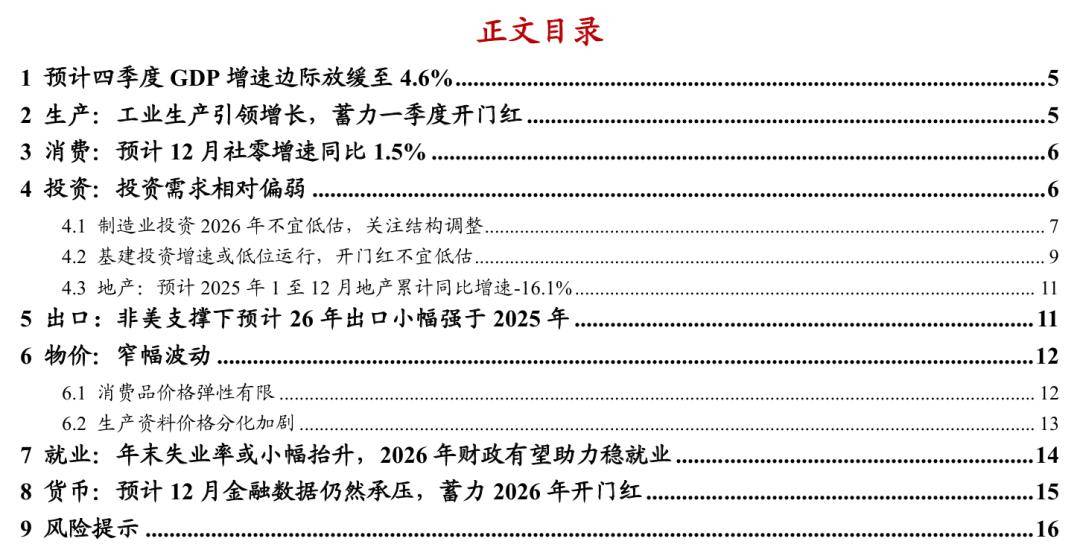
【浙商宏观||李超】12月经济前瞻:工业生产引领增长,蓄力一季度开门红
Xin Lang Cai Jing· 2026-01-03 09:59
炒股就看金麒麟分析师研报,权威,专业,及时,全面,助您挖掘潜力主题机会! (来源:李超宏观研究与资产配置) 分析师:李超/林成炜/廖博/何佳烨/潘高远/费瑾/王瑞明 研究助理:汤子玉 具体参见2026年1月2日报告《12月经济前瞻:工业生产引领增长,蓄力一季度开门红——2025年12月宏观数据预测》,如需报告全文或数据底稿,请联系 团队成员或对口销售。 全文约16000字,阅读大约需要36分钟 我们预计2025年四季度GDP同比增速为4.6%,经济运行呈现生产偏强、需求修复偏温和的格局:供给端,工业生产延续稳增长态势,对增长形成主要支 撑;需求端,12月社零同比预计小幅回升,以旧换新资金前置与元旦"拼假"效应对消费构成托底,但汽车在销量同比下滑与年末加大折扣导致的量价双压 下仍是主要拖累。投资端仍处低位,制造业投资相对有韧性,但基建偏弱、地产继续承压,制约内需弹性。外需保持韧性,出口增速预计维持正增长。价 格层面,CPI温和、PPI负值收敛但通胀修复仍偏缓。金融数据仍显示信用扩张偏弱,M1、M2增速小幅回落。综合来看,一方面,12月经济活动相较上月 总体加快,12月随着内外需修复及年底各行业年度收官冲刺,有望 ...
德国就业人数五年来首次下降
Xin Hua Cai Jing· 2026-01-03 03:26
Group 1 - The core point of the articles indicates that Germany's employment is projected to decline in 2025, marking the first decrease since 2020, with an average employment number dropping by approximately 5,000 compared to 2024 [1] - In 2025, the manufacturing sector is expected to see a significant reduction of 143,000 jobs, a decline of 1.8%, while the construction sector will lose 23,000 jobs, a decrease of 0.9% [1] - The service sector, however, is projected to avoid a sharp decline, with an increase of 164,000 jobs, representing a growth of 0.5%, particularly in public services, education, and health, which will see an increase of 205,000 jobs, a growth of 1.7% [1] Group 2 - The unemployment rate in Germany is expected to rise significantly, with an increase of 161,000 unemployed individuals, marking a growth of 10.8%, leading to an unemployment rate increase from 3.1% to 3.5% [1] - The analysis from the Federal Statistical Office suggests that the slowdown in economic growth and demographic changes are impacting the labor market, with fewer young workers entering the workforce to replace retiring baby boomers [2] - The participation rate in the labor market is being supported by the net immigration of foreign workers and the increasing employment of older individuals and women [2]
中信证券:后续预计政策效果将进一步显现,推动经济延续边际改善
Xin Lang Cai Jing· 2026-01-01 09:13
Core Viewpoint - The manufacturing sector showed signs of recovery in December, driven by an increase in working days and the effectiveness of policy financial tools, which improved demand in infrastructure and manufacturing investment chains [1] Group 1: Manufacturing Sector - Key indicators related to production and demand improved across the board, with factory price indicators rebounding, reflecting recovery in various manufacturing sectors due to the combination of working day differences and policy support [1] - Industries benefiting from this recovery include those in the infrastructure chain driven by policy financial tools, as well as the automotive and textile sectors, which saw improvements in export growth [1] Group 2: Non-Manufacturing Sector - The non-manufacturing PMI showed improvement, primarily driven by a recovery in the construction industry, while the service sector remains relatively weak, indicating that the impact of incremental tools needs to expand further [1] Group 3: Economic Outlook - Overall, the economic climate improved in December due to the combination of more working days and the influence of policy financial tools, with expectations that the effects of these policies will continue to manifest, promoting marginal economic improvement [1]

前瞻2026:全新的大周期正在开启
Jing Ji Guan Cha Bao· 2026-01-01 07:34
Group 1 - The core theme for 2026 is characterized by uncertainty and possibility, driven by geopolitical dynamics and technological advancements, particularly in AI [2][3] - The AI bubble may burst, similar to past technological waves, but the long-term evolution of AI remains unchanged as it is still in its early stages [2] - The first cohort of AI Native graduates in 2026 will face significant workplace transformations as AI replaces entry-level jobs, providing insights into the future of work [2] Group 2 - The concept of "rebalancing" describes the shift from Western dominance to a more equitable global power structure, particularly between the US and China [7] - The G2 relationship between the US and China is crucial, as both countries can learn from each other while navigating their respective economic challenges [7][8] - The global perception of Chinese innovation is changing, with foreign companies increasingly recognizing the value of China's technological advancements [8] Group 3 - The era of creativity is emerging as AI takes over repetitive tasks, prompting organizations to rethink the value of human contributions [10] - Key human attributes such as intuition, imagination, emotion, and common sense will become increasingly valuable in the AI-driven workplace [10][11][12][13] - The focus will shift from knowledge itself to the ability to transform knowledge into insights and creativity [14] Group 4 - The attention economy is being disrupted by AI, which is changing how information is accessed and consumed, leading to a re-evaluation of business models [16][17] - AI is expected to streamline processes, reducing the time spent on searching for information and products, thus altering the dynamics of consumer engagement [16][17] - New technological standards are emerging to facilitate AI interactions, shifting the focus from user attention to efficient problem-solving [18] Group 5 - A "relativistic world" is emerging, emphasizing development over security and the importance of human exploration in an AI-dominated landscape [19][20] - The value of different types of capital (financial, natural, human, and social) will fluctuate, impacting economic growth and development strategies [21][22] - The rise of social capital, characterized by trust and community, will become increasingly important as AI handles standardized tasks [22] Group 6 - The dual-speed economy is a significant issue in both the US and China, where technological sectors are thriving while traditional sectors face stagnation [23][24] - In the US, economic growth is concentrated among elites in tech, while ordinary citizens experience rising living costs and stagnant wages [23][24] - China's economic challenges are compounded by structural issues, including a sluggish domestic market and pressures on consumer confidence [24][25] Group 7 - The transition to a stock economy signifies a shift from growth-driven to capability-driven economic dynamics, where opportunities become more differentiated [25][26] - The need for policy focus on service sector reforms and stable job creation is critical in addressing the dual-speed economy [25][26] - The future will require a reevaluation of human capital development in light of AI's impact on labor markets and job structures [26] Group 8 - The cyclical nature of economic phases suggests that understanding past growth patterns can inform future strategies in a changing global landscape [27][28] - The upcoming economic cycle will necessitate embracing AI-driven opportunities while navigating geopolitical uncertainties [28][29]

外资机构:消费在中国GDP中的占比将继续提升
Xin Lang Cai Jing· 2026-01-01 06:23
万事达卡经济研究所研究报告指出,2026年中国消费将呈现出显著的强化趋势,"新消费"品类——如美 容健康、新兴生活方式以及由"粉丝经济"驱动的消费热潮有望持续扩容。特别是消费者从追求"单纯低 价"转向拥抱"精明消费"的变革趋势,正重塑中国零售业与数字渠道的生态。 德意志银行中国区首席经济学家熊奕表示,2026年消费将继续成为中国经济增长的主引擎,预计将为 GDP贡献2.8个百分点,商品消费或将录得温和增长,服务消费亦将在政策支持下持续改善。 中新社上海1月1日电 (记者 姜煜)新年伊始,多家外资机构展望2026年中国经济发展前景时不约而同指 出:消费仍是主引擎,其在中国GDP中的占比将继续提升。 据威灵顿投资管理宏观策略师郁嘉言分析,2025年,中国消费的复苏得益于强有力的财政支持,一个可 喜的迹象是,消费结构正在由商品转向服务,消费者更愿意把钱花在休闲旅游、外出就餐、个人兴趣爱 好及生活方式等体验和享受型消费方面。与此同时,部分细分领域出现高端化趋势,消费者更青睐产品 的设计与品质,而非价格。这些都是在消费信心回升以及商品供给充裕背景下出现的新型消费升级形 态。 "2026年,消费在中国GDP中的占比将继续 ...