
股票

Search documents
【UNFX周评】一周评述 :宽松预期主导下,风险与避险资产的联袂狂欢
Sou Hu Cai Jing· 2025-09-13 15:09
Group 1: Market Overview - The global financial market experienced a unique rally where both risk and safe-haven assets rose simultaneously, driven by weak labor market data in the US, paving the way for potential interest rate cuts by the Federal Reserve [1] - Major global stock indices saw significant gains, with the S&P 500 rising approximately 1.6% for the week, marking its best weekly performance of the month and reaching historical highs [1][3] - European stock markets also recorded gains, albeit more modestly, influenced by improved global risk sentiment and the European Central Bank's decision to maintain interest rates [1] Group 2: Regional Market Performance - The Nikkei 225 index in Japan reached a new historical high, benefiting from positive global risk sentiment and a weaker yen, which favored export-oriented companies [2] - Semiconductor and AI-related stocks were key drivers of the Nikkei's rise, reflecting strong performance in these sectors [2] Group 3: Commodity Market Dynamics - Gold emerged as a standout performer, breaking historical highs due to expectations of Fed rate cuts, a weaker dollar, and declining real yields, supported by ongoing central bank purchases and geopolitical uncertainties [2] - The oil market exhibited mixed trends, influenced by concerns over economic slowdown and OPEC+ production increases, while a weaker dollar and ongoing geopolitical tensions provided some support [2]
近10%涨幅只是开胃菜?华尔街看好小盘股还能再涨20%!
智通财经网· 2025-09-12 11:14
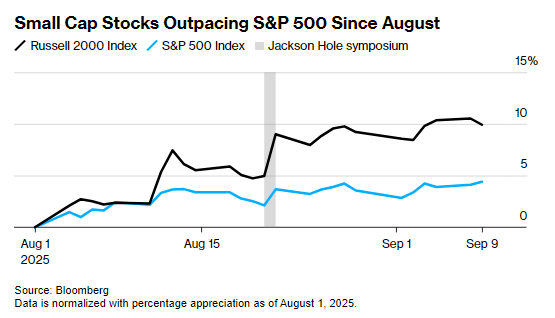
Core Viewpoint - The Russell 2000 index, which includes some of the riskiest stocks in the market, has seen a significant surge recently, with multiple Wall Street strategists believing that this rally is just beginning [1] Group 1: Market Performance - The Russell 2000 index has risen nearly 10% since the end of July, outpacing the S&P 500 index by two times [1] - Analysts predict that the Russell 2000 index could rise another 20% over the next year, while the S&P 500 index is expected to increase by 11% [1] - Despite the recent surge, the Russell 2000 index's cumulative gain in 2025 still lags behind that of the S&P 500 index [1] Group 2: Economic Factors - The anticipated interest rate cuts by the Federal Reserve are expected to significantly lower the financing costs for companies within the Russell 2000 index, thereby enhancing their profit margins [1] - The recent inflation and employment data have reinforced optimistic sentiments, leading investors to believe that the Federal Reserve will initiate interest rate cuts soon [2] Group 3: Analyst Insights - Morgan Stanley's Michael Wilson noted that the Fed's rate cuts could propel the bull market into its "next phase," benefiting small-cap stocks [5] - Over 60% of companies in the Russell 2000 index exceeded earnings expectations for Q2 2024, with average revenue surpassing expectations by 130 basis points [5] - Analysts from Manulife John Hancock Investments highlighted that small-cap stocks have been undervalued compared to other stock categories [5] Group 4: Valuation and Investor Sentiment - The Russell 2000 index's price-to-earnings ratio is slightly above its long-term average, but still presents a lower valuation pressure compared to large-cap stocks [6] - The options market indicates increasing investor confidence in the continued rise of small-cap stocks, with a more bullish positioning compared to the S&P 500 index [6] - Passive funds have started to flow into U.S. small-cap stocks, although there is a caution that signs of economic recovery are needed for sustained growth [6] Group 5: Strategic Recommendations - Barclays analysts recommend prioritizing investments in technology and small-cap stocks due to their strong earnings momentum, suggesting that small-cap stocks are facing significant opportunities [7]

大类资产早报-20250912
Yong An Qi Huo· 2025-09-12 01:49
Report Summary 1. Report Date - The report was released on September 12, 2025, by the macro team of the research center [2] 2. Global Asset Market Performance 2.1 Government Bond Yields - **10 - year Government Bond Yields**: Yields showed various changes across different economies. For example, the US 10 - year yield on September 11, 2025, was 4.022, with a latest change of - 0.025, a one - week change of - 0.140, a one - month change of - 0.264, and a one - year change of 0.190 [3] - **2 - year Government Bond Yields**: The US 2 - year yield on September 11, 2025, was 3.540, with a latest change of 0.050, a one - week change of - 0.120, a one - month change of - 0.070, and a one - year change of - 0.370 [3] 2.2 Exchange Rates - **USD against Major Emerging Economies' Currencies**: The USD/Brazilian Real exchange rate on September 11, 2025, was 5.389, with a latest change of - 0.37%, a one - week change of - 1.06%, a one - month change of - 0.52%, and a one - year change of - 4.52% [3] - **Renminbi**: The on - shore RMB exchange rate on September 11, 2025, was 7.119, with a latest change of - 0.03%, a one - week change of - 0.32%, a one - month change of - 0.88%, and a one - year change of - 0.04% [3] 2.3 Stock Indices - **Major Economies' Stock Indices**: The S&P 500 index on September 11, 2025, was 6587.470, with a latest change of 0.85%, a one - week change of 1.31%, a one - month change of 1.84%, and a one - year change of 19.15% [3] - **Other Stock Indices**: The Hang Seng Index on September 11, 2025, was 26086.320, with a latest change of - 0.43%, a one - week change of 4.10%, a one - month change of 2.22%, and a one - year change of 47.79% [3] 2.4 Credit Bond Indices - The US investment - grade credit bond index on September 11, 2025, was 3529.910, with a latest change of 0.28%, a one - week change of 1.28%, a one - month change of 2.09%, and a one - year change of 5.49% [3][4] 3. Stock Index Futures Trading Data 3.1 Index Performance - The closing price of the A - share index was 3875.31, with a change of 1.65% [5] 3.2 Valuation - The PE (TTM) of the CSI 300 was 14.18, with a环比 change of 0.24 [5] 3.3 Risk Premium - The risk premium (1/PE - 10 - year interest rate) of the S&P 500 was - 0.37, with a环比 change of 0.00 [5] 3.4 Fund Flows - The latest value of fund flows into A - shares was 1342.66, and the 5 - day average was 30.55 [5] 4. Government Bond Futures Trading Data - The closing price of the T00 government bond futures was 107.880, with a change of - 0.31% [6] 5. Other Stock Indices - The Malaysian index on September 11, 2025, was 1582.850, with a latest change of - 0.50%, a one - week change of 0.30% [9]
美联储降息在即 新兴市场投资价值凸显
Zhi Tong Cai Jing· 2025-09-11 02:32
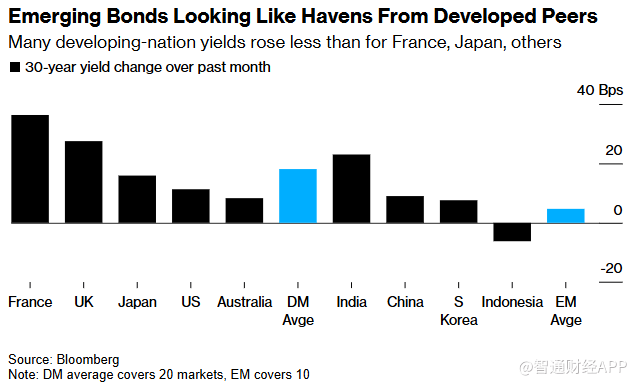
Group 1 - Emerging markets are becoming more attractive due to expectations of interest rate cuts by the Federal Reserve, low local inflation, and relatively low public debt [1] - Emerging market stock prices are currently 65% lower than those in the US, presenting various investment opportunities across different markets and sectors [1] - Actual interest rates in emerging markets remain high, comparable to the highest levels since the financial crisis, which will be beneficial as the US enters a rate-cutting cycle [1] Group 2 - Political risk has become a dominant concern in emerging markets, especially with upcoming elections in countries like Indonesia, South Africa, Mexico, and India [2] - Developed countries are facing increasing political risks due to rising debt levels and budget constraints, with the US experiencing heightened political uncertainty [2] - Emerging market bonds appear to offer more safe-haven value compared to developed market bonds [2] Group 3 - Recent trends show that emerging market stock performance has outpaced that of the US stock market for the first time since 2017 [4] - The total debt of developing countries is projected to be about 75% of their annual economic output, significantly lower than the 125% for G7 developed countries [4] - Indonesia and Vietnam have public debt ratios of 40% and 33% respectively, which are much lower than those of certain developed countries [4] - Low inflation and ample foreign exchange reserves strengthen the fiscal prudence of emerging markets, providing central banks with the ability to manage market volatility [4] - There is a growing realization that the perception of emerging markets as inherently riskier may not be accurate [4]
大类资产早报-20250911
Yong An Qi Huo· 2025-09-11 01:49
Report Date - The report was published on September 11, 2025 [2] Global Asset Market Performance 10 - Year Treasury Yields of Major Economies - On September 10, 2025, yields in the US, UK, France, etc. were 4.047, 4.632, 3.461 respectively. Latest changes ranged from -0.041 (US) to 0.005 (Switzerland). Weekly changes were from -0.171 (US) to -0.057 (Switzerland). Monthly changes varied from -0.188 (US) to 0.127 (France). Annual changes were from -0.309 (Italy) to 0.579 (UK) [3] 2 - Year Treasury Yields of Major Economies - On September 10, 2025, yields in the US, UK, Germany, etc. were 3.490, 3.936, 1.949 respectively. Latest changes were from -0.020 (US) to 0.033 (South Korea). Weekly changes, monthly changes, and annual changes also showed different trends [3] Dollar - Exchange Rates Against Major Emerging - Market Currencies - On September 10, 2025, the exchange rate of the dollar against the Brazilian real was 5.409 with a latest change of -0.54%. Weekly, monthly, and annual changes also varied for different currencies [3] Stock Indices of Major Economies - On September 10, 2025, the S&P 500 was at 6532.040 with a latest change of 0.30%. Weekly, monthly, and annual changes differed among various indices such as the Dow Jones Industrial Average, NASDAQ, etc. [3] Credit Bond Indices - For credit bond indices including US investment - grade, euro - area investment - grade, etc., latest changes were from 0.03% (euro - area high - yield) to 0.46% (emerging - market high - yield). Weekly, monthly, and annual changes also showed different magnitudes [3][4] Stock Index Futures Trading Data Index Performance - Closing prices of A - shares, CSI 300, SSE 50, etc. were 3812.22, 4445.36, 2939.59 respectively on September 10, 2025. Percentage changes were 0.13%, 0.21%, 0.37% respectively [5] Valuation - PE (TTM) of CSI 300, SSE 50, and CSI 500 were 13.94, 11.79, 33.18 respectively. Their环比changes were 0.04, 0.04, - 0.03 respectively [5] Risk Premium - Risk premium (1/PE - 10 - year interest rate) of S&P 500 was -0.37 with a环比change of 0.03, and that of German DAX was 2.47 with a环比change of 0.02 [5] Fund Flows - Latest values of fund flows for A - shares, the main board, etc. were -460.27, -445.33, etc. respectively. Their 5 - day average values also varied [5] Trading Volume - Latest trading volumes of the Shanghai and Shenzhen stock markets, CSI 300, etc. were 19781.23, 5355.39, etc. respectively. Their环比changes were -1404.01, -273.22, etc. respectively [5] Main Contract Basis - Basis of IF, IH, IC were -12.96, -1.79, -68.71 respectively, and their basis spreads were -0.29%, -0.06%, -0.99% respectively [5] Treasury Bond Futures Trading Data - Closing prices of T00, TF00, T01, TF01 were 107.725, 105.570, 107.490, 105.425 respectively. Their percentage changes were 0.00%, -0.01%, -0.08%, -0.01% respectively [6] - Money market rates of R001, R007, SHIBOR - 3M were 1.4592%, 1.4988%, 1.5530% respectively, and their daily changes were -3.00BP, 1.00BP, 0.00BP respectively [6]
贝莱德智库:美联储降息在即 驱动新兴市场股票上涨20%的三大引擎
Zhi Tong Cai Jing· 2025-09-11 01:30
Group 1 - Emerging markets have shown strong performance this year, with global emerging market bond returns near 9% compared to 4.5% for US Treasury bonds, and the MSCI Emerging Markets Index rising 20% versus 14% for the MSCI World Index [1] - The weakening of the US dollar, economic resilience, and disruptive trends are driving the performance of emerging markets, necessitating selective investment strategies [1] - The overall view on emerging market equities is neutral, while there is optimism for local currency bonds in emerging markets [1] Group 2 - The macroeconomic environment has improved, with the IMF predicting a narrowing of the economic growth gap between emerging and developed markets by 2025, despite structural changes in some countries that create favorable conditions for sustained growth [2] - Countries like India and Vietnam are excelling in services and manufacturing, while Mexico and Brazil demonstrate disciplined monetary policies, and Chile's strong financial system adds stability [2] - Some emerging markets have seen inflation rates return to pre-pandemic levels, with interest rate cuts already initiated in countries like Mexico, Indonesia, and Poland [2] Group 3 - The restructuring of supply chains benefits countries like Mexico, Brazil, and Vietnam, while Taiwan and South Korea are deeply involved in the semiconductor sector for AI development, and China is advancing its AI technology [3] - South American countries like Chile and Peru benefit from the demand for key materials under the low-carbon transition trend [3] - India is expected to develop into a leading digital economy due to its young population and accelerated digitalization, which supports a positive long-term outlook for emerging markets [3]
全球大类资产配置周报:市场笃定美联储9月降息,双重因素推升黄金再创纪录-20250907
Yin He Zheng Quan· 2025-09-07 09:50
Core Insights - The report indicates that the U.S. labor market is showing signs of weakness, with only 22,000 new non-farm jobs added in August, significantly below market expectations, paving the way for a potential interest rate cut by the Federal Reserve in September [1][6] - The report highlights that gold prices have surged over 37% this year, driven by expectations of monetary policy easing and macroeconomic uncertainty, with spot gold breaking through $3,600 per ounce, setting a new historical record [2][9] - The report notes that the U.S. Treasury yields are on a downward trend due to weak employment data, with short-term and long-term yields both declining, indicating a market expectation of further rate cuts [4][21] Commodity Market - Gold prices have reached new highs, with COMEX gold futures closing at $3,600.8 per ounce, supported by declining U.S. Treasury yields and expectations of a rate cut [9][10] - The oil market has experienced significant downward pressure, with WTI crude oil prices dropping from $64.69 per barrel to $61.87 per barrel, amid concerns of oversupply and weak demand [15][16] Bond Market - U.S. Treasury yields have decreased across the board, with the 1-year to 30-year yields falling between 15 to 19 basis points, reflecting market expectations of aggressive monetary easing by the Federal Reserve [21][22] - The report indicates that the Chinese bond market is experiencing fluctuations, with short-term yields adjusting more than long-term yields, influenced by market sentiment and policy expectations [23] Currency Market - The U.S. dollar index has shown a slight decline, influenced by weak economic data and political uncertainties, with expectations of continued weakness in the dollar [27][28] - The euro has strengthened against the dollar, supported by expectations of a stable European Central Bank policy and moderate economic growth in the Eurozone [37][41] Equity Market - The report notes a mixed performance in global equity markets, with technology stocks benefiting from anticipated rate cuts, while concerns over global economic slowdown and corporate earnings prospects create volatility [51][52] - The Nasdaq index has outperformed due to its high concentration of technology stocks, while European indices have faced downward pressure from economic uncertainties [51][52]
美债收益率大幅下跌 就业数据疲软引发市场押注美联储加快降息
Zhi Tong Cai Jing· 2025-09-05 23:28
Group 1 - The U.S. Treasury yields fell significantly as investors expect the Federal Reserve to implement larger rate cuts to support a slowing job market [1][2] - The August non-farm payroll report indicated a stagnation in the labor market for four consecutive months, with a rare downward revision of June's data showing a net decrease in jobs [1] - Market expectations for a 50 basis point rate cut in September have risen to 10.2%, compared to 0% the previous day, while the probability of a 25 basis point cut stands at 89.7% [1] Group 2 - The weak job market has reignited concerns about potential recession risks, with investors adjusting their growth and earnings expectations [2][3] - Despite initial optimism in the market, the weak data led to a reassessment of corporate earnings and economic growth prospects [3] - Short-term volatility is expected, but support from rate cuts and fiscal policies may provide upward momentum for the stock market by 2026 [2][3]
非农夜,恐成转折点!
Sou Hu Cai Jing· 2025-09-05 09:25
Group 1 - Gold prices fell by 0.4% to close at $3545.63, with a low of $3511.44 during the session, but saw a slight increase in the European market, hovering around $3548 [1] - The U.S. stock market saw all three major indices rise, with the Dow Jones up 350.06 points (0.77%), the Nasdaq up 209.96 points (0.98%), and the S&P 500 up 53.82 points (0.83%) [1] - The ADP employment report for August showed an increase of 54,000 jobs, below the expected 65,000, indicating a slowdown in hiring activity and supporting the view of cooling labor market demand [1] Group 2 - Initial jobless claims in the U.S. rose to 237,000, exceeding expectations and increasing by 8,000 from the previous week, further confirming the trend of labor market slowdown [3] - Traders have increased bets on a Federal Reserve rate cut on September 17, with a 99.4% probability of a 25 basis point cut [3] Group 3 - The independence of the Federal Reserve is under scrutiny due to a criminal investigation into board member Lisa Cook, with warnings of unprecedented political interference from the Trump administration [4] - This interference could lead to rising inflation expectations, a depreciation of the dollar, and turmoil in global financial markets [4] Group 4 - President Trump signed an executive order to implement the U.S.-Japan trade agreement, which includes adjustments to tariffs and aims to prevent double taxation on certain imports from Japan [5] - Japan is committed to increasing its procurement of U.S. rice by 75% and purchasing $8 billion worth of U.S. agricultural products annually, including corn and soybeans [7] Group 5 - The upcoming non-farm payroll report is highly anticipated, with economists predicting an addition of 75,000 jobs and a slight increase in the unemployment rate from 4.2% to 4.3% [7] - Average hourly earnings are expected to remain flat month-over-month, with a year-over-year growth rate slowing from 3.9% to 3.7% [7] Group 6 - Historically, September is not a strong month for U.S. stocks, with a higher probability of declines compared to gains [8] - The Federal Reserve's upcoming meeting on September 17 could provide clarity on interest rate changes, which significantly impact stock market liquidity [8]

大类资产早报-20250905
Yong An Qi Huo· 2025-09-05 05:09
Report Information - Research Team: Guanyi'an Futures Research Center Macro Team [1] - Report Date: September 5, 2025 [1] Global Asset Market Performance 10 - Year Treasury Yields of Major Economies - On September 4, 2025, yields varied widely across countries, e.g., the US was 4.162%, Japan 3.589%, and China 1.806% [2] - Recent changes showed mixed trends, with some yields rising and others falling over different time - frames (latest, one - week, one - month, one - year) [2] 2 - Year Treasury Yields of Major Economies - Yields on September 4, 2025, such as the US at 3.660%, the UK at 3.944%, and Germany at 1.961% [2] - Changes over different periods also showed a mix of increases and decreases [2] Dollar Exchange Rates Against Major Emerging Economies' Currencies - On September 4, 2025, exchange rates were as follows: Brazil 5.447, South Africa zar 17.779, etc. [2] - Exchange rates had different percentage changes over various time - spans, with some appreciating and others depreciating [2] Performance of Major Economies' Stock Indices - On September 4, 2025, indices like the S&P 500 was 6502.080, the Nikkei was 42580.270, etc. [2] - Indices showed different trends in terms of daily, weekly, monthly, and yearly changes [2] Credit Bond Indices - Different credit bond indices (US investment - grade, Eurozone investment - grade, etc.) had varying percentage changes over different time periods [2][3] Stock Index Futures Trading Data Index Performance - Closing prices on September 4, 2025: A - share was 3765.88, CSI 300 was 4365.21, etc. [4] - All indices had negative percentage changes on that day, e.g., A - share - 1.25%, CSI 300 - 2.12% [4] Valuation - PE (TTM) values and their环比 changes were provided for several indices, such as CSI 300 (13.85, - 0.16) and S&P 500 (27.06, 0.28) [4] Risk Premium - Risk premium values and their环比 changes were given for some indices, e.g., S&P 500 (- 0.47, 0.01) and Germany's DAX (2.38, - 0.01) [4] Fund Flows - Latest and 5 - day average fund flow values were negative for most segments, e.g., A - shares (- 1326.31, - 1317.62) [4] Trading Volume - Latest trading volume and环比 changes were presented for different markets, e.g., Shanghai and Shenzhen stock markets (25442.57, 1801.71) [4] Basis and Spread of Main Contracts - Basis and spread percentages were provided for IF, IH, and IC contracts, e.g., IF (- 15.81, - 0.36%) [4] Treasury Futures Trading Data Futures Closing Prices and Changes - Closing prices on September 4, 2025, for T00 was 108.350, TF00 was 105.815, etc. [5] - All had positive percentage changes, e.g., T00 0.15%, TF00 0.09% [5] Money Market Interest Rates - Interest rates for R001, R007, and SHIBOR - 3M were 1.3577%, 1.4622%, and 1.5500% respectively, with R001 having a - 10.00 BP daily change [5]