
高技术制造业

Search documents
事关工业稳增长,工信部部长发声,信息量很大
Xin Lang Cai Jing· 2026-01-12 03:47
Core Viewpoint - The Chinese Ministry of Industry and Information Technology emphasizes the importance of stabilizing industrial growth, promoting technological innovation, and integrating industry and technology to support economic development [1][2][3] Group 1: Industrial Growth Strategies - The Ministry will focus on four key areas: "stabilize," "expand," "create," and "increase" to ensure industrial growth [2][3] - "Stabilize" involves maintaining growth in key industries and regions, which account for 80% of total industrial output [2][3] - "Expand" aims to enhance effective demand by promoting flexible manufacturing and accelerating the application of new technologies like artificial intelligence [2][3] - "Create" focuses on value creation and quality improvement through the revitalization of traditional industries and the development of emerging industries [2][3] Group 2: Support for Enterprises - The Ministry plans to enhance the vitality of business entities by improving cash flow for small and medium-sized enterprises and addressing overdue payments [3][8] - A national industrial and information technology conference highlighted the need to consolidate the positive trend in industrial growth and support major industrial provinces [3][8] Group 3: Future Industrial Development - Economic experts predict that new production capabilities and policy tools will support industrial production in 2026, despite challenges from weak demand in investment, consumption, and exports [3][9] - Specific provincial goals for 2026 include a target of approximately 6.5% growth in industrial output for Anhui and around 6% for Zhejiang, with a focus on digital economy and manufacturing investment [9][10]
上月CPI同比上涨0.8% 回升至2023年3月以来最高
Sou Hu Cai Jing· 2026-01-11 12:33
Group 1: CPI Analysis - In December 2025, the Consumer Price Index (CPI) increased by 0.2% month-on-month and 0.8% year-on-year, marking the highest level since March 2023 with a 0.1 percentage point increase from November [1] - The core CPI rose by 1.2% year-on-year, maintaining a growth rate above 1% for four consecutive months [5] - The increase in CPI was primarily driven by rising prices of industrial consumer goods, excluding energy, and a significant rise in food prices, particularly fresh fruits and seafood [4][6] Group 2: PPI Analysis - The Producer Price Index (PPI) fell by 1.9% year-on-year in December 2025, but the decline was less severe than in November, with a 0.3 percentage point narrowing of the drop [3][7] - Month-on-month, the PPI increased for three consecutive months, indicating a strengthening trend [3] - Factors contributing to the PPI increase include seasonal demand improvements and rising prices in the non-ferrous metals sector, which have been supported by anti-involution measures [7][8] Group 3: Sector-Specific Insights - The prices in the non-ferrous metal mining sector have been rising for 22 consecutive months, driven by both international demand for key metals and domestic growth in high-end manufacturing sectors such as lithium batteries and photovoltaic equipment [9] - The government's policy to stabilize growth in the non-ferrous metal industry aims for an average annual increase of 5% in value-added output from 2025 to 2026 [9]


基金经理备战2026,紧盯AI变现
Sou Hu Cai Jing· 2026-01-11 05:25
Group 1 - The A-share market is expected to shift focus from pure track speculation to more pragmatic profit realization in 2026, with technology innovation, particularly in the AI sector, becoming the main battlefield for capital investment [1][5] - The "14th Five-Year Plan" emphasizes the integration of technological and industrial innovation, marking a transition from real estate-driven growth to innovation-driven growth, with high-tech industries becoming new growth drivers [2][3] - High-quality development will be the main theme for economic work throughout 2026, with significant growth momentum observed in high-tech manufacturing, green energy, and the digital economy [2][3] Group 2 - In investment strategies, AI remains a focal point, with a shift from infrastructure to application and commercialization, highlighting opportunities in AI applications and domestic alternatives [3][4] - The market is expected to transition from "valuation-driven" to "profit-driven" performance, leading to a more balanced market style, as some growth sectors appear crowded [4][5] - Despite concerns about an "AI bubble," many fund managers believe that the infrastructure for AI is not yet at a stage where bubble discussions are warranted, with high compound annual growth rates expected in the coming years [4][5]
去年海南规上工业增加值快速增长 前11个月增速位居全国前二
Xin Lang Cai Jing· 2026-01-10 07:05
Core Insights - Hainan's industrial added value for large-scale enterprises experienced rapid growth, with a year-on-year increase of 10.4% from January to November, ranking among the top two in the nation [1] - The high-tech manufacturing sector saw a significant increase in added value, growing by 33.2% [1]
2025年12月制造业市场需求回升,原材料供应端交货时间持续缩短 | 高频看宏观
Sou Hu Cai Jing· 2026-01-08 15:14
Economic Activity Index - The China High-Frequency Economic Activity Index (YHEI) as of January 6, 2026, is 1.13, an increase of 0.05 from December 30, 2025, driven by a rise in the coastal coal freight index [1][3] - The "import dry bulk freight index" remained stable at 1.15, indicating consistent shipping costs [1][3] Manufacturing Sector - The manufacturing PMI for December 2025 is 50.1%, up 0.9 percentage points from the previous month, marking a return to expansion for the first time since April 2025 [17] - High-tech manufacturing, equipment manufacturing, and consumer goods sectors saw PMIs of 52.5%, 50.4%, and 50.4%, respectively, all above the neutral line [17] - New orders index rose from 49.2% to 50.8%, and the production index increased by 1.7 percentage points to 51.7% [2][17] - The procurement volume index also returned to expansion at 51.1%, indicating increased demand for raw materials [2][17] Non-Manufacturing Sector - The non-manufacturing business activity index for December 2025 is 50.2%, up 0.7 percentage points, indicating a return to expansion [18] - The construction and service sectors reported indices of 52.8% and 49.7%, respectively, with construction rebounding after four months of contraction [18] Price Trends - The producer price index increased by 0.7 percentage points to 48.9%, while the main raw material purchase price index remains high at 53.1% [2][17] Financial Market Indicators - The central bank's net cash withdrawal through open market operations was 695.9 billion yuan, with a reverse repurchase rate of 1.4% [5] - The overnight interbank rate decreased by 1 basis point to 1.33%, while the seven-day repo rate fell by 66 basis points to 1.49% [8] Real Estate Market - In the week ending January 6, 2026, new and second-hand home transaction areas in first-tier cities fell by 48.57% and 38.95%, respectively [30] - Second-tier cities saw a decline of 59.67% and 23.04% in transaction areas for new and second-hand homes [30] Consumer Behavior - The average daily box office for movies reached 154 million yuan, an increase of 78.64 million yuan from the previous week [32]

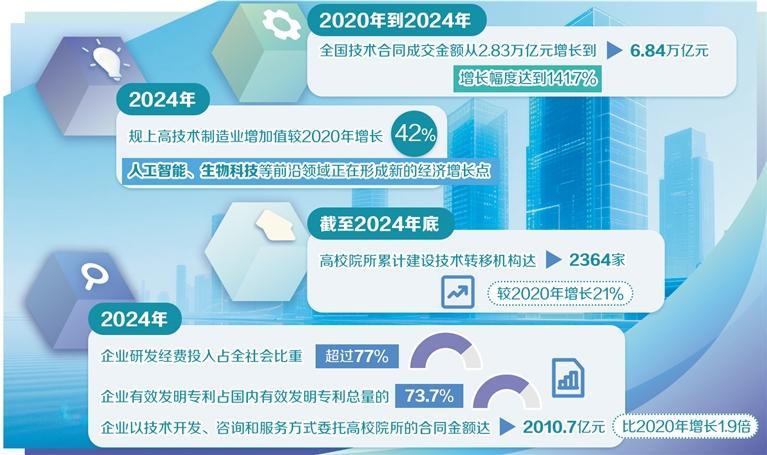
科技成果加速“变现” 2020年至2024年全国技术合同成交额增幅达141.7%
Jing Ji Ri Bao· 2026-01-08 04:03
Core Viewpoint - The report presented by Chen Jiachang, Vice Minister of the Ministry of Science and Technology, highlights the significant growth in technology contract transaction amounts in China, indicating a robust acceleration in the transformation of scientific and technological achievements into productive forces, with a focus on enhancing the synergy between the innovation chain and the industrial chain [1][2]. Policy Guidance - The primary challenge in accelerating the transformation of scientific achievements is the insufficient collaboration between the innovation chain and the industrial chain, leading to a disconnect between research and industry needs [2]. - China is progressively establishing a comprehensive institutional framework for the transformation of scientific achievements, including the decentralization of rights related to the use, disposal, and benefits of achievements [2]. - During the 14th Five-Year Plan period, China has made significant strides in fields such as quantum technology and artificial intelligence, transitioning from a "follower" to a "leader" in innovation [2]. Mechanism Innovation - The "island effect" among innovation entities is a major bottleneck hindering systematic advancement in the transformation of scientific achievements [3]. - Universities and research institutions are taking the lead in breaking through these challenges by integrating resources and establishing comprehensive platforms for technology transfer [3]. - By the end of 2024, the number of technology transfer institutions in universities and research institutes is expected to reach 2,364, marking a 21% increase since 2020 [3]. Financial Support - Funding is identified as a critical factor for the transformation of scientific achievements, with many technology-based enterprises facing challenges related to financing [5]. - The establishment of a technology finance service system is underway, with significant investments from national funds and local governments to support technology transformation [6]. - By the end of Q3 2025, loans to technology-based small and medium-sized enterprises are projected to reach 35.6 trillion yuan, reflecting a year-on-year growth of 22.3% [6].
科技成果加速“变现”
Xin Lang Cai Jing· 2026-01-07 21:21
Core Insights - The report presented by Chen Jiachang, Vice Minister of the Ministry of Science and Technology, highlights a significant increase in the national technology contract transaction amount from 2.83 trillion yuan in 2020 to 6.84 trillion yuan in 2024, marking a growth of 141.7% [2] - The report emphasizes the importance of transforming technological innovation into high-quality development, with a focus on streamlining the path for technology transfer [2] Policy Guidance - The primary challenge in accelerating the transformation of scientific and technological achievements is the lack of coordination between the innovation chain and the industrial chain [3] - A comprehensive institutional framework for technology transfer has been established, with over 200 supporting policy documents created at local levels [3] - During the 14th Five-Year Plan period, China has made significant advancements in fields such as quantum technology and artificial intelligence, transitioning from a "follower" to a "leader" in these areas [3] Mechanism Innovation - The "island effect" among innovation entities hinders the systematic advancement of technology transfer [4] - Universities and research institutions are taking the lead in breaking through these barriers by integrating resources and establishing comprehensive platforms for technology transfer [4] - By the end of 2024, the number of technology transfer institutions in universities and research institutes reached 2,364, a 21% increase from 2020 [4] Funding Support - Funding is identified as a critical factor for the transformation of technological achievements, with many technology-based enterprises facing challenges in financing [6] - The National Technology Transfer Guidance Fund has invested in over 700 technology enterprises, leading to a total scale of local technology transfer funds exceeding 1.4 trillion yuan [6] - By the end of Q3 2025, loans to technology-based small and medium-sized enterprises reached 3.56 trillion yuan, a year-on-year increase of 22.3% [6] Capital Market and Insurance Support - The bond market for technology has progressed steadily, with around 100 institutions issuing technology innovation bonds exceeding 250 billion yuan [7] - Insurance for technology research and transfer provided risk coverage of approximately 9 trillion yuan in 2024 [7] - Continuous support for venture capital institutions and the establishment of a comprehensive evaluation mechanism for state-owned venture capital funds are essential for sustaining the momentum of technology transfer [7]
四月国民经济延续回升向好态势
Ren Min Ri Bao· 2026-01-06 01:57
Group 1 - The core viewpoint of the articles indicates that China's national economy showed stable growth in April, with improvements in production, demand, and high-quality development [1][2] Group 2 - In April, the industrial added value of large-scale industries increased by 6.7% year-on-year, with over 80% of industries and nearly 60% of products experiencing a rebound in growth [1] - The service production index grew by 3.5% year-on-year, indicating overall stability in the service sector [1] - The total import and export volume in April increased by 8% year-on-year, with the first four months of 2023 achieving a record high for the same period [1] - Retail sales of consumer goods in April rose by 2.3% year-on-year, reflecting an expanding market demand [1] - Fixed asset investment grew by 4.2% year-on-year from January to April, with manufacturing investment increasing by 9.7% [1] - The manufacturing purchasing managers' index expanded for two consecutive months, with the production and business activity expectation index at 55.2% and the service business activity index at 50.3% [1] Group 3 - The added value of equipment manufacturing and high-tech manufacturing industries increased by 9.9% and 11.3% year-on-year in April, respectively [2] - New retail models such as instant retail and live streaming sales contributed to an 11.1% year-on-year growth in online retail sales of physical goods from January to April [2] - Investment in the livelihood sector increased significantly, with education and sports investments growing by 7.7% and 12.7% year-on-year, respectively, outpacing overall investment growth [2]
东海证券晨会纪要-20260105
Donghai Securities· 2026-01-05 09:19
Group 1: Pharmaceutical and Biotech Industry - The pharmaceutical and biotech industry in China is entering a new era of innovative drugs, transitioning from a generics-dominated market (pre-2018) to a focus on innovation from 2026 onwards, with significant growth expected in innovative drug development and commercialization [5] - The report highlights the importance of monitoring the launch rhythm of innovative drugs, competitive landscape, and key clinical data in 2026, as well as the impact of international business development (BD) transactions on cash flow [5] - The CXO and upstream scientific reagent sectors are expected to benefit from the rapid development of innovative drugs, maintaining a strong growth momentum [5] Group 2: Medical Device Industry - The medical device industry has faced significant challenges over the past three years, including anti-corruption measures and price reductions, leading to a decline in profitability for listed companies [6] - However, since 2025, there has been a gradual recovery in the industry, with improved profitability expected in 2026 as negative factors clear and new technologies like brain-computer interfaces and AI products emerge [6] - The overseas market is anticipated to become a new growth point due to companies' investments in capacity, channels, and branding [6] Group 3: Medical Services Consumption - The medical services consumption sector has been under pressure from macroeconomic conditions and policy changes, but is expected to recover as domestic consumption gradually improves [7] - The report emphasizes the potential for specialized hospitals with brand and chain advantages to lead growth in 2026, alongside the retail service market benefiting from the diversification of services [7] - A list of recommended stocks includes companies like Kelun Pharmaceutical, Rongchang Bio, and Yifeng Pharmacy, which are positioned to capitalize on these trends [7] Group 4: Manufacturing PMI Insights - The manufacturing PMI for December 2025 was reported at 50.1%, indicating a recovery from the previous value of 49.2%, driven by improved demand and supply conditions [10][11] - Factors contributing to this increase include positive expectations from recent important meetings, a recovery in trade relations, and increased pre-holiday inventory demands [10][12] - High-tech manufacturing sectors showed significant growth, with the high-tech PMI reaching 52.5%, indicating strong performance in this segment [13] Group 5: Economic Policy and Market Outlook - The central economic work conference has set a positive tone for 2026, emphasizing the importance of domestic demand and investment stabilization [15] - The report suggests that upcoming policies will focus on enhancing consumer spending and investment, with potential adjustments in housing policies expected to support the market [15] - The market is advised to focus on sectors benefiting from technological advancements and domestic consumption trends, particularly in light of anticipated policy support [16]
12月PMI数据点评:PMI回升持续性仍需观察
LIANCHU SECURITIES· 2026-01-05 06:05
Report Summary 1. Report's Industry Investment Rating - No industry investment rating is provided in the report. 2. Core Viewpoints - The rebound of the December PMI data needs further observation. Although the manufacturing PMI has unexpectedly rebounded, there are still potential risks, and policy support is required. The service industry has a slight rebound but remains in the contraction range, while the construction industry has significantly improved due to the release of the effects of stable - growth policies [3]. 3. Summary by Related Catalogs Manufacturing Industry - **Overall PMI**: In December, the manufacturing PMI was 50.1%, up 0.9 percentage points from the previous month, returning to the expansion range after eight months. Policy transmission lag, Spring Festival misalignment, and industry structure optimization are the main reasons for the unexpected rebound, but there are still problems such as the low - prosperity of small enterprises [3]. - **Production**: The December production index was 51.7%, up 1.7 percentage points from the previous value, indicating strong production resilience. The main reason for the sharp rebound is the Spring Festival misalignment, as the Spring Festival in 2026 is later than usual [4]. - **Demand**: The new order index was 50.8%, up 1.6 percentage points from the previous value, indicating a significant overall improvement in demand. The improvement in domestic demand is the core, and external demand maintains resilience. The increase in indices such as procurement volume, on - hand orders, finished - product inventory, and raw - material inventory supports the short - term recovery of demand [5]. - **Prices**: The raw material purchase price was 53.1%, still in the expansion range, and the ex - factory price index rose 0.7 percentage points to 48.9%. The "low - selling - price, high - cost" pattern restricts corporate profit repair and investment expansion willingness [6]. - **Enterprise Structure**: Large - and medium - sized enterprises and small enterprises, as well as high - tech and consumer goods industries and traditional industries, show significant differentiation. Large - scale enterprises support the overall improvement of the manufacturing industry, while small enterprises have a low prosperity level. High - tech manufacturing and consumer goods industries perform well, while some traditional industries face demand contraction pressure [8]. Service Industry - In December, the service industry prosperity index was 49.7%, up 0.2 percentage points from the previous month, but still in the contraction range for two consecutive months. The demand has increased, and the expectation has improved, but the price is weak. The lack of service repair power mainly comes from the transformation of traditional industries and the continuous adjustment of the real - estate market [9]. Construction Industry - The construction industry prosperity index increased significantly by 3.2 percentage points to 52.8%, mainly due to the lag effect of previous stable - growth policies, the relatively high temperature in southern provinces, and enterprises seizing the construction progress near the two festivals. Structurally, demand has improved at a low level, input prices are expanding, business activity expectations are optimistic, while sales prices and the employee index are weak [10].