
电气机械

Search documents
前5个月利润同比增长7.2% 装备制造业 “压舱石”作用凸显
Shang Hai Zheng Quan Bao· 2025-06-27 19:53
Core Viewpoint - The gradual recovery of industrial product prices and the implementation of domestic demand expansion policies are expected to maintain a positive trend in domestic demand, leading to a slight recovery in the profit growth of large-scale industrial enterprises in the second half of the year, influenced by a low base from the previous year [1][3]. Group 1: Industrial Profit Trends - In the first five months, the total profit of large-scale industrial enterprises reached 27,204.3 billion yuan, an increase of 6,034.1 billion yuan compared to the first four months, but a year-on-year decline of 1.1% [1]. - The profit of large-scale industrial enterprises in May alone saw a year-on-year decline of 9.1% [1]. - Despite the decline in profit, the gross profit and revenue of industrial enterprises continued to grow, with gross profit increasing by 1.1% year-on-year, contributing to a 3 percentage point increase in overall profit [1]. Group 2: Sector Performance - The equipment manufacturing sector showed strong performance, with profits increasing by 7.2% year-on-year, contributing 2.4 percentage points to the overall profit of large-scale industrial enterprises [2]. - Among the eight industries in equipment manufacturing, seven reported profit growth, with significant increases in the electronics, electrical machinery, and general equipment sectors, achieving year-on-year growth rates of 11.9%, 11.6%, and 10.6% respectively [2]. - The aerospace, aviation, and maritime industries experienced rapid growth, with profits increasing by 56.0% year-on-year, and the shipbuilding and related equipment manufacturing sector saw an impressive profit growth of 85% [2]. Group 3: Policy Impact and Future Outlook - The implementation of "two new" policies has effectively stimulated domestic demand, leading to positive profit performance in related industries [3]. - The general and specialized equipment sectors benefited from large-scale equipment renewal policies, with profits increasing by 10.6% and 7.1% year-on-year, respectively, contributing 0.6 percentage points to the overall profit growth [3]. - The outlook for the next phase suggests that with ongoing recovery in market conditions and industrial product prices, along with strengthened domestic demand policies, the profit growth of large-scale industrial enterprises may show slight recovery in the second half of the year [3].
5月工企利润同比转负
HTSC· 2025-06-27 12:55
Profit Trends - In May, industrial enterprises' profit growth rate dropped significantly to -9.1% year-on-year, down from 3% in April[1] - Revenue growth for industrial enterprises also declined to 0.8% in May from 2.6% in April, correlating with a slowdown in export growth[1] - The profit margin for industrial enterprises fell to 4.8% in May, down from 5.3% in April, indicating a negative impact from tariff policies[8] Sector Performance - State-owned and foreign enterprises saw profit declines of -18.1% and 7.3% respectively in May, while private enterprises' profit growth fell to 0.8% from 14.1% in April[6] - Upstream industries experienced a profit decline of 36.3% year-on-year, worsening from 30.8% in April, with coal and oil extraction profits dropping significantly[7] - Midstream manufacturing profits turned negative at -0.7%, down from 12.6% in April, with notable declines in electrical machinery and specialized equipment sectors[7] Economic Indicators - The overall fiscal expenditure growth rate slowed in May, indicating a decrease in fiscal expansion momentum, particularly affected by real estate cycle downturns[2] - High-frequency data showed a 6.6% year-on-year decline in commodity housing sales in major cities from May's 3.3% drop, reflecting weak real estate cycles[2] - The "trade war" uncertainties and the expiration of the "tariff exemption" period on July 9 may further disrupt external demand and profit margins for enterprises[2]
多维数据传递经济运行积极信号 工业高质量发展活力显现
Yang Shi Wang· 2025-06-27 07:29
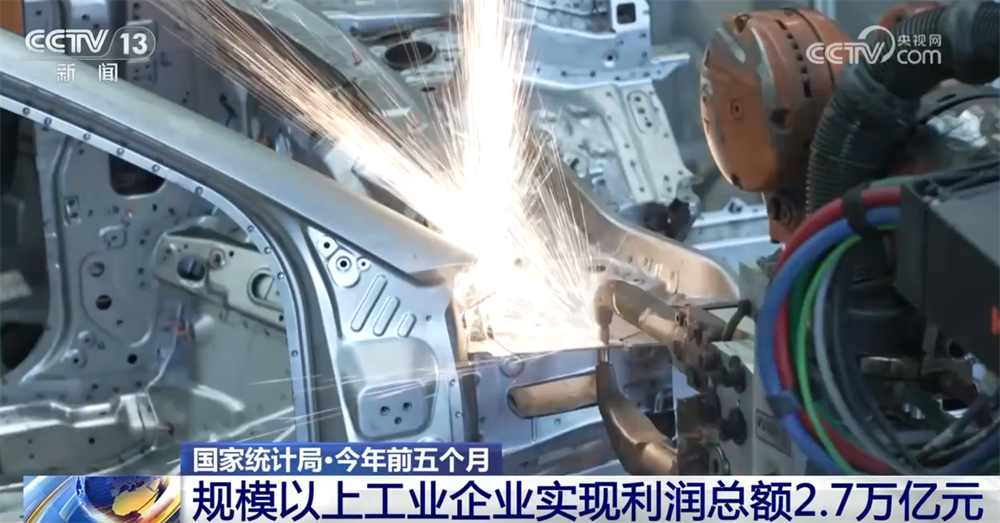
Group 1 - The total profit of industrial enterprises in China reached 2.7 trillion yuan in the first five months of this year, with a year-on-year decline of 1.1% [1] - The revenue of industrial enterprises above designated size was 54.76 trillion yuan, showing a year-on-year growth of 2.7%, indicating a sustained growth trend in industrial revenue [1] - The equipment manufacturing industry maintained a high level of profitability, with profits increasing by 7.2% year-on-year in the first five months [3] Group 2 - The aerospace, aviation, and maritime industries experienced rapid growth, leading to a 56.0% year-on-year increase in profits for the railway, shipping, and aerospace sectors [5] - Specific industries such as aircraft manufacturing, spacecraft and launch vehicle manufacturing, and shipbuilding saw profit increases of 120.7%, 28.6%, and 85.0% respectively [5] Group 3 - The integration of technological and industrial innovation is enhancing the technical content of industrial products, with a continuous release of market demand for smart, green, and high-quality products, contributing to profit growth for related enterprises [7] - Proactive macroeconomic policies are expected to support stable industrial economic operations and create favorable conditions for improving industrial enterprise profitability [7] Group 4 - The total revenue of China's cultural industry reached 19.1423 trillion yuan in 2024, marking a year-on-year growth of 7.1% [13] - The profit of the cultural industry totaled 1.7737 trillion yuan, an increase of 1.291 trillion yuan, reflecting a 7.9% growth [13]

1至5月成都市规上工业增加值同比增长8.0%
Xin Hua Cai Jing· 2025-06-23 13:23
Economic Performance - Chengdu's industrial added value for the first five months of the year increased by 8.0% year-on-year, with a product sales rate of 96.8% among large-scale industrial enterprises [1] - Among different economic types, state-owned enterprises saw a 5.3% increase, foreign and Hong Kong, Macao, and Taiwan-invested enterprises grew by 20.9%, and private enterprises increased by 10.7% [1] - Out of 37 major industries, 24 experienced growth in added value, with notable increases in the automotive manufacturing sector (26.2%), computer, communication, and other electronic equipment manufacturing (18.2%), and electrical machinery and equipment manufacturing (12.9%) [1] Fixed Asset Investment - Fixed asset investment in Chengdu (excluding rural households) grew by 7.0% year-on-year, with private investment increasing by 9.7% [1] - Investment in the primary industry rose by 12.5%, while the secondary industry saw a significant increase of 72.4%, with industrial investment specifically growing by 73.7% [1] Consumer Market - The total retail sales of consumer goods in Chengdu reached 465.0 billion yuan, marking a year-on-year growth of 6.5% [2] - Key product categories showed substantial growth, including telecommunications equipment (92.2%), household appliances and audio-visual equipment (31.3%), and gold and silver jewelry (27.0%) [2] Foreign Trade - Chengdu's total foreign trade import and export volume for the first five months was 351.5 billion yuan, reflecting a year-on-year increase of 10.4% [2] - Exports totaled 205.8 billion yuan, up by 13.7%, while imports reached 145.7 billion yuan, growing by 6.1% [2] Financial Sector - As of the end of May, the balance of deposits in Chengdu's financial institutions was 65.739 billion yuan, an increase of 7.5% year-on-year [2] - The balance of loans in financial institutions was 70.729 billion yuan, reflecting a growth of 10.6% [2]
苏浙皖前5月经济稳中有进
Guo Ji Jin Rong Bao· 2025-06-23 13:20
Economic Overview - Jiangsu, Zhejiang, and Anhui provinces have reported stable economic performance in recent months [1] - Fixed asset investment in Zhejiang increased by 1.9% year-on-year from January to May, with project investment growing by 12.1% [3] - Infrastructure investment in Zhejiang rose by 14.2%, accounting for 26.4% of total investment, an increase of 2.9 percentage points year-on-year [3] - Anhui's fixed asset investment grew by 0.2% year-on-year, with infrastructure investment increasing by 12.4% [3] - Jiangsu's fixed asset investment decreased by 1.4% year-on-year, but infrastructure investment grew by 8.7% [3] Trade Performance - Zhejiang ranked first in the country for export contributions, with total goods import and export reaching 2.24 trillion yuan, a 6.5% increase [4] - Anhui's total import and export value was 374.79 billion yuan, growing by 15.4% [4] - Jiangsu's total goods trade value was 2.33 trillion yuan, a 5.3% increase year-on-year [4] Consumer Spending - All three provinces maintained a retail sales growth rate of over 5% in the first five months [5] - Jiangsu's retail sales totaled 1.98839 trillion yuan, growing by 5.6% [5] - Zhejiang's retail sales reached 1.55 trillion yuan, with a growth of 5.3% [5] - Anhui's retail sales increased by 5.5% [5] Industrial Growth - Jiangsu's industrial added value grew by 7.7% year-on-year, with equipment manufacturing accounting for 54.6% of the total [7] - High-tech manufacturing and digital product manufacturing in Jiangsu saw increases of 9.8% and 9.7%, respectively [7] - Zhejiang's industrial added value grew by 7.6%, with significant contributions from petroleum processing and automotive sectors [8] - Anhui's industrial added value increased by 8.4%, with high-tech manufacturing growing by 29.3% [9]
高盛:运用细分贸易数据解读中国出口韧性
Goldman Sachs· 2025-06-23 02:30
Investment Rating - The report indicates a positive outlook on China's export resilience, highlighting strong growth in exports, particularly to emerging markets [2][3]. Core Insights - China's exports have demonstrated surprising strength, achieving double-digit growth since Q4 2023, driven by factors such as front-loading of export orders and trade re-routing [2][3][4]. - The report emphasizes the shift of China's export flows from developed markets to emerging markets, particularly ASEAN, which has become a key trading partner [2][3][4]. Summary by Sections Export Growth Dynamics - Real exports from China have shown double-digit year-over-year growth since Q4 2023, with significant contributions from emerging markets [2][3]. - Front-loading of export orders has played a crucial role in maintaining high export levels, particularly in anticipation of US tariffs [5][6]. Trade Patterns and Destinations - Exports to ASEAN accounted for 16% of China's total exports in 2024, surpassing exports to the US, indicating a strategic shift in trade routes [2][3][4]. - The report notes that strong trade growth with major emerging economies has been a significant contributor to China's export strength over the past decade [2][3]. Sectoral Analysis - Exports of vehicles and electrical machinery to emerging markets have risen sharply, driven by supply chain diversification and increasing local demand for electric vehicles [2][3][4]. - The report highlights a transition in China's export product mix from traditional goods to new sectors such as electric vehicles, lithium-ion batteries, and solar cells [26][35]. Impact of US Tariff Policies - US tariff policies have induced front-loading and trade re-routing, which have helped stabilize China's overall export growth despite a decline in US-bound exports [5][6][18]. - The report estimates that cumulative front-loading of US-bound exports during Q4 2024 to Q1 2025 was around 30% of trend-implied monthly export values [5][6]. ASEAN's Role in Trade - The ASEAN-China Free Trade Agreement has significantly reduced tariffs, contributing to the rise in ASEAN-bound exports from China [37]. - Trade data discrepancies suggest potential transshipment of goods through ASEAN to avoid US tariffs, indicating a complex trade dynamic [39][41].
发电量为什么和工业增加值“脱节”?
2025-06-23 02:09
Summary of Conference Call Notes Industry or Company Involved - The discussion primarily revolves around the electricity generation industry and its relationship with industrial value-added growth in the context of the broader economy. Core Points and Arguments - There is a significant divergence between electricity generation growth and industrial value-added growth, attributed to differences in statistical scope, as data from small-scale enterprises (such as renewable energy and distributed photovoltaic) is not fully captured in the statistics [1][3] - Industrial electricity consumption growth is approximately 3%, while the growth of industrial value-added for large-scale enterprises is around 6%, indicating a disparity in development between large and small enterprises [1][4] - The domestic economic growth target of 5% is likely achievable, but tail risks remain, particularly for low-income residents, small enterprises, and local governments with heavy debt burdens [1][5] - The divergence in growth rates is particularly pronounced in the electrical machinery, chemical, non-metallic minerals, and general equipment sectors, where capacity utilization rates are at historical lows [1][6] - In 2025, risk warnings in various industries, especially electrical machinery, chemicals, non-metallic minerals, and communication equipment, are higher than in 2024, indicating significant changes on the supply side with little improvement on the demand side [1][7] - The phenomenon of divergence is expected to continue, with a proposed solution being to strengthen supply-side clearing efforts and improve capacity utilization rates [1][8] Other Important but Possibly Overlooked Content - The rapid growth of small-scale enterprises in electricity generation is not reflected in overall statistics, leading to a misleading picture of the industry [3][4] - The performance of large enterprises is significantly better than that of small and medium-sized enterprises, contributing to the observed divergence in data [4][6] - The need for policy support to mitigate risks faced by low-income residents and small enterprises is emphasized, highlighting the importance of addressing these tail risks for overall economic stability [5]
晚间公告丨6月17日这些公告有看头
第一财经· 2025-06-17 15:19
Core Viewpoint - Multiple companies in the Shanghai and Shenzhen stock markets have announced significant developments, including acquisitions, new product launches, and changes in management, which may present investment opportunities and risks for investors [2] Group 1: Major Announcements - BOE Technology Group plans to acquire a 30% stake in Rainbow Optoelectronics for a base price of 4.849 billion yuan, aiming to enhance its competitive edge [3] - Taihe Intelligent intends to acquire 100% of Sunshine Yuchu for 45.8 million yuan, with the transaction being an affiliated deal [5][6] - Guoxin Technology successfully tested a new quantum-resistant encryption card, which combines quantum-resistant algorithms with traditional national encryption algorithms [7] Group 2: Stock Performance and Risks - Dongxin Peace reported a significant stock price increase of over 20% in two consecutive trading days, while acknowledging uncertainties in its blockchain and digital wallet projects [4] - Huayang New Materials warned of irrational speculation risks due to significant stock price fluctuations, clarifying that it does not possess rare earth permanent magnet attributes [8] Group 3: Management Changes - Guodian Nanrui elected Zheng Zongqiang as the chairman of its board of directors [9] - Daqin Railway appointed Zhang Hongyi as the new general manager following the retirement of the previous manager [10] Group 4: Financial Performance - Jingyi Equipment expects a revenue increase of 36.54% to 42.48% year-on-year for the first half of 2025, projecting revenue between 690 million and 720 million yuan [11] Group 5: Shareholding Changes - Enhua Pharmaceutical's chairman increased his stake by purchasing 237,900 shares, which will not affect the company's control or governance structure [12] - Yunlu Co. plans for its executives to collectively increase their holdings by 4 million to 12 million yuan within six months [13][14] Group 6: Share Buybacks - Guangda Special Materials' chairman proposed a share buyback plan with a total amount between 200 million and 400 million yuan to support employee stock ownership plans or convertible bonds [15] Group 7: Major Contracts - Zhongchao Holdings announced that its subsidiaries won multiple power cable projects with a total bid amount of 1.061 billion yuan, representing 19.29% of the company's audited revenue for 2024 [16]




深度 | 发电量为什么和工业增加值“脱节”?——中观看实体之五【陈兴团队•财通宏观】
陈兴宏观研究· 2025-06-17 11:55
Core Viewpoint - The growth rate of electricity generation has consistently lagged behind the growth rate of industrial added value this year, indicating a potential structural issue rather than short-term fluctuations [1][3][21] Group 1: Reasons for Divergence - The first discrepancy in metrics arises from the definition of electricity generation, which refers to the output of large-scale industrial power generation enterprises, excluding smaller enterprises that contribute less than 8% to total electricity consumption [4][8] - The second discrepancy is that while electricity generation data is not comprehensive, it aligns with electricity consumption data, which does not differentiate between large and small enterprises, whereas the industrial added value growth rate is based solely on large enterprises [8][12] - The slowdown in the number of large industrial enterprises and the increase in industrial added value suggest that larger companies are performing well, while smaller companies are dragging down overall growth [8][9] Group 2: Industry Analysis - Significant divergence in electricity consumption and industrial added value growth is observed in industries such as electrical machinery, chemicals, non-metallic minerals, and general equipment, which are currently facing low capacity utilization rates [14][15][17] - The low capacity utilization indicates potential overcapacity, leading to a slowdown in electricity consumption growth, while efficient enterprises are likely to thrive by adopting advanced technologies and management practices [15][19] - Data from listed companies show that larger firms in the aforementioned industries are performing better than smaller firms, highlighting a trend of market-driven capacity elimination [19][21] Group 3: Future Outlook - The divergence between electricity generation growth and industrial added value growth is expected to persist, primarily due to weak demand and overcapacity in the industry, reminiscent of the supply-side structural reform period in 2015 [21]

5月经济数据点评:为何消费与生产背离?
Shenwan Hongyuan Securities· 2025-06-17 03:13
Consumption - In May, the retail sales growth rate reached 6.4%, exceeding expectations of 4.9% and the previous value of 5.1%[8] - The increase in retail sales was driven by e-commerce promotions and an additional 2 days of holidays compared to last year, leading to concentrated demand release[2] - Significant improvements were noted in household appliances (+14.2 percentage points to 53.0%) and communication equipment (+13.1 percentage points to 33.0%) sales[9] Investment - Fixed asset investment growth slowed to 3.7%, below the expected 4%, with a monthly decline of 0.7 percentage points to 2.8%[8] - The decline in investment was primarily due to the end of the equipment renewal cycle and a drop in traditional infrastructure and real estate investments[3] - Real estate investment fell by 10.7%, slightly worse than the expected decline of 10.5%[8] Production - Industrial value-added growth in May was 5.8%, a decrease of 0.3 percentage points from April[25] - Manufacturing production saw a significant decline, down 0.4 percentage points to 6.2%, influenced by fewer working days in May compared to last year[25] - The decline in production was exacerbated by weak real estate and export sectors, particularly affecting transportation equipment and electrical machinery[25]