
美妆

Search documents
“急闯”港股 丸美生物突围还是解困?
Zhong Guo Ji Jin Bao· 2026-01-13 13:56
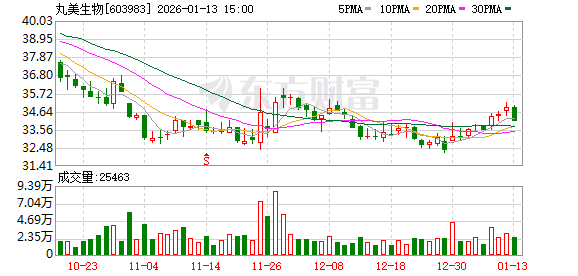
Core Viewpoint - Marubi Biotechnology is seeking a dual listing on the Hong Kong Stock Exchange to enhance its capital strength and international financing capabilities amid increasing competition in the domestic beauty industry and rising online traffic costs, which have led to a situation of revenue growth without profit increase [2][12]. Financial Status - Marubi plans to issue up to 15% of its total share capital as H-shares in its Hong Kong listing [2]. - The company has faced financial scrutiny due to irregularities in financial accounting and has been ordered to rectify these issues by regulatory authorities [2][12]. - As of the end of 2025, Marubi's short-term borrowings amount to approximately 573 million yuan, with total short-term liabilities around 977 million yuan [8][12]. Dividend Policy - Marubi's dividend payout ratio has surged from 37.77% in 2019 to 202.82% in 2023, with a notable payout ratio of 235.87% in 2024 [7]. - The majority of dividends benefit the founding couple, who hold over 80% of the company's shares, raising concerns among investors about the sustainability of such high payouts amid financial pressures [7][9]. Revenue and Profitability - Marubi reported a revenue of 2.97 billion yuan in 2024, with 2.45 billion yuan generated in the first three quarters of 2025 [12]. - Despite revenue growth, net profit growth has slowed, with a mere 2.13% increase in net profit attributable to shareholders in the first three quarters of 2025, while non-recurring net profit declined by 5.42% [12][11]. Marketing and Sales Strategy - The company's marketing expenses have significantly increased, reaching 1.415 billion yuan in the first three quarters of 2025, with a marketing expense ratio of 57.7% [12]. - A high reliance on online sales channels, which accounted for 87.6% of revenue in the same period, has led to increased operational costs due to platform rules and traffic costs [12]. Research and Development - Marubi is transitioning towards a biotechnology-focused beauty company, with an emphasis on research in areas like recombinant collagen [14]. - However, R&D spending has been insufficient, with only a slight increase in R&D expenses compared to a significant rise in sales expenses [16].


“急闯”港股,丸美生物突围还是解困?
Zhong Guo Ji Jin Bao· 2026-01-13 13:49
Core Viewpoint - Marubi Biotechnology is seeking a dual listing in Hong Kong to enhance its capital strength and international financing capabilities amid increasing competition in the domestic beauty industry and rising online traffic costs, which have led to a situation of revenue growth without profit increase [2][3]. Financial Pressure - Marubi plans to issue up to 15% of its total share capital as H-shares in its Hong Kong listing [3]. - The company reported a net cash outflow of 391 million yuan in Q3 2025, significantly reducing its cash and cash equivalents [5]. - Short-term borrowings reached 573 million yuan, with total short-term liabilities amounting to approximately 977 million yuan [6]. Dividend Policy - Marubi's dividend payout ratio has surged from 37.77% in 2019 to 202.82% in 2023, with a payout ratio of 235.87% in 2024 [10]. - The majority of dividends benefit the founders, who hold over 80% of the shares, raising concerns among investors about the sustainability of high dividends amid financial pressures [10]. Institutional Shareholding - Institutional shareholding has decreased significantly, with the number of shares held by funds dropping from 23.65 million at the end of 2024 to 9.61 million by the end of September 2025 [10][11]. Revenue and Profit Trends - Marubi's revenue grew to 2.97 billion yuan in 2024, with 2.45 billion yuan generated in the first three quarters of 2025 [12]. - However, net profit growth has slowed, with a mere 2.13% increase in net profit attributable to shareholders in the first three quarters of 2025, while non-recurring net profit declined by 5.42% [12]. Marketing Expenses - Marketing expenses for the first three quarters of 2025 reached 1.415 billion yuan, with an expense ratio climbing to 57.7%, primarily due to reliance on online sales channels [12][14]. - The company faced a significant drop in net profit in Q2 2025 despite revenue growth, with sales expense ratios exceeding 60% [14]. Technology Transformation - Marubi officially rebranded to "Marubi Biotechnology" in December 2024, emphasizing its transition to a biotechnology-focused beauty company [18]. - The company has increased its investment in research and development, particularly in recombinant collagen products, which have shown significant market growth potential [18][20]. - However, R&D spending has not kept pace with sales expenses, with only a slight increase in R&D costs compared to a substantial rise in marketing expenses [21].

“急闯”港股,丸美生物突围还是解困?
中国基金报· 2026-01-13 13:38
Core Viewpoint - Marubi Biotechnology is seeking a dual listing in Hong Kong to enhance its capital strength and international financing capabilities, amid concerns over its financial health and high dividend payouts [2][4]. Group 1: Financial Performance and Pressures - Marubi's financial report indicates significant cash flow pressure, with a net cash outflow of 391 million yuan in Q3 2025, leading to a notable decrease in cash and cash equivalents [6]. - The company has short-term borrowings of 573 million yuan and total short-term liabilities of approximately 977 million yuan [8]. - Despite revenue growth, net profit growth has slowed, with a mere 2.13% increase in net profit attributable to shareholders in the first three quarters of 2025, while non-operating profit dropped by 5.42% [16]. Group 2: Dividend Policy and Shareholder Concerns - Marubi's dividend payout ratio has surged from 37.77% in 2019 to 202.82% in 2023, with a staggering 235.87% payout ratio in 2024, raising concerns among investors about the sustainability of such high dividends amid financial pressures [11]. - The majority of dividends benefit the founding couple, who hold over 80% of the shares, leading to investor worries about the prioritization of dividends over business reinvestment [11]. Group 3: Market Position and Competition - The competitive landscape in the domestic beauty industry is intensifying, with rising online traffic costs contributing to Marubi's struggle to increase profitability despite revenue growth [2]. - The company's reliance on online sales channels, which accounted for 87.6% of revenue in the first three quarters of 2025, has made it vulnerable to platform rules and rising costs [18]. Group 4: Technological Transformation and R&D Investment - Marubi is transitioning towards a biotechnology-focused beauty company, with significant investments in research and development, particularly in recombinant collagen products [20]. - However, R&D spending has not kept pace with sales expenses, with only a slight increase in R&D costs compared to a substantial rise in marketing expenses, indicating a potential imbalance in investment strategy [22].
毛戈平加速“出海”背后:营收增速放缓、彩妆平均售价下滑
Xin Jing Bao· 2026-01-13 11:29
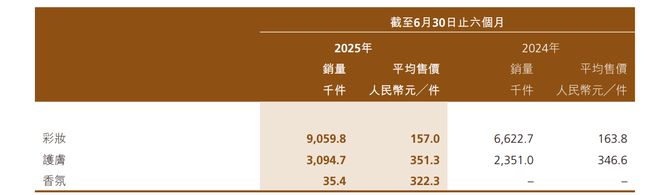
Core Viewpoint - MAOGEPING, known as the "first domestic color cosmetics stock in Hong Kong," is accelerating its overseas market expansion through a strategic partnership with private equity firm LWK & Partners, while also undergoing significant internal shareholding adjustments [1][2][3]. Group 1: Strategic Partnership and Market Expansion - MAOGEPING has signed a strategic cooperation framework agreement with LWK & Partners to enhance global market expansion, acquisitions, strategic investments, capital structure optimization, and talent introduction [1][2]. - The partnership aims to leverage LWK & Partners' global investment network to assist MAOGEPING in expanding its high-end retail channels overseas [2]. - A specialized equity investment fund focusing on the global high-end beauty sector is planned to be established as part of this collaboration [2]. Group 2: Shareholding Adjustments - MAOGEPING's founders and key shareholders plan to collectively reduce their holdings by up to 17.2 million shares, amounting to over 1.4 billion HKD, citing personal financial needs [3][4]. - This reduction involves a "family-style" divestment, with most of the shareholders being relatives of the founder, raising concerns about the company's commitment to its own growth [3][4]. Group 3: Financial Performance and Challenges - MAOGEPING's revenue growth has slowed, with a reported 31.3% increase in revenue for the first half of 2025, down from 41% in the previous year [6]. - The company achieved a revenue of 25.88 billion RMB in the first half of 2025, with net profit rising to 6.7 billion RMB, reflecting a 36.1% year-on-year increase [6]. - Despite maintaining a strong market position, MAOGEPING faces challenges related to its "light R&D" reputation, with R&D expenses remaining below 1% of revenue, significantly lower than industry peers [8]. Group 4: Marketing and Sales Dynamics - MAOGEPING's marketing and promotional expenses increased by 23.9% to approximately 540 million RMB, constituting about 45.2% of total revenue [8]. - The average selling price of color cosmetics decreased by approximately 4.15% in the first half of 2025, indicating potential pricing pressures despite a 36.8% increase in sales volume [7][8].
天猫「扶优」一年,新品牌迎来黄金时代
3 6 Ke· 2026-01-13 11:27
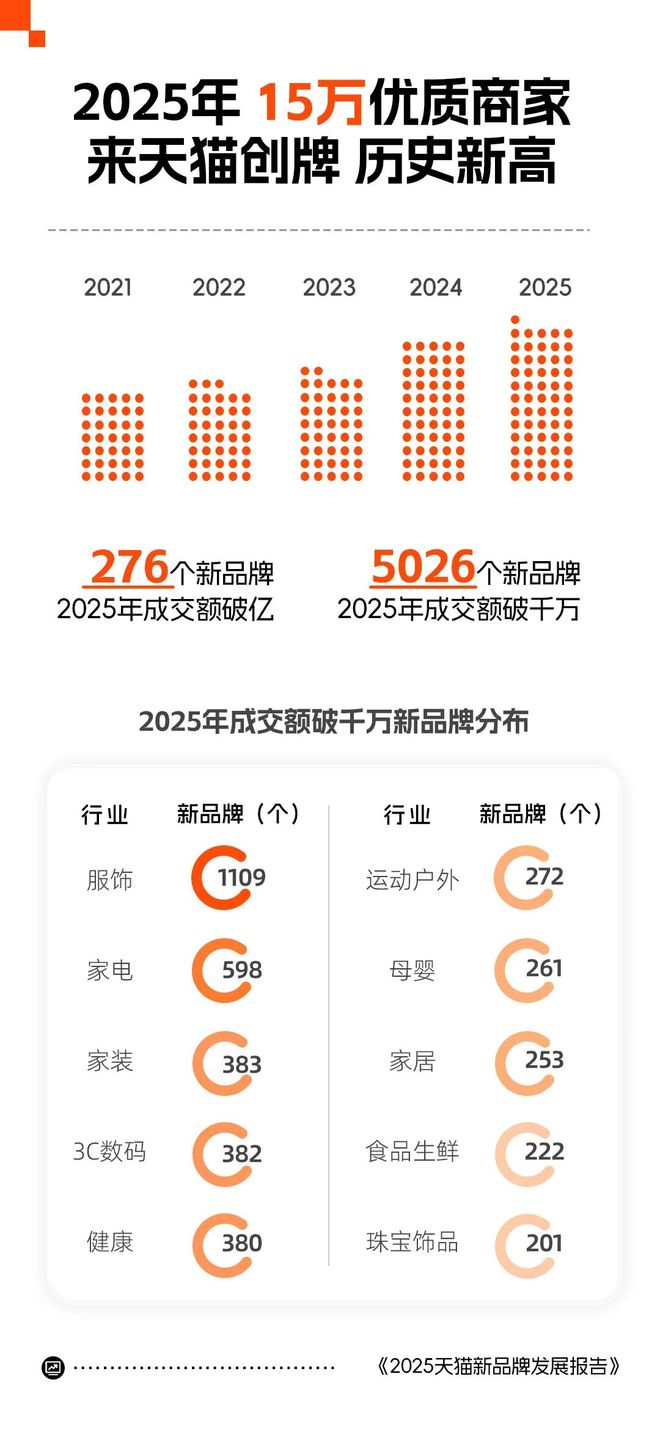
Core Insights - The report from Tmall indicates a strong performance in the new brand sector, contradicting the narrative of a declining consumer market, with 150,000 new merchants and 276 new brands achieving over 100 million in sales [1][8] - The data suggests that 2025 is a significant year for new brand entrepreneurship, showcasing a thriving environment for brands that focus on product quality rather than price competition [8][10] Group 1: Market Performance - Tmall's report highlights a historical high in the number of new brands achieving significant sales milestones within three years of establishment, with a year-on-year growth of over 40% for brands reaching 100 million in sales in their opening year [1][8] - The report emphasizes that the consumer market is not "cooling down" but rather becoming more selective, rewarding brands that focus on genuine product quality [13][30] Group 2: Brand Strategies - Successful brands are characterized by their commitment to product excellence, as seen in the case of brands like Xucuihua, which focuses on high-quality, plant-based cat litter, and CrzYoga, which tailors products to local consumer preferences [10][24] - The report identifies three main winning strategies among new brands: technology translation into user experience, pain point customization, and leveraging IP for sustained consumer engagement [23][24][26] Group 3: Consumer Trends - The evolving consumer demand is shifting towards a balance of emotional and practical value, with a consistent increase in the quality index of consumer goods over the past ten quarters [34][35] - The report suggests that the future growth opportunities lie in high-quality products that meet the evolving needs of consumers, particularly in sectors like AI hardware, smart accessories, and innovative home appliances [30][34]
重磅|从世界工厂到全球心智占领——中国品牌出海路径解析
科尔尼管理咨询· 2026-01-13 09:59
Core Insights - The article highlights the global success of Chinese brands, particularly through the example of Pop Mart's IPs, which have gained significant traction in international markets, with overseas revenue reaching 1.4 billion yuan in the first half of 2024, accounting for 30% of total revenue, a nearly threefold increase compared to the same period in 2021 [1] Group 1: Brand Globalization Acceleration - The process of establishing brand recognition overseas has been significantly shortened from ten years to approximately 3-5 years, marking a shift from a prolonged battle to a rapid engagement strategy [8] - This acceleration is supported by improved infrastructure, including cross-border e-commerce platforms, social media for targeted marketing, and robust supply chain systems [9] Group 2: Transformation of Export Categories - The scope of Chinese exports is evolving from physical products to cultural IP and services, with IP product exports growing at 8%, surpassing the average growth rate of consumer goods exports [10] - This shift indicates a transition from being mere suppliers in the global supply chain to becoming value co-creators through deeper user engagement [10] Group 3: Deepening Export Models - Chinese brands are transitioning from a trade-based export model to a global supply chain layout, enhancing their market competitiveness and integrating more deeply into local economies [11] Group 4: Upgrading Consumer Connection Channels - Brands are moving away from reliance on platforms like Amazon to a diversified omnichannel operation, which includes direct-to-consumer (DTC) models and multi-channel strategies to better engage local consumers [12] Group 5: Regional Market Variations - The Asia-Pacific market is characterized by rapid demand growth and an expanding middle class, with consumers prioritizing quality and individual expression, benefiting culturally adaptable consumer goods [17] - In North America and Europe, despite slower overall growth, consumers are highly sensitive to product value, favoring categories with technological barriers and sustainable attributes [18] - Emerging markets like Latin America present unique opportunities for high-value, practical products, while the Middle East and Africa focus on meeting basic needs with cost-effective solutions [19] Group 6: Category Differentiation Strategies - Chinese companies must focus on their resource endowments and strategic priorities to maximize export efficiency, categorizing consumer goods into three types based on market share and growth potential [20] - For durable goods, the challenge lies in breaking through competitive saturation while enhancing profit margins through brand premium and supply chain resilience [25][26] - Fashion and cultural products must build deep emotional connections with consumers to transition from short-term popularity to long-term loyalty [29] Group 7: Case Studies of Successful Brands - Haier exemplifies successful globalization with a revenue of 285.98 billion yuan in 2024, where overseas income surpassed domestic for the first time, showcasing a robust local operational system [27][28] - Miniso's global strategy emphasizes emotional connection with consumers, achieving a revenue of 17 billion yuan in 2024, with overseas revenue growing by 41.9% [30][31] - Huaxizi, a beauty brand, has effectively penetrated international markets by leveraging unique cultural narratives and products, achieving significant sales in Japan and expanding into Europe [32][33]



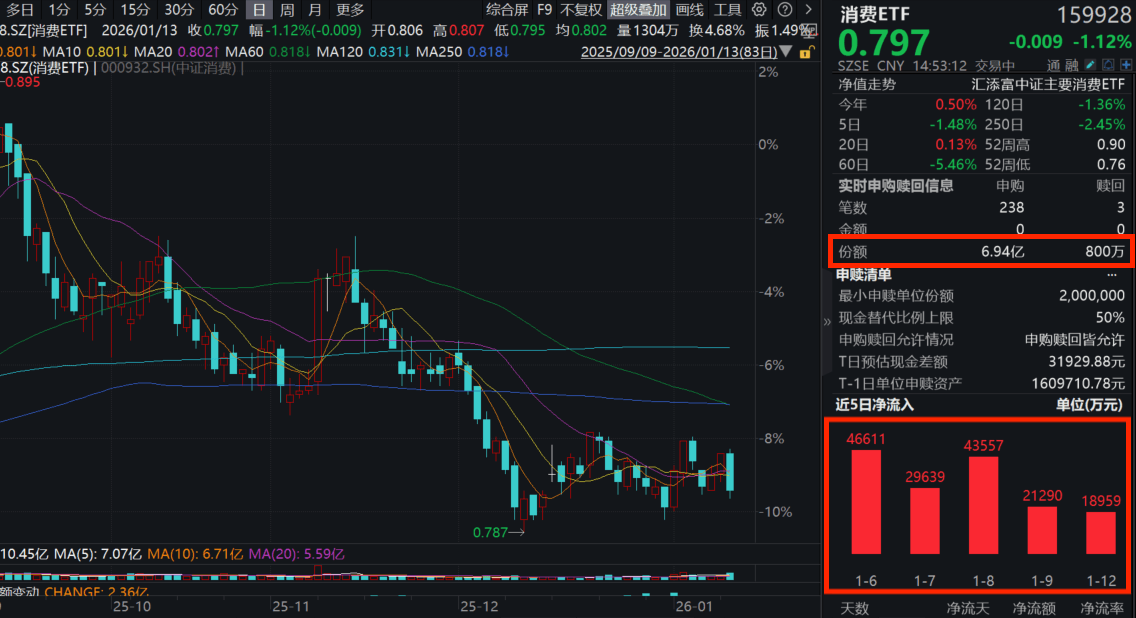
上海促消费新政重磅落地,积极布局内需消费!消费ETF(159928)回调超1%,大举揽金超6.8亿份!此前5日累计“吸金”超16亿元!
Sou Hu Cai Jing· 2026-01-13 07:04
Group 1 - The Shanghai Composite Index experienced fluctuations and a decline, with the consumer sector retreating, as the Consumption ETF (159928) corrected over 1% after two consecutive days of gains, with trading volume exceeding 1 billion yuan [1] - The Shanghai municipal government issued measures to enhance service quality and stimulate consumption, focusing on 28 policy initiatives aimed at optimizing supply and expanding consumption, particularly in key sectors like finance, transportation, and entertainment [3] - Moutai 1935 may implement a new pricing system, with both the payment price and retail price expected to decrease, indicating a potential gross margin of nearly 10% even after the price adjustment [4] Group 2 - The Hong Kong Stock Connect Consumption 50 ETF (159268) fell by 0.86%, with major stocks like Pop Mart and Li Ning experiencing declines of over 3% [6] - Domestic consumption is becoming a key driver of economic growth, with a shift in consumer behavior towards personalized and emotional spending, creating numerous niche opportunities [8] - The Consumer Price Index (CPI) rose by 0.8% year-on-year in December 2025, reflecting the effectiveness of consumption policies and increased consumer demand [9] Group 3 - The Consumption ETF (159928) has a strong resilience to economic cycles, with the top ten constituent stocks accounting for over 68.55% of its weight, including major liquor brands and agricultural companies [10] - The top holdings in the ETF include Yili, Moutai, and Wuliangye, with significant representation from the food and beverage sector [11] - The Hong Kong Stock Connect Consumption 50 ETF (159268) offers efficient access to the consumer sector, particularly targeting the Z generation's spending trends [12]
中信建投:看好26年高端消费复苏投资机会 中前期刚需性强品类率先复苏
智通财经网· 2026-01-13 03:13
Core Viewpoint - The report from CITIC Securities indicates a gradual recovery in high-end consumption in China since Q3 2025, driven by the wealth effect from rising stock markets, with positive signs from international luxury brands and high-end retail properties [1] Group 1: Recovery Indicators - International luxury brands have shown signs of recovery since Q2 2025, with revenue growth returning in the Asia-Pacific region by Q3 2025 [2] - High-end retail properties in China began to recover at the end of 2024 and early 2025, with improved occupancy rates and sales, particularly in top luxury malls [2] - The global luxury market also entered a recovery phase starting Q3 2025 [2] Group 2: Investment Opportunities in High-End Consumption - The recovery of high-end consumption is influenced by factors such as the proportion of VIC (Very Important Customer) groups, the sequence of consumption based on wealth increase, the elasticity of supply, and consumption trends [3] - Categories with strong initial demand, driven by social status and identity needs, are expected to recover first, while categories with a high proportion of VIC customers and good supply conditions will show more sustained growth [3] - The fastest-growing segments in the luxury market from 2019 to 2025 include luxury cruises, private jets, high-end dining, personal luxury goods, luxury hotels, and high-end home goods [3] Group 3: Recommended Investment Targets - The report recommends focusing on luxury jewelry and leather goods, high-end domestic beauty products, and high-end outdoor sports [4] - Specific companies to watch include gold and jewelry brands like Lao Pu Gold and Chow Tai Fook, beauty brands like Mao Ge Ping, and sportswear brands like Anta Sports [4] - Other areas of interest include high-end commercial real estate, high-end residential real estate, gaming, private aviation, high-end tourism and dining, and premium liquor [4]





流量失灵,美妆品牌换战场了
3 6 Ke· 2026-01-12 11:49
Core Insights - The beauty industry is undergoing a significant transformation as consumers prioritize product ingredients and efficacy over marketing narratives and brand stories [1][2] - The competition among companies is shifting from traditional marketing to a focus on scientific validation and technical authority, particularly regarding core ingredients [1][3] Group 1: Industry Dynamics - The battle for defining the "ingredient king" is exemplified by the prolonged conflict between Huaxi Biological and Juzhi Biological over recombinant collagen, highlighting the industry's shift towards scientific discourse [1][2] - Companies are increasingly engaged in disputes over intellectual property and scientific narratives, as seen in the conflict between medical company Aierfu and skincare brand Zhanmeiya, which revolves around the storytelling of scientific advancements [3] Group 2: Market Competition - The competition for established, cash-generating scientific products is illustrated by the dispute between Shuiyang Co. and Ruoyu Chen over the agency rights for the Spanish brand "Mestique," which has shown remarkable growth in the Chinese market [5][6] - The financial performance of companies varies significantly, with some experiencing revenue growth alongside increased R&D spending, while others face declining revenues despite high R&D investments [6][7] Group 3: Consumer Behavior - A significant shift in consumer preferences is noted, with 58.8% of consumers prioritizing product ingredients in their purchasing decisions, indicating a growing demand for transparency and efficacy [15][21] - The rise of the "ingredient party" has led to increased scrutiny of product claims, pushing companies to provide credible testing reports and validate their ingredients [15][21] Group 4: Future Trends - The beauty industry's future is marked by a "scientific arms race," with brands striving to establish their authority in scientific research and ingredient validation [8][16] - Companies are exploring unique natural ingredients and integrating skincare with makeup, reflecting a trend towards holistic beauty solutions [20][21]


需要13亿来“改善生活”?毛戈平家族的上市财富盛宴
Guan Cha Zhe Wang· 2026-01-12 10:44
Core Viewpoint - The article discusses the financial maneuvers of the Mao Geping family following their company's IPO in Hong Kong, highlighting significant cash withdrawals and questioning the alignment of their actions with the company's stated growth strategies and investor interests [1][4][6]. Group 1: IPO and Financial Maneuvers - Mao Geping withdrew its IPO application from A-shares three times, citing "business prospects, future development strategy, and market environment" as reasons [1]. - After the withdrawal, the Mao Geping family repurchased 10% of shares from Jiuding for 730 million yuan and distributed dividends totaling 1 billion yuan within three months, exceeding the previous year's net profit [1][6]. - The company successfully listed on the Hong Kong Stock Exchange, raising approximately 2.1 billion yuan, while the family has since cashed out over 2 billion yuan through dividends and share sales [1][6][7]. Group 2: Shareholder Actions and Market Reactions - Recently, the family announced plans to sell up to 17.2 million H-shares, representing 3.51% of the total shares, with a potential value of 1.41 billion HKD (approximately 1.3 billion yuan) [4][5]. - Investors have expressed skepticism regarding the rationale behind the family's cashing out, questioning the need for personal financial improvement when substantial dividends have already been distributed [5][15]. - The family's actions have raised concerns about the alignment of their financial interests with those of minority shareholders, especially given the significant amount of cash withdrawn from the company [15]. Group 3: Business Model and Governance Structure - Mao Geping's business model relies heavily on outsourcing production, with a low investment in R&D (only 0.59% of revenue), raising questions about the sustainability of its "high-end" branding [8][12]. - The company has a family-dominated board, with six out of nine directors being family members, leading to potential conflicts of interest between family and corporate goals [13][14]. - The governance structure suggests that the family's financial interests are prioritized, as evidenced by their substantial compensation and the timing of their cash withdrawals [14][15].
