调味品

Search documents
莲花控股荣登“最具人气上市公司TOP100”“机构青睐上市公司”榜单
Cai Fu Zai Xian· 2026-01-16 10:35
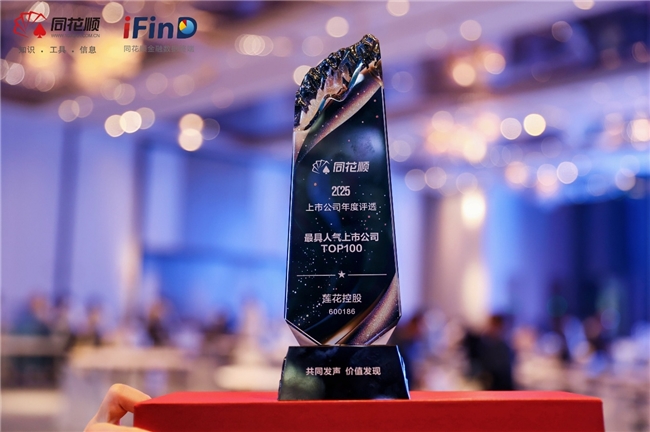
Core Viewpoint - Lianhua Holdings has been recognized in the "Top 100 Most Popular Listed Companies" and "Institutional Favorite Listed Companies" categories in the 2025 Tonghuashun Annual List of Listed Companies, marking its third consecutive year in the "Top 100 Most Popular Listed Companies" [1][5] Group 1: Awards and Recognition - Lianhua Holdings ranked in the "Top 100 Most Popular Listed Companies" and "Institutional Favorite Listed Companies" categories, with its Secretary of the Board, Gu Youqun, also recognized in the "Top 100 Most Popular Secretaries" [1] - The awards are based on public voting and professional institution data, aimed at enhancing interaction between listed companies and investors [1] Group 2: Business Strategy and Performance - Lianhua Holdings has implemented a brand revival strategy, focusing on innovation and reform to enhance operational management capabilities [5] - The company has achieved continuous growth in key operational indicators, leading the industry in growth rates [5] - Lianhua Holdings is advancing a "dual-drive" strategy of consumption and technology, focusing on both its core seasoning business and the development of its computing technology innovation sector [5] - New intelligent products, such as Lianxiaobox, Lianxiaomiao, and Lianxiaoring, have been launched, leveraging strong computing power and service capabilities [5]


食品饮料行业双周报(2026、01、02-2026、01、15):茅台发布市场化运营方案,关注春节备货-20260116
Dongguan Securities· 2026-01-16 07:56
Investment Rating - The report maintains an "Overweight" rating for the food and beverage industry, expecting the industry index to outperform the market index by over 10% in the next six months [57]. Core Insights - The report highlights that Kweichow Moutai has released a market-oriented operation plan, with a focus on inventory preparation for the Spring Festival. The white liquor sector is experiencing a weak recovery in demand, prompting Moutai to implement various measures to adapt to market and consumer trends [4][52]. - The SW food and beverage industry index rose by 0.64% from January 2 to January 15, 2026, but underperformed the CSI 300 index by approximately 1.98 percentage points [11][12]. - Approximately 76% of stocks in the industry recorded positive returns during the same period, with notable gainers including Ziyuan Food (+33.73%) and Haoxiangni (+21.90%) [14]. - The overall price-to-earnings (PE) ratio for the industry is approximately 20.47 times, which is below the five-year average of 31 times, indicating a potentially undervalued sector [15][18]. Summary by Sections Market Review - The SW food and beverage industry index underperformed the CSI 300 index, with a rise of 0.64% from January 2 to January 15, 2026, ranking 28th among Shenwan's primary industries [11]. - Most sub-sectors also lagged behind the CSI 300 index, with the pre-processed food sector showing the highest increase of 4.91%, while the dairy sector experienced the largest decline of 3.70% [13]. Industry Data Tracking - **Liquor Sector**: The price of Feitian Moutai decreased to 1520 RMB per bottle, down 20 RMB from January 1, while the prices of other brands remained stable [21]. - **Condiment Sector**: Prices for soybean meal and white sugar increased slightly, while glass prices saw a decrease [24]. - **Beer Sector**: The price of aluminum increased significantly, while the price of corrugated paper decreased [31]. - **Dairy Sector**: The average price of fresh milk was 3.02 RMB per kilogram, showing a slight decrease [39]. - **Meat Sector**: The average wholesale price of pork rose to 18.00 RMB per kilogram, reflecting a month-on-month increase [41]. Important News - The report notes a 3.4% year-on-year decline in retail sales of tobacco and alcohol in November 2025, indicating potential challenges in consumer demand [43]. - A slight decrease in the national white liquor price index was reported for December, suggesting price stabilization in the market [44]. Company Announcements - Kweichow Moutai announced a share repurchase plan and a market-oriented operation strategy aimed at adapting to market changes [50]. - Eastroc Beverage projected a significant increase in annual net profit for 2025, indicating strong performance in the soft drink sector [51].

老干妈“味道变了”?陶华碧“出山救子”?公司回应来了
Nan Fang Du Shi Bao· 2026-01-16 06:09
Core Viewpoint - The recent discussions surrounding the flavor change of "Lao Gan Ma" have sparked consumer speculation about ingredient changes, while the company maintains that its recipe and production methods remain unchanged [1][10]. Group 1: Company Performance - Lao Gan Ma's revenue for 2024 is projected to reach 5.391 billion RMB, nearing its historical peak of 5.403 billion RMB in 2020 [2]. - The company's revenue has shown a recovery trend, with figures of 4.201 billion RMB, 5.26 billion RMB, and 5.381 billion RMB from 2021 to 2023 [2]. - The return of founder Tao Huabi to management in 2019 is believed to have contributed to the company's revenue recovery, although this has not been officially confirmed [5]. Group 2: Management and Succession Issues - Tao Huabi, nearing 80 years of age, remains a central figure in the company's management, raising concerns about succession planning [8]. - The lack of a suitable successor among family members and professional managers poses a potential risk to the company's future [8]. - The company's conservative management style, characterized by a "no financing, no listing" philosophy, is seen as a stabilizing factor in its operations [7]. Group 3: Consumer Perception and Product Quality - Consumers have expressed dissatisfaction with the taste of Lao Gan Ma products, attributing changes to potential ingredient substitutions [1][10]. - The company asserts that its ingredients and production processes have not changed, attributing taste differences to evolving consumer preferences [11]. - Analysts suggest that maintaining high quality and cost-effectiveness is crucial for Lao Gan Ma to avoid significant declines in performance [10].

海天味业1月15日获融资买入4710.07万元,融资余额10.29亿元
Xin Lang Cai Jing· 2026-01-16 01:37
Group 1 - The core business of the company is the production and sale of condiments, including soy sauce, seasoning sauce, oyster sauce, chicken essence, and vinegar, with soy sauce being the primary product accounting for 52.05% of revenue [2] - For the period from January to September 2025, the company achieved a revenue of 21.628 billion yuan, representing a year-on-year growth of 6.02%, and a net profit attributable to shareholders of 5.322 billion yuan, with a year-on-year increase of 10.54% [2] - The company has distributed a total of 32.71 billion yuan in dividends since its A-share listing, with 13.196 billion yuan distributed in the last three years [3] Group 2 - As of January 15, the company's financing balance was 10.29 billion yuan, accounting for 0.49% of its market capitalization, which is above the 50th percentile level over the past year, indicating a relatively high level [1] - On the same day, the company had a net financing purchase of 22.57 million yuan, with a total financing and securities lending balance of 1.034 billion yuan [1] - The company’s top ten circulating shareholders include Hong Kong Central Clearing Limited, which holds 149 million shares, a decrease of 46.83 million shares from the previous period [3]

广东研讨"十五五"食品安全标准新方向
2 1 Shi Ji Jing Ji Bao Dao· 2026-01-15 14:10
Core Insights - The Guangdong Province Food Technology Innovation Empowerment Conference was held in Guangzhou on January 15, focusing on the "14th Five-Year Plan" direction and discussing food technology innovation and the promotion of digital labels for pre-packaged foods [1] Group 1: Digital Label Promotion - Guangdong is actively implementing a "Digital Label Promotion Year" initiative, aiming to enhance the application of digital labels in the food industry by 2025 [1] - Currently, nearly 40 companies and 120 products in the province have participated in the digital label application practice, exceeding the annual target [1] - Major food enterprises, such as Haitian Flavoring & Food Co., have shown significant enthusiasm, with their practices recognized as typical cases of digital labels at the national level, serving as a good demonstration [1]
2025中国企业ESG“金责奖”最佳责任进取奖揭晓
Xin Lang Cai Jing· 2026-01-15 07:31
Core Viewpoint - The 2025 China Enterprise ESG "Golden Responsibility Award" aims to recognize companies that have made significant contributions to ESG (Environmental, Social, and Governance) practices, with over 5,000 enterprises participating in the evaluation process [1][4]. Group 1: ESG Award Overview - The award was launched in November 2025 by Sina Finance ESG Rating Center, focusing on promoting sustainable development and responsible investment [1][4]. - The award emphasizes the importance of responsibility in ESG practices, symbolizing that responsibility is as valuable as gold [1][4]. - The evaluation process included comprehensive performance assessments, professional scoring, and online voting, culminating in the announcement of the award winners after three months of competition [1][4]. Group 2: Award Winners - The "Best Responsibility Initiative Award" was awarded to ten companies, including: - Fenghuo Communication - Wens Foodstuff Group - Haitian Flavoring and Food - Aier Eye Hospital - Yunnan Baiyao - Anker Innovation - Jinfa Technology - Huatai Securities - Seres - Hainengda [2][5]. - The award committee congratulated the winners and expressed hope that these companies will lead by example in enhancing their ESG capabilities and contribute to China's high-quality development [2][5]. Group 3: ESG Rating Center Introduction - The Sina Finance ESG Rating Center is the first Chinese platform dedicated to ESG information and ratings, promoting sustainable development and responsible investment [3][6]. - The center aims to establish ESG evaluation standards suitable for China's characteristics and enhance corporate ratings [3][6]. - It also publishes multiple ESG innovation indices to provide investors with more options regarding corporate ESG performance [3][6].




中国消费板块 2026 展望:消费信心复苏是否已开启?-China Consumer Sector_ 2026 Outlook_ are we at the beginning of consumer confidence recovery_
2026-01-15 06:33
Summary of the Conference Call Transcript Industry Overview - **Industry**: China Consumer Sector - **Outlook**: The sector is believed to be in the early stage of a multi-year recovery cycle that began in Q3 2024, with expectations for gradual improvement in consumer sentiment and spending through 2026E [2][11][12] Key Insights - **Valuation**: MSCI China Consumer Discretionary and Staples are trading at 17x and 15x 12-month forward PE, approximately one standard deviation below the 10-year averages, indicating that current valuations do not reflect a potential consumption recovery [2][9] - **Consumer Confidence**: The China Consumer Confidence Index has been trending upwards since September 2024, suggesting a gradual restoration of consumer confidence despite ongoing challenges in the property market [12][19] - **K-shaped Recovery**: The recovery is characterized by a K-shaped trend, where mid- to high-income consumers in tier-1 cities are expected to lead spending, while lower-tier city consumers remain focused on value for money [3][48] Consumer Behavior Trends - **Shifting Preferences**: A UBS Evidence Lab survey indicates a divergence in consumer behavior, with over 50% of mid- to high-income consumers reporting investment gains and showing strong spending intentions, particularly in premium and experiential categories [3][37] - **Spending Intentions**: The strongest spending intentions are noted in beauty and skincare (41%) and tourism (37%), reflecting a shift towards experiential and premium spending [51] - **Investment Gains**: 64-74% of mid- to high-income consumers reported increased investment returns, with many planning to reinvest or spend on travel, health services, and consumer electronics [40][41] Stock Implications - **Company Ratings**: - Upgrades to Neutral for Fenjiu due to expected benefits from non-business baijiu consumption - Buy ratings maintained for companies like MIXUE, Guming, China Foods, CR Beer, and YUM China, among others [4] - **Dividend Payouts**: Premium baijiu companies are noted for their >75% dividend payout, which is expected to protect share prices from downside risks [4] Structural Growth Opportunities - **Emerging Themes**: Key investment themes for 2026E include changing consumer preferences, corporate restructuring, and industry consolidation, particularly in sectors like home appliances and mass-market consumption [14][50] - **Corporate Restructuring**: Companies are expected to adapt their business models to align with changing consumer behaviors, which may lead to sustainable long-term earnings growth [4][50] Risks and Challenges - **Property Market Downturn**: The ongoing downturn in the property market is anticipated to weigh on household balance sheets, potentially impacting consumer spending [13][48] - **Policy Support**: The pace of recovery is contingent on stabilizing the property market and effective policy implementation to boost consumption [13][48] Conclusion - The China consumer sector is poised for a recovery, driven by improving consumer confidence and shifting spending patterns. However, the recovery will be uneven across different income groups and city tiers, necessitating a nuanced investment approach to capture emerging opportunities while being mindful of potential risks associated with the property market downturn.



创始人救场 老干妈重返巅峰仍存隐忧
Bei Jing Shang Bao· 2026-01-14 15:22
保持着低调且行事神秘作风的老干妈,最近因为重回营收高位受到广泛关注。近日,#老干妈创始人出 山救子又赚翻了#话题登上微博热搜榜,再次将大众视线聚焦于这瓶国民辣椒酱背后的"陶华碧帝国"。 据《2025贵州企业100强》榜单,贵阳南明老干妈风味食品有限责任公司(以下简称"老干妈")2024年 营收达到53.91亿元,排名第57位。拉长时间线可以发现,2021—2023年,老干妈的营收已持续回升, 分别为42.01亿元、52.6亿元、53.81亿元,不断向2020年54.03亿元的巅峰水平靠近。 重回增长轨道 老干妈品牌创立于1996年,在创始人陶华碧的带领下,从贵阳一间40人的小作坊起步,凭借风味豆豉油 制辣椒酱等核心产品,逐步成为国民级调味品牌。因其出众的味道、稳定的品质,老干妈辣椒酱成为年 轻人的"下饭神器",甚至远销欧美,成为国外货架上的"奢侈品"。据《2020—2025年中国辣椒酱行业市 场前景及投资机会研究报告》,老干妈长期占据中国辣椒酱市场约1/5的份额,稳居第一。 2014年,老干妈的营收达到40亿元。也是在这一年,老干妈创始人陶华碧将个人股份转让到两个儿子手 上,淡出管理层。天眼查信息显示,201 ...
老干妈否认为节省成本换原料!一年狂揽54亿元,78岁陶华碧被曝出山救子?
凤凰网财经· 2026-01-14 13:05
Core Viewpoint - Lao Gan Ma has shown resilience with a slight revenue increase in 2024, attributed to the return of founder Tao Huabi to operational roles, despite previous challenges related to ingredient changes and cost-cutting measures [1][2]. Group 1: Company Performance - Lao Gan Ma ranked 57th in the "Top 100 Enterprises in Guizhou 2025" with a revenue of 5.391 billion yuan in 2024, a marginal increase of 0.18% from 5.381 billion yuan in 2023, marking three consecutive years of growth [1]. - The company is close to its historical peak revenue of 5.403 billion yuan in 2020, being only 0.12 billion yuan short [1]. Group 2: Management and Operational Changes - Tao Huabi, the founder, stepped back from operations in 2014, leading to a shift in ingredient sourcing that negatively impacted product taste and sales in 2017 and 2018 [2]. - In 2019, Tao Huabi returned to the company, reinstating the original ingredients, which has been linked to the recent revenue recovery [2]. - Company representatives have denied any changes to the production process or ingredients, attributing taste variations to consumer preferences rather than operational changes [3]. Group 3: Brand and Market Presence - Lao Gan Ma is recognized as the largest producer and seller of chili products in China, with a diverse product line including over 20 series of items [7]. - The brand has gained international recognition, being marketed as a premium product in various countries, including the U.S., where it has been featured as a luxury condiment [7]. - The company's social media presence has been noted as limited, with infrequent updates and no recent live streaming activities, raising questions about its engagement strategy [4].

营收重回54亿,陶华碧“救场”后,老干妈挑战仍在
Bei Jing Shang Bao· 2026-01-14 11:28
2014年,老干妈的营收达到40亿元。也是在这一年,老干妈创始人陶华碧将个人股份转让到两个儿子手上,淡出管理层。天眼查信息显示,2014年6月,陶 华碧退出股东阵营,同时卸任公司法定代表人;股权变更后,陶华碧长子李贵山持股49%,次子李妙行持股51%,李妙行现为公司实际控制人。 2015年,老干妈陷入"用河南辣椒代替贵州辣椒"的舆论风波,当时陶华碧对媒体回应称,贵州辣椒与杂交品种相比,产量低、抗病性不强,品种退化,种植 成本高收益低,因而被边缘化。一时间"老干妈味道不如从前"的质疑声四起。此后老干妈的营收出现下滑,公开信息显示,2016—2018年,老干妈的营收分 别为45.49亿元、44.47亿元、43.89亿元。 近日,#老干妈创始人出山救子又赚翻了#话题登上微博热搜榜,再次将大众视线聚焦于这瓶国民辣椒酱背后的"陶华碧帝国"。 据《2025贵州企业100强》榜单,贵阳南明老干妈风味食品有限责任公司(以下简称"老干妈")2024年营收达到53.91亿元,排名第57位。拉长时间线可以发 现,在2021—2023年,老干妈的营收已持续回升,分别为42.01亿元、52.6亿元、53.81亿元,向2020年54.0 ...