
政府部门

Search documents
美国8月失业率升至4.3%,劳动力市场警报再次拉响
Sou Hu Cai Jing· 2025-09-08 01:37
Group 1: Labor Market Overview - The unemployment rate in the U.S. rose to 4.3% in August, marking a new high in nearly four years, which is significantly above market expectations [1] - Non-farm payrolls increased by only 22,000 in August, a sharp decline from the revised 79,000 in July, and well below economists' expectations of 75,000 [1] - The number of permanent job losses increased to 1.915 million in July, indicating a shift from temporary layoffs to long-term structural reductions [3] Group 2: Sector Performance - Job growth in August was primarily driven by the healthcare sector, which added 31,000 jobs, although this is below the average monthly increase of 42,000 over the past year [3] - Manufacturing experienced job losses for the fourth consecutive month, shedding 24,000 jobs, largely due to tariff impacts and supply chain restructuring [3] - Federal government employment decreased by 15,000 in August, with a total reduction of 97,000 jobs since January [3] Group 3: Economic Implications - The weak labor market has raised concerns about the economic outlook, with some economists suggesting that the economy is sliding towards recession [1][4] - The average hourly wage for non-farm employees rose to $36.53 in August, a 0.3% month-over-month increase and a 3.7% year-over-year increase, although reduced working hours have raised concerns about economic growth [7] - The Federal Reserve is expected to lower interest rates in response to the weak employment data, with a potential 25 basis point cut anticipated in the upcoming policy meeting [7] Group 4: Political and Structural Factors - Political factors have influenced economic data, with President Trump dismissing the head of the Bureau of Labor Statistics over alleged manipulation of employment data [4] - Young graduates face a high unemployment rate of 6.6%, the highest in a decade, indicating that entry-level positions now often require several years of experience [5] - The OECD has downgraded the U.S. economic growth forecast for 2025 to 1.6%, warning that tariffs could push the unemployment rate above 4.4% by early 2026 [11]

日本公务员将迎来34年来最大幅度加薪
财联社· 2025-08-07 11:03
Group 1 - The Japanese government is set to implement the largest salary increase for civil servants in 34 years, with an average monthly basic salary increase of 3.62%, leading to a total salary increase of 5.1% for this year [1][2] - This salary adjustment will affect approximately 280,000 civil servants, which is seen as a positive development for the Bank of Japan as it seeks to establish a sustainable wage growth to support inflation [2][5] - The salary increase is influenced by the recent wage negotiations in the private sector, where companies have agreed to an average salary increase of 5.25%, marking the largest increase in 34 years [5][6] Group 2 - The Japanese government has been under pressure to provide competitive salaries in the public sector to attract and retain talent, especially in light of a declining population and difficulties in recruiting young professionals [5][6] - A report indicated that the number of recent graduates applying for public sector jobs has reached a historical low, prompting the government to propose an increase in starting salaries by over 5% [6][7] - The estimated cost of implementing the proposed salary increase for civil servants is approximately 334 billion yen (about 2.3 billion USD) [7]

美国就业崩了吗?7月非农数据解读
2025-08-05 03:15
Summary of Key Points from the Conference Call Industry Overview - The conference call primarily discusses the **U.S. labor market** and its implications for the economy and monetary policy, particularly in light of the **July non-farm payroll data** [1][2]. Core Insights and Arguments - **July Non-Farm Payroll Data**: The July non-farm payroll data showed an increase of only **73,000 jobs**, significantly below the expected **104,000 jobs**. Additionally, the job numbers for May and June were revised down by approximately **100,000 jobs** [2]. - **Unemployment Rate**: The unemployment rate rose to **4.2%**, which was in line with expectations. However, the average monthly job growth over the past three months was only **35,000 jobs**, a stark decline from the pre-pandemic average of **100,000 jobs** per month [2][5]. - **Sector Performance**: Job growth was concentrated in the **education and healthcare sectors**, which added **79,000 jobs** in July. In contrast, sectors like manufacturing and wholesale trade, which are sensitive to tariffs and interest rates, showed weakness [2][5]. - **Labor Market Dynamics**: The decline in labor participation rates has contributed to a downward pressure on the unemployment rate. Factors such as early retirements and reduced immigration due to strict policies have led to a rigid labor supply [4][9]. - **Economic Resilience Concerns**: Despite positive GDP data, the disruptions in imports and inventory, along with weak non-farm data, have raised concerns about economic resilience and increased expectations for interest rate cuts by the Federal Reserve [1][5]. Monetary Policy Implications - **Interest Rate Expectations**: The market widely anticipates that the Federal Reserve will cut interest rates by **25 basis points** in September. However, the lack of clear signals from the Fed regarding easing has led to fluctuations in these expectations [6][7]. - **Future Monetary Policy Adjustments**: If inflation data does not exceed expectations in the coming months, the Fed may be prompted to lower rates, especially as signs of weakness appear in residential investment, manufacturing, and auto consumption [5][6]. Political Environment Impact - **Political Influence on Economic Policy**: The current political climate, particularly actions by former President Trump against Federal Reserve officials, has increased uncertainty in economic policy and market conditions. This interference may lead to heightened asset volatility and a shift in market risk appetite [8][9]. Additional Important Points - **Labor Market Challenges**: The prolonged unemployment duration and the rise in long-term unemployed individuals indicate adverse effects on the job market due to demand contraction [1][2]. - **Market Reactions**: The adjustments in employment data and the political environment are likely to influence market behavior and investor sentiment moving forward [9].
凯德北京投资基金管理有限公司:美7月非农仅增7.3万远低预期
Sou Hu Cai Jing· 2025-08-02 09:11
Group 1 - The U.S. Labor Department reported a non-farm payroll increase of 73,000 in July, significantly below the expected 185,000, marking the lowest level since December 2023 [2] - Three major sectors showed notable declines: retail sector layoffs of 12,000 (seasonally adjusted), a reduction of 34,000 temporary jobs indicating corporate contraction, and zero job growth in government sectors reflecting peak fiscal spending [3] - The market reacted sharply with a 15 basis point drop in U.S. Treasury yields, a 2% short-term jump in gold prices, and a mixed performance in the S&P 500 as investors bet on earlier interest rate cuts [4] Group 2 - Despite the employment slowdown, hourly wages increased by 0.4% month-over-month (annualized at 4.8%), creating a paradox of wage inflation against the backdrop of a cooling job market [4] - The report highlights the delayed effects of interest rate hikes and suggests that the policy debate is entering a more complex phase, as the narrative of a "soft landing" faces challenges from the data [4] - The market is advised to prepare for greater volatility as the economic indicators present conflicting signals regarding the labor market and inflation risks [4]

政府就业被高估——7月美国非农数据解读【陈兴团队•财通宏观】
陈兴宏观研究· 2025-08-02 05:56
Core Viewpoint - The July non-farm employment data shows a significant downward revision in previous months, indicating an overestimation of employment levels, particularly in government sectors. The overall labor market is cooling down, with rising unemployment rates and declining labor participation rates [2][3][5]. Employment Data Revision - The July non-farm employment recorded an increase of 73,000 jobs, but previous months' data were heavily revised downwards. June's employment was adjusted from 147,000 to 14,000, and May's from 144,000 to 19,000, totaling a downward revision of 258,000 jobs [3][2]. Unemployment Rate Trends - The unemployment rate rose slightly by 0.1 percentage points to 4.2% in July, while the U6 unemployment rate increased by 0.2 percentage points to 7.9%. This indicates a broad cooling of the job market, with a decrease in labor participation rate to 62.2%, the lowest since the beginning of 2023 [5][6]. Sector-Specific Employment Changes - Job growth in July was concentrated in the education and healthcare sectors, with retail, education, and financial activities seeing the most significant increases. However, government employment decreased by 10,000 jobs, marking the third negative month this year, with substantial downward revisions in previous months [6][2]. Labor Market Supply and Demand - As of June, job vacancies in the U.S. fell to 7.44 million, with a vacancy rate of 4.4%. The labor supply-demand gap recorded 422,000, indicating a return to pre-pandemic levels and suggesting a balance in the labor market [8]. Wage Growth Trends - Average hourly earnings in July increased by 0.3% month-over-month, with a year-over-year growth of 3.9%. However, long-term trends show a slowdown in wage growth since November 2024 [9][10]. Real Wage Growth - The real wage growth, adjusted for inflation, showed a year-over-year increase of 1% in June, down by 0.4 percentage points from the previous month. This indicates stable wage income growth [10]. Sectoral Wage Changes - In July, the highest year-over-year wage growth was observed in the retail and business services sectors, at 5.2% and 5.1%, respectively. Conversely, the slowest growth was in public utilities and construction, with declines of approximately 0.7 and 0.2 percentage points [12]. Interest Rate Expectations - Following the release of weak employment data, expectations for interest rate cuts in September have increased, with the probability rising from 40% to 80%. The anticipated number of rate cuts for the year has also increased from 1.3 to 2.2 [16].

6月美国非农数据点评:就业状况指数指向“halffull”还是“halfempty”?
Huachuang Securities· 2025-07-05 13:46
Group 1: Employment Data Overview - In June, non-farm employment increased by 147,000, exceeding expectations of 106,000, marking the fourth consecutive month of surpassing market forecasts[2] - The unemployment rate fell from 4.2% to 4.1%, below the expected 4.3%, while the labor participation rate decreased from 62.4% to 62.3%[2] - Hourly wage growth was lower than expected at 0.2% month-on-month, compared to the forecast of 0.3% and a previous value of 0.4%[2] Group 2: Market Reactions and Trends - Market expectations for interest rate cuts have significantly cooled, with the probability of a July rate cut dropping from 25.3% to 4.7% and September from 91% to 70.7%[2] - Following the non-farm report, U.S. stock markets and the dollar index rose, while long-term U.S. Treasury yields increased[2] - The Dow Jones Industrial Average rose by 0.77%, the Nasdaq by 1.02%, and the S&P 500 by 0.83%[2] Group 3: Employment Market Analysis - The employment market conditions index, based on 15 employment-related indicators, recorded 0.389, slightly better than the previous months but weaker than the end of last year[4] - Employment growth breadth remains at a cycle low since 2015, with the monthly employment diffusion index dropping from 51.8% to 49.6%[4] - Government sectors contributed 50% of the new jobs, with significant growth in education and healthcare services, while private sector job growth was below expectations[4]
6月美国非农数据解读:失业率意外下降,细节暗藏隐忧
China Post Securities· 2025-07-04 09:21
Employment Data Analysis - In June, the U.S. added 147,000 jobs, exceeding the expected 110,000, with revisions in April and May adding 16,000 jobs[1] - The unemployment rate fell slightly to 4.1%, better than the expected 4.3%[1] - Labor force participation rate has declined, primarily due to a drop in participation among younger workers, while the 25-54 age group saw an increase[2] Wage and Hour Trends - Average hourly earnings increased by only 0.2% month-on-month, falling short of expectations[2] - Average weekly hours worked have also shown a slowdown, indicating a potential cooling in labor demand[2] Sector-Specific Insights - Job growth was mainly driven by state government and healthcare sectors, with government jobs increasing by 73,000 and private sector jobs by 74,000[2] - The education sector added 40,000 jobs, likely reflecting seasonal effects[2] Labor Supply Concerns - Tightening immigration policies have led to a decrease in the number of foreign-born workers, with employment in this group declining for three consecutive months[2] - The number of individuals continuing to claim unemployment benefits has been rising since April, indicating a slowdown in hiring and increased difficulty for unemployed individuals to find new jobs[2] Federal Reserve Outlook - Despite the strong surface-level employment data, underlying issues suggest weakening labor supply and demand, leading to expectations of interest rate cuts by the Federal Reserve in September and three cuts throughout the year[3] - Risks include potential changes in tariff policies and unexpected inflation increases that could affect the Fed's rate-cutting schedule[4]
大摩评非农:反移民拉低失业率,美联储将重点关注关税后续对通胀和消费影响
Hua Er Jie Jian Wen· 2025-07-04 02:16
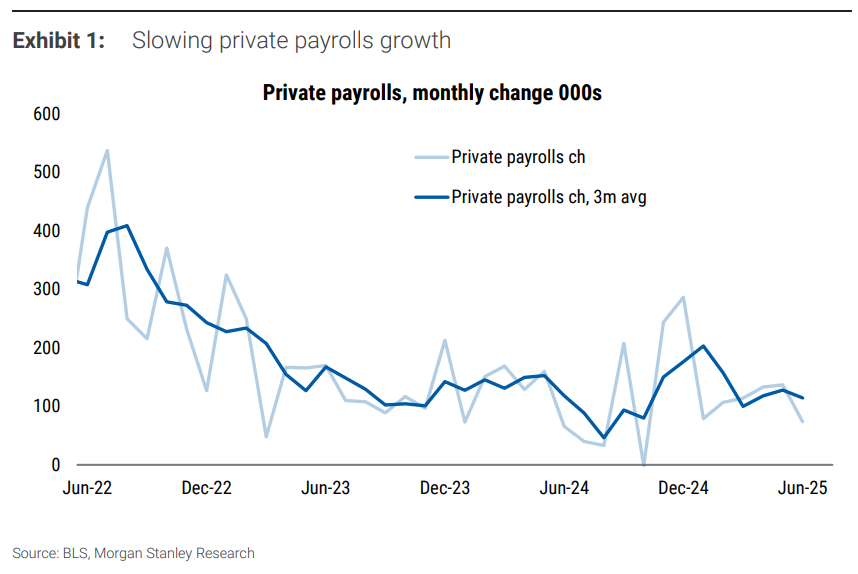
Core Insights - The latest employment report indicates a slowdown in private sector job growth, attributed to tighter immigration policies leading to a decrease in labor supply [1][4] - The Federal Reserve is expected to maintain a wait-and-see approach, awaiting data on tariffs' impact on inflation and consumption [1][8] Employment Data Summary - In June, non-farm payrolls increased by 147,000, exceeding expectations, but private sector jobs only rose by 74,000, below the three-month average of 128,000 [1][4] - The unemployment rate fell from 4.24% to 4.12%, not due to increased job opportunities but rather a decline in labor force participation, also linked to stricter immigration policies [3][4] Labor Market Dynamics - The labor market is exhibiting a paradox where private sector job growth is slowing, yet the market is becoming tighter [4] - Job growth in June was primarily in state government and healthcare, with private sector employment led by a slowdown in the service industry [4] Immigration Policy Impact - Immigration restrictions have two main effects on the labor market: 1. It lowers the employment balance point needed to maintain stable unemployment from 210,000 jobs per month last year to 140,000 this year, with expectations of a further drop to 70,000 by year-end [5] 2. It suppresses labor force participation rates, as enforcement actions create a chilling effect, reducing the willingness of workers to participate [7] Federal Reserve Outlook - Average hourly earnings increased by 0.2% month-over-month in June, with a year-over-year growth rate declining from 3.8% to 3.7% [8] - Despite a gradual slowdown in labor input, there is no significant market loosening, and the unemployment rate remains low, leading the Federal Reserve to likely refrain from interest rate cuts in July [8]
美国6月非农新增14.7万人超预期,失业率意外降至4.1%,4、5月合计上修1.6万人
Sou Hu Cai Jing· 2025-07-03 14:45
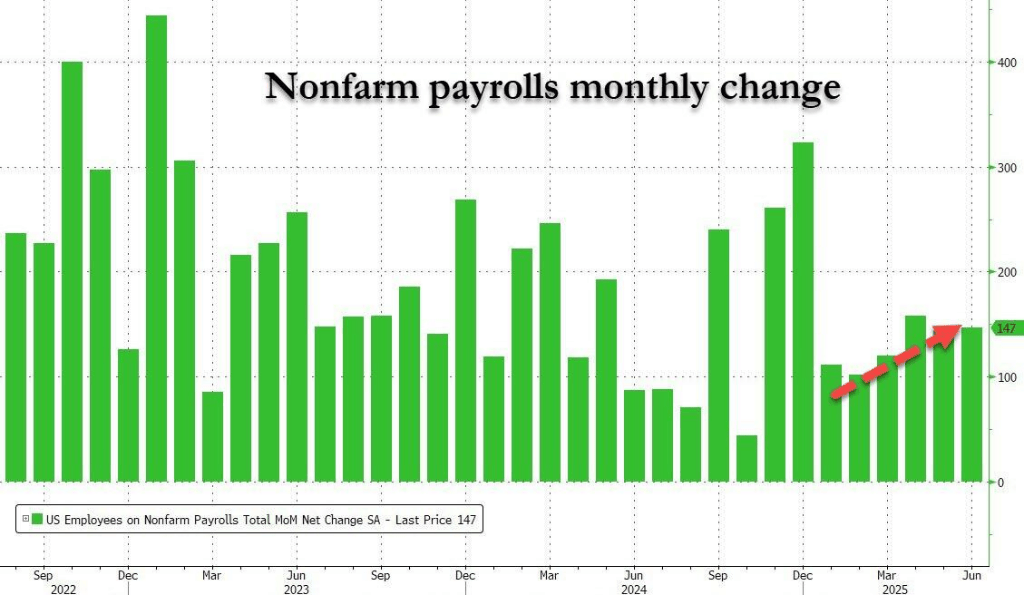
Core Viewpoint - The U.S. labor market demonstrates strong resilience, with June employment growth exceeding expectations for the fourth consecutive month and a further decline in the unemployment rate, potentially leading the Federal Reserve to adopt a more cautious approach in its next interest rate decision [1][7]. Employment Data Summary - In June, the U.S. added 147,000 jobs, significantly surpassing the market expectation of 106,000 jobs, and the previous month's data was revised upward by 16,000 jobs [3][4]. - The unemployment rate fell unexpectedly from 4.2% to 4.1%, breaking the market expectation of an increase to 4.3% [7][8]. - The labor force participation rate remained unchanged at 62.3%, the lowest level in two years, while the employment-population ratio stabilized at 59.7% [11]. Sector-Specific Insights - Job growth was primarily concentrated in state and local government sectors, with a notable increase of 73,000 jobs in government employment, driven by education [15]. - The healthcare sector added 39,000 jobs in June, aligning closely with the average monthly increase over the past year [15]. - The federal government continued to reduce its workforce, with a decrease of 7,000 jobs, totaling a loss of 69,000 jobs since January [16]. Wage Growth and Economic Indicators - Average hourly earnings increased by only 0.2% month-over-month, below the expected 0.3%, with the annual wage growth rate at 3.7%, also lower than the revised 3.8% [12]. - The average weekly hours worked for private non-farm employees slightly decreased to 34.2 hours, indicating a cautious approach from employers regarding layoffs despite economic uncertainties [14]. Market Reactions - Following the employment report, U.S. Treasury prices fell sharply, with short-term yields rising nearly 10 basis points, while the 10-year Treasury yield increased to 4.261% [21]. - The U.S. dollar index rose approximately 40 points, currently at 97.26, and U.S. stock futures saw a slight increase, with the Nasdaq 100 futures up by 0.3% [24][27].
机构:白领需求减少或使美政府前雇员难以再就业 DOGE裁员潮影响将开始显现
news flash· 2025-07-03 03:52
Group 1 - The demand for white-collar jobs in the U.S. is decreasing, making it difficult for former federal employees to find reemployment [1] - The recent layoffs at DOGE are expected to have a more pronounced impact on employment growth in the near future [1] - High interest rates are suppressing the hiring intentions of technology companies, leading to a noticeable contraction in tech recruitment [1] Group 2 - The current trend indicates that the job market is tightening, with a significant reduction in job vacancies and hiring scales [1] - If the upcoming non-farm payroll data shows an increase of only 115,000 jobs, it would reflect the weakest performance since the financial crisis, excluding 2020 [1] - The demand for white-collar positions is shrinking more significantly compared to technical roles that require on-site work, posing a serious challenge for new entrants into the labor market [1]