债券

Search documents
美国债市:国债与股票双双下跌 收益率曲线大幅趋陡
Xin Lang Cai Jing· 2026-01-20 20:57
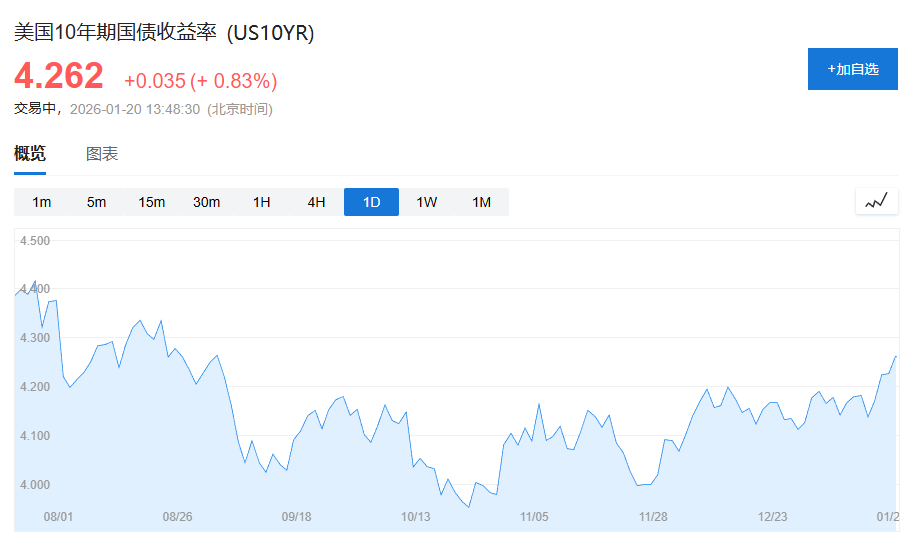
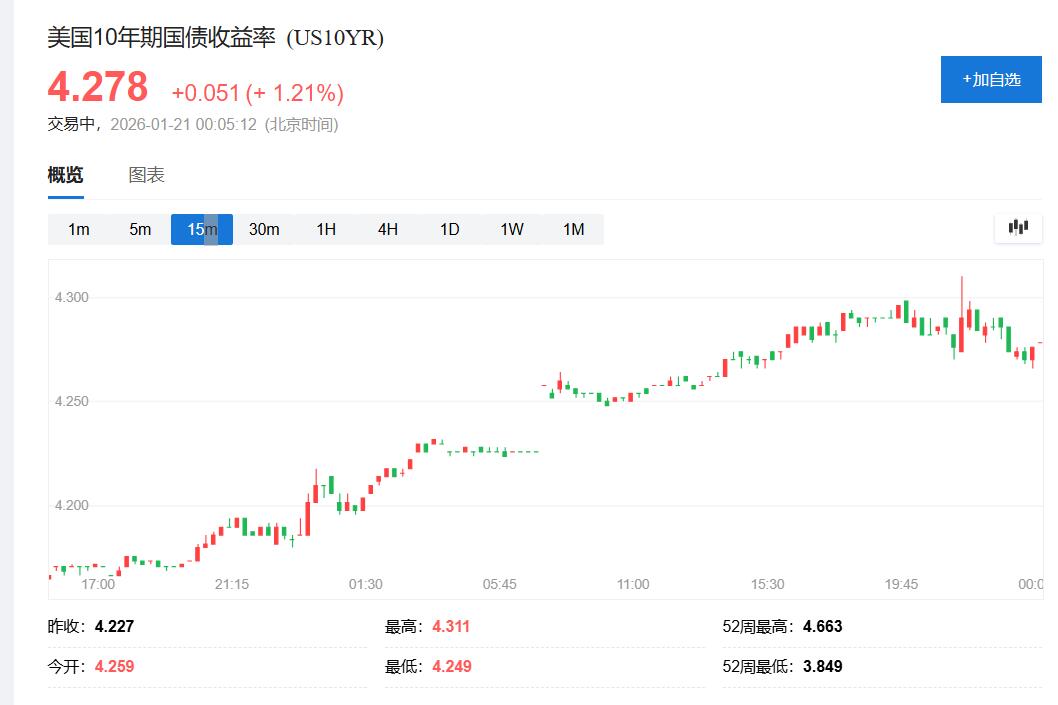
Core Viewpoint - US Treasury bonds are under pressure, maintaining a downward trend during trading hours, influenced by geopolitical tensions and market risk aversion [1][4]. Group 1: Market Trends - The long end of the US Treasury yield curve steepened, with yields rising by up to 8 basis points compared to the previous trading day [1][4]. - The 2-year/10-year yield spread widened by 6 basis points, while the 5-year/30-year spread increased by 4.5 basis points [1][4]. Group 2: Yield Data - As of 3:05 PM Eastern Time, the yields were reported as follows: 2-year at 3.5947%, 5-year at 3.854%, 10-year at 4.2906%, and 30-year at 4.9179% [3][6]. - The yield spread between 5-year and 30-year bonds was 106.21 basis points, and the spread between 2-year and 10-year bonds was 69.37 basis points [3][6]. Group 3: Trading Activity - Strong demand for 5-year and 10-year Treasury bonds helped prevent a more significant sell-off, with notable purchases totaling approximately $12.5 million/DV01 [5]. - The S&P 500 index fell by about 2%, while gold prices rose nearly 2%, reflecting market reactions to heightened tensions between the US and Europe [5].
Treasury Market's Quietest Period Since 2021 Is Ending. Why Trump Is Rattling Bonds.
Barrons· 2026-01-20 18:39
Core Viewpoint - The Treasury market has experienced a significant shift after a period of low volatility, with the benchmark 10-year yield remaining stable within a narrow range, indicating a potential change in market dynamics [1] Group 1: Treasury Market Performance - The benchmark 10-year yield has shown minimal movement, remaining within a range of 0.051 percentage points, marking the narrowest range over an 11-day period since January 5, 2021 [1] - The ICE BofA MOVE Index, which measures expected volatility in the bond market, has decreased to 56.14, the lowest closing value since September 2021, suggesting reduced market fear and uncertainty [1]
10年期意债收益率涨3个基点,希债收益率涨超15个基点
Jin Rong Jie· 2026-01-20 17:44
Core Viewpoint - European bond yields experienced fluctuations, with notable increases in several countries' long-term bonds, indicating market reactions to economic conditions and investor sentiment [1] Group 1: France - The yield on France's 10-year government bonds rose by 2.6 basis points to 3.526%, reaching a peak of 3.568% at 20:12 Beijing time [1] - The yield on France's 2-year bonds decreased by 0.6 basis points to 2.242% [1] - The yield on France's 30-year bonds increased by 2.3 basis points to 4.442%, hitting a daily high of 4.505% at 17:08 [1] Group 2: Italy - The yield on Italy's 10-year government bonds increased by 3.1 basis points to 3.5% [1] Group 3: Spain - The yield on Spain's 10-year government bonds rose by 2.3 basis points to 3.252% [1] Group 4: Greece - The yield on Greece's 10-year government bonds surged by 15.4 basis points to 3.495%, reaching a high of 3.525% at 20:10 [1]
有效信披带动活跃交易 以点带面构建高成长产业债良好生态
Xin Hua Cai Jing· 2026-01-20 17:18
新华财经上海1月20日电(记者杨溢仁)高成长产业债自推出以来,正稳步发展为交易所债券市场服务 实体经济的有力融资渠道之一。 截至2025年12月31日,市场累计迎来70家发行人,成功发行112单债券,募集资金规模达683.48亿元, 广泛覆盖化工、机械、电气设备、消费、建筑、交通运输等国民经济关键领域。 记者调研发现,高成长产业债发行人普遍在募集说明书中设置了强化信息披露的相关条款。一家发行人 在接受采访时表示:"合规是第一位的,底线是没有财务造假。作为公开市场债券发行人,信息披露既 是公司的义务,也是向投资者展示公司信用的重要途径。增加自愿披露内容体现了公司积极做好信息披 露的态度。" 从满足合规要求至主动传递信用信息,高成长产业债发行人正逐步践行"信用即价值",即回归信用本 源。 "发行人通过及时披露重大事项,针对性地分析相关事项对偿债能力的影响,有助于提高信息披露的有 效性,从而使债券成交定价更加准确、交易更加活跃,吸引更多投资者参与债券市场。"上交所债券业 务中心的相关负责人表示。 记者从多家高成长产业债发行人处了解到,信息披露带来的积极效应不仅体现在资本市场的流动性改善 方面,也有助于企业在公开市场 ...
How Rising Interest Rates Change Safe Retirement Withdrawal Plans
Yahoo Finance· 2026-01-20 16:55
Core Insights - Rising interest rates have negatively impacted retirees relying on systematic withdrawals from balanced portfolios, particularly the traditional 60/40 portfolio, which has seen declines in both stocks and bonds [1][5][6] - The inverse relationship between bond prices and interest rates has led to significant losses in bond portfolios, with intermediate-term bonds losing 10-15% in value in 2022 [2][6] - Higher interest rates have improved the outlook for new retirees, allowing for higher sustainable withdrawal rates due to better yields on bonds and dividend stocks [3][7][9] Impact on Retirees - Retirees who entered retirement during a zero-rate environment are facing challenges as rising rates have reduced the sustainability of their withdrawal plans [3][4] - The popular 4% withdrawal rule is now outdated due to the rapid rate hikes and the resulting negative returns from bonds, which previously provided stability [5][6] - Retirees with portfolios heavily allocated to long-duration bonds or growth stocks may need to reduce their withdrawal rates to preserve capital [10][11] Portfolio Strategies - A well-structured portfolio today can yield 4-5% or more, allowing for more conservative withdrawal rates while still generating sufficient income [9][15] - Retirees entering retirement today can build portfolios with a mix of investment-grade bonds and dividend stocks, supporting higher withdrawal rates of 4.5% or even 5% [13][15] - It is crucial to differentiate between portfolios damaged by rising rates and those constructed in the current environment to optimize withdrawal strategies [14][15]
贝森特称日本国债抛售潮波及美债市场,已与日方对口官员沟通
Hua Er Jie Jian Wen· 2026-01-20 16:19
美国财政部长贝森特表示,日本国债的抛售潮已经波及到美国国债市场,他已与日本的对口官员进行交谈。这一表态凸显了全球债券市场的连锁反应 风险,以及主要经济体财政政策对跨境资本流动的影响。 当地时间20日周二,日本债市遭遇出现交易员口中"近年来最混乱交易日",日本30年期和40年期国债的收益率均飙升逾25个基点,创自2025年4月特朗 普政府公布所谓"对等关税"震动全球市场以来的最大波动幅度。 贝森特将周二美国国债的价格下跌部分归因于日本债市的"溢出效应"。曾有数十年对冲基金经理生涯的贝森特表示,日本债券市场出现了"六个标准 差"的波动幅度。 美东时间周二美股盘前,美国10年期国债收益率日内升约6个基点至4.29%,周二欧股盘中曾升破4.31%,触及2025年8月以来最高水平。贝森特在瑞士 达沃斯参加世界经济论坛间隙接受媒体采访时表示:"我一直与日本方面负责经济事务的对口官员保持沟通,我相信他们会开始发表一些能够安抚市场 的言论。" 日债抛售引发市场恐慌 评论认为,本次日本7.6万亿美元债券市场的抛售开始来得缓慢,然后似乎骤然间全面爆发。虽然日本财政状况面临的担忧已经酝酿数周,但市场在周 二下午几乎毫无预警地突然沸 ...

固收周报丨转债中的哪些结构性机会值得关注?
Xin Lang Cai Jing· 2026-01-20 10:39
Group 1: Market Overview - The funding environment is expected to tighten this week due to the tax period, with government bond net payment increasing and disturbances from the Beijing Stock Exchange's new listings, leading to an anticipated rise in funding rates [1][3] - The central bank's intention to support the market is clear, with major banks maintaining high levels of net lending, and overnight rates expected to peak below 1.6% [1][3] Group 2: Government Bond Supply - This week, government bond issuance has significantly increased, totaling 706.57 billion yuan, with net payments rising approximately 250 billion yuan to 206.52 billion yuan, primarily concentrated in the latter half of the week [4] - Local government bonds saw net payments of 217.22 billion yuan, with issuance accelerating; however, the actual issuance in January is only 54.08% of the planned amount [4] - The issuance of national bonds has increased significantly, with a net payment of -10.7 billion yuan and a total issuance of 475 billion yuan, marking a substantial increase compared to previous periods [4][5] Group 3: Interbank Certificates of Deposit - The maturity scale of interbank certificates of deposit remains large at 706.71 billion yuan, and banks are expected to issue more certificates to replenish liabilities amid the tax period and market disturbances [6][7] Group 4: Credit Market Insights - The credit bond market is advised to focus on medium to short-duration defensive strategies, with a notable performance in secondary capital bonds and city investment bonds [9][31] - The total issuance of credit bonds last week was 288.2 billion yuan, with a weighted average issuance rate of 1.91%, down 11 basis points from the previous week [30] Group 5: Equity and Convertible Bond Market - The stock market showed mixed results, with the Shanghai Composite Index down 0.45% and the Shenzhen Component Index up 1.14%, indicating sectoral divergence [34] - The convertible bond index rose by 1.08%, outperforming the stock indices, with an overall increase in conversion premiums [38]
信用债周报:发行及成交规模增长,收益率多数下行-20260120
BOHAI SECURITIES· 2026-01-20 07:47
1. Report Industry Investment Rating No relevant content provided. 2. Core Viewpoints of the Report - During the period from January 12th to January 18th, 2026, the issuance guidance rates announced by the National Association of Financial Market Institutional Investors all declined, with an overall change range of -8 BP to -1 BP. The issuance scale of credit bonds increased month - on - month, but the net financing amount decreased due to the increase in the maturity scale. In the secondary market, the trading volume of credit bonds increased month - on - month, and most of the yields declined. The credit spreads of medium - and short - term notes and urban investment bonds were differentiated, while those of enterprise bonds mostly narrowed. In the long run, the yields of credit bonds are still in a downward channel, but one should be cautious when chasing high, and can increase positions during adjustments. One can implement a coupon strategy through credit sinking and extending the duration, and pay attention to the coordination and transformation of allocation and trading strategies [1][53]. - The central and local governments are continuously optimizing real estate policies, which play a positive role in stabilizing the real estate market. As the market stabilizes, risk - preferring funds can consider early deployment in real estate bonds, focusing on enterprises with outstanding new financing and sales performance. The allocation focus is on central and state - owned enterprises with stable historical valuations and high - quality private enterprise bonds with strong guarantees [2][55]. - Under the principle of coordinating development and security, the probability of urban investment bond default is very low, and it can still be a key allocation variety for credit bonds. One can pay attention to the reform and transformation opportunities of "entity - type" financing platforms, and the allocation strategy can prioritize short - to - medium - term credit sinking, while the trading strategy can choose to extend the duration of medium - and high - grade bonds [3][55]. 3. Summary According to Relevant Catalogs 3.1 Primary Market Situation 3.1.1 Issuance and Maturity Scale - From January 12th to January 18th, 2026, a total of 335 credit bonds were issued, with an issuance amount of 288.193 billion yuan, a month - on - month increase of 7.58%. The net financing amount was 34.34 billion yuan, a month - on - month decrease of 82.176 billion yuan. The issuance amounts of enterprise bonds, corporate bonds, and short - term financing bills increased, while those of medium - term notes and private placement notes decreased. The net financing amounts of all varieties decreased, with negative net financing for enterprise bonds, medium - term notes, and private placement notes, and positive net financing for corporate bonds and short - term financing bills [12]. 3.1.2 Issuance Interest Rates - The issuance guidance rates announced by the National Association of Financial Market Institutional Investors all declined, with an overall change range of -8 BP to -1 BP. By term, the 1 - year variety rate changed from -6 BP to -1 BP, the 3 - year variety from -8 BP to -1 BP, the 5 - year variety from -6 BP to -2 BP, and the 7 - year variety from -6 BP to -1 BP. By rating, the key AAA - grade and AAA - grade variety rates changed from -3 BP to -1 BP, the AA + - grade variety from -5 BP to -3 BP, the AA - grade variety from -6 BP to -3 BP, and the AA - - grade variety from -8 BP to -3 BP [13][15]. 3.2 Secondary Market Situation 3.2.1 Market Trading Volume - From January 12th to January 18th, 2026, the total trading volume of credit bonds was 931.702 billion yuan, a month - on - month increase of 9.52%. The trading volume of short - term financing bills decreased, while that of other varieties increased [16]. 3.2.2 Credit Spreads - For medium - and short - term notes, the credit spreads of each variety were differentiated. For enterprise bonds, most of the credit spreads narrowed. For urban investment bonds, the credit spreads were also differentiated [19][25][28]. 3.2.3 Term Spreads and Rating Spreads - For AA + medium - and short - term notes, the 3Y - 1Y, 5Y - 3Y, and 7Y - 3Y term spreads all narrowed, and most of the 3 - year rating spreads also narrowed. For AA + enterprise bonds, the term spreads mostly narrowed, and the 3 - year rating spreads all narrowed. For AA + urban investment bonds, the 3Y - 1Y and 7Y - 3Y term spreads narrowed, and the 3 - year rating spreads all narrowed [37][42][46]. 3.3 Credit Rating Adjustment and Default Bond Statistics 3.3.1 Credit Rating Adjustment Statistics - From January 12th to January 18th, 2026, there were no company rating (including outlook) adjustments [51]. 3.3.2 Default and Extended - Maturity Bond Statistics - During the same period, there were no defaults or extensions of credit bonds under any issuer [52]. 3.4 Investment Views - The overall view is consistent with the core viewpoints, emphasizing that credit bonds will continue the repair market, and one can implement a coupon strategy through credit sinking and extending the duration, while paying attention to the coordination of strategies and the impacts of policies, the equity market, and the supply - demand pattern [53].
流动性跟踪与地方债策略专题:为何地方债供给依然偏慢?
Guolian Minsheng Securities· 2026-01-20 07:15
Group 1 - The report indicates that the liquidity environment may face pressure due to the upcoming expiration of nearly 1 trillion yuan in pledged reverse repos, accelerated government bond issuance, and tax payment deadlines around January 20, which is a significant tax month [6][9][12] - The central bank has stated it will continue to increase liquidity injection and flexibly use various tools in open market operations to maintain ample liquidity, aiming to guide overnight rates close to the policy rate level of 1.40% [6][9][12] - The report highlights that local government bond issuance plans for January to March 2026 total 21,180 billion yuan, with 8,145 billion yuan planned for January, 4,424 billion yuan for February, and 8,611 billion yuan for March [14][37] Group 2 - The report notes that local bond supply has been notably slow, attributed to the delayed timing of local legislative sessions, which affects the actual issuance of new bonds [14][37] - As of January 18, 2026, local government bonds issued totaled 4,241 billion yuan, with 2,458 billion yuan in ultra-long bonds, accounting for 58% of the total, and 1,799 billion yuan in debt-restructuring bonds, accounting for 42% [14][37] - The report suggests that the current market conditions may lead to a focus on market-oriented issuance for ultra-long bonds, particularly in regions like Xinjiang, where the bidding spread is set significantly higher than secondary market spreads [41][43]
美债日债领跌!关税担忧与财政压力引发全球债市抛售潮
Hua Er Jie Jian Wen· 2026-01-20 05:58
Core Viewpoint - The global bond market is experiencing a significant sell-off, driven by concerns over U.S. fiscal spending, renewed tariff threats, and doubts about the safe-haven status of U.S. Treasuries [1][5]. Group 1: Market Reactions - U.S. 10-year and 30-year Treasury yields have risen by at least 4 basis points, while Japan's 10-year yield increased by 8 basis points [1]. - The sell-off has affected major global bond markets, with Japan's 40-year bond yield reaching 4%, the highest since its introduction in 2007 [2]. - Australian and New Zealand bonds have also seen declines, alongside a drop in German government bond futures [2]. Group 2: Tariff Threats and Policy Uncertainty - President Trump's plan to impose tariffs on certain European countries has reignited concerns about the unpredictability of government policies, potentially exacerbating inflation and fiscal deficit worries [2][6]. - The tariff threats are seen as a catalyst for the current bond market sell-off, leading to a reassessment of policy stability [6]. Group 3: Fiscal Deficit and Investor Sentiment - The expanding U.S. fiscal deficit is diminishing the appeal of Treasuries as a safe haven, with fears that European countries may sell off U.S. bonds in response to the tariff conflict [5][7]. - Japanese investors may withdraw from U.S. debt due to rising domestic yields, further pressuring the U.S. bond market [7][8]. Group 4: Structural Market Pressures - The rise in Japanese bond yields is making U.S. Treasuries less attractive for Japanese investors, who may prefer to repatriate funds for better returns domestically [8]. - This trend could create structural pressures on the U.S. bond market, especially given the reliance on foreign capital for financing deficits [8].