
新能源车

Search documents
古天乐喜提中国新能源车 成为乐道L90第40000台交付用户
Feng Huang Wang· 2025-12-04 06:29
Core Insights - NIO's sub-brand, Ladao Automotive, has reached a significant delivery milestone with the delivery of the 40,000th unit of the Ladao L90 Black Knight Special Edition, marking the start of nationwide delivery for this model [1] - The L90 has shown rapid market acceptance, achieving 40,000 units delivered within just four months of its launch, making it the top-selling model in the pure electric large SUV segment [1] - The L90 leverages NIO's decade-long technological expertise and nationwide charging and battery swapping network to address long-distance travel challenges for electric vehicles [1] Product Performance - The L90 is positioned as the flagship product of the Ladao brand, focusing on family-oriented design by optimizing interior space and enhancing third-row seating comfort and luggage capacity [1] - The model aims to accelerate the transition of the large SUV market towards electrification [1] Market Strategy - To boost year-end sales, Ladao Automotive has introduced a special market incentive policy, allocating approximately 110 million yuan in vehicle purchase benefits for December [1] - The brand emphasizes the speed of vehicle supply and offers up to 13,000 yuan in purchase tax exemptions and test drive incentives for recent buyers, aiming to solidify its market share in the segment [1]


异动盘点1204 | 资本界金控跌创历史新低,澳达控股复牌暴涨超200%;热门中概股普跌,美股机器人概念股强劲拉升
贝塔投资智库· 2025-12-04 04:05
Group 1 - The core viewpoint of the articles highlights significant stock movements in the Hong Kong and US markets, driven by company announcements and strategic partnerships [1][2][5][6][7]. Group 2 - Gilead Sciences-B (01672) saw a nearly 9% increase after announcing a share buyback plan, utilizing up to 300 million HKD for repurchases [1]. - OSL Group (00863) rose nearly 2% as it plans to offer compliant digital asset trading services in Europe by Q1 2026 [1]. - Gako Science-B (01167) increased over 5% following a 125 million RMB payment from Haisheng Capital, enhancing its cash reserves for oncology therapy development [1]. - Zhida Technology (02650) surged over 4%, reaching a new high, after signing a sales order exceeding 100 million RMB with Saudi Controls Ltd for a five-year collaboration [2]. - Capital界金控 (00204) fell over 40%, marking a historical low, with a cumulative decline exceeding 80% for the week [2]. - Semiconductor stocks performed well, with Huahong Semiconductor (01347) up 3.18%, Shanghai Fudan (01385) up 2.79%, and SMIC (00981) up 1.86% [2]. - Pacific Shipping (02343) rose nearly 5% as the Baltic Dry Index reached 2845 points, a 9.42% increase, marking the largest rise since October 2025 [3]. - Aoda Holdings (09929) resumed trading with a surge of over 200%, following a major share sale involving 1.5 billion shares at a price of 0.11 HKD per share [4]. - Robotics stocks saw significant gains, with Dechang Motor Holdings (00179) up 9.11% and Sanhua Intelligent Control (02050) up 9.06% [4]. - Ansem Semiconductor (ON.US) rose 11.01% after announcing a strategic partnership with Innosec to advance GaN technology applications [5]. - The Nasdaq Golden Dragon Index fell 1.38%, with notable declines in popular Chinese stocks like Xpeng Motors (XPEV.US) down 4.02% and Alibaba (BABA.US) down 1.89% [5]. - Microchip Technology (MCHP.US) increased by 12.17% after raising its revenue and earnings per share forecasts due to strong booking performance [6]. - Bitcoin-related stocks saw gains, with Iren Ltd (IREN.US) up 6.91% and Coinbase (COIN.US) up 5.19% [6]. - The robotics sector in the US experienced a boost, with Richtech Robotics (RR.US) up 18.54% and iRobot (IRBT.US) up 73.85% amid government support for the industry [7].

港股开盘|恒生指数高开0.17% 京东健康等涨逾3%
Xin Lang Cai Jing· 2025-12-04 03:53
Group 1 - The Hang Seng Index opened up by 0.17%, while the Hang Seng Tech Index increased by 0.21% [1] - JD Health, Zijin Mining, and Trip.com all saw gains of over 3% [1] - New energy vehicle stocks experienced a decline, with Li Auto, Xpeng Motors, and NIO all reporting drops [1]



港股科技ETF(513020)盘中涨超1%,近10日净流入超2亿元,看好科技板块引领作用
Mei Ri Jing Ji Xin Wen· 2025-12-04 03:18
Group 1 - The core viewpoint is that major companies are accelerating their computing power layout, maintaining a positive outlook on the technology sector's leading role, and valuing the allocation of internet heavyweight assets [1] - The Q3 earnings season for the internet sector has concluded without significant narrative changes, but there is optimism for individual stock EPS recovery, especially for those previously impacted by competition, and for AI-related valuation increases in the coming year [1] - The recommendation is to strategically invest in fundamentally strong internet giants that will benefit from AI catalysts, particularly as the gaming sector is currently valued at a mid-low level, presenting opportunities for valuation recovery driven by AI applications [1] Group 2 - The Hong Kong Technology ETF (513020) tracks the Hong Kong Stock Connect Technology Index (931573), which covers core assets in sectors such as internet, innovative pharmaceuticals, and new energy vehicles, reflecting the diversified characteristics of the technology industry in the Hong Kong market [1] - The Hong Kong Stock Connect Technology Index has a higher allocation in new energy vehicles and innovative pharmaceuticals compared to the Hang Seng Technology Index, with a cumulative return of 256.46% from the base date at the end of 2014 to October 2025, outperforming the Hang Seng Technology Index by nearly 160% [1]
乘联分会崔东树:1-10月中国占世界新能源车份额68%
Xin Lang Cai Jing· 2025-12-04 02:23
Core Insights - The global sales of new energy passenger vehicles reached 17.36 million units from January to October 2025, representing a year-on-year increase of 30% [1] - In October, global sales of new energy passenger vehicles were 2.11 million units, showing a year-on-year increase of 17% but a month-on-month decrease of 3% [1] - In the first ten months of this year, the United States sold 1.4 million new energy vehicles, with a growth rate of 10%. However, due to high tariffs and the removal of subsidies, sales in October dropped to 93,000 units, a year-on-year decline of 32% and a month-on-month decline of 51% [1] - By 2025, China's share of the global new energy passenger vehicle market is projected to be 68%, with a significant share of 75% in October [1]
A股小幅高开,这一板块集体走强
Di Yi Cai Jing Zi Xun· 2025-12-04 02:03
Group 1 - The core viewpoint of the news highlights the performance of various stock indices and sectors in the A-share and Hong Kong markets, with a notable focus on the robotics sector [2][3][4]. - The A-share market opened with all three major indices rising slightly, with the Shanghai Composite Index up by 0.04%, the Shenzhen Component Index up by 0.02%, and the ChiNext Index up by 0.01% [3][4]. - The robotics sector in the A-share market saw significant gains, with companies like Junya Technology, Longxi Co., and Ruineng Technology hitting the daily limit up, while other stocks in the sector also experienced increases [2][4]. Group 2 - In the Hong Kong market, the Hang Seng Index opened up by 0.17%, and the Hang Seng Tech Index rose by 0.21%, with notable gains in stocks like JD Health and Zijin Mining, both rising over 3% [5]. - The robotics concept stocks in the Hong Kong market also opened strong, with Sanhua Intelligent Control rising by 5.67% and Yuejiang up by 4.06%, indicating a positive trend in this sector [4][5].

A股小幅高开,这一板块集体走强
第一财经· 2025-12-04 01:57
Market Overview - The bond futures market opened with the 30-year main contract down by 0.64%, the 10-year main contract down by 0.14%, the 5-year main contract down by 0.09%, and the 2-year main contract down by 0.01% [3] - The A-share market opened with all three major indices rising slightly: the Shanghai Composite Index up by 0.04%, the Shenzhen Component Index up by 0.02%, and the ChiNext Index up by 0.01% [4][5] Sector Performance - The robotics industry chain showed strong performance with multiple stocks opening high, including Junya Technology and Longxi Co., both hitting the daily limit, while other stocks like Daying Electronics approached the limit as well [3][6] - In the Hong Kong stock market, the robotics concept stocks also opened high, with Sanhua Intelligent Control rising by 5.67% and Yuejiang Technology rising by 4.06% [6][7] - Conversely, sectors such as ultra-hard materials, CPO, 6G, satellite navigation, consumer electronics, and photovoltaic themes showed weakness [6] Notable Stocks - In the Hong Kong market, JD Health, Zijin Mining, and Trip.com all rose over 3%, while new energy vehicle stocks like Li Auto, Xpeng Motors, and NIO experienced declines [7]

AH股指数小幅高开,机器人产业链走强,贵金属延续涨势,商业航天活跃,国债期货大跌
Hua Er Jie Jian Wen· 2025-12-04 01:57
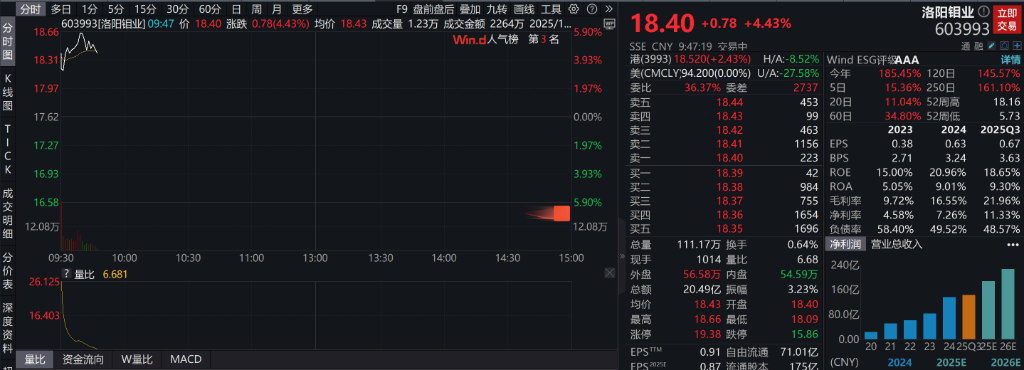
Market Overview - A-shares opened higher with the Shanghai Composite Index up 0.04% and the ChiNext Index up 0.01% [1] - Hong Kong stocks also opened higher, with the Hang Seng Index up 0.17% and the Hang Seng Tech Index up 0.21% [1][7] - The commodity futures market saw most prices decline, with rubber down 1.58% and lithium carbonate down 1.31% [1] Robotics Industry - The robotics industry chain showed strength, with the U.S. government considering an executive order to accelerate the development of the robotics sector [1] - U.S. Secretary of Commerce has been meeting with CEOs from the robotics industry to support growth [1] Copper Industry - Luoyang Molybdenum and Zijin Mining reached new highs in A-shares and H-shares, with Morgan Stanley optimistic about copper prices and copper stocks due to a structural supply-demand gap [2] - The copper industry is expected to benefit from strong profit growth and diversified asset layouts [2] Aerospace Sector - The commercial aerospace concept in A-shares was active, with Aerospace Mechatronics hitting the daily limit and other aerospace stocks also seeing significant gains [4] Bond Market - The bond futures market opened lower across the board, with the 30-year main contract down 0.64% [4][5]



长安启源Q05:客户看中空间和快充,对比最多的是元UP
车fans· 2025-12-04 00:30
Core Viewpoint - The article discusses the launch and market performance of the Qiyuan Q05 electric SUV, highlighting its pricing, target audience, and competitive positioning in the electric vehicle market. Group 1: Product Launch and Pricing - The Qiyuan Q05 was launched on October 21 and arrived at dealerships on October 25, with the majority being the 506 Max version priced at 99,900 yuan and the 405 Max version at 89,900 yuan [2][3] - The vehicle is available in six models, with prices ranging from 79,990 to 109,900 yuan, offering two versions with a range of 405 km and four versions with a range of 506 km [4] - The car is currently a special model with no discounts, but there is a 1,000 yuan subsidy for government personnel, including active military [6] Group 2: Target Audience and Marketing Strategy - The Q05 is positioned as a "global urban boutique pure electric SUV," targeting small family users aged 25-35, focusing on range, intelligence, and comfort [8] - Marketing efforts include cross-industry collaborations, particularly on platforms like Xiaohongshu, aiming to attract more female users [9] Group 3: Market Reception and Customer Feedback - Initial sales have been slow, with an average of four customer groups visiting daily and fewer than ten pre-orders within the first five days [10] - Customer feedback indicates that while the vehicle's size and comfort are appreciated, concerns about range and interior quality persist [10][17] - Competitors include BYD Yuan UP, Yuan PLUS, and Leap Motor B10, with the Q05 being compared favorably in terms of size and range [12][13] Group 4: Financial Policies and Incentives - Financing options include a zero-interest loan for up to 36 months on an 80,000 yuan loan, which is a new offering for Qiyuan models [22] - A no-threshold trade-in policy offers a direct discount of 5,000 yuan, which may help boost sales [22] Group 5: Future Considerations - The current market for new energy vehicles remains stable, with strict controls on pricing, suggesting that potential buyers may want to act before subsidies end [24] - There are indications that new energy vehicles will soon be subject to purchase taxes, and future policies remain uncertain [24]

美股异动 | 新能源车股多数走低 特斯拉(TSLA.US)涨超2.8%
智通财经网· 2025-12-03 15:41
智通财经APP获悉,周三,新能源车股多数走低,截至发稿,小鹏汽车(XPEV.US)、理想汽车(LI.US)跌 超3%,蔚来(NIO.US)跌超4%,Rivian Automotive(RIVN.US)跌0.41%;特斯拉(TSLA.US)涨超2.8%。 ...


