
房地产

Search documents
策略周报:两会前后市场如何演绎?-20260228
Guoxin Securities· 2026-02-28 09:26
Core Conclusions - Historical data indicates a high probability of market gains before and after the Two Sessions, with cyclical industries showing stronger performance [2][19] - Market performance around the Two Sessions is closely tied to policy expectations, which significantly influence market trends [3][24] - The spring market rally is expected to continue, supported by multiple positive factors, with a balanced allocation strategy recommended, particularly emphasizing AI applications and sectors like resources, real estate, and liquor [1][28] Market Performance Analysis - Since mid-December last year, the spring market rally has gradually unfolded, with a notable increase in trading volume post-holiday. The Shanghai Composite Index has seen a rise of 3.7% from February 3 to the present, with the CSI 300 and the Wind All A Index increasing by 2.3% and 5.2%, respectively [1][13] - Historical analysis from 2005 onwards shows that the market tends to rise significantly in the 20 trading days before the Two Sessions, with probabilities of 76.2% for the Shanghai Composite Index and 85.7% for the Wind All A Index [19][20] Style and Sector Performance - Before the Two Sessions, small-cap stocks outperform, with an 85.7% probability of gains, while post-Two Sessions, the performance of large-cap stocks improves [20][22] - Cyclical sectors tend to perform better before and after the Two Sessions, with resource sectors like steel and non-ferrous metals showing high probabilities of gains [20][22] Policy Influence - The Two Sessions serve as a critical window for observing economic policy directions, with expectations for stable growth policies to rise before the meetings, leading to increased trading activity [3][24] - Post-Two Sessions, as policies are clarified and implemented, there is often a seasonal uptick in high-frequency data, which can enhance optimistic market expectations [3][24] Investment Opportunities - The report suggests a balanced investment approach, focusing on cyclical sectors and real estate, alongside technology driven by AI applications. The resource sector is expected to benefit from domestic policies and global liquidity conditions [28][29] - The real estate sector is highlighted as having a 76.2% probability of gains post-Two Sessions, with recent policy changes in major cities indicating a recovery in the housing market [20][29]
打破共识系列之一:地产落,消费升
Shenwan Hongyuan Securities· 2026-02-28 08:41
Group 1: Market Trends - The current consensus that consumption will continue to be affected by the downturn in real estate is challenged; international experience suggests that consumption tends to rise at the midpoint of real estate adjustments, indicating China may be at such a turning point[3] - The "U-shaped" characteristic of consumption inclination around real estate turning points is often overlooked, with consumption growth typically leading income growth by about five years post-adjustment[4][14] Group 2: Economic Effects - The three main effects of real estate changes on the economy are the "income effect," "wealth effect," and "crowding-out effect," with the income effect dominating in the early years of the post-real estate era, leading to lower consumption[4][15] - After the peak of the real estate cycle in 2020, the average growth rate of disposable income is expected to decline from 8%-10% to 3%-4% over approximately ten years, aligning with international patterns[4][14] Group 3: Future Projections - By 2026, the significant weakening of the crowding-out effect may initiate a new cycle of rising consumption inclination, as housing price-to-income ratios have returned to pre-2015 levels, suggesting a new economic balance[7][72] - Regions experiencing significant declines in housing prices from 2022 to 2024, such as Fujian and Zhejiang, have already shown improvements in consumption inclination[7][72] Group 4: Policy Implications - The ongoing expansion of domestic demand policies, including targeted measures to boost consumption, is expected to effectively support the recovery of consumer confidence[9] - The shift in population and industry towards non-first-tier cities is expected to alleviate the pressure of high housing prices on young consumers, further enhancing consumption potential[78]
“打破共识”系列之一:地产“落”,消费“升”
Shenwan Hongyuan Securities· 2026-02-28 07:43
Group 1: Market Trends - The report suggests that consumer sentiment is expected to improve before the real estate market stabilizes, indicating a potential "U-shaped" recovery in consumption trends[3][16]. - Historical data shows that after a peak in the real estate cycle, consumer spending tends to rise before income levels improve, typically around the fifth year of the post-real estate era[4][17]. - The average disposable income growth rate in major economies tends to decline from 8%-10% to 3%-4% over approximately ten years following a real estate peak, with China's peak occurring in 2020[4][18]. Group 2: Economic Effects - The report identifies three main effects of real estate fluctuations: "income effect," "wealth effect," and "crowding-out effect," with the income effect dominating in the early years of the post-real estate era[4][18]. - The crowding-out effect, which suppresses consumer spending due to rising housing costs, is expected to weaken significantly in the next five years, allowing for a recovery in consumer spending[5][7]. - Evidence suggests that regions experiencing significant declines in housing prices from 2022 to 2024, such as Fujian and Zhejiang, have already seen improvements in consumer sentiment[7][79]. Group 3: Policy Implications - The report emphasizes that ongoing domestic demand expansion policies are crucial for stimulating consumption, with targeted measures such as optimizing personal consumption loan subsidies being highlighted[9][8]. - The transition to a new economic cycle is anticipated around 2026, characterized by a decrease in the savings rate and an increase in consumer spending as housing prices stabilize[7][78]. - The report warns of potential risks, including deviations from international experiences and unexpected changes in the real estate market, which could impact policy effectiveness[9][8].
春节中观景气跟踪:春节旅游景气提升,科技和资源涨价
GUOTAI HAITONG SECURITIES· 2026-02-28 05:44
Group 1: Spring Festival Tourism - The Spring Festival travel demand significantly increased due to a 9-day extended holiday, with average daily cross-regional passenger flow up by 6.0% year-on-year during the first 24 days of the Spring Festival travel period [7][10] - Domestic average daily tourism volume and revenue during the Spring Festival increased by 5.7% and 5.5% year-on-year, respectively, recovering to 111.7% and 121.6% of the levels seen in 2019 [10][12] - Despite the increase in volume, the average daily spending per tourist was 149.8 yuan, down 11.3% year-on-year, indicating a need for improvement in consumer spending willingness [10][12] Group 2: Downstream Consumption - New home sales in 30 major cities increased by 47.7% compared to the same period last year, with first-tier cities seeing an 84.0% increase [18][21] - The average price of live pigs decreased by 0.9% week-on-week, attributed to a still ample supply [22][23] - The release of new real estate policies in Shanghai is expected to effectively stimulate pent-up housing demand [18] Group 3: Technology and Manufacturing - The prices of DRAM memory chips remained high, with average prices for DDR3, DDR4, and DDR5 increasing by 0.3%, 0.0%, and 0.1% respectively compared to pre-holiday levels [24][25] - The revenue of the semiconductor industry in Taiwan continued to grow rapidly, with storage sector companies seeing a year-on-year revenue increase of approximately 200% [24][25] - Lithium carbonate prices rose by 5.8% and lithium hydroxide prices by 5.1% due to increased expectations for downstream energy storage demand [26] Group 4: Upstream Resources - Coal prices increased slightly by 0.7% week-on-week, with port inventories continuing to decline [29][31] - Industrial metal prices showed a strong fluctuation, with copper and aluminum prices on the Shanghai Futures Exchange rising by 1.1% and 1.5% respectively [32][33] - International industrial metal prices also experienced upward trends due to expectations of interest rate cuts and geopolitical tensions [32][33]
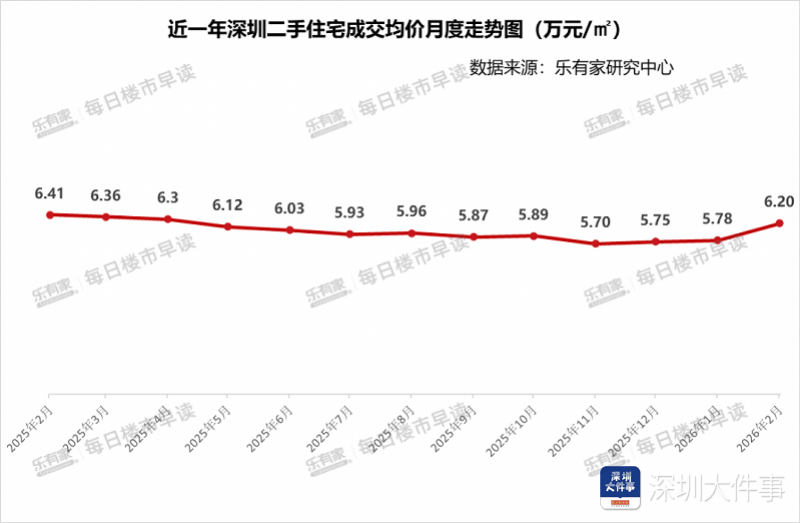
深圳二手房价格连续3个月上涨
Sou Hu Cai Jing· 2026-02-28 04:21
Group 1 - The core viewpoint of the article indicates that the price increase in the real estate market is influenced by structural factors, with the proportion of transactions for improved housing priced between 8 million to 10 million yuan rising significantly by 3.4 percentage points [1] - Following a long adjustment period, prices have gradually stabilized, and there are clear signs of market confidence and expectations improving [1] - The Shenzhen market has become active post-New Year, with both consultation and transaction volumes returning to pre-holiday levels, driven by market confidence, positive expectations, and the popularity of school district housing [1] Group 2 - Notable transaction data from the new housing sector includes the Juyue Mingdu project near the Baozhong business district, which sold 50 units in one day, boosting confidence in the real estate market [1] - A monthly price trend chart for second-hand residential properties in Shenzhen from February 2025 to February 2026 is referenced, indicating ongoing monitoring of market conditions [2]

上海楼市新政落地,释放哪些重要信号
Bei Jing Ri Bao Ke Hu Duan· 2026-02-28 00:54
Core Viewpoint - The implementation of Shanghai's new housing policy "Hu Qitiao" aims to stabilize the real estate market and support housing consumption, reflecting a commitment to maintaining stability in the housing sector through various measures [1][2]. Group 1: Key Changes in "Hu Qitiao" - The policy allows individuals with one year of social security contributions in Shanghai to purchase homes, and significantly increases the housing provident fund loan limit by 50%, reaching a theoretical maximum of 3.24 million yuan [1][5]. - The measures also include tax exemptions on certain housing transactions, providing substantial support for homebuyers with reasonable housing consumption needs [1][5]. Group 2: National Impact of "Hu Qitiao" - The proactive measures taken by Shanghai are expected to serve as a positive example for other cities across the country, enhancing market expectations and consumer confidence [2][6]. - The overall market performance in Shanghai, which has shown signs of recovery, indicates that the policies are effective and can guide national strategies for stabilizing the real estate market [2][5]. Group 3: Market Trends and Expectations - Recent months have shown a warming trend in the Shanghai housing market, with increased activity despite traditionally low sales seasons in January and February, suggesting a structural bottoming out of the market [7][9]. - There are indications of price stabilization and high transaction volumes in first-tier and some second-tier cities, contributing to a positive market outlook [8][9]. Group 4: Future Policy Considerations - The focus on demand-side measures, such as those in "Hu Qitiao," should be complemented by attention to supply-side policies to ensure a balanced approach to market stabilization [10][12]. - Maintaining policy consistency and avoiding excessive supply increases in response to market recovery is crucial for sustaining positive trends [11][12].
弱势盘整,成交额继续放量
Ge Long Hui· 2026-02-27 20:52
Market Overview - The market showed cautious sentiment with fluctuations, closing with the Shanghai Composite Index down 0.01% and the Shenzhen Component Index up 0.19%, while the ChiNext Index fell by 0.29% [1] - A total of over 2800 stocks declined across both markets, with a combined trading volume of 2.54 trillion yuan [1] Real Estate Sector - The real estate sector faced significant adjustments, closing down 2.84%, with rental and sales rights, real estate development, and real estate services leading the declines [3] - Notable stocks such as Hualian Holdings, City Investment Holdings, and Shilian Holdings all experienced declines exceeding 6% [3] Film and Entertainment Sector - The film and cinema sector continued to retract, closing down 2.87%, with Bona Film Group hitting the daily limit down and Hengdian Film falling by 6.9% [3] Technology and Hardware Sector - The computing hardware sector showed strong performance, with PCB, CPO, liquid cooling servers, and computing chip concepts performing well, leading to stocks like Shenzhen South Circuit, Dazhu Laser, Guanghe Technology, and Chuanrun Co. hitting the daily limit up [3] Power and Energy Sector - The power sector strengthened, with stocks like Gan Energy Co. achieving two consecutive limit ups and Huayin Electric hitting the daily limit up [3] - The gas turbine concept saw a collective surge, with companies such as Yingliu Co., Wanze Co., Dongfang Electric, and Changbao Co. all reaching the daily limit up [3] Small Metals Sector - The small metals sector was active, with Yunnan Zhenye and Zhangyuan Tungsten both achieving two consecutive limit ups [3] Environmental Sector - Environmental stocks saw a late surge, with Zhongke Environmental and Qidi Environment both hitting the daily limit up [3] Market Sentiment - Despite the current market corrections and adjustments, there is a sense of hope for future opportunities, indicating that the ongoing process may be a necessary phase for post-holiday positioning and portfolio rebalancing, although it is perceived as somewhat arduous [3]

现在卖掉房子,是“聪明”还是“蠢”?内行人一语道破,终于懂了
Sou Hu Cai Jing· 2026-02-27 17:44
Core Viewpoint - The domestic real estate market in China is experiencing a long-term adjustment trend, with average housing prices declining over 30% nationwide, and various policies are being implemented to stabilize the market [1][3]. Group 1: Market Trends - The average housing price in January for 100 cities was 12,905 yuan per square meter, showing a month-on-month decline of 0.85% and a year-on-year decline of 8.67% [1]. - Housing prices in second and third-tier cities have already started to decline, and now first-tier cities like Shanghai and Shenzhen are also seeing price drops [1]. Group 2: Policy Responses - Many cities have lifted purchase restrictions, increased the ceiling for housing provident fund loans, and reduced mortgage rates to below 3.2%, with down payment ratios lowered to 20% [3]. - Tax incentives such as reductions in deed tax and value-added tax have been introduced to encourage home purchases [3]. Group 3: Selling Decisions - The decision to sell a property is influenced by three key factors: the current trend of housing prices, the price-to-income ratio, and the rental yield [6][10]. - The price-to-income ratio in second and third-tier cities is between 20-25, while in first-tier cities it is around 40, indicating that it would take decades for an average person to afford a home [10]. - The rental yield is currently low, suggesting that properties do not hold investment value, and investment demand is unlikely to enter the market until yields reach 3-4% [9].

未来十大趋势,大运来了!
Sou Hu Cai Jing· 2026-02-27 17:04
Group 1 - Autonomous driving technology is expected to experience explosive growth in the next one to two years, significantly improving urban travel experiences by alleviating traffic congestion caused by human driving differences [3] - The development of humanoid robots is set to liberate humans from tedious and dangerous labor, with potential applications in logistics and elder care, combining AI and precision mechanics for enhanced emotional interaction [3] - AI large models are showing capabilities that may surpass human experts in drug development and target discovery, with the potential to tackle complex diseases like cancer and ALS in the next five to ten years, possibly extending human lifespan to 120 years [3] Group 2 - AI is evolving towards general large models, expected to replace over 90% of existing applications across various service scenarios, necessitating increased regulation and value guidance [5] - The demand for raw materials such as copper, aluminum, and rare earths will continue to rise due to the reliance of AI on powerful computing, with China's green electricity capacity surpassing coal power and a surge in energy storage needs [5] - The real estate sector is entering a new development phase characterized by significant "80/20" differentiation, where core urban assets remain strong while 80% of the population continues to leave cities, leading to a lack of fundamental support in those markets [5] Group 3 - The aging population and declining birth rates are accelerating trends in the "silver economy" and health industries, while also driving the rapid rise of pet economy, single economy, emotional value consumption, and cost-effective consumption [7] - The complex global geopolitical landscape is intensifying great power competition, leading to a new arms race and highlighting the importance of strategic resources such as aerospace, communication satellites, and rare earths in modern warfare [7] - Biotechnology is revolutionizing the food industry with scalable production of basic nutrients like mushroom protein and synthetic starch, potentially replacing traditional agriculture and contributing to carbon neutrality and ecological restoration [7] Group 4 - China has established a dominant position in global photovoltaic, new energy vehicles, and power battery sectors, with future advancements in domestic AI large models, GPU chips, and super applications expected to accelerate breakthroughs and form a more complete self-controlled industrial chain [9] - The article aims to provide trend references based on public information and industry observations, emphasizing the importance of maintaining a learning and open mindset to better understand changes and embrace the future [9]

每日机构分析:2月27日
Xin Hua Cai Jing· 2026-02-27 16:54
Group 1: US Housing Market - The average interest rate for a 30-year fixed mortgage in the US fell to 5.98% as of February 26, down from 6.01% the previous week and significantly lower than 6.76% a year ago. This decline is primarily attributed to the drop in the 10-year Treasury yield. However, economists believe this decrease is insufficient to materially stimulate housing demand [1] - The current decline in mortgage rates is seen as a result of market volatility rather than strong economic fundamentals, raising questions about its sustainability. Analysts emphasize that the shortage of housing inventory remains a core constraint on market recovery, indicating that merely lowering rates will not drive demand unless supply improves [1] - Despite the lower rates, there has been a noticeable increase in mortgage refinancing activity [1] Group 2: UK Government Bonds - UK government bond prices have risen due to market expectations that the Office for Budget Responsibility will announce a reduction in bond issuance for the current fiscal year and further cuts in the 2027 fiscal year. Analysts suggest that strong tax revenues early in the year may lead to a downward revision of bond issuance expectations [2] Group 3: Japan Inflation - In February, Tokyo's core consumer prices, excluding fresh food, rose by 1.8% year-on-year, slightly above economists' median forecast of 1.7%. The inflation rate is cooling as the impact of government measures to lower utility bills becomes evident and food cost increases slow down [2] Group 4: South Korea Exports - South Korea's exports are expected to grow for the ninth consecutive month in February, driven by a surge in chip demand amid a global AI investment boom. Analysts predict a 24.0% year-on-year increase in exports, with semiconductor prices rising faster than expected and low inventory levels supporting strong export momentum [2] - There is a high likelihood that semiconductor export growth will exceed 100% in the first half of the year [2] Group 5: Singapore Trade Performance - Singapore's manufacturing and trade performance may be adversely affected by uncertainties in US trade policy by 2026. Potential trade tensions and geopolitical conflicts among major economies could raise production costs and exacerbate global economic policy uncertainty, ultimately dampening global investment flows and trade activities [2]