电商

Search documents
2月20日热门中概股多数下跌 华住酒店集团涨1.54%,携程跌2.28%
Xin Lang Cai Jing· 2026-02-19 21:36
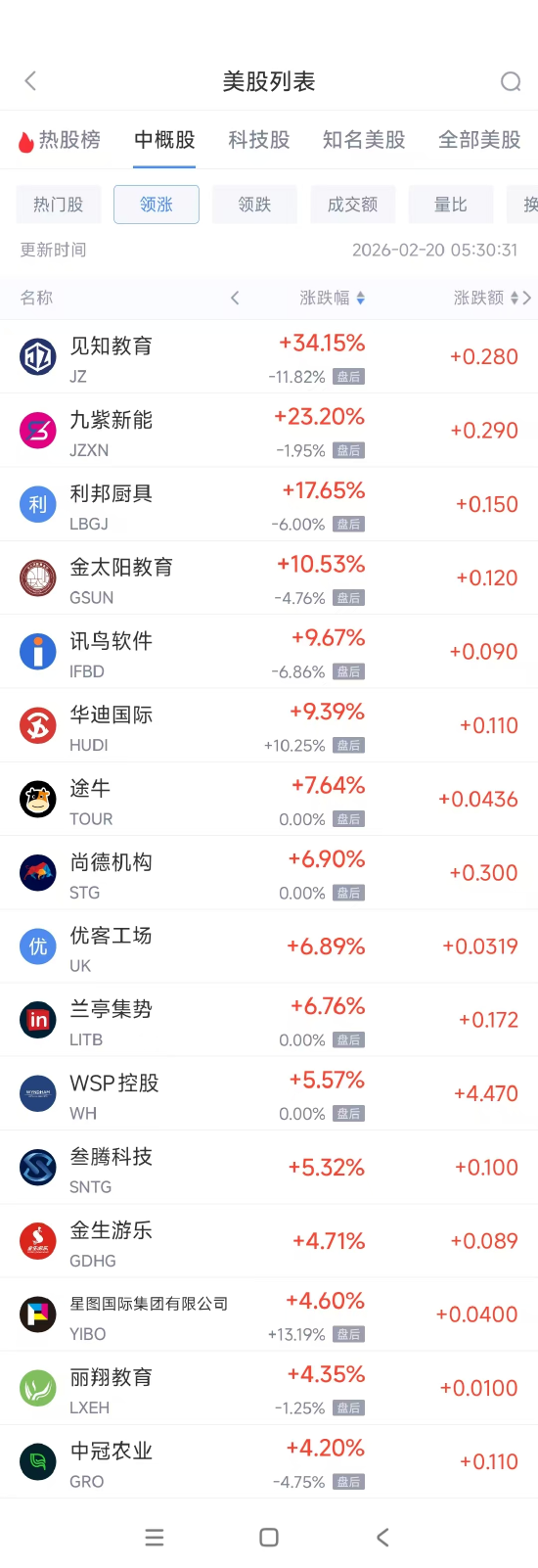
Market Overview - The Nasdaq China Golden Dragon Index (HXC) declined by 0.35% on February 20, with most Chinese concept stocks experiencing a drop [1][7] - The Dow Jones Industrial Average fell by 267.50 points, or 0.54%, closing at 49,395.16 points, while the Nasdaq Composite dropped by 70.91 points, or 0.31%, to 22,682.73 points [8] Gainers and Losers in Chinese Concept Stocks Gainers - Futu Holdings increased by 0.65% - ZTO Express rose by 0.51% - Huazhu Group gained 1.54% - NIO saw an increase of 0.41% - New Oriental Education grew by 0.32% [1][7] Losers - TSMC decreased by 0.52% - Alibaba fell by 0.96% - Pinduoduo dropped by 0.94% - Ctrip saw a decline of 2.28% - Baidu and JD.com both fell by 0.55% and 0.51% respectively [1][7] U.S. Market Performance - The S&P 500 index's year-to-date gain narrowed to 0.2%, while the Dow Jones has increased by over 2% [2][8] - The Nasdaq index, which has a high concentration of technology stocks, has seen a cumulative decline of over 2% in 2026 [2][8] Notable Stock Movements Top Gainers - Jianzhijiao Education surged by 34.15% - Jiuzi Holdings increased by 23.20% - Libang Kitchenware rose by 17.65% [9][10] Top Losers - Jiarishi Talent fell by 14.14% - Dashu Cloud dropped by 11.89% - Weiba International decreased by 11.22% [12][13]

春节假期云南消费市场全面升温
Xin Lang Cai Jing· 2026-02-19 20:57
Core Insights - The consumption market in Yunnan has shown significant growth during the Spring Festival holiday, with retail sales increasing by 14.5% compared to the previous year [1] - Online retail sales surged by 49.6% year-on-year, indicating a strong shift towards e-commerce [3] - Key promotional activities, including the distribution of over 500,000 consumption vouchers, have effectively stimulated consumer spending [3] Retail Performance - Retail sales from February 15 to 17 reached a notable increase of 14.5% compared to the same period last year [1] - Specific categories such as home appliances, furniture, and communication devices saw sales growth of 25.6%, 17.3%, and 12.1% respectively [2] - The sales of sports and entertainment products experienced a remarkable increase of 54.5% [3] Consumer Incentives - The "I Celebrate the New Year in Yunnan" campaign included a lottery for consumers spending over 100 yuan, with prizes up to 800 yuan [2] - A total of 897,000 applications for subsidies on old-for-new purchases in automobiles and home appliances were recorded, driving consumption by 5.47 billion yuan [2] E-commerce and Vouchers - The distribution of various types of consumption vouchers, exceeding 1 billion yuan in total, has been a key strategy to boost spending [3] - The average daily outbound volume for popular products like flowers and blueberries reached 1 million and 250,000 units respectively [3] Local Events and Consumer Engagement - Local governments organized over 50 "Colorful Cloud Market" events to enhance consumer engagement and promote local culture [4] - Major shopping districts reported an average daily foot traffic of 1.771 million, with specific areas like Kunming's South Ping Street attracting 364,000 visitors daily [5] - The restaurant sector also thrived, with some cities reporting restaurant revenue growth of 103.9% year-on-year [5]
千亿巨头,大举加仓
Zhong Guo Ji Jin Bao· 2026-02-19 14:40
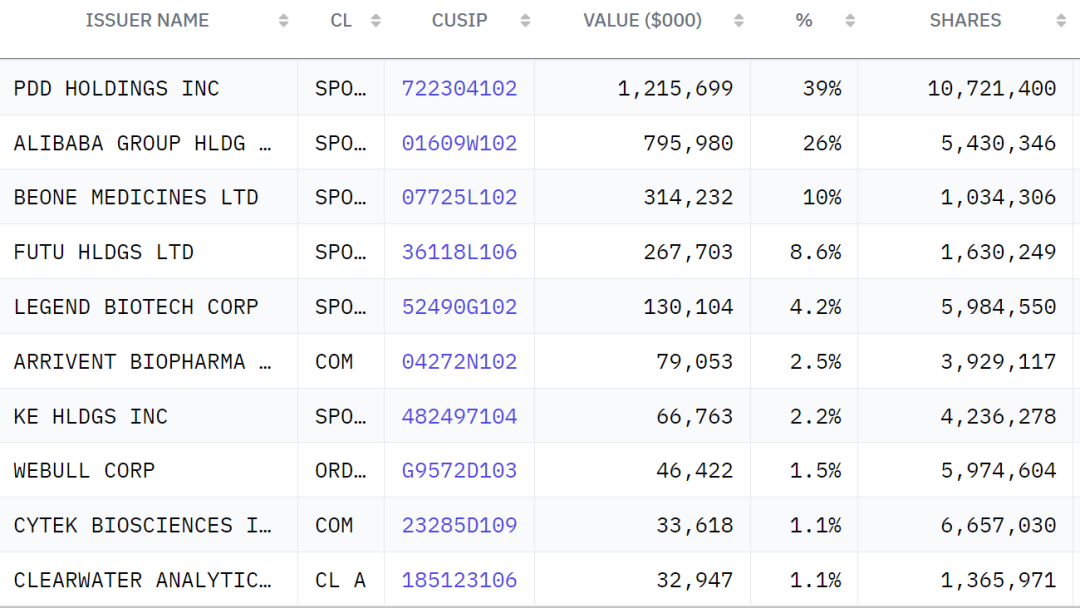
Core Insights - HHLR Advisors, a fund management platform under Hillhouse Capital, revealed its U.S. stock holdings report as of Q4 2025, showing a total market value of $3.104 billion, a decrease of 24% quarter-over-quarter [2]. Group 1: Portfolio Adjustments - HHLR Advisors held a total of 33 stocks at the end of Q4, with significant adjustments including increased positions in Alibaba, Pinduoduo, and Taiwan Semiconductor, while initiating a position in iShares Bitcoin ETF and reducing holdings in Futu and Webull [3][10]. - The top ten holdings of HHLR Advisors included seven Chinese concept stocks, which accounted for 92% of the total market value, focusing on internet e-commerce leaders, biomedicine, and fintech [5]. Group 2: Major Increases - Pinduoduo (PDD) was the largest holding, with shares increasing from 8.59 million to 10.72 million, raising its market value from $1.136 billion to $1.216 billion, now representing 39% of the portfolio [7]. - Alibaba (BABA) also saw a significant increase in holdings, with shares rising from 3.289 million to 5.43 million, increasing its market value from $588 million to $796 million, now making up 26% of the portfolio [7]. Group 3: New Investments - HHLR Advisors made a new investment in the iShares Bitcoin ETF (IBIT), indicating an exploration into emerging asset classes [11]. - A small increase was noted in Taiwan Semiconductor (TSM), with a market value of $3.434 million at the end of Q4 [11]. Group 4: Reductions and Exits - HHLR Advisors significantly reduced its holdings in Futu Holdings, cutting shares from 3.238 million to 1.63 million, with the market value dropping from $563 million to $268 million [13]. - Webull was nearly fully divested, with holdings decreasing from 3.308 million shares to 597,000 shares [13]. - The firm completely exited positions in Baidu, NetEase, and several other companies [14].


美股三大指数集体低开,科技股普跌
Feng Huang Wang Cai Jing· 2026-02-19 14:40
Market Overview - US stock indices opened lower, with Nasdaq down 0.51%, Dow Jones down 0.28%, and S&P 500 down 0.29% [1] Company News - Nvidia's CEO Jensen Huang announced a "world-first" new chip to be unveiled at the GTC 2026 conference, which is expected to strengthen Nvidia's leadership in AI infrastructure [2] - Meta plans to launch an AI-enabled smartwatch later this year, named Malibu 2, along with an upgraded version of its Meta Ray-Ban Display smart glasses, marking its entry into the competitive wearable device market after a four-year hiatus [3] - OpenAI is finalizing initial investment commitments for a $100 billion funding round, potentially valuing the company at $830 billion, with SoftBank expected to lead with a $30 billion investment [4] - Google has partnered with Sea Ltd to develop AI tools for e-commerce and gaming, focusing on creating AI-driven shopping prototypes for Sea's Shopee platform [5] - Walmart reported Q4 revenue of $190.66 billion, slightly above estimates, but projected adjusted EPS for FY2027 at $2.75 to $2.85, below market expectations of $2.97, leading to a pre-market drop of over 2% [6] - Tesla reported that its Full Self-Driving (FSD) system has accumulated over 8.2 billion miles driven, with significant reductions in collision rates [7] - Boeing secured a $22.5 billion order from Vietnam's Sun Group for 40 Dreamliner 787-9 aircraft, enabling intercontinental flight services [8] - Airbus reported a 2025 net profit of €5.221 billion, a 23% increase year-over-year, with revenues of €73.42 billion and a delivery of 793 aircraft [9]


亚马逊(AMZN.US)超越沃尔玛(WMT.US) 登顶全球营收榜首
智通财经网· 2026-02-19 13:53
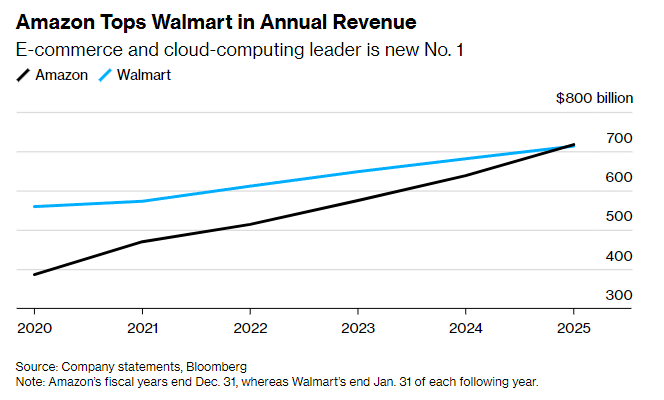
Group 1 - Amazon has officially surpassed Walmart to become the highest-grossing company globally, marking a significant achievement since its founding in 1994 as an online bookstore [1][4] - Walmart reported sales of $713.2 billion for the 12 months ending January 31, while Amazon projected sales of $717 billion for 2025 [1] - Amazon's revenue growth is largely attributed to its dominance in the cloud computing sector, which Walmart has not entered; without AWS, Amazon's revenue for 2025 would be $588 billion [4] Group 2 - The achievement of becoming the highest-grossing company symbolizes large scale and extensive consumer reach, but it is not the only metric valued by investors [4] - Previous companies that held the title, such as ExxonMobil and General Motors, faced stricter regulatory scrutiny and higher consumer expectations [4] - Currently, Nvidia holds the title of the highest market capitalization company at $4.5 trillion, which is more than double Amazon's market cap and over four times that of Walmart [4]


春节假期前三天云南消费市场全面升温
Xin Lang Cai Jing· 2026-02-19 13:46
Core Insights - The consumption market in Yunnan has shown a significant increase during the first three days of the Spring Festival holiday, with retail sales rising by 14.5% compared to the same period last year [1] Group 1: Consumer Activities and Promotions - The "I Celebrate the New Year in Yunnan" campaign launched on February 11, offering consumers a chance to win up to 800 yuan by submitting invoices for purchases over 100 yuan in various sectors [2] - A total of 89.7 million applications for subsidies for replacing old automobiles, home appliances, and digital products were recorded, driving consumption by 5.47 billion yuan [2] Group 2: Sales Performance by Product Category - Sales of home appliances and audio-visual equipment, furniture, communication devices, and automobiles increased by 25.6%, 17.3%, 17.3%, and 12.1% respectively during the first three days of the holiday compared to last year [2] - The online retail sales surged by 49.6% year-on-year, with significant sales in flowers and blueberries, averaging 1 million and 250,000 units shipped daily [3] Group 3: Local Events and Consumer Engagement - Various local events, such as the "Colorful Cloud Market" series, were organized to enhance consumer engagement, featuring local delicacies and cultural performances [4] - The average daily foot traffic in monitored shopping streets reached 1.771 million, with Kunming's South Ping Street attracting 364,000 visitors [4] - Retail sales in Kunming, Lincang, and Yuxi increased by 39.6%, 14.6%, and 13.3% respectively, while restaurant revenues in Yuxi, Pu'er, and Lincang grew by 103.9%, 25.2%, and 22% [4]
美股盘前要点丨三大股指期货集体下跌、三星HBM4芯片拟大幅提价30%
Xin Lang Cai Jing· 2026-02-19 13:45
Group 1 - OpenAI is reportedly nearing the completion of the first phase of a new funding round, expected to exceed $100 billion, making it one of the largest financing deals in tech history. The overall valuation of the company may surpass $850 billion, higher than the previous estimate of $830 billion. The first phase of funding will primarily come from strategic investors, including Amazon, SoftBank, Nvidia, and Microsoft [1] - Walmart's stock is down 3% in pre-market trading after issuing a cautious earnings forecast [5] - Hims & Hers shares rose approximately 7% in pre-market trading after announcing a deal to acquire Eucalyptus for over $1 billion [6] - DoorDash shares surged nearly 10% in pre-market trading due to strong revenue growth following its acquisition of Deliveroo [7] - Airbus reported a revenue of €73.42 billion for the fiscal year 2025, a 6% year-over-year increase, with a net profit of €5.221 billion, up 23%, and earnings per share of €6.61 [9] - Vietnam's Sun Group announced a $22.5 billion agreement with Boeing to purchase 40 787-9 Dreamliner aircraft [11] Group 2 - The three major U.S. stock index futures are collectively down, with Dow futures down 0.25%, S&P 500 futures down 0.22%, and Nasdaq 100 futures down 0.36% [2] - European stocks are broadly down, with the FTSE MIB index in Italy falling over 1%, the Euro Stoxx 50 index and DAX 30 in Germany down nearly 1%, the FTSE 100 in the UK down 0.6%, and the CAC 40 in France down 0.8% [3] - U.S. storage stocks saw slight gains in pre-market trading, with SanDisk up 2% and Western Digital up 2%. The storage industry received positive news as Samsung Electronics is reportedly negotiating prices for the new generation HBM4 chips, with quotes up to 30% higher than the previous generation, reaching approximately $700 [4] - Nvidia's CEO Jensen Huang teased an upcoming "unprecedented" new chip at the GTC 2026 conference, generating significant industry interest [10]
黄仁勋:为GTC 2026准备了多款前所未见的新芯片;英伟达清仓Arm全部股份;OpenAI最新一轮融资有望突破1000亿美元【美股盘前】
Mei Ri Jing Ji Xin Wen· 2026-02-19 10:17
Market Overview - Major U.S. stock index futures are showing slight declines, with Dow futures down 0.12%, S&P 500 futures down 0.08%, and Nasdaq futures down 0.04% [1] Semiconductor Sector - Storage chip stocks are experiencing a pre-market rally, with SanDisk and Micron Technology both rising over 1% [2] Nvidia Developments - Nvidia's CEO Jensen Huang announced the preparation of several unprecedented new chips for GTC 2026, emphasizing the challenges in technology advancements but expressing confidence in his team's capabilities [2] - Nvidia has sold its remaining 1.1 million shares of Arm Holdings, valued at approximately $156 million, while still holding a 20-year technology license from Arm [2] Meta Platforms - Meta has restarted its "Malibu 2" smartwatch project, expected to launch in 2026, featuring health tracking capabilities and an integrated Meta AI assistant [2] OpenAI Financing - OpenAI is nearing the completion of a new funding round expected to exceed $100 billion, with a projected overall valuation surpassing $850 billion, up from an initial estimate of $830 billion [3] - The pre-funding valuation is anticipated to remain at $730 billion, with major strategic investors including Amazon, SoftBank, Nvidia, and Microsoft [3] Mining Sector - Rio Tinto's 2025 earnings report showed a basic profit of $10.87 billion, flat year-over-year but slightly below market expectations of $11.03 billion, leading to a decline of over 2% in its stock [3] eBay Performance - eBay's Q4 2025 earnings report exceeded expectations, with revenue of $3 billion, a 15% year-over-year increase, and adjusted earnings per share of $1.41, surpassing the forecast of $1.35 [4] - eBay announced the acquisition of fashion marketplace Depop from Etsy for $1.2 billion [4] Silver Stocks - Silver-related stocks are showing strength, with Pan American Silver up over 4% and Hecla Mining rising nearly 2% [5] Google and Sea Partnership - Google is collaborating with Southeast Asian tech group Sea to develop AI tools for Sea's e-commerce and gaming products, including a prototype AI Agent for the Shopee platform [5]

大涨超580%!电商消费爆发,巨头“发力”|新春e线
Xin Lang Cai Jing· 2026-02-19 09:40
Core Insights - The e-commerce consumption during the Spring Festival in 2026 shows a significant shift towards online shopping as the primary channel for purchasing New Year goods, with comprehensive e-commerce platforms like Taobao and JD.com leading the market share [1][2] - The logistics and delivery systems have been enhanced, with major platforms ensuring timely delivery even during the holiday period, reflecting a commitment to customer service [1][2] - The consumer behavior is evolving, with younger generations (post-90s and post-00s) driving a transition from traditional bulk purchasing to experience-oriented and self-indulgent consumption [2][3] E-commerce Trends - In 2026, comprehensive e-commerce platforms accounted for 45.43% of the New Year goods purchasing channels, followed by offline supermarkets at 38.96% and fresh e-commerce platforms at 34.01% [1] - The online retail sales reached 9897.3 billion yuan by February 8, 2026, with post-00s consumers contributing significantly to this growth, showing a 47% year-on-year increase in order amounts [2] Logistics and Delivery Enhancements - Taobao and JD.com have implemented measures such as "Spring Festival does not close" to ensure delivery services across 220 cities, with Taobao's delivery efficiency improving by at least half a day compared to the previous year [1][2] - The logistics network has been optimized with a "large warehouse + small warehouse" model to ensure quick response times and availability of popular products [2] Changing Consumer Preferences - There is a notable rise in demand for "emotional value" products, with nostalgic and emotional food items gaining popularity among consumers, particularly among younger demographics [3] - Alcohol consumption has seen a significant increase, with double-digit growth in sales, particularly for traditional and low-alcohol beverages [3] - Pre-prepared dishes for New Year's Eve are also trending, with sales of specific product lines like the "封神" series increasing by 116% [3] Market Outlook - The 2026 Spring Festival e-commerce consumption reflects a clear trend towards quality, personalization, and digitalization in the Chinese consumer market, indicating a robust potential for future growth in the e-commerce sector [4]

未来10年,这18个赛道将带来48万亿美元收入
创业家· 2026-02-19 09:33
Core Insights - McKinsey's report identifies 18 industry sectors likely to reshape the global business landscape, predicting revenues of $29 trillion to $48 trillion by 2040, contributing 18-34% to global GDP growth [2] E-commerce - By 2040, e-commerce's share of global retail revenue is expected to rise to 27%-38%, up from approximately 20% currently [3] - Growth drivers include market expansion in developing countries and new product categories in developed nations, such as healthcare and emotionally valuable products [4] - Significant investments are anticipated in customer acquisition and last-mile delivery across e-commerce platforms [5] Electric Vehicles - Electric vehicles (EVs) are projected to exceed 50% of global passenger car sales by 2040 [6] - Breakthroughs in battery technology and smart algorithms will significantly influence this sector, prompting increased R&D investments from both EV manufacturers and traditional automakers [7] Cloud Services - The demand for higher storage and computing capabilities is driven by a more interconnected world and the need for AI products requiring substantial computational power [9] - The cloud services industry experienced a 17% compound annual growth rate (CAGR) from 2005 to 2020, with similar growth expected in the coming decades [10] Semiconductors - The semiconductor industry is essential for the digital world, with demand from computing, data storage, automotive, communication, and industrial electronics driving growth [11] - A sustained CAGR of 6%-8% is forecasted for the semiconductor sector over the next decade [11] AI Software Services - The rapid development of AI has led to its classification as a distinct sector, with increasing usage of AI assistants [12] - Companies in the AI space are engaged in a competitive race to develop advanced foundational models and applications [13] Digital Advertising - Digital advertising, through search, social media, and media services, is expanding in value as internet usage among the middle class increases [14] - Continuous algorithm improvements enhance platforms' abilities to target customers and track advertising costs, although competition for user attention necessitates increased investment in engaging content [15] Streaming Video - Investment in customer acquisition and content production is rising, prompting streaming platforms to seek new revenue models [17] - Developing countries may provide incremental growth in subscription and advertising revenue for streaming services, with projections indicating over 1 billion households subscribing to long-form video services by 2040 [18] Shared Autonomous Vehicles - The advent of autonomous driving technology may reduce the necessity for personal vehicle ownership [19] - By 2040, shared autonomous vehicles could account for 25%-51% of shared mobility revenue [20] Space Economy - The world is on the brink of entering a space economy era, with advancements in reusable rocket technology transforming the aerospace industry [21][22] Cybersecurity - Cybercrime caused approximately $950 billion in direct economic losses in 2020, with indirect losses potentially reaching $4-6 trillion [24] - Increasing awareness of cybersecurity has led companies to enhance their investments in this area [25] Batteries - Significant advancements in battery technology have tripled energy density over the past few decades [26] - The global energy transition is driving demand for batteries, particularly in electric vehicles, energy storage, and consumer electronics, with EVs expected to represent over 80% of the battery market by 2040 [28] Video Games - By 2030, an estimated 40% of the global population may become video game players [30] - New gaming models, such as mobile and cloud gaming, are accelerating market growth, with free-to-play games generating substantial revenue [32] Robotics - The integration of AI with robotics is creating significant expectations for humanoid robots, which are seen as potential "ultimate intelligent agents" [33] Industrial and Consumer Biotechnology - Breakthroughs in gene editing and other technologies are accelerating the application of biotechnology in agriculture, alternative proteins, consumer products, and bio-materials [37] Modular Construction - Modular construction methods, which involve prefabricating building components for on-site assembly, can significantly enhance construction efficiency [38] Nuclear Fission Power - The development of safer, smaller modular reactors presents opportunities to supplement renewable energy sources [39] Air Traffic - Electric vertical takeoff and landing vehicles and delivery drones are expected to drive significant technological changes in air traffic [41] Obesity Treatment Drugs - The prevalence of obesity is projected to rise from 15% in 2020 to 24% by 2035, indicating a potential market for effective weight loss products [43]