
铜

Search documents
有色金属走强,上证180ETF指数基金(530280)红盘向上
Sou Hu Cai Jing· 2025-12-01 02:04
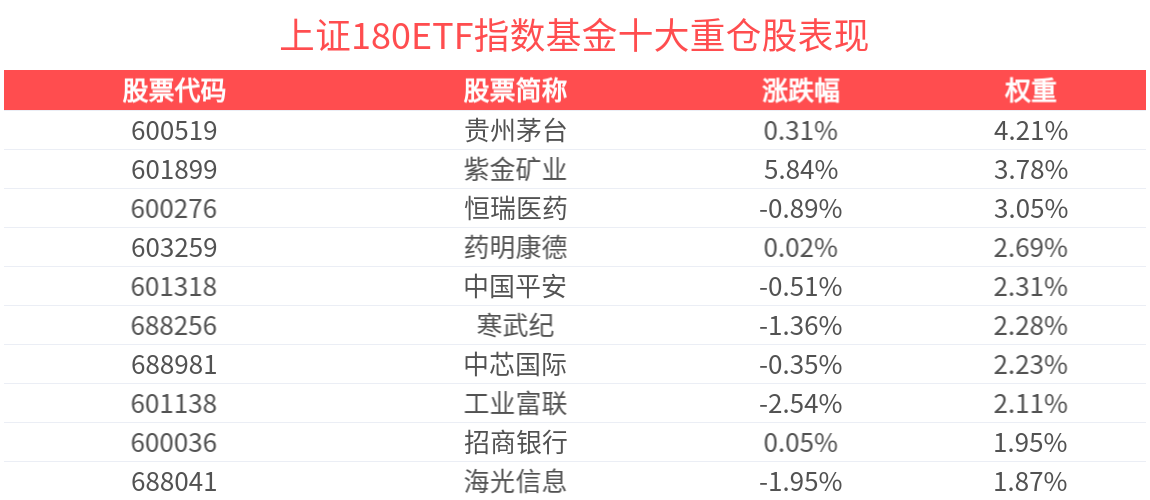
Core Insights - The A-share market is experiencing an upward trend, with expectations of a volatile structure in the short term, influenced by signals from the Federal Reserve [3] - The demand for copper is anticipated to rise due to tightening supply and increased demand from AI data center construction, while silver prices have reached historical highs [2][3] - The top ten weighted stocks in the Shanghai 180 Index account for 26.13% of the index, indicating concentrated investment opportunities [4] Group 1: Market Performance - As of December 1, 2025, the Shanghai 180 Index rose by 0.36%, with notable increases in stocks such as Jiangxi Copper (up 7.80%) and China Merchants Energy (up 6.24%) [1] - The Shanghai 180 ETF Index Fund also saw a slight increase of 0.34%, closing at 1.2 yuan [1] Group 2: Commodity Insights - Silver prices have surged significantly, with COMEX silver futures reaching a peak of $57.245 per ounce, marking a 90% increase year-to-date [1] - The Chilean state-owned copper company has raised long-term contract premiums to $350 per ton, highlighting supply constraints in the copper market [2] Group 3: Investment Opportunities - The electric aluminum sector is showing defensive characteristics with high dividends, and leading companies are seeing valuations drop to historical lows, suggesting potential for recovery [2] - Upcoming important meetings in December are expected to create investment opportunities related to economic policy and emerging industries such as AI and carbon materials [3]

有色钢铁行业周观点(2025年第48周):金铜的跨年行情或将展开,有色布局正当时-20251201
Orient Securities· 2025-12-01 01:43
Investment Rating - The report maintains a "Buy" rating for the non-ferrous and steel sectors, indicating a positive outlook for investment opportunities in these industries [9][10]. Core Viewpoints - The report suggests that a cross-year market for gold and copper may unfold, making it an opportune time to invest in non-ferrous metals [9][10]. - It highlights that the copper supply shortage is expected to continue, which may drive up copper prices, while strict control over smelting capacity could lead to improved profitability for midstream players [9][10]. - The report also emphasizes the bullish outlook for gold prices, projecting a rise to $4,500 per ounce by the end of 2025 and potentially exceeding $5,000 per ounce in 2026 [9][10]. - For the electrolytic aluminum sector, the report suggests that despite recent stock dilution, the overall supply-demand dynamics remain intact, presenting opportunities for investment [9][10]. Summary by Sections Non-Ferrous Metals - The report notes a 3.37% increase in the non-ferrous metals sector, driven by a significant rise in copper prices due to supply constraints and inflation expectations [9][10]. - It highlights the historical high copper premium set by Codelco, which is expected to further tighten supply [9][10]. - The report recommends focusing on investment opportunities in copper, gold, and aluminum sectors [9][10]. Steel Industry - The report indicates a slight decrease in iron and steel production, with rebar consumption at 2.28 million tons, down 1.23% week-on-week but up 1.15% year-on-year [16][21]. - It mentions that overall steel inventory continues to decline, with total social and steel mill inventories down by 2.15% [23][24]. - The profitability of most steel products has significantly improved due to rising costs, with the average price index for common steel rising by 0.42% [26][35]. New Energy Metals - The report states that lithium carbonate production in October 2025 saw a significant year-on-year increase of 67.28%, indicating strong supply growth [39][40]. - It also notes that the production of new energy vehicles continues to grow, with October 2025 production reaching 1.68 million units, up 19.94% year-on-year [43][46]. - The report highlights price increases in lithium and cobalt, with lithium carbonate priced at 93,300 yuan per ton, reflecting a slight decrease of 0.27% week-on-week [49][50].



特朗普称已确定下任美联储主席人选
Dong Zheng Qi Huo· 2025-12-01 01:29
1. Report Industry Investment Ratings No relevant content provided. 2. Core Views of the Report - Trump has determined the next Fed Chair nominee, likely Kevin Hassett, which is expected to increase market risk appetite and weaken the US dollar [2][13]. - After a sharp decline, the odds of the bond market have improved, but there is a risk of further adjustment as policy expectations rise [3][23]. - Due to floods in palm oil - producing areas, the supply pressure is expected to ease, and palm oil prices may rebound [4][25]. - CSPT's decision to cut copper production in 2026 and other factors are expected to drive copper prices to continue to rise [4][45]. - OPEC+ has decided to suspend production increases in Q1 2026, and short - term oil prices will maintain a volatile trend [5][67]. 3. Summary by Directory 3.1 Financial News and Comments 3.1.1 Macro Strategy (Gold) - A data center cooling system problem in Chicago led to a trading halt at CME, causing disruptions in multiple markets. Gold rose about 1.5% and silver soared 5% on Friday, driven by expectations of Fed rate cuts. The Shanghai and Shanghai Gold Exchange silver inventories are falling, and the CME trading halt has reduced market liquidity. It is recommended to reduce positions [10]. 3.1.2 Macro Strategy (Foreign Exchange Futures - US Dollar Index) - The Japanese Finance Minister said the rapid yen depreciation is not driven by fundamentals. Trump has determined the next Fed Chair nominee, and it is expected that Hassett will be elected, leading to increased market risk appetite and a weaker US dollar [11][13]. 3.1.3 Macro Strategy (US Stock Index Futures) - Ukraine's new negotiation representative went to the US to discuss ending the war. The CME system failure caused trading interruptions. The US rate - cut expectations are rising, and the market risk appetite has improved. The US stock index is expected to continue to repair and show a strong - biased volatile trend [15][16]. 3.1.4 Macro Strategy (Stock Index Futures) - China's November official manufacturing PMI was 49.2, slightly up from the previous value. The National Development and Reform Commission held a private enterprise symposium. The stock market trading volume has shrunk, and there may be no trend - based market in the short term. It is recommended to evenly allocate long positions in stock indices [18][19]. 3.1.5 Macro Strategy (Treasury Bond Futures) - China's November official manufacturing PMI was 49.2, in line with expectations. The central bank conducted a 3013 - billion - yuan 7 - day reverse repurchase operation, with a net withdrawal of 737 billion yuan on the day. The bond market has a risk of further adjustment as policy expectations rise. It is recommended to short long - term bond varieties on rebounds [21][23]. 3.2 Commodity News and Comments 3.2.1 Agricultural Products (Soybean Oil/Rapeseed Oil/Palm Oil) - Continuous heavy rain in Indonesia's Sumatra has caused floods and landslides. The supply pressure of palm oil is expected to ease, and prices may rebound. It is recommended to consider short - term long positions [25]. 3.2.2 Agricultural Products (Sugar) - As of the end of November, about 30 sugar mills in Guangxi and Yunnan have started production. The sugar production in Guangxi in November is expected to be 100,000 tons, far lower than last year. The Zhengzhou sugar 1 - month contract is expected to oscillate, and the main funds will gradually shift to the 5 - month contract [26][31]. 3.2.3 Agricultural Products (Cotton) - In October, China's cotton product exports decreased year - on - year but increased month - on - month. The EU's clothing imports from China increased in Q3. The US cotton export signing and shipment increased in the week ending October 16. The Zhengzhou cotton is expected to be strongly volatile in the short term and cautiously optimistic in the long term [32][35]. 3.2.4 Black Metals (Rebar/Hot - Rolled Coil) - Malaysia plans to add 48.4 million tons of steel production capacity from 2030 - 2035. China's November automobile dealer inventory warning index was 55.6%, up year - on - year and month - on - month. Steel prices are expected to oscillate with a slight rebound, and it is recommended to take an oscillatory approach [36][38]. 3.2.5 Agricultural Products (Soybean Meal) - Oil mills maintained a high operating rate. Argentina's soybean planting was 39% complete as of November 27. The US sold 312,000 tons of soybeans to China. International markets should focus on China's soybean purchases and South American weather, and domestic soybean meal is expected to oscillate [39][41]. 3.2.6 Agricultural Products (Corn Starch) - The price difference between corn starch and tapioca starch has widened. Corn starch is expected to be strong in the short term, and it is recommended to operate in the price - difference range in the medium - short term and expect it to strengthen in the long term [42][43]. 3.2.7 Agricultural Products (Corn) - As of November 27, the average grain - selling progress in Northeast China was 26%, and in North China was 25%, both faster than last year. Corn futures contracts are expected to have different trends, and it is not recommended to short against the trend in the short term [43][44]. 3.2.8 Non - ferrous Metals (Copper) - CSPT agreed to reduce copper production capacity by over 10% in 2026. Chile's October copper production decreased by 7% year - on - year. Copper prices are expected to rise, and it is recommended to buy on dips [45][48]. 3.2.9 Non - ferrous Metals (Polysilicon) - Hainan's new - energy power price was cleared at the upper limit. Polysilicon prices are under pressure, and it is recommended that investors operate with caution due to high volatility [49][51]. 3.2.10 Non - ferrous Metals (Industrial Silicon) - The operating rates of silicon enterprises in Sichuan and Yunnan are declining. The market is expected to oscillate between 8800 - 9500 yuan/ton, and it is recommended to focus on range - bound operations [52][54]. 3.2.11 Non - ferrous Metals (Lead) - On November 27, LME lead had a large - scale backwardation. The old - standard electric bicycle CCC certificates will be cancelled from December 1. The lead market is short of supply and strong in demand, and it is recommended to buy on dips [55][56]. 3.2.12 Non - ferrous Metals (Zinc) - On November 27, LME zinc had a large - scale contango. Antamina's zinc ore tender price was below $30/dry ton. Zinc prices are likely to rise, and it is recommended to observe buying opportunities on the right side and hold long - spread positions [57][58]. 3.2.13 Non - ferrous Metals (Lithium Carbonate) - Frontier Lithium released its mid - term report. The lithium carbonate market may face short - term callback pressure, and it is recommended to short on highs in the short term and buy on lows in the medium term [59][62]. 3.2.14 Non - ferrous Metals (Nickel) - Indonesia simplified the RKAB approval process. The nickel market is in surplus, and nickel prices are expected to oscillate at the current level [63][64]. 3.2.15 Energy Chemicals (Carbon Emissions) - On November 28, the EUA main contract closed at €83.26/ton. EU carbon prices are supported by auction suspension and reduced supply in 2026 but may be suppressed by warm weather [65]. 3.2.16 Energy Chemicals (Crude Oil) - OPEC+ decided to suspend production increases in Q1 2026. US crude oil production reached a record high in September. Short - term oil prices will maintain a volatile trend, and it is recommended to pay attention to the Russia - Ukraine negotiation progress [67][70]. 3.2.17 Shipping Index (Container Freight Rates) - The UK plans to cancel the small - package tariff exemption in 2029. The SCFI index rose. The container freight market is expected to oscillate, and it is recommended to consider light - position long positions in the 02 contract [71][72].
黄金原油双反弹: 申万期货早间评论-20251201
申银万国期货研究· 2025-12-01 00:57
Economic Overview - The manufacturing PMI for November in China is 49.2%, an increase of 0.2 percentage points from the previous month, while the non-manufacturing PMI is 49.5%, a decrease of 0.6 percentage points [1] - The comprehensive PMI output index stands at 49.7%, down 0.3 percentage points from last month, indicating overall economic stability [1] - The China Macro Economic Forum (CMF) report suggests that by 2025, China will strive for breakthroughs to achieve expected development goals, with three new opportunities for economic development in 2026 [1] Market Performance - Major U.S. stock indices rose, with the agricultural sector leading gains and the banking sector lagging [2] - The market turnover reached 1.60 trillion yuan, with a financing balance increase of 2.75 billion yuan to 24.55 trillion yuan [2] - The "14th Five-Year Plan" focuses on technological self-reliance, indicating a long-term direction for the technology sector [2] Commodity Insights Copper - Copper prices rose by 1.5% in the night session, with tight supply of concentrates and smelting profits at breakeven [18] - Investment in power grids continues to show positive growth, while real estate remains weak [18] Oil - SC crude oil prices increased by 1.11%, amid hopes for a peace process in Ukraine [12] - The International Energy Agency reported that OPEC's oil supply in October was 23.77 million barrels per day, a decrease of 180,000 barrels from September [12][13] Methanol - Methanol prices fell by 0.28%, with domestic production capacity operating at 75.74%, a decrease of 0.51 percentage points [14] - Coastal methanol inventories decreased by 9,450 tons, a drop of 5.88% from the previous week [14] Rubber - Rubber prices are expected to remain volatile, with supply pressures from overseas and stable demand from the tire industry [15] Agricultural Products - The soybean planting rate in Brazil reached 78%, up from 69% the previous week, but U.S. soybean exports remain slow [20] - Palm oil prices are supported by production concerns due to adverse weather conditions in Indonesia [22] Financial Market - The 10-year government bond yield fell to 1.832%, with the central bank continuing to inject liquidity into the market [11] - The overall market sentiment is cautious as year-end approaches, with expectations for policy announcements to boost market confidence [11]

“美元转弱+白银新高”,金属板块投资策略再梳理
2025-12-01 00:49
Summary of Key Points from Conference Call Records Industry Overview - The conference call primarily discusses the precious metals sector, focusing on gold and silver, as well as other base metals like copper and aluminum, and the energy metals sector, particularly lithium and nickel. Core Insights and Arguments Precious Metals Market - In the early stages of interest rate cuts, gold dominates the market while silver follows. As inflation expectations rise in the later stages, silver begins to catch up with gold, indicating a transition into the second phase of the rate cut trade, which is supported by improving economic expectations [1][2][3]. - The expectation of a weaker dollar is anticipated to trigger a second wave of bullish trends in the non-ferrous metals market, with silver expected to outperform and gradually influence copper and aluminum prices [1][3]. - Silver stocks are expected to perform strongly, similar to gold stocks in the previous year, due to a resonance between valuation and earnings [4]. Specific Company Recommendations - Key silver industry stocks in the A-share market include: - **Shengda Resources**: Approximately 50% gross profit margin, significant performance inflection expected in the next 3-4 quarters [5][6]. - **Xingye Mining**: Holds 40% of China's silver reserves, the second-largest resource endowment globally [5][6]. - **Shan Jin International**: Notable for its gold-silver resonance characteristics, expected to have significant valuation differences in a growing market [5][6]. Gold Market Insights - Gold prices are expected to stabilize around $4,000, with significant valuation recovery potential for gold stocks, which have returned to early-year levels (approximately 15x PE for current and 10x PE for long-term) [7][8]. - Recommended gold stocks include **Zhongjin Gold**, **Shan Jin International**, **Chifeng Jilong Gold**, **Shandong Gold**, and **Zhaojin Mining** [8]. Copper Market Dynamics - Copper prices recently broke through $11,000, driven by supply disruptions and negotiations between domestic smelters and overseas mines, with a potential 10% production cut expected [9]. - The copper market is anticipated to remain tight, supporting higher prices, with current valuations around 12x, which is considered low compared to historical averages [9]. Aluminum Market Outlook - Aluminum is viewed as the most cost-effective metal, with prices expected to recover significantly from previous crisis levels. Current prices are projected to be in the $24,000-$25,000 range [10][11]. - Companies to watch in the aluminum sector include **Yun Aluminum**, **Shenhuo**, and **China Hongqiao** [11]. Energy Metals Sector - The lithium carbonate industry is optimistic, with expectations for price increases in 2026 compared to 2025, despite short-term supply disruptions [12][13]. - Recommended companies in the energy metals sector include **Tianhua New Energy**, **Dadong Mining**, and **Huaou Cobalt** for high elasticity, and **China Molybdenum** for stability [13][14]. Nickel Market Insights - Nickel prices are at historical lows, but there is potential for recovery due to improving demand from electric vehicles and overseas markets [13][14]. - **Huayou Cobalt** is highlighted for its potential to double nickel production in the next two to three years, with significant profit growth expected [14][15]. Additional Important Points - The overall sentiment in the precious metals and base metals markets is bullish, driven by macroeconomic factors such as interest rate cuts and inflation expectations, which are expected to create favorable conditions for investment in these sectors [1][2][3][4][9].
突发:欧佩克+暂停增产!铜价创历史新高,仍有做多机会?
Qi Huo Ri Bao· 2025-11-30 23:37
Group 1: OPEC+ Oil Production - OPEC+ members agreed to maintain oil production quotas unchanged for 2026 and established a mechanism to assess members' maximum oil production capacity [1] - Eight major oil-producing countries reaffirmed their decision to pause production increases in the first quarter of 2026 due to seasonal reasons [1] - Geopolitical risk premiums have risen, providing support for oil prices, but a significant decline in geopolitical risk could lead to oversupply and price corrections [1] Group 2: Copper Price Surge - Copper prices reached a historical high, with London copper hitting $11,210.5 per ton, driven by supply shortages and strong demand from sectors like renewable energy [2][3] - Analysts believe that the current market conditions present a significant opportunity for bullish positions in copper, as U.S. arbitrage trading is leading to supply shortages outside the U.S. [2] - The overall decline in copper production from major producers and low processing fees indicate a supply shortage, while demand from sectors such as electric vehicles and data centers continues to grow [3][4] Group 3: Market Outlook for Copper - The copper market is expected to experience high volatility in December, with potential profit-taking by bullish investors and limited room for price corrections due to tight supply and low inventories [5] - The global refined copper supply is projected to remain tight until 2026, with structural demand from energy transition and infrastructure investments likely to sustain high price levels [5] - Key factors to monitor include the recovery pace of mining production, domestic demand conditions, and global monetary policy trends [5]

新能源、有色组行业铜年报:供应的老问题,需求的新展望
Hua Tai Qi Huo· 2025-11-30 11:53
1. Report Industry Investment Rating No relevant content provided. 2. Core Viewpoints of the Report - In 2026, the center of copper prices is likely to continue rising. However, with the TC remaining at -$40 per ton, mine - end disturbances may not be able to drive significant price increases. The demand side may have positive momentum under the "15th Five - Year Plan", and macro - factors and the strong gold price may make copper price fluctuations more difficult to predict. The annual price is expected to fluctuate between 80,000 yuan/ton and 100,000 yuan/ton [9]. - The supply - demand gap of copper is expected to gradually widen from 2025 - 2026, start to narrow in 2027, and turn into a surplus in 2028, at which time processing fees are expected to recover. Short - term copper prices are supported by the supply - demand gap, while in the medium - to - long term, they will depend more on the realization of terminal demand [10]. - In 2026, the copper terminal demand will show a multi - polar driven pattern with relatively stable power demand and potential surprises from the electronics sector. But in 2026 specifically, copper demand may only show a slight increase due to a short - term decline in the photovoltaic sector and relatively weak real estate demand [15]. 3. Summary According to Related Catalogs 3.1 Strategy Summary - In 2025, copper prices first rose and then fell. At the beginning of the year, tight mineral supply, low processing fees, expectations of the Fed's interest rate cut, and the strong gold price pushed copper prices up. After that, due to the uncertainty of US tariff policies, copper prices dropped significantly around the Tomb - sweeping Festival. In the second half of the year, with loose macro - expectations, good demand in the AI and new energy fields, and supply disturbances such as the shutdown of Grasberg, the center of copper prices moved up again, and it entered a shock range at the end of the year [8]. 3.2 Supply - side Overview 3.2.1 Annual Mine - end Supply Disturbances and No Improvement in Mid - stream Smelting Profit Margins - In 2025, the TC price of imported copper concentrates continued to decline, reaching -$42.15 per ton by mid - November. Smelter profits mainly came from by - products such as sulfuric acid, gold, and silver. The TC price set by Antofagasta and Chinese smelters in the middle of the year was $0 per ton, slightly higher than market expectations, highlighting the tight supply situation at the mine end [10][24]. - In the third quarter of 2025, the production of major global copper miners showed a structural tightening trend, with output generally declining. For example, BHP's copper concentrate production decreased slightly, and Southern Copper, Freeport, and Zijin Mining all had different degrees of production cuts due to factors such as grade decline and accidents [10][26]. - Although the processing fees were low, the strong prices of by - products supported the growth of domestic refined copper production. The expansion of smelting capacity was slightly faster than that of the mine end. In the future, the profit of the copper industry chain will continue to concentrate upstream. The supply - demand gap of copper concentrates is expected to widen from 2025 - 2026, start to narrow in 2027, and turn into a surplus in 2028 [10][32][35]. 3.2.2 Refined Ore Supply Constraints Suppress Smelter Profits, and Scrap Copper Supply Also Has Short - term Bottlenecks - From January to October 2025, domestic refined copper production was about 1.115 billion tons, a year - on - year increase of nearly 12%. Domestic smelting maintained a high operating rate, relying on the strong prices of by - products and scrap copper to offset the decline in processing fees. In the future, the sustainability of this state depends on the realization of overseas mine production and the support of by - products and scrap copper [13][41]. - From January to September 2025, scrap copper production was 902,600 tons, a year - on - year increase of 4.18%. However, due to policy adjustments and import constraints, the supply of scrap copper was limited and there was a risk of a slight decline in the future [42]. 3.2.3 The Tight Spot Pattern in Shanghai and London Continues, and Copper Prices Are Prone to Rise and Difficult to Fall under Tariff Expectations - From January to October 2025, domestic electrolytic copper imports decreased by 6.14% year - on - year, while exports increased by 29.44% year - on - year. The Comex premium led to the migration of inventories from London and Shanghai to the US. The Shanghai and London markets were in a tight Back structure, and if tariffs were implemented, the tight pattern of Shanghai copper would be difficult to ease, and the overall copper price center would be prone to rise [46][48]. 3.3 Primary Processing - end Situation Overview 3.3.1 Copper Rods - Grid Rush Installation and Temporarily Tight Refined Copper Lead to a Recovery in Processing Fees - In July - September 2025, the wire and cable tenders of the State Grid and China Southern Power Grid increased by 18% year - on - year. Due to smelter maintenance, the production of 8 - mm copper rods decreased, and the processing fees rebounded from 550 yuan to 700 yuan. After that, the processing fees fell back to 600 - 650 yuan but were still higher than in 2024. In 2026, copper rod consumption may maintain positive growth, and the processing fee center may oscillate between 550 - 700 yuan [50][53]. 3.3.2 Copper Tubes - Air - conditioner Production Scheduling First High and Then Low, and Exports Rush to the "Tariff Window" - In July - August 2025, the production scheduling of household air - conditioners increased by 12%. In September, due to the possible increase in HVAC tariffs in 2026, copper tube exports increased by 26% year - on - year. After October, air - conditioner production scheduling decreased, and processing fees fell slightly. In 2026, domestic air - conditioner sales will enter the replacement cycle, and exports may be under pressure. If copper prices remain above 80,000 yuan, "aluminum replacing copper" may accelerate, and copper tube consumption may have zero growth, with the processing fee range at 4,500 - 5,200 yuan [55]. 3.3.3 Copper Foil - Lithium - battery Demand Is "Not Weak in the Off - season", and Processing Fees Bottomed out and Rebounded - In July 2025, the production scheduling of lithium - ion batteries decreased, and the operating rate of lithium - ion copper foil reached a minimum of 68%. After August, with the implementation of policies such as energy storage and "trading in the old for the new", the production scheduling of power batteries increased, and processing fees rebounded. In 2026, new copper foil production capacity will be mainly high - end projects, and processing fees are expected to continue to recover [58]. 3.4 Terminal Situation Overview 3.4.1 Power - A Solid Foundation for Copper Demand and Potential Demand Growth Points in the Construction of a New Power System - The power sector is the largest part of domestic copper terminal demand. According to the "15th Five - Year Plan", the strategic position of the power sector is emphasized again. By 2030, the copper consumption in the power sector is expected to reach more than 800 million tons. The growth of renewable energy such as wind and solar power and the construction of UHV projects will be the main driving forces for copper demand growth. However, in 2026, the marginal growth rate of copper demand in the power sector may decline due to the possible short - term decline in the photovoltaic sector and the slowdown of UHV construction [60][61][63]. 3.4.2 Real Estate - Structural Opportunities in the Stock Era - The real estate sector's demand for copper is concentrated in building wiring, pipeline systems, etc. Although the real estate market is in a deep adjustment period, there will be a major opportunity for demand structure transformation during the "15th Five - Year Plan". The renovation of old communities, urban renewal, and the development of smart homes and "photovoltaic - energy storage - charging" integrated parking lots will drive copper demand. However, in 2026, the real estate sector may still drag down copper terminal demand [75][76][77]. 3.4.3 Automobiles - The Automobile Sector Still Has a Certain Pulling Effect on Demand under the Electrification Transformation - With the continuous increase in the penetration rate of new energy vehicles, they have become the core driving force for copper demand in the transportation sector. In 2024, new energy vehicles consumed about 1.068 billion tons of copper, accounting for about 60% of transportation copper demand. By 2030, the total copper consumption in the transportation sector is expected to exceed 2.4 billion tons [83][85]. 3.4.4 Home Appliances - The "15th Five - Year Plan" May Be an Era of Both Quantity and Quality Improvement - In the "15th Five - Year Plan", the home appliance industry will face the full upgrade of energy - efficiency standards and the wave of intelligence. The copper consumption of air - conditioners and refrigerators is expected to increase. The export market will also have certain growth, and the home appliance industry will maintain a stable growth rate of 3 - 4% in copper consumption during the "15th Five - Year Plan" [92][93]. 3.4.5 Electronics Sector - The Most Important Demand Growth Point - During the "15th Five - Year Plan", the domestic electronics information industry will continue to develop in the directions of high - end, electrification, and intelligence. PCB and electronic wiring harnesses will be the main driving forces for copper demand growth. By 2030, the copper consumption in the electronics sector is expected to reach 2 billion tons, with an average annual growth rate of 7.3% [100][101][102]. 3.4.6 Summary of Changes in Copper Terminal Demand in Each Sector - In 2026, the power, automobile, home appliance, and electronics sectors will have positive marginal increments in copper demand, while the real estate sector will have a negative marginal increment. Overall, the total copper demand will increase slightly [108]. 3.5 Comex Inventory Continues to Rise, while Inventories in Shanghai and London Are Difficult to Accumulate Continuously - In 2025, Comex inventory continued to rise significantly, approaching 400,000 tons. This is mainly due to the previous high premium in the US market caused by tariff expectations. In the Shanghai and London markets, low inventories may lead to squeeze - out risks from time to time [107]. 3.6 Domestic Supply in 2026 May Continue to Be in a Slight Surplus - According to the forecast, in 2026, the global refined copper production will be 2.8166 billion tons, and the demand will be 2.8076 billion tons, with a surplus of 90,000 tons [116].
有色金属大宗商品周报(2025/11/24-2025/11/28):铜冶炼利润周期有望见底,铜价或突破上行-20251130
Hua Yuan Zheng Quan· 2025-11-30 05:09
Investment Rating - The investment rating for the non-ferrous metals industry is "Positive" (maintained) [4] Core Views - The copper smelting profit cycle is expected to bottom out, and copper prices may break upward. Recent price changes for copper are +2.66% (LME), +2.07% (SHFE), and +5.64% (COMEX). The domestic copper inventory has significantly decreased, with LME copper inventory at 159,425 tons (+2.84%), SHFE copper inventory at 97,930 tons (-11.46%), and COMEX copper inventory at 41,900 short tons (+3.93%) [5][25] - The aluminum market is experiencing inventory depletion, leading to rising aluminum prices. The current price of aluminum is 21,510 CNY/ton, with a weekly increase of 0.21%. The operating rate of the domestic aluminum processing industry has increased to 62.3% [5][33] - The lithium market is seeing a reversal in supply and demand, with lithium prices entering a new cycle. The price of lithium carbonate has risen by 1.57% to 93,750 CNY/ton, and spodumene prices have increased by 5.60% to 1,150 USD/ton [5][72] - The cobalt market remains tight, with cobalt prices expected to continue rising. The price of MB cobalt has increased by 0.31% to 23.90 USD/pound, and domestic cobalt prices have risen by 0.25% to 406,000 CNY/ton [5][80] Summary by Sections 1. Industry Overview - The non-ferrous metals sector has outperformed the Shanghai Composite Index, with a weekly increase of 3.37% compared to the index's 1.40% [12][13] - The PE_TTM valuation for the non-ferrous metals sector is 24.90, while the PB_LF valuation is 3.08, indicating a premium over the overall market [21][22] 2. Copper - Copper prices have increased, with LME copper up 2.66% and SHFE copper up 2.07%. The copper smelting profit margin remains negative at -1,816 CNY/ton, but losses are narrowing [25][33] 3. Aluminum - The aluminum market shows signs of recovery with rising prices and decreasing inventories. The operating rate for aluminum processing has increased, indicating stronger demand [33][41] 4. Lithium - Lithium prices are on the rise, with significant increases in both lithium carbonate and spodumene prices. The supply-demand dynamics are shifting positively for lithium producers [72][80] 5. Cobalt - Cobalt prices are expected to rise due to tight supply conditions. The recent increase in cobalt prices reflects ongoing demand pressures [80][81]
帮主郑重:原油四连跌、金银铜创新高,大宗商品这波“冰火两重天”该怎么看?
Sou Hu Cai Jing· 2025-11-28 23:57
其实周五那天的市场特别有戏剧性,本来美国赶上"黑色星期五",大家都忙着购物,期货市场的交易量 就比平时清淡,结果芝商所的交易平台还出了几个小时的故障,直接把全球大宗商品的波动给放大了, 连到期的汽油、柴油期货合约都跟着乱了阵脚。就在这种乱糟糟的行情里,原油和金属硬是走出了两条 完全相反的路。 先说说原油,这波四连跌可是2023年以来最长的一次,周五最后收在58美元多一桶。核心原因其实就两 点,一是大家担心市场供应过剩,二是地缘政治的风险溢价在下降。听说特朗普上周跟委内瑞拉的马杜 罗通了电话,还聊到了潜在会面的事,这两国关系一缓和,石油市场的紧张情绪自然就松了不少。另外 大家也在等周日OPEC+的线上会议,目前看他们大概率会维持到2026年初暂停增产的计划,短期也没 法缓解供应压力,油价自然扛不住。还有俄乌那边,普京也说特朗普的停火方案能当谈判基础,虽然关 键分歧还在,但局势缓和的预期已经影响了市场。 各位朋友,我是帮主郑重,做了20年财经记者、专盯中长线投资的老炮儿!最近大宗商品市场真是 把"反差感"拉满了,一边是原油跌跌不休连着四个月走低,另一边白银、铜价直接飙到历史新高,是不 是好多朋友看懵了,想知道这背 ...

宏观策略、大类资产配置与大宗投资机会-11月刊
Guo Tou Qi Huo· 2025-11-28 13:23
Report Title - The report is titled "Macro Strategy, Asset Allocation, and Commodity Investment Opportunities - November Issue: Internal Market Exchange Meeting Strategy Sharing" by the Research Institute of Guotou Futures [1] Industry Investment Rating - No industry investment rating is provided in the report Core Viewpoints - The report focuses on the current state of global macro - liquidity, geopolitical and economic - trade situations, and their impacts on financial products and commodities. It suggests that the market is in a state of transition, with a shift from "recovery" and "recession" trading to "safe - haven" or "stagflation" trading. Attention should be paid to the linkage between geopolitical situations and Fed policies, the movement of the Japanese yen, and domestic economic policies [2][5][7] Summary by Related Catalogs 1. Previous Market Review and Outlook - **Macro - running features**: In the past month, there has been a recurrence of dollar liquidity, along with geopolitical and economic - trade disturbances. The Fed's pursuit of a stable and strong dollar has brought a de - leveraging effect on global credit expansion. Domestic economic policies have shown limited changes [3][5] - **Asset - running features**: Asset pricing has shifted towards "safe - haven" or "stagflation" trading. Precious metals have squeezed out other risk assets, and the stock market has re - balanced between technology and value sectors [5] 2. Future Outlook (1 - 2 months) - **Key factors to watch**: Geopolitical situation and Fed policy linkage, Japanese yen movement, and domestic policy orientation. Different scenarios of geopolitical cooling or intensification will have different impacts on dollar liquidity and risk assets [7][8][10] 3. Outlook for Financial Products - **Equity indices**: After September, the market has shifted to wide - range oscillations. It is recommended to wait for policy turns on a defensive configuration basis [11] - **Treasury bonds**: The central bank is expected to smooth fluctuations through various means. The yield curve may flatten slightly, but policy and institutional behavior are key variables that may cause adjustments [11][28] 4. Outlook for Commodities - **General situation**: The precious - metal - led market is in a transition to a re - inflation market, but is affected by dollar liquidity. Attention should be paid to geopolitical situations and domestic policy signals [18][19] - **Specific commodities** - **Energy**: Crude oil is expected to be weak in the medium - term due to supply - demand dynamics. Asphalt is under long - term negative pressure, and fuel oil has different supply - demand situations for high - sulfur and low - sulfur types. The far - month of the European shipping line is weak [23][30][31] - **Chemicals**: The salt - chemical sector is in a weak situation. Different strategies are recommended for glass, soda ash, caustic soda, PVC, methanol, and urea [24][34][35] - **Non - ferrous metals and precious metals**: At the end of the year, the market shows a strategy of high - low switching. Copper is in high - level oscillations, and precious metals are in a stage of adjustment. The market for lithium carbonate is affected by pre - Spring Festival production arrangements [39][40][41] - **Black commodities**: Steel is likely to continue oscillating at the bottom, iron ore may face increasing downward pressure, coke is expected to be weak, and coking coal is in an oscillating pattern. Ferroalloys are under downward pressure [43][44] - **Agricultural products**: The supply of rapeseed is uncertain, the pig industry is in a capacity - reduction process, and the egg industry's supply pressure is expected to ease [46][47][48] - **Soft commodities**: Different situations exist for rubber, sugar, apples, and logs, with corresponding investment suggestions [49][50]