机械

Search documents
欧盟碳关税草案扩围,180种下游产品纳入CBAM
Xin Lang Cai Jing· 2025-12-22 02:14
Group 1 - The European Commission released a new draft of the Carbon Border Adjustment Mechanism (CBAM) on December 17, which will include 180 types of steel and aluminum-intensive downstream products starting in 2028 to prevent foreign manufacturers from evading carbon taxes through product assembly exports [1][7] - The draft expands the coverage of CBAM to include machinery, electrical appliances, and specialized industrial equipment, expected to affect 7,000 new importers, with 94% being industrial supply chain products and an average steel and aluminum content of 79% [7][8] - Future expansions of the CBAM may include sectors such as cement, fertilizers, and hydrogen [7] Group 2 - Emission indicators will include both default and actual values, with default emission values set to increase, particularly affecting major exporting markets like Indonesia, India, and China [7][8] - By 2026, a 10% surcharge will be added to default values, increasing to 20% in 2027 and 30% in 2028, while fertilizer importers will face a 1% annual surcharge [7][8] Group 3 - Significant cost impacts are anticipated, particularly for imports from Indonesia, China, and India, with additional costs for hot-rolled steel from China projected to be €189 per ton in 2026 and increasing to €302 per ton by 2028 [8] - The draft clarifies the operation of CBAM, but companies face uncertainties as emission values will be further reviewed in 2026 and 2027, and details regarding foreign carbon price deductions remain undecided, complicating cost planning [2][8]

美国还“挑”上了?特朗普宣称愿取消对华关税,但有一个条件
Sou Hu Cai Jing· 2025-12-21 23:36
Group 1 - The U.S. initiated a new round of tariffs on Chinese imports, particularly targeting electronics and machinery, with rates set at 25%, leading to increased costs for American importers and higher prices for consumers [1][3] - The agricultural sector in the U.S. faced significant challenges as China retaliated with tariffs on U.S. soybeans and aircraft parts, resulting in inventory buildup and economic decline in the Midwest [3][10] - The introduction of tariffs on textiles and chemicals further strained U.S.-China trade relations, causing disruptions in the supply chain and impacting U.S. companies like Tesla, which experienced production halts [5][6] Group 2 - The automotive industry was affected by a 20% tariff on imported cars, primarily aimed at protecting the domestic market from Chinese electric vehicles, leading to increased vehicle prices and reduced sales [8][10] - The imposition of tariffs resulted in a 10% drop in production for renewable energy projects due to restrictions on key mineral exports from China, causing significant economic pressure on U.S. companies [10][12] - Negotiations regarding TikTok's U.S. operations became intertwined with tariff discussions, with the U.S. suggesting that a sale to a domestic company could lead to reduced tariffs, highlighting the strategic use of tariffs as leverage [12][18] Group 3 - The ongoing trade tensions have led to a decline in the stock market, with the Nasdaq dropping by 4% and significant losses reported in the technology sector due to increased costs and supply chain disruptions [10][12] - The overall economic growth forecast for the U.S. was adjusted downward by 0.2% in the first quarter, reflecting the adverse effects of the tariff conflict on business operations and consumer spending [3][10] - The situation remains unresolved, with ongoing negotiations and potential future tariffs threatening to further complicate U.S.-China trade relations and impact the technology sector [18]

A股盈利的四个宏观线索
一瑜中的· 2025-12-21 15:49
从销售净利率来看,A股部分行业存在费用控制与需求不足并存的现象 。多数行业销售毛利率下降反映出终端需求弱、价格传导不畅的问题,而销售净利率的回升 则得益于期间费用优化,尤其是财务费用和销售费用。从资产周转率和资产负债率来看,A股行业运营效率有所企稳,同时杠杆维持稳健。资产周转率过去一年整 体回落但Q3边际改善,与产能利用率的回升一致。 文 : 华创证券研究所副所长 、首席宏观分析师 张瑜(执业证号:S0360518090001) 联系人: 李星宇(18810112501) 核心观点 我们聚焦2025Q3万得全A的盈利分析,通过杜邦分解和供需格局等视角,寻找上市公司盈利数据背后的宏观线索,以辅助宏观经济的跟踪与研判,可以发现:1) ROE的企稳主要靠销售净利率提升(费用控制)支撑,但销售毛利率持续承压,说明宏观需求偏弱的背景下企业更多依赖"节流"而非"开源"来稳定盈利;此外,从 资产周转率和资产负债率来看,上市公司运营效率有所改善,同时杠杆水平维持稳定。2)我们通过产能利用率与资本开支/折旧摊销来观察行业供需格局,观察到 17个行业中有10个行业处于产能利用率低且资本开支/折旧摊销低的状态,在宏观上意味着多数行 ...

兴证策略张启尧团队:本轮躁动行情有哪些潜在启动信号?
Xin Lang Cai Jing· 2025-12-21 10:30
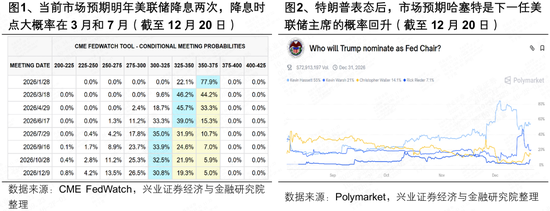
Group 1 - The market is experiencing increased volatility since December, reflecting a series of important events impacting liquidity and fundamental expectations, leading to a cautious and speculative sentiment among investors [1][27] - The recent Federal Reserve meeting and the domestic Central Economic Work Conference have set a more favorable overall tone than market expectations, laying a good foundation for a potential market rally [1][32] - The U.S. employment and inflation data released this week did not trigger further pessimism, instead providing more room for the Fed to consider further easing, with the November unemployment rate slightly rising and CPI data significantly below expectations [1][30] Group 2 - Japan's recent interest rate hike of 25 basis points did not lead to the anticipated liquidity shock from carry trade unwinding, as market expectations were already priced in [4][30] - The Bank of Japan's governor indicated that further data would be needed before making additional rate decisions, suggesting a cautious approach moving forward [4][30] - The convergence of various international events affecting liquidity expectations, combined with a supportive domestic policy environment, is expected to shift investor behavior from cautiousness to actively seeking opportunities [6][32] Group 3 - Historical patterns indicate that market rallies often require a catalytic event, with potential signals for the current rally categorized into three types: strong macro policy shifts, year-end market performance stabilization, and early-year market dynamics [7][33] - The current market conditions align with the second category, where strong performance throughout the year leads to a rally after year-end disturbances are resolved [7][33] - Key indicators to watch for potential rally signals include the possibility of interest rate cuts and improvements in fundamental data such as PPI, PMI, and corporate earnings forecasts [17][19] Group 4 - The investment strategy should focus on sectors benefiting from economic recovery and supportive policies, particularly in cyclical industries and new consumption trends [20][22] - High-growth sectors such as AI, renewable energy, and advanced manufacturing are expected to lead the market rally, supported by favorable liquidity conditions and risk appetite [24][22] - The market is anticipated to transition from a balanced style to favoring small-cap and technology growth sectors as the rally progresses [18][24]
中信证券:人民币持续升值的背景下,可以关注 短期肌肉记忆驱动、利润率变化驱动 以及政策变化驱动三条线索
Sou Hu Cai Jing· 2025-12-21 09:16
推动人民币升值的因素逐渐增多,市场关注度也开始升温,投资者要逐步适应在一个人民币持续升值的 环境下去做资产配置。从过去20年间7轮人民币升值周期来看,汇率并不是主导行业配置的决定性因 素。然而,部分行业在持续升值预期形成的初期确实会有更好表现,市场可能会复制这样的肌肉记忆, 同时从成本收入分析来看,约19%的行业会因为升值带来利润率提升,这些行业也会逐步被投资者重视 起来。此外,为抑制过快单边升值趋势而做出的政策应对,反而是影响行业配置的更重要因素。行业配 置上,在人民币持续升值的背景下,可以关注短期肌肉记忆驱动、利润率变化驱动以及政策变化驱动三 条线索,我们在本期聚焦详细梳理了潜在受益行业。 推动人民币持续升值的因素逐渐增多,市场关注度也开始升温 我们认为投资者要逐步开始适应在一个人民币持续升值的环境下去做资产配置。今年前11个月中国的累 计贸易顺差达到1.076万亿美元,同比增长21.7%,创历史新高。更重要的是出口企业的结汇意愿开始不 断上升,今年10月顺差转化为顺收的比例已经超过100%,这是与过去几年最大的差异。2022年以来, 我们估算出口商积累的待结汇规模为1万亿美元左右,一旦人民币升值预期形成 ...

A股市场运行周报第72期:中线方向三天两变,一颗红心、两手准备-20251220
ZHESHANG SECURITIES· 2025-12-20 09:34
Core Insights - The market is experiencing a range-bound fluctuation, with major indices showing mixed performance, indicating a "three changes in direction over three days" characteristic [1][56] - Future trading strategies are shifting from "defensive volatility and reduced elasticity" to "finding entry points and waiting for opportunities" as the market adjustment becomes more sufficient [1][58] - The report suggests a cautious approach to timing, advising against chasing prices and increasing costs, while setting "strike zones" based on previous index lows [1][58] Market Overview - Major indices showed mixed results this week, with the Shanghai Composite Index and the Shanghai 50 rising by 0.03% and 0.32% respectively, while the CSI 300 fell by 0.28% [12][56] - The consumer sector showed signs of recovery, with significant gains in retail and consumer services, while technology-related sectors experienced adjustments [15][57] - Average daily trading volume in the Shanghai and Shenzhen markets decreased to 1.74 trillion yuan, down from 1.94 trillion yuan the previous week [17][28] Sector Analysis - The consumer sector saw notable recovery, with retail and consumer services rising by 6.58% and 4.40% respectively, while non-bank financials increased by 2.99% [15][57] - Conversely, technology-related sectors such as electrical equipment and electronics saw declines, with drops of 3.09% and 3.02% respectively [15][57] Investment Strategy - The report recommends focusing on the brokerage sector, which is showing signs of underperformance but expanding market share, and suggests monitoring the home appliance sector, which historically performs well in December [1][58] - Individual stocks in the pharmaceutical, consumer, and AI application sectors that are relatively low in price should be considered, along with low-performing stocks above the annual line [1][58]
普惠性、区域性政策中支持制造业发展的税费优惠政策
蓝色柳林财税室· 2025-12-20 06:16
Core Viewpoint - The article discusses the tax incentives and policies aimed at supporting the development of the manufacturing industry in China, particularly focusing on accelerated depreciation methods for fixed assets and the benefits for small and micro enterprises [20][21]. Group 1: Accelerated Depreciation Policies - Enterprises can shorten the depreciation period or adopt accelerated depreciation methods for fixed assets that are subject to rapid technological advancements or are in harsh operating conditions [4]. - The minimum depreciation period for shortened depreciation methods cannot be less than 60% of the prescribed depreciation period [10]. - Accelerated depreciation methods include double declining balance or sum-of-the-years-digits methods, which must be consistently applied once chosen [12]. Group 2: Eligibility and Application - Eligible enterprises include those in the manufacturing sector, information transmission, software, and IT services, with specific conditions outlined for integrated circuit manufacturing companies [8][9]. - The application process for tax benefits includes monthly and quarterly prepayment declarations and annual tax reconciliation submissions [13]. - Required documentation for claiming benefits includes invoices for fixed asset purchases and records demonstrating compliance with industry standards [14]. Group 3: Tax Incentives for Small and Micro Enterprises - Small and micro enterprises can benefit from a 25% reduction in taxable income, with a tax rate of 20% applicable from January 1, 2023, to December 31, 2027 [31][32]. - To qualify, enterprises must meet specific criteria, including an annual taxable income not exceeding 3 million yuan, a workforce of no more than 300 employees, and total assets not exceeding 50 million yuan [33]. - The policy allows for cumulative benefits, enabling enterprises to enjoy multiple tax incentives simultaneously [30].

报告预计2026年我国钢材需求量小幅下降
Di Yi Cai Jing· 2025-12-20 04:27
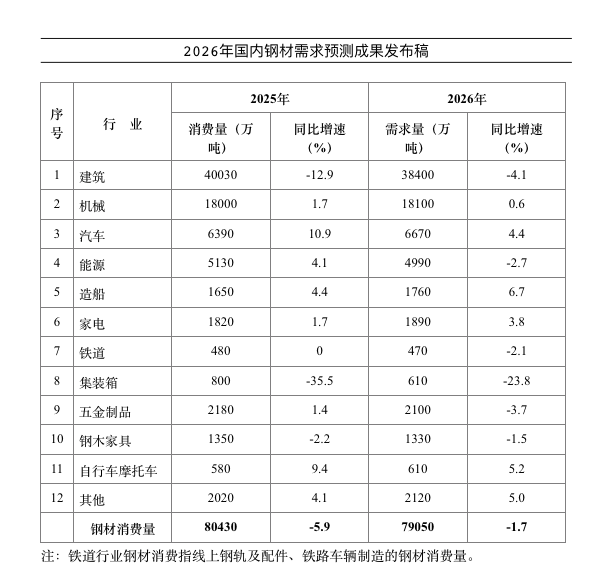
Global Steel Demand Forecast - The global steel demand is projected to reach 1.736 billion tons in 2026, reflecting a year-on-year growth of 1.0% [1] - In 2025, the global steel consumption is expected to decline to 1.719 billion tons, a decrease of 1.8% compared to the previous year [1] China's Steel Demand Outlook - China's steel consumption is anticipated to be 808 million tons in 2025, marking a decline of 5.4% year-on-year, and further decreasing to 800 million tons in 2026, a drop of 1.0% [1] - The report indicates that the decline in steel consumption in China is primarily due to insufficient domestic demand, particularly from the real estate sector [1] Sector-Specific Steel Consumption - The construction sector in China is projected to consume approximately 40 million tons of steel in 2025, down 12.9% year-on-year, and about 38.4 million tons in 2026, a decrease of 4.1% [2] - The machinery sector is expected to maintain a stable growth, with steel consumption estimated at 18 million tons in 2025, an increase of 1.7%, and 18.1 million tons in 2026, a growth of 0.6% [2] - The automotive industry is forecasted to consume 6.39 million tons of steel in 2025, reflecting a growth of 10.9%, and 6.67 million tons in 2026, a rise of 4.4% [3] Summary of Steel Consumption by Industry - The following table summarizes the steel consumption forecast for various industries in China: | Industry | 2025 Consumption (10,000 tons) | Year-on-Year Growth (%) | 2026 Demand (10,000 tons) | Year-on-Year Growth (%) | |------------------|-------------------------------|-------------------------|---------------------------|-------------------------| | Construction | 4003 | -12.9 | 3840 | -4.1 | | Machinery | 1800 | 1.7 | 1810 | 0.6 | | Automotive | 639 | 10.9 | 667 | 4.4 | | Energy | 513 | 4.1 | 499 | -2.7 | | Shipbuilding | 165 | 4.4 | 176 | 6.7 | | Home Appliances | 182 | 1.7 | 189 | 3.8 | | Railways | 48 | 0 | 47 | -2.1 | | Containers | 80 | -35.5 | 61 | -23.8 | | Hardware | 218 | 1.4 | 210 | -3.7 | | Steel-Wood Furniture | 135 | -2.2 | 133 | -1.5 | | Bicycles & Motorcycles | 58 | 9.4 | 61 | 5.2 | | Others | 202 | 4.1 | 212 | 5.0 | | **Total Steel Consumption** | **8043** | **-5.9** | **7905** | **-1.7** | [5]
巴西消费进口占比创22年来新高 中国产品影响力持续扩大
Yang Shi Xin Wen Ke Hu Duan· 2025-12-18 23:24
Core Insights - The Brazilian National Confederation of Industry (CNI) reported that the proportion of imported goods in consumer purchases in Brazil will rise to 26.7% in 2024, marking a record high since the survey began in 2002 [1] - Since the survey's inception in 2003, the share of imported goods in Brazilian consumption has increased from 13.4% to 26.7% [1] - Chinese products have become a significant driver of this growth, now accounting for 9.2% of the Brazilian consumer market, more than double the figure from a decade ago [1] Industry Impact - The influence of Chinese products in the Brazilian market has been expanding, covering high-value sectors such as hybrid and electric vehicles, as well as everyday items purchased through international e-commerce platforms [1] - In terms of specific categories, the market share of Chinese-manufactured machinery, equipment, and computer products in Brazil continues to rise, alongside textiles [1]
十大国产PLM系统,全球供应链协同款!
Sou Hu Cai Jing· 2025-12-18 18:28
Core Insights - The article emphasizes that Product Lifecycle Management (PLM) systems are no longer exclusive to large multinational corporations but are increasingly being adopted by Chinese manufacturing enterprises to enhance their core business processes [2] - Domestic PLM systems are designed to address complex global supply chain challenges, offering unique advantages in aligning with local operational models and facilitating cross-regional and cross-enterprise collaboration [2] Group 1: Collaborative Capabilities of Domestic PLM Systems - To assess whether a PLM system possesses the "global supply chain collaboration" capability, it is essential to examine its internal logic architecture that supports the entire lifecycle data flow from concept to disposal [3] - A significant barrier to global collaboration is "data silos," where different departments may not be able to access or utilize the same data effectively. A robust PLM system acts as a powerful data hub, enforcing a single source of truth for all participants [4] - Real-time and transparent data synchronization in PLM systems helps avoid rework and waste caused by information delays, with experts noting that the success of PLM implementation largely depends on the standardization and unified management of data [4] Group 2: Process Integration and Automation - The core value of collaborative PLM lies in managing processes rather than just outcomes, enabling the automation of complex engineering change processes and new product introduction workflows [5] - In a collaborative PLM environment, all relevant personnel receive tasks and can view change details, comment, and approve online, significantly speeding up decision-making and ensuring compliance and consistency in processes [5] Group 3: Overview of Leading Domestic PLM Systems - The article identifies ten prominent PLM systems in the domestic market based on market share, technological advancement, industry reputation, and supply chain collaboration features [6] - CAXA PLM is highlighted as a leading solution, providing an integrated platform that connects design and manufacturing processes, showcasing its capability to manage complex product data effectively [9] - Other notable systems include Yonyou PLM, Kingdee PLM, and Siemens Teamcenter (localized version), each with unique strengths tailored to specific industries [9] Group 4: Future of PLM Systems - The evolution of domestic PLM systems is increasingly focused on "global supply chain collaboration," which is essential for maintaining resilience and agility in a competitive global landscape [10] - The integration of technologies such as artificial intelligence, industrial internet, and digital twin technology is expected to make PLM systems more intelligent and proactive in predicting supply chain risks and optimizing R&D paths [10]