家用电器

Search documents
11月13日深证龙头(399653)指数涨1.73%,成份股瑞达期货(002961)领涨
Sou Hu Cai Jing· 2025-11-13 10:06
Core Insights - The Shenzhen Leading Index (399653) closed at 3104.35 points, up 1.73%, with a trading volume of 105.65 billion yuan and a turnover rate of 0.96% [1] - Among the index constituents, 36 stocks rose while 12 fell, with Ruida Futures leading the gainers at an increase of 8.07%, and Binjiang Group leading the decliners with a drop of 3.33% [1] Index Constituents Summary - The top ten constituents of the Shenzhen Leading Index include: - Ningde Times (20.44% weight) at 415.60 yuan, up 7.56%, with a market cap of 1896.42 billion yuan [1] - Zhongji Xuchuang (8.35% weight) at 481.00 yuan, down 2.19%, with a market cap of 534.45 billion yuan [1] - Midea Group (7.67% weight) at 79.60 yuan, up 0.14%, with a market cap of 611.73 billion yuan [1] - Luxshare Precision (6.06% weight) at 57.38 yuan, down 0.68%, with a market cap of 417.85 billion yuan [1] - Sungrow Power (5.67% weight) at 190.51 yuan, up 1.53%, with a market cap of 394.97 billion yuan [1] - BYD (5.25% weight) at 99.83 yuan, up 2.11%, with a market cap of 910.17 billion yuan [1] - Wugong Liquor (4.41% weight) at 121.20 yuan, up 0.68%, with a market cap of 470.45 billion yuan [1] - Gree Electric (3.53% weight) at 41.00 yuan, down 0.36%, with a market cap of 229.66 billion yuan [1] - ZTE Corporation (2.83% weight) at 40.35 yuan, up 1.56%, with a market cap of 193.02 billion yuan [1] - Yuanlefang A (2.75% weight) at 4.04 yuan, unchanged, with a market cap of 151.15 billion yuan [1] Capital Flow Analysis - The net inflow of main funds into the Shenzhen Leading Index constituents totaled 3.862 billion yuan, while retail investors experienced a net outflow of 684 million yuan [1] - Notable capital flows include: - Ningde Times saw a net inflow of 2.655 billion yuan from main funds, while retail investors had a net outflow of 448 million yuan [2] - BYD had a net inflow of 607 million yuan from main funds, with retail investors experiencing a net outflow of 208 million yuan [2] - Zhongji Xuchuang had a net inflow of 409 million yuan from main funds, while retail investors had a negligible outflow [2]







8.76亿元资金今日流出家用电器股
Zheng Quan Shi Bao Wang· 2025-11-13 09:04
家用电器行业今日上涨0.27%,全天主力资金净流出8.76亿元,该行业所属的个股共94只,今日上涨的 有60只,涨停的有2只;下跌的有28只。以资金流向数据进行统计,该行业资金净流入的个股有29只, 其中,净流入资金超千万元的有6只,净流入资金居首的是九阳股份,今日净流入资金1.01亿元,紧随 其后的是立达信、康盛股份,净流入资金分别为2839.36万元、2721.73万元。家用电器行业资金净流出 个股中,资金净流出超3000万元的有12只,净流出资金居前的有开能健康、格力电器、汉宇集团,净流 出资金分别为1.93亿元、1.65亿元、7626.41万元。(数据宝) 家用电器行业资金流向排名 | 代码 | 简称 | 今日涨跌幅(%) | 今日换手率(%) | 主力资金流量(万元) | | --- | --- | --- | --- | --- | | 300272 | 开能健康 | 2.59 | 33.95 | -19314.92 | | 000651 | 格力电器 | -0.36 | 0.80 | -16460.22 | | 300403 | 汉宇集团 | -0.91 | 11.48 | -7626.41 | ...
A股市场大势研判:大盘探底回升,三大指数小幅收跌
Dongguan Securities· 2025-11-13 02:01
Market Overview - The market experienced a slight decline with the three major indices closing lower, indicating a bottoming out and recovery phase [1][4] - The Shanghai Composite Index closed at 4000.14, down 0.07%, while the Shenzhen Component Index fell 0.36% to 13240.62 [2] Sector Performance - The top-performing sectors included Household Appliances (up 1.22%), Comprehensive (up 1.05%), and Textile & Apparel (up 0.87%), while the weakest sectors were Electric Equipment (down 2.10%) and Machinery Equipment (down 1.23%) [3][4] - Concept sectors showed strong performance in Cell Immunotherapy (up 2.20%) and Combustible Ice (up 1.81%), while sectors like Cultivated Diamonds and Superconducting Concepts faced declines [3][4] Future Outlook - The market is in a critical phase of style switching, supported by policy stabilization and liquidity easing, with a recommendation for a balanced investment strategy focusing on high-dividend assets in sectors like pharmaceuticals, chemicals, and banking [6] - The People's Bank of China emphasized maintaining reasonable growth in financial volume and implementing a moderately loose monetary policy, which is expected to provide further support to the market [5][6]
从三季报看中国经济 科创驱动上市公司稳中向好
Jing Ji Ri Bao· 2025-11-13 00:16
Core Insights - A-share listed companies have shown strong performance in Q3 2025, with both year-on-year and quarter-on-quarter growth driven by macro policies and technological innovation [1][2][3] Electronics Industry - The electronics sector is entering an upward cycle, with high-tech industries maintaining rapid growth. R&D investment in high-tech manufacturing services reached 229.6 billion yuan, a 9% increase year-on-year, driving revenue and net profit growth of 10% and 19% respectively [2][3] - The semiconductor industry, particularly AI-driven segments, has seen significant profit increases, with companies like Cambrian achieving a revenue of 4.607 billion yuan, up 2386.38% year-on-year, and a net profit of 1.605 billion yuan [2] - The overall revenue for the Shenzhen electronics sector reached 1.59 trillion yuan, a 15.03% increase year-on-year, with net profit growing by 32.12% to 79.122 billion yuan [3][4] New Energy Sector - The new energy sector has become a key area for growth, with companies in the battery, photovoltaic, and wind power equipment sectors achieving a combined revenue of 1.06 trillion yuan, up 10.56% year-on-year, and a net profit of 78.705 billion yuan, up 31.87% [5][6] - Notable performers include CATL, which reported a revenue of 283.072 billion yuan, a 9.28% increase, and a net profit of 49.034 billion yuan, a 36.20% increase [5][6] Consumer Sector - The consumer sector has shown resilience, with policies aimed at boosting consumption leading to steady growth. Companies in the home appliance sector reported a revenue increase of 5.17% year-on-year [8][9] - The demand for smart home products has surged, with companies like Ecovacs seeing a net profit increase of 131% [9] - The automotive sector, particularly in new energy vehicles, has also seen significant growth, with major manufacturers reporting over 10% increase in sales [9][10] Future Outlook - The electronics and new energy sectors are expected to maintain high growth levels, supported by AI demand and domestic substitution trends [3][4] - The consumer sector is likely to benefit from ongoing policy support and technological advancements, with new consumption scenarios emerging [10][11]





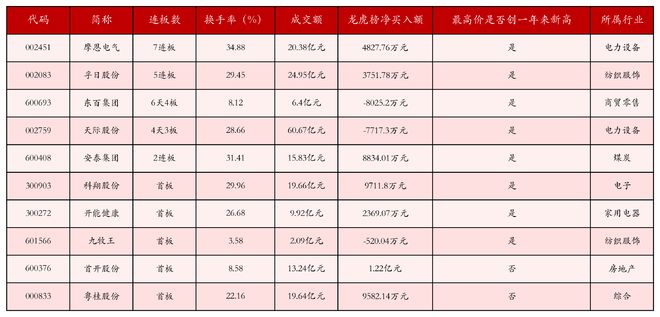
11月12日沪深两市强势个股与概念板块
2 1 Shi Ji Jing Ji Bao Dao· 2025-11-12 10:45
Group 1: Strong Stocks - As of November 12, the Shanghai Composite Index fell by 0.07% to 4000.14 points, the Shenzhen Component Index decreased by 0.36% to 13240.62 points, and the ChiNext Index dropped by 0.39% to 3122.03 points [1] - The top three strong stocks today are Moen Electric (002451) with a 7-day continuous rise, Furui Shares (002083) with a 5-day continuous rise, and Dongbai Group (600693) with 4 rises in 6 days [1] - Moen Electric had a turnover rate of 34.88% and a transaction amount of 2.038 billion yuan, while Furui Shares had a turnover rate of 29.45% and a transaction amount of 2.495 billion yuan [1] Group 2: Strong Concept Sectors - The top three concept sectors with the highest increase are Cell Immunotherapy, Combustible Ice, and Monkeypox Concept [2] - The Cell Immunotherapy sector saw a decline of 2.2%, with 71.19% of its component stocks rising [2] - The Monkeypox Concept sector had a decline of 1.57%, with 76.0% of its component stocks increasing [2]


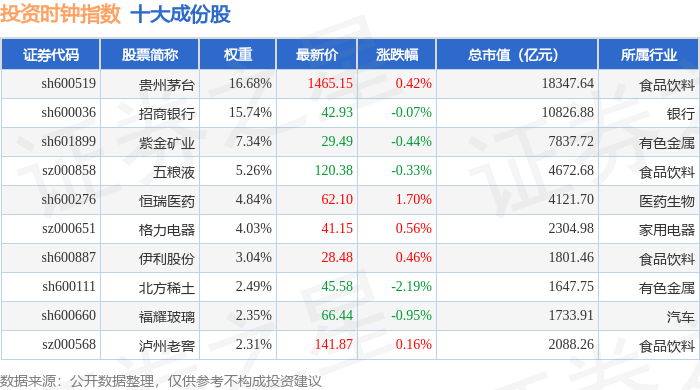
11月12日投资时钟(399391)指数跌0.01%,成份股华侨城A(000069)领跌
Sou Hu Cai Jing· 2025-11-12 10:04
Core Viewpoint - The Investment Clock Index (399391) closed at 3417.47 points, down 0.01%, with a trading volume of 89.182 billion yuan and a turnover rate of 0.94% on November 12 [1] Group 1: Index Performance - Among the constituent stocks of the Investment Clock Index, 28 stocks rose while 71 stocks fell, with China Aluminum leading the gainers at a 6.65% increase and Overseas Chinese Town A leading the decliners at a 4.1% decrease [1] - The top ten constituent stocks of the Investment Clock Index include Kweichow Moutai, China Merchants Bank, and others, with Kweichow Moutai holding the highest weight at 16.68% [1] Group 2: Stock Details - Kweichow Moutai's latest price is 1465.15 yuan, with a slight increase of 0.42% [1] - China Merchants Bank's latest price is 42.93 yuan, with a minor decrease of 0.07% [1] - The total market capitalization of Kweichow Moutai is approximately 183.48 billion yuan, while China Merchants Bank's market cap is around 108.27 billion yuan [1] Group 3: Capital Flow - The net outflow of main funds from the constituent stocks totaled 2.074 billion yuan, while retail investors saw a net inflow of 1.909 billion yuan [1] - The detailed capital flow indicates that China Aluminum had a net inflow of 390 million yuan from main funds, while it experienced a net outflow of 278.5 million yuan from speculative funds [2]




家用电器行业11月12日资金流向日报
Zheng Quan Shi Bao Wang· 2025-11-12 09:32
Core Points - The Shanghai Composite Index fell by 0.07% on November 12, with 11 industries experiencing gains, led by household appliances and comprehensive sectors, which rose by 1.22% and 1.05% respectively [1] - The power equipment and machinery sectors saw the largest declines, with drops of 2.10% and 1.23% respectively [1] - Overall, there was a net outflow of 58.897 billion yuan in the main funds across the two markets, with the pharmaceutical and banking sectors seeing the largest net inflows of 2.402 billion yuan and 1.810 billion yuan respectively [1] Industry Summary - The household appliances sector rose by 1.22%, with 43 out of 94 stocks in the sector gaining, and one stock hitting the daily limit [2] - The sector experienced a net outflow of 11.2438 million yuan, with Gree Electric leading the net inflow at 177 million yuan, followed by Aokang Health and Midea Group with inflows of 174 million yuan and 169 million yuan respectively [2] - The top three stocks with the largest net outflows in the household appliances sector were Sanhua Intelligent Control, Hanyu Group, and Sichuan Changhong, with outflows of 187 million yuan, 120 million yuan, and 96.0643 million yuan respectively [2] Fund Flow Analysis - The household appliances sector had a mixed performance in terms of fund flow, with 33 stocks seeing net inflows, while 50 stocks experienced outflows [2] - The top stocks by net inflow included Gree Electric, Aokang Health, and Midea Group, while the largest outflow stocks were Sanhua Intelligent Control, Hanyu Group, and Sichuan Changhong [2][3] - The overall trend indicates a cautious sentiment among investors, with significant outflows in certain stocks despite the sector's overall positive performance [1][2]

81股今日获机构买入评级 18股上涨空间超20%
Zheng Quan Shi Bao Wang· 2025-11-12 09:28
Core Insights - A total of 81 stocks received buy ratings from institutions today, with 16 stocks receiving initial coverage [1] - The mechanical equipment sector is the most favored, with 13 stocks listed in the buy rating report, followed by the pharmaceutical and food & beverage sectors with 11 and 7 stocks respectively [2] Institutional Ratings - 84 buy rating records were published today, with 24 records providing future target prices; 18 stocks have an upside potential exceeding 20% [1] - The highest upside potential is for Aofei Data, with a target price of 29.78 yuan, indicating a 59.00% upside; other notable stocks include ZTE Corporation and Huicheng Co., with upside potentials of 51.35% and 46.13% respectively [1] - Among the stocks rated today, 16 received initial attention from institutions, including Aimeike and BeiGene [1] Market Performance - Stocks with buy ratings averaged a decline of 0.77%, underperforming the Shanghai Composite Index; 33 stocks saw price increases, with the largest gains from BeiGene, Century Huatong, and Zhongji Xuchuang, which rose by 5.62%, 5.11%, and 5.06% respectively [1] - Stocks with significant declines included Aters, Longi Green Energy, and Yisheng Magic, with drops of 14.33%, 7.35%, and 6.47% respectively [1] Sector Analysis - The mechanical equipment industry is highlighted as the most attractive, with key stocks like Yizhim and Juxing Technology receiving buy ratings [2] - The pharmaceutical and food & beverage sectors also garnered attention, with 11 and 7 stocks respectively making it to the buy rating list [2]
纺织服饰行业11月12日资金流向日报
Zheng Quan Shi Bao Wang· 2025-11-12 09:21
Core Points - The Shanghai Composite Index fell by 0.07% on November 12, with 11 industries experiencing gains, led by household appliances and comprehensive sectors, which rose by 1.22% and 1.05% respectively [1] - The textile and apparel industry ranked third in terms of daily gains, increasing by 0.87% [2] - The overall market saw a net outflow of 58.897 billion yuan, with the pharmaceutical and banking sectors attracting the most inflow of 2.402 billion yuan and 1.810 billion yuan respectively [1] Industry Summary Textile and Apparel Industry - The textile and apparel sector had a daily increase of 0.87%, with 59 out of 105 stocks rising, including 7 hitting the daily limit [2] - The leading stock in terms of net inflow was Seven Wolves, with a net inflow of 183 million yuan, followed by Xinha and Jiumuwang with inflows of 53.176 million yuan and 41.275 million yuan respectively [2] - The sector also saw a net outflow of 504,100 yuan, with 17 stocks experiencing significant outflows, led by Wanlima with a net outflow of 126.504 million yuan [3] Key Stocks in Textile and Apparel - Top inflow stocks included: - Seven Wolves: +7.39%, 14.47% turnover, 183 million yuan inflow - Xinha: +4.94%, 10.66% turnover, 53.176 million yuan inflow - Jiumuwang: +10.05%, 3.58% turnover, 41.275 million yuan inflow [2] - Top outflow stocks included: - Wanlima: -5.39%, 29.61% turnover, -126.504 million yuan outflow - Yunzhi: -9.50%, 10.87% turnover, -46.626 million yuan outflow - Cuihua Jewelry: -2.01%, 7.48% turnover, -29.524 million yuan outflow [3]
【盘中播报】沪指涨0.27% 石油石化行业涨幅最大
Zheng Quan Shi Bao Wang· 2025-11-12 03:28
Market Overview - The Shanghai Composite Index increased by 0.27% as of 10:28 AM, with a trading volume of 61.67 billion shares and a transaction value of 893.47 billion yuan, a decrease of 6.50% compared to the previous trading day [1] Industry Performance - The top-performing industries included: - Oil and Petrochemicals: Increased by 1.77% with a transaction value of 8.62 billion yuan, led by Sinopec Oilfield Service, which rose by 10.21% [1] - Banking: Increased by 1.52% with a transaction value of 15.41 billion yuan, led by Agricultural Bank of China, which rose by 2.89% [1] - Home Appliances: Increased by 1.01% with a transaction value of 14.36 billion yuan, led by Beiyikang, which rose by 10.78% [1] - The worst-performing industries included: - Communication: Decreased by 1.33% with a transaction value of 34.89 billion yuan, led by Yongding Co., which fell by 5.45% [2] - Electric Power Equipment: Decreased by 1.25% with a transaction value of 148.46 billion yuan, led by Canadian Solar, which fell by 13.92% [2] - National Defense and Military Industry: Decreased by 0.92% with a transaction value of 16.72 billion yuan, led by Triangle Defense, which fell by 7.34% [2] Stock Performance - A total of 1,864 stocks rose, with 49 hitting the daily limit, while 3,394 stocks fell, with 2 hitting the lower limit [1]