
纯碱

Search documents
炉料延续分化,成材表现承压
Zhong Xin Qi Huo· 2025-11-20 06:36
Report Industry Investment Rating - The mid - term outlook for the industry is "oscillation" [5] Core View of the Report - Currently, the supply - demand situation in the industry is marginally weakening, in line with off - season characteristics. The fundamental pattern is expected to continue, with limited trend guidance for prices. In the short term, the market will maintain an oscillatory trend. If there are more positive macro and policy signals later, there may be phased upward opportunities [5] Summary by Directory 1. Iron Element - Overseas mine shipments have increased significantly on a month - on - month basis, and the arrival volume has continued to decline after peaking. Port inventories have decreased slightly. Small - sample hot metal production has slightly decreased, and large - scale maintenance has not occurred. In the short term, hot metal is expected to be supported, and iron ore restocking demand is expected to be released, so iron ore prices are firm. Scrap steel has a weak supply - demand situation, and its spot price is expected to fluctuate with finished products in the short term [1] 2. Carbon Element - After the lifting of environmental protection restrictions, steel mills are still actively producing, and coke demand is still supported. However, cost support has weakened. After four rounds of price increases, coke is in a dilemma of rising or falling, and its futures price is expected to fluctuate with coking coal. Coking coal supply is expected to remain weak. Mongolian coal imports may remain at a high level but with limited replenishment. Although downstream procurement is gradually slowing down, the fundamentals are still healthy, and spot coal prices are strongly supported. However, the futures price is still suppressed by finished products, and the warehouse receipt pressure is still large, with a small possibility of further significant decline [2] 3. Alloys - In the short term, the firm cost supports the price of ferromanganese silicon, but the market supply - demand is loose, and there is insufficient driving force for price increases. The firm cost also supports the price of ferrosilicon, but the supply - demand relationship is loose, and the price has insufficient upward driving force. It is expected to run around the cost at a low level [2] 4. Glass and Soda Ash - Supply still has disturbance expectations, but the mid - and downstream inventories are moderately high. Fundamentally, the current supply - demand is still in surplus. If there is no more cold repair by the end of the year, high inventories will always suppress prices, and prices are expected to oscillate weakly. Otherwise, prices will rise. The cost of the soda ash industry has increased, with obvious bottom support. However, the surplus supply - demand pattern always suppresses price increases. Recently, the decline in glass prices has dragged down soda ash prices, which are expected to oscillate in the short term. In the long run, the surplus supply pattern will intensify, and the price center will decline, promoting capacity reduction [2] 5. Specific Product Analysis Steel - The spot market trading is weak, mainly with low - price transactions. Steel mill profits are poor, and production has decreased significantly. Construction site funds have increased slightly, and demand shows some resilience after the off - season decline. Steel inventories are still higher than the same period last year, and there are still fundamental contradictions. It is expected to oscillate widely [7][9] Iron Ore - Port trading volume has increased. Spot prices are oscillating. Overseas mine shipments have increased, and the arrival volume has decreased. Hot metal is expected to be supported in the short term, but there is a seasonal weakening expectation. Inventories are expected to accumulate. It is expected to oscillate strongly in the short term [7][9] Scrap Steel - Supply and demand are both weak. After the price decline, the cost - performance ratio has recovered, and the downward space is limited. It is expected to fluctuate with finished products [8] Coke - The futures price is under pressure and oscillating. The spot price is stable. Supply is temporarily stable, and demand is still supported. Inventories are low. It is expected to follow coking coal to oscillate [8][11][12] Coking Coal - The market sentiment is poor, and the futures price is under pressure and oscillating. Supply recovery is slow, and imports are at a high level but with limited replenishment. The fundamentals are healthy, and the spot price is strongly supported. The futures price is suppressed by finished products, and the warehouse receipt pressure is large. It is less likely to fall significantly, and attention can be paid to the winter storage situation in the industrial chain [13] Glass - Macro is neutral. Supply is expected to decline due to possible cold repair at the end of the year. Demand is weak, and mid - and downstream inventories are high, suppressing the price. If there is no more cold repair, it is expected to oscillate weakly; otherwise, the price will rise [13] Soda Ash - Macro is neutral. Production has decreased due to maintenance. Demand is weakening. The cost has increased, with obvious bottom support. The supply - demand surplus suppresses price increases. It is expected to oscillate in the short term and decline in the long run [14] Ferromanganese Silicon - The futures price has declined due to the weakening of coking coal and coke. The spot price is stable. The cost is supported, but the supply - demand is loose, and the upward pressure is large. It is expected to run around the cost at a low level [17] Ferrosilicon - The futures price is oscillating at a low level. The spot market trading is average. The cost is supported, but the supply - demand is loose, and the upward driving force is insufficient. It is expected to run around the cost at a low level [18]
纯碱:厂家挺价情绪伴随,轻重碱走势分化
Sou Hu Cai Jing· 2025-11-20 04:48
Core Viewpoint - The overall production load of soda ash manufacturers is low due to maintenance activities, leading to a mixed performance between light and heavy soda ash prices [1] Group 1: Production and Maintenance - Several manufacturers, including Fengcheng Salt Chemical, Xiangyu Salt Chemical, and China Salt Kunshan, are undergoing maintenance, resulting in reduced production capacity [1] - Key soda ash production facilities in Henan, Tianjin, Shaanxi, Hunan, and Huainan are also experiencing maintenance, contributing to the overall low operational load [1] Group 2: Market Demand and Pricing - The demand for light soda ash remains stable, with tight supply in the central and eastern regions, leading to a strong pricing sentiment among manufacturers [1] - Most manufacturers have filled their orders for the month, indicating a robust market for light soda ash [1] - In contrast, the demand for heavy soda ash is weak, with futures prices declining and a noticeable price advantage for futures sources, resulting in increased transaction volumes for heavy soda ash [1] - The transaction price focus for heavy soda ash has shifted downward due to these market dynamics [1]
《能源化工》日报-20251120
Guang Fa Qi Huo· 2025-11-20 01:36
1. Report Industry Investment Ratings - No industry investment ratings are provided in the reports. 2. Core Views of the Reports Polyolefins - PP shows a pattern of both supply and demand growth, with reduced maintenance leading to increased supply and a slight accumulation of inventory under the pressure of new production capacity. PE shows increased supply and decreased demand. Although unplanned maintenance eases some supply pressure, imported goods are abundant, and demand is generally weak except for agricultural films. The inventory of hedging merchants is gradually decreasing, the basis is strengthening, and inventory is being cleared. When the price is below 6800, the downstream's willingness to buy increases. The cost side is affected by the shock of crude oil and the strength of coal, and the PDH profit has continued to weaken this week. [2] Methanol - In the domestic market, Baofeng continues to purchase externally, and Jiutai has an unexpected maintenance. The domestic production will continue to increase. Currently, the marginal devices in the domestic market have suffered losses. In the port market, the gas restriction in Iran has been postponed, and the shipment has accelerated. As of November 19, Iran has shipped 885,000 tons, putting significant pressure on the port methanol market. With high inventory and the profit of imported methanol from Iran, the willingness to hold goods has weakened, and the price has declined while the basis remains stable. The demand side is based on rigid procurement. The market is currently trading on the logic of "weak reality", and the core contradiction lies in the high inventory in the port. The inventory contradiction of the 01 contract cannot be resolved, and the weak reality will continue to be traded before the gas restriction in Iran. [4] Glass and Soda Ash - Soda ash: The market has returned to a weak state, and the overall pattern of oversupply is still prominent. Fundamentally, the weekly production remains at a high level of around 750,000 tons, and the oversupply is obvious compared with the current rigid demand. The inventory of manufacturers has been transferred to the middle and lower reaches, and the trade inventory has continued to rise. In the medium term, there is no expectation of a significant increase in downstream production capacity, so the overall demand for soda ash will continue the previous rigid demand pattern. If there is no actual production capacity exit or load reduction in the future, the supply - demand situation will be further pressured. - Glass: The spot sales have strengthened, and the high sales rate in some regions has continued to be above 100%. Consecutive price cuts have driven the middle and lower reaches to purchase. Although 4 production lines in the Shahe area were cold - repaired last week, there will be production lines restarting and igniting in the future, which will put pressure on the supply side. The latest deep - processing order days have improved slightly, and there is still some rigid demand support in the short term as November is the peak season for year - end rush work. However, in the medium and long term, at the end of the peak season, the market is worried about the sustainability of future demand. As the temperature in the north drops, outdoor construction will gradually stop, and the demand side will shrink after December, putting pressure on the glass price. The real estate is still in the bottom cycle, and the completion volume has decreased significantly. Therefore, in the oversupply pattern, the glass industry still needs to clear production capacity to solve the oversupply dilemma. [7] PVC and Caustic Soda - Caustic soda: The supply - demand situation of the caustic soda industry still faces certain pressure. The purchasing enthusiasm of the main downstream alumina has decreased, so the support from the main demand side of caustic soda is weak, which suppresses the caustic soda price upwards. During the northern environmental protection control period, some alumina plants may have production reduction expectations. There is an overhaul expectation in the East China region, and the supply will decrease slightly. The price in this region may be relatively stable due to certain rigid demand support, but in the long term, the supply - demand still has pressure. The non - aluminum market is still sluggish, and overall, the supply - demand pressure is still relatively large. It is expected that the caustic soda price will fluctuate weakly. - PVC: The PVC spot market continues to fluctuate weakly. This week, maintenance and partial device load reduction have led to a decrease in production on a month - on - month basis, but it is still at a high level. Affected by local logistics, the market arrivals have decreased, and the social inventory has decreased on a month - on - month basis. Next week, the supply - side operating rate will increase. The demand side is in the traditional off - season from November to January of the next year. As the outdoor construction in the north gradually decreases in winter, the overall real estate demand reduction still has a negative impact. In terms of exports, India has officially cancelled the BIS certification for imported PVC issued in 2024, which is beneficial for domestic PVC to enter the Indian market. However, there is an expectation of anti - dumping duties, and the Asian contract price for December is still to be observed next week. It is expected that the external demand will be difficult to increase. The overall demand side has limited support for PVC. The supply - demand is still in an oversupply pattern, and it is difficult for the price to form an upward drive. It is expected to continue the weak pattern at the bottom. [8] Natural Rubber - The supply side: Yunnan has encountered cold weather, which has accelerated the end of the tapping season in Yunnan. The rainy season in southern Thailand continues, and the price of overseas raw materials is high, which strongly supports the rubber price. The demand side: Currently, the overall demand is weak. Channels are cautious in purchasing and mainly focus on digesting inventory. Next week, the purchasing enthusiasm of some agents on an as - needed basis may increase slightly, which will drive the overall sales volume. However, the overall demand is weakening, and the actual increase in purchasing volume is limited. The market still mainly focuses on digesting inventory. In conclusion, the natural rubber inventory has entered the seasonal inventory accumulation period, and the terminal demand support is insufficient. There is an expectation that the operating rate of downstream enterprises will further decline. It is expected that the natural rubber market will enter a range - bound consolidation. In the future, attention should be paid to the raw material output in the peak production season of the main producing areas and macro - level changes. If the raw material supply is smooth, the rubber price is expected to decline. If the raw material supply is not smooth, the rubber price is expected to operate in the range of 15,000 - 15,500. [9] Pure Benzene and Styrene - Pure benzene: Recently, many sets of pure benzene devices have overhaul expectations, but the import expectation remains high, and the overall supply may still be relatively loose. On the demand side, the load of downstream styrene has increased due to the restart of some devices, but some loss - making varieties have reduced production to maintain prices, and the domestic demand side has limited support. The port inventory has increased, and there are still many arrivals in the future, so the supply pressure of pure benzene is relatively large. After the overhaul of the disproportionation device in the US Gulf ends, the support from blending oil may weaken, but South Korea's aromatics have an export expectation to the US, and the US dollar price of pure benzene has increased. Overall, the supply - demand expectation of pure benzene is still relatively loose, and the limited support from the cost side may limit the upward space. It may fluctuate and consolidate. However, since the current valuation of pure benzene is low, future attention should be paid to device changes. In the short term, it is advisable to wait and see for BZ2603. - Styrene: After the overhaul of the disproportionation device in the US Gulf ends, the blending oil demand may weaken. However, in November, the supply - demand situation of styrene has further improved. With the South Korean mixed aromatics trading, styrene has an export transaction expectation, and the port inventory has decreased. There are positive factors supporting styrene, and it will mainly fluctuate and repair in the short term. However, as the profit of styrene is repaired, the overhaul of some factories may be delayed. Coupled with the trial operation of new devices and the expected weakening of downstream EPS demand, it is expected that the upward space of styrene will be limited. In the short term, the price of EB01 may mainly fluctuate and consolidate. [10] Polyester Industry Chain - PX: Recently, the operating loads of Asian and domestic PX have decreased. However, the supply of Asian MX is abundant, and some factories rely on MX to supplement PX production, so the PX supply still remains at a relatively high level. On the demand side, the PTA price still has certain support this week. However, the spot floating price and monthly spread of PX are still weak, and the overall support from oil prices is limited. It is expected that the rebound space of PX is limited. Strategically, PX should be regarded as a short - term high - level shock. - PTA: As two PTA devices in East China are gradually under maintenance, the basis has slightly strengthened. According to the balance sheet, the supply - demand of PTA is in a tight balance in November, but the supply - demand of PTA is expected to be relatively loose from December to the first quarter of next year, and the upward drive of the basis is limited. In terms of absolute price, recently, the absolute price of PTA is relatively strong due to the support of blending oil demand and India's cancellation of BIS certification. However, the overall support from oil prices is limited, and the rebound space of PTA is still limited. Strategically, TA should be regarded as a short - term high - level shock, and TA1 - 5 should be treated as a rolling reverse spread. - Ethylene glycol: The operating load of ethylene glycol is at a high level. The arrival of overseas ethylene glycol shipments is relatively concentrated in November, and the port inventory will continue to increase recently, and the basis will weaken. In addition, the inventory accumulation amplitude of ethylene glycol from November to December is expected to be relatively high, and the upward pressure on ethylene glycol is significant. Strategically, the seller of the out - of - the - money call option with an exercise price of no less than 4100 for EG2601 should hold, and EG1 - 5 should be reversely spread at high levels. - Short - fiber: Although the spot processing margin of short - fiber has been significantly compressed recently, there is still profit at present, and the inventory pressure of short - fiber factories is not large, so the short - fiber supply remains at a high level. On the demand side, the terminal demand has seasonally weakened in November. In addition, the cancellation of India's BIS certification has certain benefits for PTA and filament, but has relatively little impact on short - fiber. Therefore, under the short - term weak supply - demand expectation and cost - side support, it is expected that the absolute price of short - fiber will be under pressure, and the processing margin still has room for compression. Strategically, the unilateral strategy is the same as that of PTA; the processing margin on the disk should be shorted at high levels. - Bottle - grade polyester: In mid - November, the Huarun device has both maintenance and restart. In addition, according to Longzhong Information, the commissioning of the new device of Dongying Fuhai has been postponed, and the domestic supply has not changed much. Considering that November is in the off - season of demand and the window period between the Spring Festival stocking, the demand side has insufficient support for bottle - grade polyester. The supply - demand of bottle - grade polyester remains in a loose pattern. Therefore, the social inventory of bottle - grade polyester will probably enter the seasonal inventory accumulation channel, and PR will mainly fluctuate with the cost side. The processing margin of PR is limitedly boosted by supply - demand and will change dynamically with the raw material cost. Strategically, the unilateral strategy of PR is the same as that of PTA; the processing margin of the main contract of PR is expected to fluctuate in the range of 300 - 450 yuan/ton. [12] Crude Oil - Overnight, affected by the news that Russia and Ukraine may restart peace talks, the geopolitical premium has declined, and the oil price has declined under pressure. However, EIA data shows that the US crude oil inventory has decreased more than expected, and the decline of the oil price has been slightly narrowed. Recently, attacks or sanctions caused by the Russia - Ukraine issue have had a short - term impact on the oil price. However, under the pressure of continuous production increase by OPEC+ and the record - high US crude oil production, the supply - demand pattern of crude oil is still weak, and the upward pressure on the oil price is significant. In the short term, attention should be paid to the support of Brent crude oil at $60 per barrel and the geopolitical dynamics between Russia and Ukraine. [14] 3. Summary According to Relevant Catalogs Polyolefins - **Price and Spread**: The closing prices of L2601, L2605, PP2601, and PP2605 have all increased, and the L15 and PP15 spreads have also increased. The spot prices of East China PP raffia and North China LLDPE have increased, while the North China LL basis has decreased significantly, and the East China pp basis has remained unchanged. The prices of some PE and PP non - standard products have remained unchanged, while the prices of some have decreased. - **Inventory**: PE enterprise inventory and social inventory have decreased, while PP enterprise inventory has increased, and PP trader inventory has decreased. - **Operating Rate**: The operating rate of PE devices has increased slightly, while the weighted operating rate of PE downstream has decreased slightly. The operating rate of PP devices and powder devices has increased, and the weighted operating rate of PP downstream has increased slightly. [2] Methanol - **Price and Spread**: The closing prices of MA2601 and MA2605 have decreased, and the MA15 spread has increased. The basis of Taicang has remained unchanged. The spot prices of Inner Mongolia North Line and Henan Luoyang have increased, while the spot price of Taicang Port has decreased. The regional spreads have changed significantly. - **Inventory**: Methanol enterprise inventory, port inventory, and social inventory have all decreased. - **Operating Rate**: The operating rates of domestic and overseas upstream enterprises have increased, the production - sales rate of Northwest enterprises has increased, the operating rate of downstream external - procurement MTO devices has decreased, the operating rate of downstream formaldehyde has increased slightly, the operating rate of downstream acetic acid has decreased significantly, and the operating rate of downstream MTBE has increased. [4] Glass and Soda Ash - **Price and Spread**: The prices of glass in North China have remained unchanged, while the prices in East China, Central China, and South China have decreased. The closing prices of glass 2601 have decreased, and the closing price of glass 2605 has remained unchanged. The 01 basis has increased. The prices of soda ash in North China, East China, Central China, and Northwest have remained unchanged. The closing prices of soda ash 2601 and 2605 have decreased, and the 01 basis has increased significantly. - **Supply**: The operating rate and weekly output of soda ash have decreased slightly, the daily melting volume of float glass has remained unchanged, the daily melting volume of photovoltaic glass has decreased, and the price of 3.2mm coated glass has decreased. - **Inventory**: The inventory of glass factories has increased, the inventory of soda ash factories has increased, the inventory of soda ash delivery warehouses has decreased, and the inventory days of soda ash in glass factories have remained unchanged. - **Real Estate Data**: The new construction area, construction area, completion area, and sales area have all decreased compared with the previous period. [7] PVC and Caustic Soda - **Price and Spread**: The prices of Shandong 32% liquid caustic soda and 50% liquid caustic soda have remained unchanged. The market prices of East China calcium - carbide - based PVC and East China ethylene - based PVC have decreased. The prices of SHSEOS, SH2601, V2605, and V2601 have decreased, and the V basis has increased significantly. - **Export and Profit**: The overseas quotes and export profits of caustic soda and PVC have some data unavailable, and some data have changed. - **Supply and Profit**: The operating rate of the caustic soda industry and the sample operating rate in Shandong have decreased slightly, the operating rate of PVC has decreased, the profit of externally - purchased calcium - carbide - based PVC has remained unchanged, and the profit of Northwest integrated PVC has decreased. - **Demand**: The operating rates of some downstream industries of caustic soda and PVC have increased or decreased. The pre - sales volume of PVC has decreased. - **Inventory**: The factory - warehouse inventory of liquid caustic soda in East China and Shandong has decreased, the upstream factory - warehouse inventory of PVC has decreased, and the total social inventory of PVC has decreased. [8] Natural Rubber - **Price and Spread**: The price of Yunnan state - owned full - latex has increased, the full - latex basis has decreased, the price of Thai standard mixed rubber has decreased, the non - standard price difference has decreased significantly, and the prices of some raw materials have remained unchanged. The 9 - 1 spread has remained unchanged, the 1 - 5 spread has increased, and the 5 - 9 spread has decreased. - **Production and Consumption**: The production of Thailand, Indonesia, and China in September has changed, the production of India has increased. The operating rates of semi - steel and full - steel tires have changed slightly, the domestic tire production in October has decreased, the tire export volume in October has decreased, the import volume of natural rubber in September has increased, and the import volume of natural and synthetic rubber in October has decreased. - **Inventory**: The bonded - area inventory and the factory - warehouse futures inventory of natural rubber in the SHFE have increased, the出库 rate of dry rubber in the bonded warehouse in Qingdao has decreased, and the入库 and出库 rates of dry rubber in general trade in Qingdao have increased. [9] Pure Benzene and Styrene - **Upstream Price and Spread**: The prices of Brent crude oil, WTI crude oil, and CFR Japan naphtha have decreased, the price of CFR Northeast Asia ethylene has remained unchanged, the price of CFR China pure benzene has increased, the pure benzene - naphtha spread and ethylene - naphtha spread have decreased,
大越期货纯碱早报-20251120
Da Yue Qi Huo· 2025-11-20 01:24
交易咨询业务资格:证监许可【2012】1091号 纯碱早报 2025-11-20 大越期货投资咨询部 金泽彬 从业资格证号:F3048432 投资咨询证号: Z0015557 联系方式:0575-85226759 重要提示:本报告非期货交易咨询业务项下服务,其中的观点和信息仅作参考之用,不构成对任何人的投 资建议。 我司不会因为关注、收到或阅读本报告内容而视相关人员为客户;市场有风险,投资需谨慎。 每日观点 纯碱: 1、基本面:碱厂产量高位,远兴二期年前预期投产,整体供给预期充裕;下游浮法玻璃供给扰动 预期,光伏日熔量延续下滑趋势,纯碱厂库处于历史同期高位;偏空 2、基差:河北沙河重质纯碱现货价1140元/吨,SA2601收盘价为1182元/吨,基差为-42元,期货升 水现货;偏空 3、库存:全国纯碱厂内库存170.73万吨,较前一周减少0.40%,库存在5年均值上方运行;偏空 4、盘面:价格在20日线下方运行,20日线向下;偏空 5、主力持仓:主力持仓净空,空增;偏空 6、预期:纯碱基本面不改疲弱,短期预计震荡运行为主。SA2601:1130-1180区间操作 影响因素总结 利多: 1、下游玻璃供给低位企稳 ...
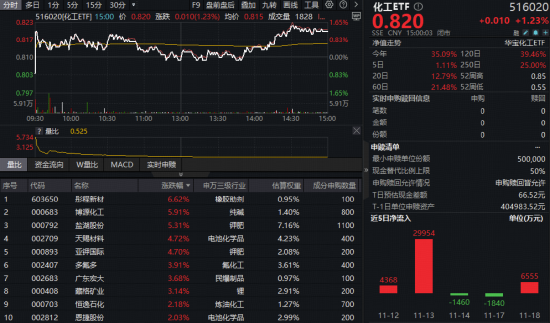
锂电材料价格持续上涨,化工板块V型反转!化工ETF(516020)摸高1.6%,近5日吸金超3.7亿元!
Xin Lang Ji Jin· 2025-11-19 11:42
Group 1 - The chemical sector showed a strong rebound on November 19, with the Chemical ETF (516020) experiencing fluctuations, reaching a maximum intraday increase of 1.6% and closing up by 1.23% [1][2] - Key stocks in the sector included rubber additives, soda ash, lithium batteries, and potash fertilizers, with notable gains from Tongcheng New Materials (up 6.62%), Boyuan Chemical, and Salt Lake Co. (both up over 5%) [1][2] - The basic chemical sector attracted significant capital inflow, with a net inflow of 8.675 billion yuan for the day and a total of 24.828 billion yuan over the past five trading days, leading among 30 sectors [1][3] Group 2 - The Chemical ETF (516020) has seen substantial net subscriptions, with over 370 million yuan in net inflows across three of the last five trading days [3][4] - The price of lithium hexafluorophosphate, a key raw material for electrolytes, has surged to 160,000 yuan per ton, more than tripling since the price bottomed out in July 2025 [3][4] - The supply of lithium hexafluorophosphate is expected to remain tight until 2026 due to production constraints among smaller firms, despite leading companies operating at full capacity [4] Group 3 - The chemical sector is anticipated to benefit from a rebound as the industry moves away from a prolonged bottoming phase, with signs of economic improvement reflected in rising PPI and CPI [5] - The chemical expansion cycle is nearing its end, with various industries, including glyphosate and PTA, beginning to experience upward profitability trends [5] - The Chemical ETF (516020) tracks the CSI sub-sector chemical industry index, with nearly 50% of its holdings in large-cap stocks, providing investors with exposure to leading companies in the sector [5]


瑞达期货纯碱玻璃产业日报-20251119
Rui Da Qi Huo· 2025-11-19 09:41
意愿并不强烈。需求端,房地产行业作为玻璃的主要下游,其表现依旧低迷。从整体地产周期来看,下行 趋势尚未扭转。当前二手房价格持续下跌,市场信心不足,新房销售也面临较大压力。汽车玻璃方面,虽 免责声明 有一定的生产备货需求,但难以完全抵消房地产市场低迷带来的负面影响。光伏玻璃市场,受行业"反内 纯碱玻璃产业日报 2025-11-19 | 项目类别 | 数据指标 纯碱主力合约收盘价(日,元/吨) | 最新 | 环比 数据指标 -32 玻璃主力合约收盘价(日,元/吨) | 最新 | 环比 | | --- | --- | --- | --- | --- | --- | | | 纯碱与玻璃价差(日,元/吨) | 1182 173 | -24 纯碱主力合约持仓量(日,手) | 1009 1345724 | -8 82458 | | | 玻璃主力合约持仓量(日,手) | 1990501 | 2524 纯碱前20名净持仓 | -263174 | -19574 | | 期货市场 | 玻璃前20名净持仓 | -325241 | 14348 纯碱交易所仓单(日,吨) | 4993 | 0 | | | 玻璃交易所仓单(日,吨) | 2 ...
黑色产业链日报-20251119
Dong Ya Qi Huo· 2025-11-19 09:23
Report Industry Investment Rating No relevant content provided. Core Viewpoints - Overall, finished steel products are supported by raw material costs at the lower end, but their upward drive is suppressed by inventory and demand. They are expected to trade in a range, with rebar likely between 2900 - 3200 and hot - rolled coil between 3100 - 3400. Attention should be paid to the de - stocking speed and downstream consumption, and the risk lies in the possible negative feedback caused by the decline in steel enterprise profitability [3]. - The iron ore fundamentals show a pattern of strong supply and weak demand, with total inventory continuously increasing, but a structural shortage of deliverable products. The price lacks a strong trend driver. The port inventory is accumulating above the seasonal level, but the inventory of deliverable brand coarse powder is decreasing, supporting the basis to strengthen. The coking coal price decline provides a seesaw support for the ore price, but the subsequent recovery of coking coal valuation may squeeze the iron ore [21]. - In the short term, the coal - coke futures and spot prices may face adjustment pressure due to factors such as the high spot price increase, weak downstream acceptance, and seasonal weakening of demand. In the long - term, the supply elasticity of coking coal will be restricted by policies, and the winter storage demand is expected to limit the downward space of coking coal prices [31]. - Ferroalloys face a fundamental situation of high inventory and weak demand. Although the cost center may shift down due to the impact of energy supply - guarantee policies on coking coal prices, the downward space is limited, and they are expected to fluctuate weakly [44]. - Soda ash is mainly priced by cost. Without production cuts, its valuation has limited upward elasticity. The medium - and long - term supply is expected to remain high, and the upper - and middle - stream inventory is high, restricting the price, but there is cost support at the lower end [53]. - The glass market has weak production and sales recently, and the high inventory in the middle stream brings significant spot pressure. The 01 contract may decline towards the delivery date, but there is cost support and policy expectations in the long - term [77]. Summary by Directory Steel - **Price Data**: On November 19, 2025, the closing prices of rebar 01, 05, and 10 contracts were 3070, 3116, and 3162 respectively; those of hot - rolled coil 01, 05, and 10 contracts were 3277, 3281, and 3298 respectively. The rebar and hot - rolled coil spot prices and basis also had corresponding values [4][8][10]. - **Ratio Data**: The 01, 05, and 10 contract ratios of rebar to iron ore were all 4, and those to coke were all 2 on November 19, 2025 [18]. Iron Ore - **Price Data**: On November 19, 2025, the closing prices of 01, 05, and 09 contracts were 791.5, 755, and 730 respectively. The basis of 01, 05, and 09 contracts were 3, 31.5, and 55 respectively. The prices of different types of iron ore in Rizhao also had corresponding values [22]. - **Fundamental Data**: As of November 14, 2025, the daily average hot - metal output was 236.88, the 45 - port desulfurization volume was 326.95, and the global shipping volume was 3516.4. The 45 - port inventory was 15129.71 [25]. Coal - Coke - **Price Data**: On November 19, 2025, the coking coal and coke warehouse - receipt costs and basis had corresponding values. The coking profit on the disk was - 72 [34]. - **Spot Price Data**: On November 18, 2025, the prices of different types of coking coal and coke in different regions had corresponding values, and the import and export profits also had corresponding values [35][36]. Ferroalloys - **Silicon Iron Data**: On November 19, 2025, the basis, month - spreads, and spot prices of silicon iron in different regions had corresponding values, and the number of silicon iron warehouse receipts was 8396 [45]. - **Silicon Manganese Data**: On November 19, 2025, the basis, month - spreads, and spot prices of silicon manganese in different regions had corresponding values, and the number of silicon manganese warehouse receipts was 19744 [46]. Soda Ash - **Price/Month - Spread Data**: On November 19, 2025, the closing prices of 01, 05, and 09 contracts of soda ash were 1182, 1257, and 1325 respectively. The month - spreads and basis also had corresponding values [53]. - **Spot Price/Spread Data**: On November 19, 2025, the heavy - alkali and light - alkali market prices in different regions had corresponding values, and the heavy - alkali minus light - alkali spreads also had corresponding values [56]. Glass - **Price/Month - Spread Data**: On November 19, 2025, the closing prices of 01, 05, and 09 contracts of glass were 1009, 1139, and 1225 respectively. The month - spreads and basis also had corresponding values [78]. - **Production and Sales Data**: From November 11 - 17, 2025, the production and sales of glass in different regions such as Shahe, Hubei, East China, and South China had corresponding values [78].
《能源化工》日报-20251119
Guang Fa Qi Huo· 2025-11-19 03:11
Group 1: Polyolefin Industry Core View PP shows a pattern of both supply and demand growth, with reduced maintenance driving supply recovery and inventory slightly accumulating under new - capacity pressure; PE shows increased supply and decreased demand. The market is in an oversupply situation, and it is recommended to gradually stop losses and reduce positions on previous short positions near the previous low, with limited expected rebound space [2]. Summary by Catalog - **Price and Spread**: On November 18, compared with November 17, L2601, L2605, PP2601, and PP2605 closing prices all declined, with L15 and PP15 spreads also decreasing. Spot prices of some products like East China PP filament and North China LDPE decreased, while North China LL basis and East China pp basis increased [2]. - **Inventory and开工率**: PE downstream weighted开工率 decreased by 0.80%, PE enterprise inventory increased by 7.96%, and social inventory decreased by 1.86%. PP装置开工率 increased by 2.28%, and downstream weighted开工率 increased by 0.3% [2]. Group 2: Methanol Industry Core View The inland market has increasing output, and marginal devices are in loss. The port methanol market is under pressure due to high inventory and increased Iranian shipments. The market is trading on the "weak reality" logic, and the inventory contradiction of the 01 contract cannot be resolved before Iranian gas restrictions [4]. Summary by Catalog - **Price and Spread**: On November 18, compared with November 17, MA2601 and MA2605 closing prices increased slightly, while MA15 spread decreased. Some regional spot prices changed slightly, and regional spreads also changed [4]. - **Inventory and开工率**: Methanol enterprise inventory decreased by 4.44%, port inventory increased by 3.80%, and social inventory increased by 2.10%. Upstream domestic and overseas enterprise开工率 increased slightly, while downstream - outer - purchased MTO装置开工率 decreased by 2.38% [4]. Group 3: Ester Industry Chain Core View PX supply remains at a relatively high level, and demand support is weak. PTA supply - demand is expected to be loose in the future, and its rebound space is limited. Ethylene glycol will see inventory accumulation, and its price is under pressure. Short - fiber supply is high, and demand is weak. Bottle - chip supply - demand is in a loose pattern [7]. Summary by Catalog - **Price and Spread**: On November 18, compared with November 17, prices of some upstream products like Brent crude oil increased, while prices of some downstream polyester products decreased. PX - related spreads and PTA - related spreads also changed [7]. - **Inventory and开工率**: MEG port inventory increased by 10.7%. Asian and Chinese PX开工率 decreased, PTA开工率 decreased slightly, and polyester综合开工率 decreased by 0.9% [7]. Group 4: Crude Oil Industry Core View The continuous attacks on Russian refineries and sanctions have increased concerns about crude oil supply, which has boosted oil prices in the short term. However, under the pressure of OPEC + continuous production increase and high US crude oil production, the crude oil supply - demand pattern is still weak, and the rebound space of oil prices is limited. Short - term Brent crude oil may fluctuate in the range of $60 - 66 per barrel [9]. Summary by Catalog - **Price and Spread**: On November 18, compared with November 17, Brent, WTI, and SC prices increased. Spreads such as Brent M1 - M3, WTI M1 - M3, and SC M1 - M3 also changed [9]. - **Product Price and Spread**: Prices of NYM RBOB, NYM ULSD, and ICE Gasoil increased, and their M1 - M3 spreads also increased [9]. - **Crack Spread**: Some crack spreads such as US gasoline and European gasoline changed, with US diesel and Singapore diesel crack spreads increasing significantly [9]. Group 5: Natural Rubber Industry Core View Supply - side factors support rubber prices, but overall demand is weak. The market is expected to enter range - bound consolidation, and attention should be paid to raw material output in the peak - production season of major producing areas and macro - level changes [10]. Summary by Catalog - **Price and Spread**: On November 18, compared with November 17, the price of Yunnan state - owned full - latex increased slightly, and the full - latex basis increased. Some raw material prices changed slightly [10]. - **Fundamental Data**: September production in Thailand, Indonesia, etc. changed. Tire开工率 of semi - steel and full - steel decreased slightly, and October domestic tire production decreased [10]. - **Inventory Change**: Bonded - area inventory and natural rubber factory - warehouse futures inventory increased, while the出库 rate of dry rubber in Qingdao changed [10]. Group 6: Pure Benzene and Styrene Industry Core View Pure benzene supply pressure is large, and its fundamentals are weak. Short - term BZ2603 may fluctuate or be short - biased at high levels. Styrene supply - demand has improved, and it may oscillate and repair in the short term, but its upward space is limited [11]. Summary by Catalog - **Price and Spread**: On November 18, compared with November 17, prices of some upstream products like Brent crude oil changed, and prices of pure benzene and styrene - related products also changed. Spreads such as EB - BZ现货价差 increased [11]. - **Inventory and开工率**: Pure benzene Jiangsu port inventory increased, and Asian and domestic pure benzene开工率 changed. Styrene开工率 increased, and downstream ABS开工率 increased slightly [11]. Group 7: LPG Industry Core View No clear overall view is mentioned in the text, mainly presenting price, inventory, and开工率 data [13]. Summary by Catalog - **Price and Spread**: On November 18, compared with November 17, PG2512, PG2601, etc. prices decreased, and spreads such as PG12 - 01 decreased [13]. - **Inventory and开工率**: LPG refinery storage - capacity ratio decreased slightly, port inventory decreased by 5.66%, and port storage - capacity ratio decreased. Upstream - main refinery开工率 decreased slightly, and downstream - PDH开工率 decreased by 4.92% [13]. Group 8: Glass and Soda Ash Industry Core View Soda ash is in an oversupply situation, and it is recommended to wait for short - selling opportunities after a rebound. Glass has short - term rigid - demand support, but in the medium - and long - term, demand will shrink, and prices will be under pressure [15]. Summary by Catalog - **Price and Spread**: On November 18, compared with November 17, glass and soda ash futures prices decreased slightly, and their basis increased [15]. - **开工率 and Production**: Soda ash开工率 decreased by 1.72%, and weekly production decreased by 1.71%. Float - glass daily melting volume remained unchanged [15]. - **Inventory and Real - Estate Data**: Glass warehouse inventory increased, and some real - estate data such as new - construction area and sales area changed [15]. Group 9: PVC and Caustic Soda Industry Core View Caustic soda supply - demand has pressure, and its price is expected to oscillate weakly. PVC is in an oversupply situation, and its price is expected to continue the bottom - weakening pattern [16]. Summary by Catalog - **Price and Spread**: On November 18, compared with November 17, prices of PVC and caustic soda - related products decreased slightly, and their basis and spreads changed [16]. - **Inventory and开工率**: Caustic soda and PVC inventory decreased slightly. Caustic soda and PVC开工率 decreased, and downstream开工率 of caustic soda and PVC also changed [16].
2025年纯碱技术年会提出:以主动创新适配行业升级需求
Zhong Guo Hua Gong Bao· 2025-11-19 02:20
中化新网讯"技术进步是纯碱行业发展的引擎,创新是引领纯碱行业发展的第一动力。"11月13日,在江 苏无锡召开的2025年纯碱技术年会上,中国纯碱工业协会会长丁超然表示,面对供大于需、原材料波 动、市场竞争加剧等问题,纯碱行业需以技术创新为核心驱动力,研发推广专业化、绿色化的技术和设 备,主动适配行业升级需求。会上,多位专家聚焦纯碱行业新技术、新工艺、新设备、新理念进行成果 分享,探讨以技术创新驱动产业升级的最新解决方案。 "我们需要聚焦行业关键共性技术难题,加大研发投入,加速成果转化,共同推动纯碱产业向高端化、 智能化、绿色化方向迈进。"纯碱协会秘书长窦进良在大会上这样呼吁。 目前,纯碱行业通常采用流化床干燥联碱法制碱,这种方式作业周期短、能耗高、尾气量大且处理困 难。对此,成都天保节能环保工程有限公司总经理王青宗带来了以回转干铵炉替代流化床的解决方案, 降低了单位产品电耗和蒸汽消耗,减少了尾气处理量,热效率显著提升。 为解决企业纯碱装置碳化塔更新改造难题,山东海天生物化工有限公司开发了新型筛板碳化塔,该设备 抗腐蚀性强、容积利用率高、传质效率优、重量轻,能极大提升传质效率、加速碳酸化反应、提高生产 产能、优 ...
炉料表现分化,成材上涨乏
Zhong Xin Qi Huo· 2025-11-19 01:33
Report Industry Investment Rating - The mid - term outlook for the industry is "oscillation" [9] Report's Core View - The performance of furnace materials is differentiated, and the upward momentum of finished products is weak. Iron ore prices are strong due to the expected release of restocking demand, while coking coal and coke prices are weak. The fundamentals of finished products in the off - season have limited highlights, and the futures prices have limited upward momentum. If there are still positive releases from the macro and policy fronts later, the phased upward opportunities can still be concerned [3][4][8] Summary by Related Catalogs 1. Overall Industry Situation - The supply and demand of the industry are marginally weakening, in line with off - season characteristics. The price is expected to oscillate in the short term. If there are positive macro and policy factors, there may be phased upward opportunities [5][8] 2. Different Product Analysis 2.1 Iron Element Products - **Iron Ore**: Overseas mine shipments have increased, and the arrival volume has declined. The port inventory has slightly decreased. The daily average hot metal has recovered, but there is a seasonal weakening expectation. The short - term price is expected to oscillate strongly. For example, the port transaction volume is 60.6(-15.2) million tons, the swap main contract is 104.4(+0.01) US dollars/ton, and the PB powder is 795(+3) yuan/ton [13][14] - **Scrap Steel**: The supply and demand are both weak. The arrival volume is low, and the total daily consumption has slightly decreased. The inventory of steel enterprises has slightly increased. It is expected that the price will oscillate with the finished products. The average price of East China crushed scrap is 2147(+1) yuan/ton, and the screw - scrap price difference in East China is 996(+8) yuan/ton [15] 2.2 Carbon Element Products - **Coke**: The supply is stable, the demand is supported, and the inventory is low. The cost support has weakened, and the price is temporarily in a dilemma. The futures price is expected to oscillate with coking coal. The quasi - first - grade coke at Rizhao Port is quoted at 1490 yuan/ton (-30) [16] - **Coking Coal**: The supply is slowly recovering, the import is at a high level, and the demand has slowed down. The market sentiment has cooled down, and the price is expected to oscillate. The medium - sulfur main coking coal in Jiexiu is 1430 yuan/ton (0), and the Mongolian No. 5 clean coal in Wubulangkou Jinquan Industrial Park is 1378 yuan/ton (0) [17] 2.3 Alloy Products - **Manganese Silicon**: The cost support is strengthened, but the supply - demand is loose, and the upward pressure is large. It is expected to operate at a low level around the cost. The ex - factory price of Inner Mongolia 6517 is 5600 yuan/ton (0) [21] - **Silicon Iron**: The cost valuation is firm, but the supply - demand is loose, and the upward driving force is insufficient. It is expected to operate at a low level around the cost. The ex - factory price of Ningxia 72 silicon iron is 5150 yuan/ton (0) [22] 2.4 Glass and Soda Ash - **Glass**: The supply is disturbed, and the inventory is high. If there is no more cold - repair before the end of the year, the price is expected to oscillate weakly; otherwise, it will rise. The mainstream large - plate price in North China is 1090 yuan/ton (-10), and the national average price is 1114 yuan/ton (-7) [18] - **Soda Ash**: The cost has increased, but the supply - demand is in excess. The short - term price is expected to oscillate, and the long - term price center will decline. The delivered price of heavy - quality soda ash in Shahe is 1170 yuan/ton (-) [20] 3. Steel Products - The third - round and fifth - batch of central ecological and environmental protection inspections may affect steel production in North China. The spot market transactions are weak, the steel mill profits are poor, the production has decreased, the demand has declined, and the inventory is still high year - on - year. It is expected that the futures price will oscillate widely. For example, the price of Hangzhou rebar is 3180 (0) yuan/ton, and the price of Shanghai hot - rolled coil is 3260 (-30) yuan/ton [12] 4. Commodity Index - On November 18, 2025, the comprehensive index of CITIC Futures commodities decreased by 0.86% to 2234.87, the commodities 20 index decreased by 0.83% to 2534.70, and the industrial products index decreased by 0.88% to 2208.90. The steel industry chain index decreased by 0.98% on that day, increased by 0.40% in the past 5 days, increased by 1.22% in the past month, and decreased by 5.49% since the beginning of the year [103][105]