
航运

Search documents
中东局势市场影响系列解读(二)
Ge Lin Qi Huo· 2026-03-06 11:50
1. Report Industry Investment Rating No relevant content provided. 2. Core Viewpoints of the Report - The market is significantly affected by the Iran - related geopolitical situation, with different trends in various sectors. The prices of many futures varieties have fluctuated, and the market is in a state of high volatility. It is necessary to closely monitor the development of the situation in the Middle East, especially the situation of the Strait of Hormuz and the production and export of Iran [7][11]. - The prices of most commodities are expected to be in a state of high - volatility. Some commodities may continue to rise under the influence of geopolitical factors, but if the situation eases, there may be significant corrections [7][11]. 3. Summary by Related Catalogs 3.1 Shipping Market - After the news that Iran did not block the Strait of Hormuz on March 5, the bullish sentiment in the container shipping European line quickly declined, with concentrated exits of long - position funds and a sharp drop in futures prices, especially in the far - month contracts [7]. - The situation between the US and Iran is still evolving, and the Strait of Hormuz is still de facto not open, and Red Sea navigation is difficult to resume in the short term. It is currently the off - season for container shipping demand, and the war has disrupted the supply - demand structure. Shipping companies have announced price increases, but it is uncertain whether they will be implemented. Maersk has temporarily stopped accepting cargo bookings to and from some Middle Eastern countries [7]. - The EC2604 contract still has the possibility of rising but with large fluctuations. If the situation in Iran eases, there may be a significant decline [7]. 3.2 Crude Oil Market - After the news that the Chinese naval escort fleet successfully escorted three Chinese - owned oil tankers through the Strait of Hormuz on March 5, the bullish sentiment in the domestic crude oil market declined, and the price gap between domestic and foreign crude oil began to narrow [11]. - Iran has stated that it will selectively strike ships in the Strait of Hormuz. The Trump administration is considering measures to deal with the soaring oil prices, such as using the national emergency oil reserve. The US has a limited tolerance for long - term significant increases in oil prices. The IEA believes that the current supply is sufficient and has not launched a reserve - release plan [11]. - The US military has increased intelligence personnel for operations against Iran, and the conflict between the US, Israel, and Iran is expected to last longer, with Brent crude oil prices breaking through $85 per barrel. It is expected that crude oil prices will be in a strong - side shock in the short term, and it is difficult to continue to rise significantly. The domestic oil price increase is expected to be weaker than that of foreign markets, and the price gap will tend to normalize [11]. 3.3 Chemicals Market 3.3.1 Fuel Oil - After the suspension of the Strait of Hormuz, the deliverable high - sulfur fuel oil supply in Asia has tightened, with a reduction of 43,500 tons in fuel oil warehouse receipts. Asian refineries have shifted to importing high - sulfur fuel oil from Russia and Venezuela, reducing their dependence on Middle Eastern raw materials [14]. - Iran's statement of restricting the passage of ships from the EU, Israel, and their allies has cooled the speculative enthusiasm for chemicals. The fuel oil price has risen slightly following the crude oil price, and the bullish sentiment in the market has declined. If the Strait of Hormuz resumes navigation, the futures market may quickly give back some of the geopolitical premium, and high volatility due to capital games should be vigilant [14]. 3.3.2 Asphalt - In the North China region, mainstream refineries have stopped producing and shipping asphalt, resulting in a contraction of regional spot supply. Shandong refineries have continuously raised prices and are strongly committed to price control. The rigid demand in the northern region is weak, and bad weather restricts terminal construction. The market trading is mainly for arbitrage and inventory, and the storage of high - priced resources has slowed down. In the southern region, the prices of major refineries remain firm, but the actual rigid demand support is limited. Overall, the market is in a state where it is easy to rise and difficult to fall, and the subsequent development of the conflict should be monitored [17]. 3.3.3 LPG - The rise in crude oil prices has driven market sentiment. Domestic refineries have limited supply and still have a certain willingness to raise prices. In the East China region, prices have risen across the board, and in Fujian, prices have remained stable. For imported gas, although the arrival of ships at the terminal has increased and the supply is not tight, due to the impact of the conflict on the arrival of ships in the second half of the month, importers are reluctant to sell. Some upstream refineries have reduced production or stopped production, and the supply of LPG is expected to decrease. On the demand side, some downstream plants in South China have stopped production, and there is an expectation of production reduction. It is recommended to pay close attention to the production dynamics of Middle Eastern crude oil and the navigation situation of the Strait of Hormuz. The price is expected to be in a high - volatility state [20]. 3.3.4 Methanol - Urea - The domestic methanol market has a pattern of strong supply and weak demand. Due to the spill - over risk of the Middle East geopolitical situation, many global refineries have reduced production or stopped production, and the production and shipment of Iranian methanol plants have been affected. Only a small part of the methanol production capacity in Iran is currently operating. Urea is mainly priced domestically, with both supply and demand increasing and inventory rising. The overseas urea price has risen significantly due to the geopolitical conflict, but it has little impact on the domestic market due to export restrictions. It is recommended to pay attention to the production and shipment of Iranian methanol plants. The price is expected to be in a high - volatility state, and methanol prices are likely to rise [23]. 3.3.5 Pure Benzene - Styrene - The chemical futures sector has been strong, with many varieties reaching the daily limit. The aromatics series (pure benzene/styrene) is directly downstream of crude oil and naphtha, and is supported by cost - side and supply - shortage factors. The domestic pure benzene market has a slightly improved pattern of reduced supply and increased demand, and April is the maintenance season. The domestic styrene market has a healthy supply - demand situation, with an expected increase and then decrease in the operating rate, and the export volume in March is expected to be optimistic. Some domestic petrochemical plants have reduced production or stopped production in advance. In the context of the ongoing Middle East war, the prices of pure benzene and styrene are likely to rise [27]. 3.3.6 Polyethylene - Polyvinyl Chloride - The polyethylene industry has three main production processes. The geopolitical impact has brought double benefits of cost and import to the domestic polyethylene market. The polyvinyl chloride has two main production methods, and the ethylene - based method is more affected. The domestic polyethylene market has a pattern of weak supply and demand, with high inventory after the Spring Festival and difficulty in cost transfer. The polyvinyl chloride market has a pattern of strong expectations and weak reality, with high operating rates, increased inventory, and weak demand recovery. Some domestic petrochemical plants have reduced production or stopped production in advance. In the context of the ongoing Middle East war, the prices of polyethylene and polyvinyl chloride are likely to rise, but the increase may be less than that of other oil - related chemicals [30][31]. 3.3.7 Propylene - Polypropylene - Propylene is a key downstream product of LPG, and China mainly produces it domestically with multiple production processes. Due to the transportation risk in the Strait of Hormuz and the reduction of Middle Eastern crude oil production, the supply of LPG is expected to shrink, which will affect propylene production. The propylene market is in a game situation, with sellers wanting to raise prices but the proportion of premium transactions decreasing, and buyers being cautious. The polypropylene market has strong cost support due to the rising crude oil price, and the spot price has risen rapidly. The downstream factories have resumed production and have purchasing demand [34]. 3.3.8 Polyester Series (PX - EG - PTA - PR - PF) - Short - term trend: As long as the geopolitical tension in the Middle East does not ease, the high - risk premium of crude oil prices will continue, providing strong cost support for the polyester chain. PX, PTA, and EG prices are expected to be in a strong - side shock. Among them, ethylene glycol (EG) may have the greatest price elasticity, PTA may follow the cost but its processing margin may be squeezed, and short - fiber (PF) may have relatively weak upward persistence. If the Middle East situation eases, the polyester series will decline with the cost. If the crude oil price remains high for 1 - 2 weeks and the downstream demand does not recover, the polyester chain may turn from a strong trend to a shock - decline [36]. - Operational suggestions: For the single - side strategy, be cautiously bullish and avoid chasing high prices. For the arbitrage strategy, consider going long on PTA and short on PF, or going long on EG and short on PTA. For the option strategy, investors who are bullish but worried about a significant decline can consider buying call options or constructing a bull - spread portfolio. For risk management, reduce positions, increase trading flexibility, and industrial customers can use futures for hedging [38][39]. 3.3.9 Rubber Series - Natural rubber: The overall trend of RU and NR this week is weaker than that of BR. The supply in the Southeast Asian rubber - producing areas is in the off - season, and the domestic inventory has been increasing after the Spring Festival. The terminal demand is not optimistic, and the overseas export orders of tire factories have been affected by the geopolitical conflict. The short - term market is expected to be in a shock - consolidation state. - Synthetic rubber: BR has continued to strengthen this week. The geopolitical conflict in the Middle East has led to an expected reduction in crude oil supply, and the market is worried about the increase in raw material costs due to the decline in the load of domestic cracking plants. There is a shortage of raw material supply. The short - term bullish expectation for butadiene rubber still exists, but the export situation has some uncertainties, and the support from the natural rubber market is weakening. It is not recommended to chase high prices. Operational suggestions: Wait and see or build long positions at low prices for RU and NR; for BR long positions, consider buying out - of - the - money put options for hedging [42]. 3.4 Aluminum Industry Chain 3.4.1 Electrolytic Aluminum - Alumina - Since the intensification of the Middle East situation last weekend, the non - ferrous metal sector represented by copper has fully priced in geopolitical risks and declined significantly. However, electrolytic aluminum has performed well. The suspension of the Strait of Hormuz has reduced the supply capacity of Middle Eastern electrolytic aluminum, with the Shanghai aluminum main contract rising by more than 5% this week and the LME London aluminum rising by more than 7%. The structural contradiction between the large electrolytic aluminum production capacity and the low alumina self - sufficiency rate in the Middle East has been exacerbated by the suspension of the Strait of Hormuz, and the impact has been reflected in the production reduction of Middle Eastern electrolytic aluminum [46]. - As the suspension of the Strait of Hormuz continues, concerns about inflation and economic recession in the Shanghai aluminum market have restricted the upward space of electrolytic aluminum. The domestic electrolytic aluminum spot price has risen significantly this week, but the downstream support is limited, and the operating rates of aluminum rods and aluminum sheets and foils need to be further restored [46]. - In the long term, the demand for electrolytic aluminum is supported by the acceleration of new energy and power grid investment, and there is a supply gap due to geopolitical factors and rising power costs. It is recommended to be bullish on Shanghai aluminum and go long at low prices [47]. 3.4.2 Caustic Soda - The caustic soda futures market has risen significantly this week. The market trading logic is still related to the spill - over impact of the Middle East situation, which has led to the reduction of PVC plant loads in East and Southeast Asia and an increase in overseas caustic soda procurement. The domestic futures market sentiment has been boosted [50]. - The domestic caustic soda market has a pattern of high supply and weak demand. The demand is restricted by the limited growth of alumina production capacity and the surplus situation of alumina. The supply is unlikely to decrease in the short term due to the increase in the enthusiasm for chlor - alkali co - production. The inventory is at a high level in recent years. In the long term, the domestic caustic soda production capacity is growing rapidly, and the downstream demand needs to be further recovered. It is recommended to be bearish on caustic soda in general, but be cautious in the short term due to the impact of sentiment and funds, and consider shorting the far - month contracts at high prices [50][51].
太平洋航运:2025年业绩逊预期,惟基本面改善,维持“增持”评级-20260306
摩根大通· 2026-03-06 10:00
Investment Rating - The report maintains a rating of "Overweight" for Pacific Basin Shipping (02343) [1] Core Insights - The report indicates that Pacific Basin Shipping's earnings for the fiscal year 2025 fell short of expectations, but it is anticipated that relocation costs will significantly decrease in fiscal year 2026, and the freight market is expected to strengthen in early 2026 [1] - The report suggests that the underperformance in earnings is unlikely to recur, and the mid-term investment thesis for the company remains intact [1] - Pacific Basin Shipping is noted as the only company listed in Hong Kong/China that focuses on small bulk shipping and stands to benefit from improvements in its fundamentals [1] Financial Projections - The forecast for the company's net profit after tax for fiscal years 2026 to 2028 is projected to increase by 0%, 1%, and decrease by 5% respectively [1] - The target price based on the price-to-earnings ratio is maintained at HKD 4.1 [1]

中东线船舶调至欧线,3月下半月运价逐步修正
Hua Tai Qi Huo· 2026-03-06 06:45
1. Report Industry Investment Rating No information provided. 2. Core Viewpoints of the Report - For the EC2604 contract nearing delivery, investors are advised to closely follow the spot market and operate flexibly, considering the profit - loss ratio. The contract's settlement price will become clearer about one and a half months before the delivery month, and its volatility will gradually converge [4]. - The EC2606, EC2607, and EC2608 contracts for the relatively peak seasons of June, July, and August are expected to have relatively strong short - term trends. However, since these contracts have risen significantly from the bottom, the actual freight rates in the future are still uncertain, and investors need to respond flexibly [5]. - The recommended strategy is to go long on EC2606 and short on EC2610 for arbitrage, with no unilateral strategy at present [7]. 3. Summary by Relevant Catalogs 3.1 Futures Prices - As of March 5, 2026, the total open interest of all container shipping index European line futures contracts was 74,605.00 lots, and the daily trading volume was 209,509.00 lots. The closing prices of EC2604, EC2605, EC2606, EC2607, EC2608, EC2609, EC2610, and EC2512 contracts were 1768.00, 1805.00, 1950.10, 2066.40, 2010.00, 1498.30, 1394.90, and 1677.30 respectively [6]. 3.2 Spot Prices - On February 27, the SCFI (Shanghai - Europe route) price was 1420 US dollars/TEU, the SCFI (Shanghai - US West route) price was 1857 US dollars/FEU, and the SCFI (Shanghai - US East) price was 2691 US dollars/FEU. On March 2, the SCFIS (Shanghai - Europe) was 1463.40 points, and the SCFIS (Shanghai - US West) was 1045.08 points [6]. 3.3 Container Ship Capacity Supply - **Static Supply**: As of February 28, 2026, 27 container ships with a total capacity of 174,232 TEU were delivered in 2026. Among them, 6 ships with a capacity of 12,000 - 16,999 TEU were delivered, with a total capacity of 86,000 TEU, and 1 ship with a capacity of over 17,000 TEU was delivered, with a capacity of 17,148 TEU. In terms of delivery expectations, for 12,000 - 16,999 TEU ships, 679,000 TEU (46 ships) will be delivered in the remaining months of 2026, 944,600 TEU (64 ships) in 2027, 1,224,000 TEU (84 ships) in 2028, and 415,400 TEU (29 ships) in 2029. For ships over 17,000 TEU, 192,900 TEU (8 ships) will be delivered in the remaining months of 2026, 862,800 TEU (40 ships) in 2027, 1,603,000 TEU (80 ships) in 2028, and 1,636,000 TEU (81 ships) in 2029. The delivery pressure of ultra - large ships in 2026 is relatively small, and the annual delivery volume of ships over 17,000 TEU in 2027, 2028, and 2029 exceeds 40 ships. Only 4 ships over 17,000 TEU were delivered in the first half of 2026 (January - June) [2][3]. - **Dynamic Supply**: The average weekly capacity of the China - European base port in March was 268,600 TEU, and the capacities in weeks 10/11/12/13/14 were 149,100/309,200/289,500/262,400/333,000 TEU respectively. The average weekly capacity in April was 287,900 TEU, and the capacities in weeks 15/16/17/18 were 299,300/314,500/299,400/238,500 TEU respectively. There were 11 blank sailings in March (4 by the OA Alliance, 1 by the Gemini Alliance, and 6 by the MSC/PA Alliance), and 3 TBNs in April. The latest capacity data shows that the average weekly capacity of the China - Europe route in March was 299,000 TEU, and in April it was 327,000 TEU [3][4]. 3.4 Supply Chain - The probability of the Suez Canal resuming navigation in the first half of the year is relatively low. In the Iran incident, the Houthi rebels' resumption of attacks on shipping in the Red Sea corridor may confirm this expectation. COSCO emphasized that the process from trial resumption to full resumption may be a gradual one lasting 3 - 5 months. The resumption of the Red Sea route requires multiple conditions to be met, including industry association evaluation, insurance companies reducing premiums, customer recognition of safety, and internal consensus within the alliance [5]. 3.5 Demand and European Economy - The monthly year - on - year growth rate of the demand side of the Asia - Europe route has been relatively high, with the year - on - year growth rate of container trade volume in most months exceeding 10% [5].
航运衍生品数据日报-20260306
Guo Mao Qi Huo· 2026-03-06 06:32
1. Report Industry Investment Rating - Not provided 2. Core Viewpoints - The escalation of the conflict between the US and Iran has become the core driver of the container shipping European line market. The risk of passage through the Strait of Hormuz has pushed up the industry's risk premium. The futures market has strengthened significantly due to emotional catalysts, and consecutive daily limit-ups highlight the market's concerns about route disruptions. The price increase expectations of shipping companies have further amplified the fluctuations [5]. - The spot market presents a pattern of "strong expectations, weak reality". Although supported by increased detour costs and rising insurance premiums, it is currently in the traditional off - season, with weak demand and excess capacity pressure. The actual freight rates have not increased significantly in sync, and shipping companies' pricing strategies are differentiated [5]. - In the short - term, the market is dominated by geopolitical emotions. In the long - term, the progress of the conflict needs to be monitored. If the situation eases, prices will return to the supply - demand fundamentals after the risk premium fades; if the conflict persists, the shipping capacity structure may be continuously affected [5]. 3. Summary by Related Content Shipping Derivatives Data - **China Export Container Freight Rates**: The SCFI - US West index is 1333, with a DIV/0! change; SCFIS - US West is 1045, up 6.52%; SCFI - US East is 1857, up 3.92%; SCFI - Northwest Europe is 1420, up 6.62%; CCFI is 1045, up 4.34%; the comprehensive SCFI index is 2691, down 6.03%. The SCFI - Mediterranean index is 1463, down 0.95%, and SCFIS - Northwest Europe is 2305, up 5.88% [1][2] Market News - Israel carried out air strikes on multiple targets in Iran. Iran launched ballistic missiles at all Gulf countries except Oman. The Houthi rebels will resume attacks on shipping in the Red Sea corridor [2] Market Conditions - The market fluctuated greatly up and down [3] Market Logic - At the end of the session, the statement of an Iranian military official that the Strait of Hormuz was not blocked hit the shipping and energy - chemical sectors. Profit - taking led to a significant sell - off, increasing risks. Large funds that have taken profits will be more cautious about re - entering the market due to the risk of buying at a high level [4] Strategy - Adopt a wait - and - see approach and consider a 4 - 5 reverse spread [7]
美银证券:升太平洋航运目标价至3.7港元 维持“中性”评级
Zhi Tong Cai Jing· 2026-03-06 06:18
Group 1 - The core viewpoint of the report indicates that Pacific Shipping (02343) is expected to have mixed performance in the second half of 2025, with weaker-than-expected profitability but surprising shareholder returns, as the dividend payout ratio is increased from 50% to 100% [1] - The report suggests that this increase supports a dividend yield of 5.6% for 2026, along with an additional buyback capacity of up to $40 million [1] - The valuation remains neutral, with the target price raised from HKD 2.75 to HKD 3.7, based on a price-to-book ratio of 1.25 times [1] Group 2 - The company acknowledges an oversupply in dry bulk shipping capacity for 2026, yet management remains confident in the market's performance and its ability to overcome pressures due to ongoing geopolitical tensions, particularly in the Middle East, which may disrupt trade flows [1] - The report notes that management believes the outlook for freight rates is improving under geopolitical disruptions, aligning with the favorable freight rates locked in for the first quarter of 2026, with daily rental rates increasing by $1,500 [1] - Consequently, the earnings forecasts for the company for the next two years have been raised by an average of 50% [1]

美银证券:升太平洋航运(02343)目标价至3.7港元 维持“中性”评级
智通财经网· 2026-03-06 06:17
Group 1 - The core viewpoint of the report indicates that Pacific Shipping (02343) is expected to have mixed performance in the second half of 2025, with weaker-than-expected earnings but surprising shareholder returns, as the dividend payout ratio is increased from 50% to 100% [1] - The report suggests that this increase supports a projected dividend yield of 5.6% for 2026, along with an additional share buyback capacity of up to $40 million [1] - The valuation remains neutral, with the target price raised from HKD 2.75 to HKD 3.7, based on the current price-to-book ratio of 1.25 times [1] Group 2 - The company acknowledges an oversupply in dry bulk shipping capacity for 2026, yet management expresses confidence in the market's performance and its ability to overcome pressures due to ongoing geopolitical tensions, particularly in the Middle East, which may disrupt trade flows [1] - The report notes that management believes the outlook for freight rates is improving under geopolitical disruptions, aligning with the favorable freight rates locked in for the first quarter of 2026, which show an increase of $1,500 per day in average rental rates [1] - Consequently, the earnings forecasts for the company for the next two years have been raised by an average of 50% [1]
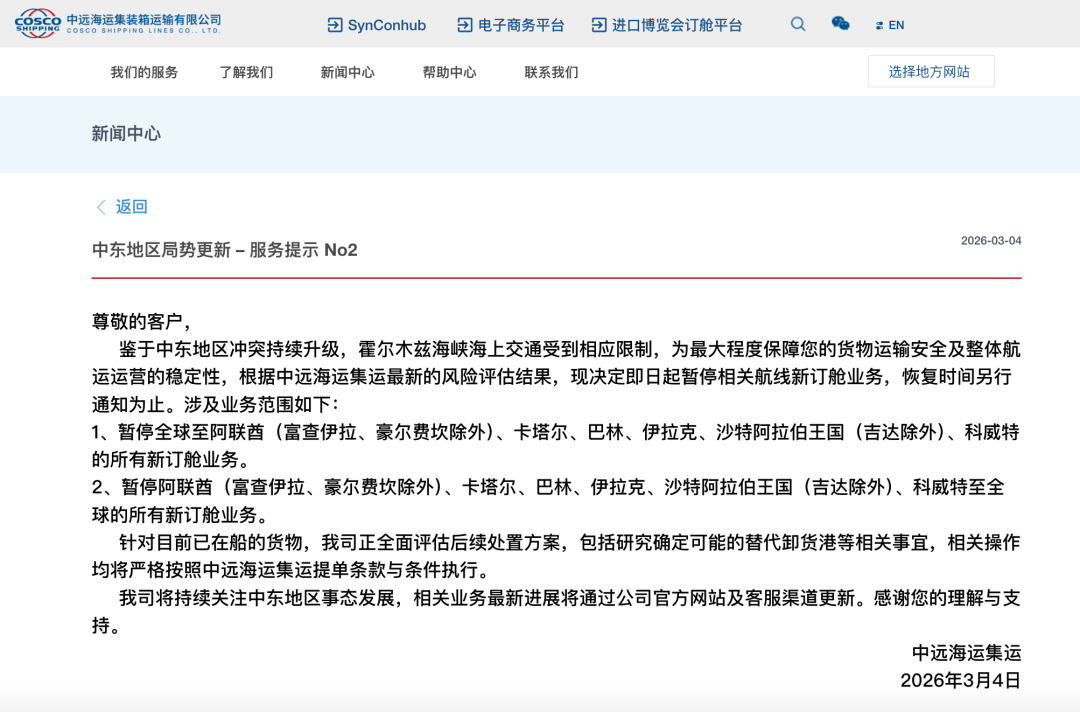
中远海运集运刚刚公告:鉴于中东地区冲突持续升级 即日起暂停相关航线新订舱业务
Mei Ri Jing Ji Xin Wen· 2026-03-06 06:12
Group 1 - The core message is that COSCO Shipping Lines has suspended new booking services for specific routes due to escalating conflicts in the Middle East, particularly affecting maritime traffic in the Strait of Hormuz [1][4] Group 2 - The suspension applies to all new bookings from global locations to the UAE (excluding Fujairah and Khor Fakkan), Qatar, Bahrain, Iraq, Saudi Arabia (excluding Jeddah), and Kuwait [2] - Additionally, new bookings from the UAE (excluding Fujairah and Khor Fakkan), Qatar, Bahrain, Iraq, Saudi Arabia (excluding Jeddah), and Kuwait to global locations are also suspended [2]



一艘中国散货船通过霍尔木兹海峡?船舶运营方公司CEO回应
凤凰网财经· 2026-03-06 05:53
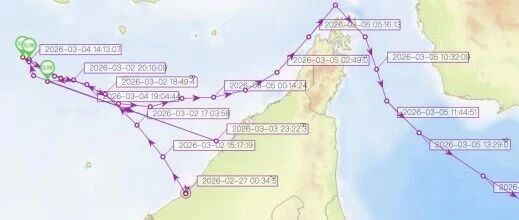
彭博社3月5日披露,一艘自动识别系统(AIS)信号上标注为"中国所有"(CHINA OWNER)的散货船通过了霍尔木兹海峡。 凤凰网《风暴眼》查询船运数据平台MagicPort发现,这艘名为"铁娘子号"(Iron Maiden)的船舶商务经理为"上海塞图斯海运有限公司"。打开该公司官 网,显示其英文名称为Cetus Maritime,而公开信息显示,Cetus Maritime即国内公司"兴达航运"。 以下文章来源于凤凰网股票 ,作者风暴眼 凤凰网股票 . 凤凰网股票,价值投资者家园。凤凰网股票为全球华人投资者提供24小时权威、独到的市场资讯和行情产品,并始终关注中国资本市场的发展与变化。 来源|凤凰网《风暴眼》 作者丨广坤 这场引起全球关注的航行,其背后公司的运营网络也浮出水面。 打开兴达航运的官网,首席执行官杨新天(Mark Young)的照片排在高管团队首位。公开信息显示,这位掌舵人持有上海海事大学国际航运管理学位, 在航运业超过30年。他的职业生涯始于2005年创立的小型散货船运营商OSL,2008年又联合创立了亚太海事公司。 凤凰网《风暴眼》联系兴达航运CEO杨新天,对于是否有其运营的船只通过霍尔木 ...
集运指数(欧线):关注地缘情绪扰动
Guo Tai Jun An Qi Huo· 2026-03-06 03:21
1. Report Industry Investment Rating - The report does not provide an industry investment rating [1] 2. Core Viewpoints of the Report - The short - term market of the container shipping index (European Line) is greatly disturbed by geopolitical sentiment. After the sharp decline, the geopolitical premium is partially reversed, but all contracts are still at par or at a premium compared to the same period in 2025. The probability of resuming navigation before July has significantly decreased. The market is expected to maintain a wide - range oscillation [12] 3. Summary by Relevant Catalogs 3.1 Fundamental Tracking - **Futures Data**: For EC2604, the closing price was 1,768.0, with a daily decline of 3.42%, trading volume of 153,840, and an open interest of 36,679 with a decrease of 1,939. For EC2606, the closing price was 1,950.1, a daily decline of 15.57%, trading volume of 30,528, and an open interest of 20,170 with a decrease of 1,467. Similar data is provided for EC2608 and EC2610 [1] - **Freight Rate Index**: The SCFIS for the European route was 1,463.40, with a weekly decline of 7.0%, and for the US - West route was 1,045.08, with a weekly decline of 6.0%. The SCFI for the European route was 1,420 ($/TEU), with a bi - weekly increase of 4.3%, and for the US - West route was 1,857 ($/FEU), with a bi - weekly increase of 3.9% [1] - **Carrier Freight**: Different carriers such as Maersk, MSC, etc. have different freight rates for the Shanghai - Rotterdam route, with different voyage days and prices for 40'GP and 20'GP containers [1] - **Exchange Rate**: The US dollar index was 98.80, and the US dollar against the offshore RMB was 6.92 [1] 3.2 Ship Schedule and Capacity - **China - Europe Base Ship Schedule**: From February to April 2026, there were 11 blank sailings in February, 11 blank sailings and 1 additional sailing in March, and 1 blank sailing and 3 undetermined sailings in April. CMA added a new OCR route. The weekly capacity from February to April showed fluctuations, with the weekly average capacity in April being 32.6 million TEU/week, a monthly year - on - year growth rate of 4.1% [4] 3.3 Geopolitical Impact - **Geopolitical Events**: There are a series of geopolitical events in the Middle East, including statements from Iran's military and political figures, actions of the Islamic Revolutionary Guard Corps, and responses from the US, Israel, and NATO [7][10] - **Impact on the Container Shipping Market**: The passage through the Strait of Hormuz is still blocked, and major container shipping liner companies have not resumed new bookings for Middle - East routes. Geopolitical events affect the container shipping European Line market through sentiment and supply - demand aspects. If the conflict cools down within 1 - 2 weeks, the global container shipping geopolitical premium is expected to decline from its high level; if it lasts for weeks to months, it will affect the global capacity tightness [8][9] 3.4 Supply - Demand and Freight Analysis - **Demand**: March - April is the regular off - season for demand after the Spring Festival. There was no large - scale missed loading in the second week of March, and the loading situation in the third week will be clearer next week [9] - **Supply**: COSCO and its subsidiary OOCL transferred the Middle - East MEX route to the Northwest Europe AEU3/LL2 route, and the AEU7 route cancelled calling at Shanghai Port in the 13th week. The overall market capacity increased significantly in the second half of March, and the PA alliance faced relatively high capacity pressure in the third week [10][11] - **Freight**: In the second week of March, the freight rates of major shipping companies on the European Line showed mixed trends. In the third week, Maersk increased the freight rate from Shanghai to Rotterdam. If other shipping companies do not take counter - actions, the market freight rate center may be around $2,500/FEU, equivalent to about 1,800 points on the SCFIS index [11]
华泰证券今日早参-20260306
HTSC· 2026-03-06 02:28
Macro Overview - The report indicates that Japan's manufacturing sector remains stable despite supply chain risks, with improvements in exports and production driven by better economic conditions and fiscal expansion [2][3] - The Japanese government aims for a reasonable recovery in prices, focusing on domestic demand and energy sectors as key areas for growth [5][6] Government Work Report Insights - The 2026 government work report emphasizes a balanced approach between quality and quantity, with a growth target set at 4.5%-5% for the year [5][6] - Key policy focuses include promoting reasonable price recovery, addressing internal competition, and enhancing carbon peak strategies [5][6] Real Estate Sector - The report highlights a shift in the real estate sector from crisis management to long-term structural reforms, focusing on quality housing and inventory management [6] - The competitive landscape is expected to evolve, with product quality and cash flow becoming core competencies for real estate companies [6] Utilities and Environmental Sector - The report notes significant growth potential in the waste incineration industry in Southeast Asia and Central Asia, with Chinese companies poised to benefit from overseas expansion [6] - Investment opportunities in waste-to-energy projects are projected to yield attractive returns, with internal rates of return (IRR) estimated at 9.5% for Indonesia and 7.4% for Central Asia [6] Key Companies - Pacific Shipping reported a revenue decline of 19.4% to $2.08 billion in 2025, with a significant drop in net profit due to weak global bulk market performance [8] - BYD's new battery technology aims to enhance charging efficiency, with plans to establish 20,000 charging stations by the end of 2026, potentially boosting sales [9] - Kuaishou's revenue for Q4 2025 reached $6.85 billion, reflecting a 38.4% year-on-year increase, with management optimistic about future growth in the e-commerce sector [15] Consumer Sector - The report indicates that Yili's liquid milk business remains stable, with expectations for a recovery in demand and continued growth in its adult nutrition segment [11] - The company plans to expand into new product areas, including protein powder and probiotics, to drive revenue growth [11] Technology Sector - Kingsoft Office is positioned as a leader in AI-driven office solutions, with anticipated revenue growth of 16% in 2025, driven by AI functionalities [10] - The company aims to leverage AI to enhance document management and user experience, supporting sustained business growth [10]