
金融业

Search documents
增值税法实施条例公开征求意见!为增值税法落地实施提供保障
Zhong Guo Jing Ji Wang· 2025-08-11 15:01
Core Points - The implementation of the new Value-Added Tax (VAT) Law in China will begin on January 1, 2026, with the Ministry of Finance and the State Taxation Administration releasing a draft for public consultation to ensure smooth implementation and adherence to the principle of tax law [1][2] - The draft includes six chapters and fifty-seven articles, detailing the VAT law's provisions, tax rates, taxable amounts, tax incentives, collection management, and other relevant regulations [1][2] - The draft aims to enhance the certainty and operability of the tax system, maintaining the stability of existing tax policies, particularly regarding the financial sector's treatment under VAT [2][3] Tax Policy Details - The draft clarifies definitions of taxable transactions, including goods, services, intangible assets, and real estate, and specifies the VAT taxable objects [2] - It provides detailed rules for the application of different tax rates and the deduction of input VAT, particularly for financial services, ensuring continuity with previous practices [2][3] - The draft optimizes tax policies to reflect the basic principles of VAT, including the non-deductibility of input VAT for non-taxable activities, aligning with international practices [3] Future Expectations - The successful implementation of the VAT Law is expected to contribute to the construction of a modern VAT system that supports high-quality economic development and the establishment of a unified national market [4]
宏观周报:物价低位运行,央行再度增持黄金-20250810
Hua Lian Qi Huo· 2025-08-10 13:27
1. Report Industry Investment Rating No relevant content provided. 2. Core View of the Report - In July 2025, the national consumer price index (CPI) was flat year - on - year. Food prices decreased by 1.6%, non - food prices increased by 0.3%, consumer goods prices decreased by 0.4%, and service prices increased by 0.5%. From January to July, the average CPI decreased by 0.1% compared with the same period last year [5][51]. - In July 2025, the producer price index for industrial products (PPI) decreased by 3.6% year - on - year, and the purchasing price index for industrial producers decreased by 4.5%. From January to July, the average PPI decreased by 2.9% compared with the same period last year, and the purchasing price index for industrial producers decreased by 3.2% [5][58]. - As of the end of July 2025, China's gold reserves were 73.96 million ounces, an increase of 60,000 ounces from the end of June 2025, increasing for 9 consecutive months. It is expected that the central bank will continue to increase its gold holdings [6]. - As of the end of July 2025, China's foreign exchange reserves were $3.2922 trillion, a decrease of $25.2 billion or 0.76% from the end of June, remaining above $3.2 trillion for 20 consecutive months [6]. - In the first 7 months of this year, China's goods trade showed an upward trend. The total value of imports and exports was 25.7 trillion yuan, a year - on - year increase of 3.5%, and the growth rate was 0.6 percentage points faster than that in the first half of the year [6]. - In July 2025, the manufacturing purchasing managers' index (PMI) was 49.3%, down 0.4 percentage points from the previous month. The manufacturing industry's prosperity level declined seasonally and generally remained in a downward trend [6]. 3. Summary According to Relevant Catalogs National Economic Accounting - GDP quarterly year - on - year growth rates from Q1 2023 to Q2 2025 are presented. Different industries such as agriculture, forestry, animal husbandry and fishery, industry, construction, and services have their respective growth rate trends [8]. - The contribution rates of different industries to GDP growth from Q1 2023 to Q2 2025 are shown, including agriculture, forestry, animal husbandry and fishery, industry, construction, and various service - related industries [13]. Industry Industrial Growth Rate - The year - on - year growth rates of added value of major industries from May to June in the past two years are provided, including coal mining and washing, oil and gas extraction, and manufacturing industries [22]. Major Industrial Output - The output data of major industrial products from June 2024 to June 2025 are listed, including energy products, industrial raw materials, and finished products [24]. Industry Electricity Consumption - The year - on - year growth rates of electricity consumption of major industries from March 2024 to May 2025 are given, including agriculture, forestry, animal husbandry and fishery, mining, and manufacturing [33]. Industrial Enterprise Profits - From January to June 2025, the total profit of large - scale industrial enterprises was 3.4365 trillion yuan, a year - on - year decrease of 1.8%. The main industry profit situations vary, with some industries showing growth and others decline [36]. - From January to June 2025, the mining industry's profit was 429.41 billion yuan, a year - on - year decrease of 30.3%; the manufacturing industry's profit was 2.59006 trillion yuan, a year - on - year increase of 4.5%; the electricity, heat, gas and water production and supply industry's profit was 417.04 billion yuan, a year - on - year increase of 3.3% [41]. Industrial Enterprise Inventory - As of the end of May 2025, the finished product inventory of large - scale industrial enterprises was 6.65 trillion yuan, a year - on - year increase of 3.5%. The overall inventory is in a stage from passive replenishment to passive destocking [46]. Price Index CPI - In July 2025, the CPI was flat year - on - year. Food prices decreased, while non - food prices increased. The average CPI from January to July decreased by 0.1% compared with the same period last year [51]. - The year - on - year and month - on - month data of CPI sub - items from July 2024 to July 2025 are presented, including food, clothing, housing, and other categories [52]. PPI - In July 2025, the PPI decreased by 3.6% year - on - year, and the purchasing price index for industrial producers decreased by 4.5%. The average PPI from January to July decreased by 2.9% compared with the same period last year [58]. - The year - on - year data of PPI for major industries from July 2024 to July 2025 are provided, including production materials, living materials, and various mining and manufacturing industries [58][61]. - The year - on - year data of industrial producer purchasing prices from July 2024 to July 2025 are given, including fuel power, black metal materials, and other categories [62]. Main City Newly - Built Residential Prices - The year - on - year and month - on - month data of the price index of newly - built commercial residential buildings in 70 large and medium - sized cities from June 2015 to June 2025 are shown, including data for first - tier, second - tier, and third - tier cities [63][64][66].
教育投资回报率下降,为什么还要上大学?
虎嗅APP· 2025-08-10 08:51
Core Viewpoint - The article discusses the changing landscape of education in China, highlighting a shift in student preferences towards practical and employment-oriented choices rather than traditional prestigious institutions. This reflects a broader transformation in the education system amid a complex job market with a record number of graduates. Group 1: Changing Preferences in Education - High-scoring students are increasingly opting for less prestigious universities with better employment prospects over top-tier institutions with less favorable job outcomes [4][6][7] - The number of college graduates in China reached a record high of 12.22 million, leading to a complex employment situation for graduates [4][6] - The traditional view of prestigious universities as the primary path to success is being challenged as students and parents become more rational in their choices, focusing on the alignment of majors with job market demands [7][8] Group 2: Employment Market Dynamics - The employment market has undergone significant changes due to macroeconomic factors, affecting the job prospects of graduates in certain fields, particularly in industries like real estate and education [7][9] - The expansion of higher education has led to a situation where the supply of graduates exceeds demand, resulting in a decline in the return on investment for a university education [13][14][15] - The average salary of college graduates has decreased relative to the average salary in society, indicating a growing disparity in employment quality [16] Group 3: Skills and Education Reform - There is a pressing need for educational institutions to adapt their curricula to better prepare students for the evolving job market, emphasizing practical skills and interdisciplinary learning [10][11][27] - The importance of soft skills, such as communication and teamwork, is increasingly recognized as essential for employability in the modern workforce [28][33] - The article suggests that universities should focus on enhancing students' adaptability and lifelong learning capabilities to meet the demands of a rapidly changing job market [10][11][39] Group 4: Future Opportunities and Challenges - The rise of artificial intelligence and automation presents both challenges and opportunities for the job market, with predictions of job displacement in certain sectors but also the creation of new roles [30][32][34] - The aging population in China is expected to drive demand for jobs in the care industry, presenting new opportunities for graduates [24] - The article emphasizes the need for a comprehensive approach to employment policies that align with educational reforms to address structural employment issues [37][39]


教育投资回报率下降,为什么还要上大学?
Hu Xiu· 2025-08-08 06:48
Group 1 - The education landscape in China is undergoing significant changes, with students increasingly prioritizing employment prospects over prestigious institutions [1][2][3] - The number of college graduates in China has reached a record high of 12.22 million, leading to a complex employment situation for graduates [2][19] - There is a growing trend of students opting for vocational education and less prestigious universities that offer better job prospects [1][3][39] Group 2 - The traditional view of prestigious universities as a marker of success is being challenged, as students and parents become more rational in their choices [4][5] - The job market's structural issues are exacerbated by the oversupply of graduates, with many graduates lacking the skills required by employers [12][18] - The increasing focus on practical skills and adaptability in education is essential to meet the demands of a rapidly changing job market influenced by AI and automation [8][24][30] Group 3 - The employment landscape is characterized by three main challenges: increased supply of graduates, decreased employment elasticity, and intensified structural mismatches [19][20][21] - Opportunities exist in the form of skill-based restructuring of talent supply, digitalization, and the growth of the elder care industry [22][23] - The financial sector is experiencing a decline in job market attractiveness, with a mismatch between the skills of graduates and the demands of employers [26][27] Group 4 - The need for educational reform is critical, with a focus on integrating practical skills training and soft skills development to enhance employability [40] - The current labor market is influenced by macroeconomic factors, with a need for policies that support job creation and address structural employment issues [36][38] - The future of higher education in China may face challenges if reforms are not implemented, potentially leading to a decline in enrollment and institutional viability [40][41]
港股红利上车机会?恒生红利低波ETF(159545)盘中获资金逆势加仓
Mei Ri Jing Ji Xin Wen· 2025-08-08 06:32
Group 1 - The Hong Kong stock market is experiencing adjustments, with the Hang Seng High Dividend Low Volatility Index down by 0.5% as of 13:55 [1] - The Hang Seng Dividend Low Volatility ETF (159545) continues to attract capital, with a net subscription of 25 million units after three consecutive days of net inflow [1] - Huatai Securities indicates that market risk appetite is expected to persist into August, although strong opposing assets may limit relative returns for high dividend sectors [1] Group 2 - The Hang Seng High Dividend Low Volatility Index consists of 50 liquid stocks within the Hong Kong Stock Connect that have a history of continuous dividends, moderate payout ratios, and low volatility, with the top three sectors being finance, energy, and real estate, accounting for nearly 60% [1] - The current dividend yield of the index is approximately 5.8% [1] - The management fee for the Hang Seng Dividend Low Volatility ETF (159545) is only 0.15% per year, providing a low-cost option for investors to gain exposure to the high dividend sector in Hong Kong stocks [1]
恒生红利低波ETF(159545)近一月强势“揽金”15亿元,最新规模突破40亿元
Mei Ri Jing Ji Xin Wen· 2025-08-07 03:32
Core Viewpoint - The Hong Kong stock market is experiencing fluctuations, with the dividend sector showing resilience, particularly the Hang Seng High Dividend Low Volatility Index, which has seen a slight increase of 0.2% as of 11:00 AM [1] Group 1: Market Performance - The Hang Seng High Dividend Low Volatility Index includes 50 stocks with good liquidity, consistent dividends, moderate payout ratios, and low volatility, with the top three sectors being finance, energy, and real estate, accounting for nearly 60% of the index [1] - The index currently has a dividend yield of approximately 5.8% [1] Group 2: Investment Trends - The Hang Seng Dividend Low Volatility ETF (159545) has attracted significant capital, with over 1.5 billion yuan net inflow in the past month, bringing its total size to over 4 billion yuan, making it the largest among similar ETFs [1] - Huatai Securities indicates that the trend of market risk appetite is expected to continue into August, suggesting that while high dividend sectors may lack relative returns, some stable and potential high dividend stocks have become attractive due to their current yield value [1] Group 3: Cost Efficiency - The Hang Seng Dividend Low Volatility ETF (159545) offers one of the lowest management fees in the ETF market at 0.15% per year, facilitating low-cost investment in high dividend assets in the Hong Kong stock market [1]
美国7月非农:“修订风波”暴露美国就业市场脆弱性
LIANCHU SECURITIES· 2025-08-05 10:54
Employment Data - In July, the U.S. non-farm payrolls increased by 73,000, significantly below the expected 106,000 and the previous value of 14,000[3] - The unemployment rate slightly rose to 4.2%, with the previous value at 4.1% and the forecast at 4.3%[3] - The Labor Department revised the non-farm employment data for May and June, with May's initial value of 139,000 adjusted down to 19,000 and June's from 147,000 to 14,000, totaling a downward revision of 253,000[3] Labor Market Trends - The average monthly job growth over the past three months is now only 35,000, a sharp decline from the first quarter's average of 111,000, indicating a potential overestimation of previous employment strength[3] - The labor force participation rate decreased to 62.2%, contributing to the stability of the unemployment rate despite job losses[10] - The number of foreign-born workers decreased by 1.241 million from January to July, while the domestic-born workforce increased by 3.073 million, affecting overall labor supply[12] Market Reactions and Federal Reserve Implications - Following the employment data release, U.S. stock markets fell, bond yields declined, and the dollar weakened, reflecting heightened market risk aversion[5] - The disappointing employment figures have led to increased market expectations for the Federal Reserve to cut interest rates by 25 basis points in September and October[5] - Key factors for the Fed's decision will include inflation data for July and August and the potential impact of political pressures from the Trump administration[15]
阿联酋经济多元化战略成效显著
Jing Ji Ri Bao· 2025-08-04 22:07
Core Insights - The UAE is increasingly focusing on sustainable development and economic diversification to reduce reliance on oil, guided by long-term strategies such as "UAE Vision 2021," "We the UAE 2031," and "UAE Centennial 2071" [1][2] Economic Transformation - The UAE's economic transformation is directed by a series of national visions, evolving from macro goals to detailed roadmaps, emphasizing a competitive knowledge economy and innovation [2] - The "UAE Vision 2021" identifies a competitive knowledge economy as one of six national priorities, while the "UAE Centennial 2071" stresses economic diversification and support for local businesses [2] - The "We the UAE 2031" vision aims to increase the UAE's GDP to 3 trillion dirhams by 2031, with non-oil exports reaching 800 billion dirhams and total trade at 4 trillion dirhams [2] Business Environment Improvement - The UAE has implemented several measures to enhance the business environment, including revising commercial laws to allow 100% foreign ownership of onshore companies [4] - The introduction of long-term visa options, such as the Golden Visa and investor visas, aims to attract global talent and high-net-worth individuals [4] - The UAE has 46 free zones that play a crucial role in economic diversification, contributing approximately 40% to total exports [4] Support for Local Enterprises - The UAE is actively supporting local businesses and talent development to create a sustainable and self-sufficient economy [5] Non-Oil Sector Development - The tourism sector is a key pillar of the UAE's economic diversification, with a target to increase its GDP contribution to 450 billion dirhams by 2031 [7] - The financial sector is rapidly growing, with initiatives like the fintech office launched by the Central Bank to promote digital transformation [7] - Renewable energy is a focus area, with the "National Energy Strategy 2050" aiming to double renewable energy capacity by 2030 and achieve carbon neutrality by 2050 [7] Trade Growth - The UAE's real GDP is projected to grow by 4% in 2024, with non-oil GDP increasing by 5%, contributing to 75.5% of the total GDP [9] - Non-oil trade reached 2.997 trillion dirhams, with significant growth in exports and imports in the first half of 2025 [9][10] - The UAE has signed comprehensive economic partnership agreements (CEPA) with 26 countries, enhancing non-oil trade with CEPA partners significantly [10]
“一行一局一会”,重磅发布!
Zheng Quan Shi Bao· 2025-08-04 13:03
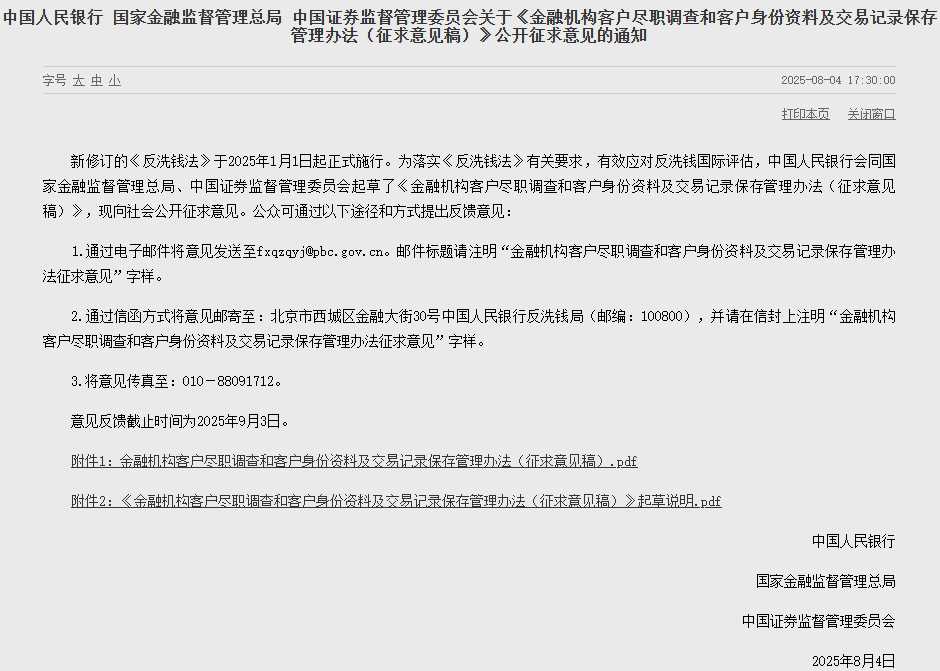
为规范金融机构客户尽职调查、客户身份资料及交易记录保存行为,中国人民银行、国家金融监督管理总局、中国证券监督管理委员 会在8月4日发布《金融机构客户尽职调查和客户身份资料及交易记录保存管理办法(征求意见稿)》(下称《管理办法》),进一步 明确基于风险的客户尽职调查具体要求。 《管理办法》要求,金融机构应当勤勉尽责,遵循"了解你的客户"的原则,识别并采取合理措施核实客户及其受益所有人身份,根据 客户特征和交易活动的性质、风险状况,采取相应的尽职调查措施。 在业务关系存续期间,金融机构应当持续关注并评估客户整体状况及交易情况,了解客户的洗钱风险。涉及较高洗钱或恐怖融资风险 的,应当采取相应的强化尽职调查措施,必要时可以采取与风险相匹配的洗钱风险管理措施。 《管理办法》规定,金融机构有合理理由怀疑客户及其交易涉嫌洗钱或恐怖融资时;对先前获得的客户身份资料的真实性、有效性或 完整性存在疑问时;与客户建立业务关系、为客户提供规定金额以上的一次性金融服务时,金融机构应当开展客户尽职调查。 有合理理由怀疑客户涉嫌洗钱或者恐怖融资,并且开展客户尽职调查会导致发生泄密事件的,《管理办法》明确金融机构可以不开展 客户尽职调查,但 ...
深圳前海上半年实际使用外资同比增长15.9% 货物进出口总值同比增长11.5%
Nan Fang Ri Bao Wang Luo Ban· 2025-08-04 08:07
Group 1 - The Qianhai Cooperation Zone has seen a 15.9% year-on-year increase in actual foreign investment in the first half of 2025, accounting for 59% of Shenzhen's total [1] - The total import and export value of the Qianhai Shekou Free Trade Zone increased by 11.5% year-on-year, representing about two-thirds of the Guangdong Free Trade Zone's total [1] - The number of multinational company headquarters in Qianhai has reached 52, making up 30.8% of Shenzhen's total [1] Group 2 - Actual foreign investment in Qianhai reached 12.326 billion yuan, with the top three industries being finance (29.5%), business services (29.4%), and software and information technology services (17.5%) [1] - Foreign investment in the finance sector grew by 19.5%, while high-tech services saw a significant increase of 72.4% [1] - The actual foreign investment in the Qianhai Shekou Free Trade Zone reached 10.702 billion yuan, a year-on-year increase of 40.5% [1] Group 3 - The Qianhai region has innovated cross-border supply chain mechanisms, establishing a "front store and back warehouse" model with Hong Kong, enhancing warehouse utilization by 52.8% [2] - Hong Kong has become the largest trading partner of Qianhai, with imports and exports to Hong Kong reaching 59.24 billion yuan in the first half of 2025, a 90.2% year-on-year increase [2] - The total retail sales of consumer goods in Qianhai reached 33.917 billion yuan, growing by 17.0% year-on-year, with retail and catering sectors increasing by 16.5% and 7.8% respectively [2]