
高技术制造业

Search documents
2025年11月经济数据点评:需求待企稳
BOHAI SECURITIES· 2025-12-16 09:50
Economic Data Overview - In November 2025, the industrial added value for large-scale enterprises grew by 4.8% year-on-year, slightly below the expected 5.0% and previous value of 4.9%[2] - The total retail sales of consumer goods increased by 1.3% year-on-year, significantly lower than the expected 2.9%[2] - The cumulative year-on-year growth rate of fixed asset investment was -2.6%, worse than the expected -2.3% and previous -1.7%[2] Industrial Production Insights - The year-on-year growth rate of industrial added value showed a slight slowdown compared to the previous value, with the monthly growth rate aligning with historical averages[3] - High-tech manufacturing sectors outperformed overall industrial growth, indicating a shift in production dynamics[3] - The annual industrial production growth rate is projected to stabilize around 5.8%, with potential constraints from "anti-involution" and a slight weakening in exports affecting December's production[3] Consumer Spending Trends - The year-on-year growth rate of retail sales in November was impacted by early online shopping promotions and diminishing subsidy effects, leading to a broader decline across most categories[4] - Notably, furniture, building materials, and home appliances were significantly affected, with automotive consumption dragging down overall growth by nearly 2 percentage points[4] - The annual retail sales growth is expected to be around 3.7%, with a focus on stimulating service consumption in the short term[4] Investment Outlook - Fixed asset investment saw an expanded decline, particularly in manufacturing, where negative growth persisted for five consecutive months[5] - Infrastructure investment showed signs of stabilization, with improvements in transportation and energy sectors, while water conservancy and public facilities continued to lag[5] - Real estate investment experienced a significant drop of -30.3% year-on-year, with ongoing declines in new construction and completion areas[5] Risk Factors - Geopolitical uncertainties may elevate market risk preferences, potentially disrupting economic stability[6] - Unexpected changes in economic conditions or policies could arise due to increasing volatility in overseas markets and domestic economic transitions[6]
2026年宏观经济与大类资产配置展望:不尽长江滚滚来
Bank of China Securities· 2025-12-16 09:29
Global Economic Outlook - The global economy is expected to grow by 3.1% in 2026, slightly down from 3.2% in 2025, indicating a continued weak recovery trend[9] - The U.S. economy is projected to grow by 2.1% in 2026, a slight increase from 2.0% in 2025, while the Eurozone and Japan are expected to see declines in growth rates[12] - The weak U.S. dollar, which fell over 8% from January to November 2025, is anticipated to continue influencing global capital reallocation in 2026[25] China Economic Growth - China's GDP is forecasted to grow by 4.7% in real terms and 4.9% in nominal terms in 2026, supported by technology and consumption sectors[1] - Fixed asset investment in China is expected to recover, with high-tech manufacturing and equipment manufacturing showing signs of improvement[31] - The retail sales of consumer goods in China grew by 4.3% year-on-year in the first ten months of 2025, indicating resilience in consumer spending[38] Asset Allocation Strategy - The recommended asset allocation for 2026 is: Stocks > Commodities > Bonds > Cash, reflecting a preference for equities amid a weak dollar environment[1] - The bond yields are expected to fluctuate within a favorable range, while commodity prices, particularly precious metals, are projected to reach new highs[1] - Currency funds are likely to focus more on liquidity safety, resembling a substitute for demand deposits in investor asset allocation[1] Risks and Uncertainties - Risks include potential underperformance of domestic policies, escalation of trade tensions, and rising fiscal security risks in major economies globally[1]
11月份经济数据解读:经济维持稳态,结构性改善明显
Caixin Securities· 2025-12-16 09:17
Report Industry Investment Rating No specific industry investment rating is provided in the report. Core Viewpoints of the Report - The economy maintained a stable state in November 2025, with obvious structural improvements, but the endogenous momentum needs to be consolidated, and the recovery trend remains to be observed. The report maintains the judgment that the economic growth rate in 2026 will still be positive, with a possible pattern of being lower in the first half and higher in the second half [4]. - In the equity market, market sentiment may continue to improve, and the market may show a volatile upward trend. In the bond market, volatility may increase, and it is not recommended to buy at the bottom in the short term. In the commodity market, the differentiation intensifies, and attention should be paid to gold, copper, and aluminum priced internationally [4]. Summary by Relevant Catalogs 1. Overview of the November 2025 Economy - The economy maintained a stable state with obvious structural improvements, including the continuous recovery of CPI, prominent economic kinetic energy switching, strengthened export competitiveness, high - level production, steady growth of industrial enterprise profits, and highlights in service consumption [5]. - The endogenous momentum needs to be consolidated, and the recovery trend remains to be observed. The "subsidy withdrawal" effect has a significant impact, economic data still needs trend improvement, the endogenous growth momentum needs to be strengthened, and real estate still has a certain drag on the economy [6]. 2. Interpretation of November 2025 Economic Sub - item Data - Manufacturing PMI increased slightly, and service PMI declined. The new order index was the main contributor to the increase in PMI. The PMI of high - tech manufacturing was above the boom - bust line. The service business activity index was below the boom - bust line for the first time since September 2024. The construction industry PMI improved [7][8]. - Fixed - asset investment continued to decline under the drag of real estate. Real estate development investment dragged down the growth rate of fixed - asset investment by 3.4 percentage points. In the future, the drag of real estate on fixed - asset investment is expected to shrink, and infrastructure investment may stabilize, while manufacturing investment should focus on emerging directions [9]. - Service consumption had highlights, while commodity consumption was highly differentiated. The total retail sales of consumer goods increased slightly. Service consumption, such as catering, maintained growth, while commodity consumption, such as automobiles and home appliances, declined due to the "subsidy withdrawal" effect [10]. - Exports showed strong resilience, with prominent structural highlights and a steady expansion of the surplus. In November, the export growth rate rebounded. The exports to Africa performed outstandingly, and the product structure was optimized. Exports are expected to be a major bright spot in the economy in 2026 [11][12]. - Real estate sales continued to bottom out. The sales area and sales volume of new commercial housing decreased year - on - year, and the market was still in the process of destocking. The prices of commercial residential buildings in large and medium - sized cities declined both month - on - month and year - on - year [13]. - The production end remained stable. In November, the added value of large - scale industrial enterprises increased year - on - year and month - on - month. The added value of the equipment manufacturing and high - tech manufacturing industries grew faster than the overall level [14]. - At the price end, CPI continued to rise, and PPI was stable and waiting to rise. In November, CPI increased year - on - year, and PPI increased month - on - month. Consumption - end prices showed a recovery trend, and production - end prices were characterized by differentiation [14]. - In November, the overall social financing was stable, and credit increased less year - on - year. Government bond financing supported the growth of social financing, while the demand of the resident sector was weak, and the demand of the enterprise sector improved marginally [18]. - The profits of industrial enterprises increased steadily. From January to October 2025, the cumulative profit growth rate of large - scale industrial enterprises increased for three consecutive months. In the future, policies are expected to promote the growth of industrial enterprise profits [19][20]. 3. Future Economic Outlook - Overseas, the main narrative is the soft landing of the economy, but there are still uncertainties in the structure. The US economy is expected to maintain a positive trend, but there are risks such as the differentiation between the real and virtual economies, the widening wealth gap, and the differentiation between AI and non - AI investments [21]. - At the domestic policy level, in 2026, the macro - policy will be more proactive. Fiscal policy will be more positive and pay attention to robustness and sustainability, and monetary policy will be moderately loose, with possible reserve requirement ratio and interest rate cuts [21]. - In terms of the economy, the economic growth rate in 2026 is expected to be lower in the first half and higher in the second half. The endogenous recovery momentum of domestic demand needs to be consolidated, and exports are expected to perform well [22]. 4. Investment Suggestions - Equity market: In the short term, the market may show a volatile upward trend. Investors should focus on sectors with positive event catalysts, sectors benefiting from the recovery of the equity market, sectors benefiting from the Fed's interest rate cuts, and the supplementary rise of the large - consumption sector [24]. - Bond market: The volatility of ultra - long bonds may increase, and it is not recommended to buy at the bottom in the short term. Attention should be paid to the expected term of fiscal bond issuance and the adjustment of the risk assessment indicators of large banks [25]. - Commodity market: The differentiation intensifies. For precious metals, the long - bull foundation of gold remains. For crude oil, the price trend may continue to be weak. For internationally priced non - ferrous metals, the price is in a medium - term upward channel. For commodities priced by the domestic fundamentals, the prices of relevant "anti - involution" varieties will enter a wide - range volatile trend [26].
【图解】11月我国工业生产稳定增长,3组数据看亮点→
Zhong Guo Jing Ji Wang· 2025-12-16 06:46
Group 1 - The core viewpoint of the article highlights the stable growth of China's industrial production in November 2025, contributing significantly to the overall economic stability [4][5]. - In November, the industrial added value of large-scale industries increased by 4.8% year-on-year, maintaining a steady growth rate compared to the previous month [5]. - Among 41 major industries, 30 industries reported year-on-year growth in added value, accounting for 73.2% [7]. Group 2 - The structure of industrial production continues to optimize and upgrade, with high-tech manufacturing and equipment manufacturing showing significant growth [9]. - In November, the added value of high-tech manufacturing increased by 7.7%, while equipment manufacturing grew by 8.4%, representing 16.9% and 36.4% of the total industrial added value, respectively [9]. - The automotive manufacturing industry and the railway, shipbuilding, aerospace, and other transportation equipment manufacturing industries both saw an increase of 11.9% in added value [10]. Group 3 - Emerging industries are growing robustly, with ongoing digital and intelligent transformation in industrial sectors [10]. - In November, the manufacturing of electronic specialty materials and integrated circuits saw remarkable growth, with added value increasing by 30.9% and 32.4%, respectively [11]. - The production of smart products is also accelerating, with smart vehicle-mounted equipment manufacturing growing by 30% and smart unmanned aerial vehicle manufacturing increasing by 49.3% [11].


权威发布|“实现全年预期目标有较好条件”
Ren Min Ri Bao· 2025-12-16 05:26
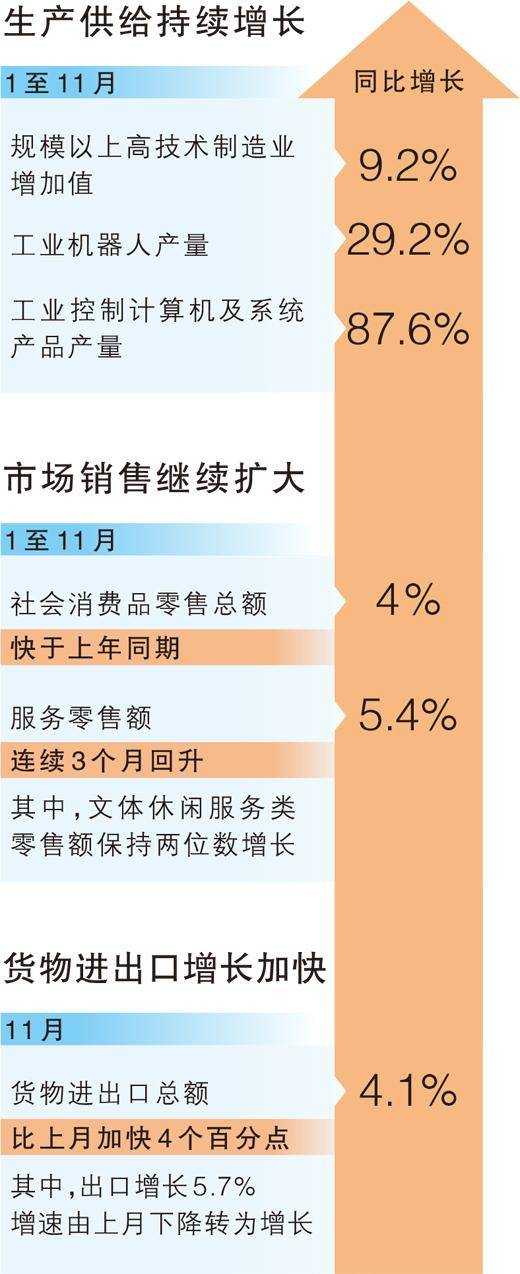
Core Viewpoint - The macroeconomic policies in China are showing positive effects, with a focus on strengthening the domestic market, increasing production supply, expanding market sales, and maintaining overall stability in employment and prices, contributing to a steady economic growth trend [1] Economic Performance - Industrial production remains stable, with the industrial added value of large-scale enterprises growing by 4.8% year-on-year in November, maintaining the same growth rate as the previous month [2] - The service sector's production index increased by 4.2% year-on-year, with significant growth in information transmission and business services [2] - Social retail sales grew by 1.3% year-on-year in November, with a cumulative growth of 5.4% from January to November [2] - The total value of imports and exports increased by 4.1% year-on-year in November, accelerating by 4 percentage points compared to the previous month [2] - The urban unemployment rate remained stable at 5.1%, while consumer prices rose by 0.7% year-on-year, marking three consecutive months of increase [2] Energy and Investment - Energy supply has been strengthened to meet winter production and living needs, with significant increases in industrial oil, natural gas, and electricity production [3] - Investment in accommodation, catering, wholesale, and retail sectors grew by 7.1% year-on-year, while electricity and heat production and supply saw a 12.5% increase [3] New Production Capacity - New quality productivity is developing rapidly, with high-tech manufacturing value added increasing by 9.2% year-on-year from January to November [4] - The production of industrial robots and control systems surged by 29.2% and 87.6% respectively, indicating strong growth in emerging industries [4] - Traditional industries are also seeing improvements, with biomass fuel processing value added growing by 15.6% [4] Consumption and Investment Potential - Consumer spending is on the rise, with retail sales of cultural and office supplies and communication equipment growing by 11.7% and 20.6% respectively [6] - Online retail sales of physical goods increased by 5.7% year-on-year, accounting for 25.9% of total social retail sales [6] - Fixed asset investment (excluding rural households) decreased by 2.6%, but project investment excluding real estate development grew by 0.8% [6] - Investment in key sectors such as equipment manufacturing and green energy transition remains strong, supporting long-term economic development [6][7]
11月国民经济稳中有进工业生产稳定增长
Qi Huo Ri Bao Wang· 2025-12-16 01:23
昨日,在国新办举行的新闻发布会上,国家统计局新闻发言人、总经济师、国民经济综合统计司司长付 凌晖表示,11月份国民经济稳中有进。 "11月份我国国民经济运行呈现出生产端稳健、需求端分化的态势。"海通期货研究所宏观策略组研究员 纪丫告诉期货日报记者,11月,规上工业增加值同比增长4.8%,其中装备制造业和高技术制造业增速 显著更快,成为重要驱动力,需求侧则表现不一:市场消费维持一定韧性,社会消费品零售总额同比增 长1.3%,服务消费和线上零售增长较快,但增速仍显温和;固定资产投资维持承压态势,11月同比下 降11.5%,主要受房地产市场深度调整的拖累,房地产投资同比下跌30%。 "尽管社会消费品零售总额增速受基数影响有所波动,但升级类商品消费保持活跃,服务零售额持续较 快增长,反映消费结构优化和内需潜力释放,新质生产力培育步伐加快。"建信期货宏观研究员冯泽仁 说。 ...
11月份国民经济延续 稳中有进发展态势
Guo Jia Tong Ji Ju· 2025-12-16 01:00
Economic Overview - The national economy in November continued to show a stable and progressive development trend, supported by strong leadership and proactive macro policies [6] - The overall grain production reached 14.298 trillion jin, an increase of 1.2% year-on-year, with autumn grain production contributing significantly [1] Industrial Production - The industrial added value for large-scale enterprises grew by 4.8% year-on-year in November, with significant growth in equipment manufacturing (7.7%) and high-tech manufacturing (8.4%) [1] - The manufacturing purchasing manager index was reported at 49.2%, indicating slight improvement in business conditions [1] Service Sector - The service sector production index increased by 4.2% year-on-year in November, with notable growth in information transmission (12.9%) and financial services (5.1%) [2] - The business activity index for the service sector was at 49.5%, while the business activity expectations index was at 55.9%, indicating positive sentiment [2] Retail and Consumption - The total retail sales of consumer goods reached 43.898 billion yuan in November, a year-on-year increase of 1.3% [2] - Online retail sales amounted to 144.582 billion yuan, growing by 9.1% year-on-year, with physical goods accounting for 25.9% of total retail sales [2] Investment Trends - Fixed asset investment (excluding rural households) decreased by 2.6% year-on-year, while manufacturing investment grew by 1.9% [3] - Infrastructure investment saw a decline of 1.1%, and real estate development investment dropped significantly by 15.9% [3] Trade Performance - The total value of goods imports and exports reached 38.987 billion yuan in November, with exports growing by 5.7% and imports by 1.7% [4] - The proportion of general trade in total trade was 63.2%, indicating a shift towards more balanced trade structures [4] Employment Situation - The urban survey unemployment rate remained stable at 5.1% in November, with slight variations among different demographics [4] - The average weekly working hours for employees were reported at 48.6 hours [4] Price Trends - The Consumer Price Index (CPI) rose by 0.7% year-on-year in November, with food prices showing mixed trends [5] - The Producer Price Index (PPI) for industrial producers decreased by 2.2% year-on-year, indicating deflationary pressures in the industrial sector [5]
“实现全年预期目标有较好条件”
Sou Hu Cai Jing· 2025-12-15 23:45
| 产供给持续增长 | | --- | | 生 | | 1至11月 | 同比增长 | | --- | --- | | 规模以上高技术制造业 增加值 | 9.2% | | 工业机器人产量 | 29.2% | | 工业控制计算机及系统 | 87.6% | | 产品产量 | | | 市场销售继续扩大 | | | 1至11月 | | | 社会消费品零售总额 | 4% | | 快于上年同期 | | | 服务零售额 | 5.4% | | 连续3个月回升 | | | 其中,文体休闲服务类 | | | 零售额保持两位数增长 | | | 货物进出口增长加快 | | | 11月 | | 数据来源:国家统计局 制图:蔡华伟 "11月,更加积极有为的宏观政策持续显效,全国统一大市场建设纵深推进,着力做强国内大循环,生 产供给持续增长,市场销售继续扩大,货物进出口增长加快,就业物价总体稳定,高质量发展扎实推 进,国民经济延续了稳中有进的发展态势。"在国务院新闻办12月15日举行的新闻发布会上,国家统计 局新闻发言人、总经济师、国民经济综合统计司司长付凌晖介绍11月国民经济运行情况。 "尽管有困难有压力,但我国经济韧性强,宏观政策支持有 ...
11月工业高端化势头明显 3D打印设备产量翻番
2 1 Shi Ji Jing Ji Bao Dao· 2025-12-15 23:36
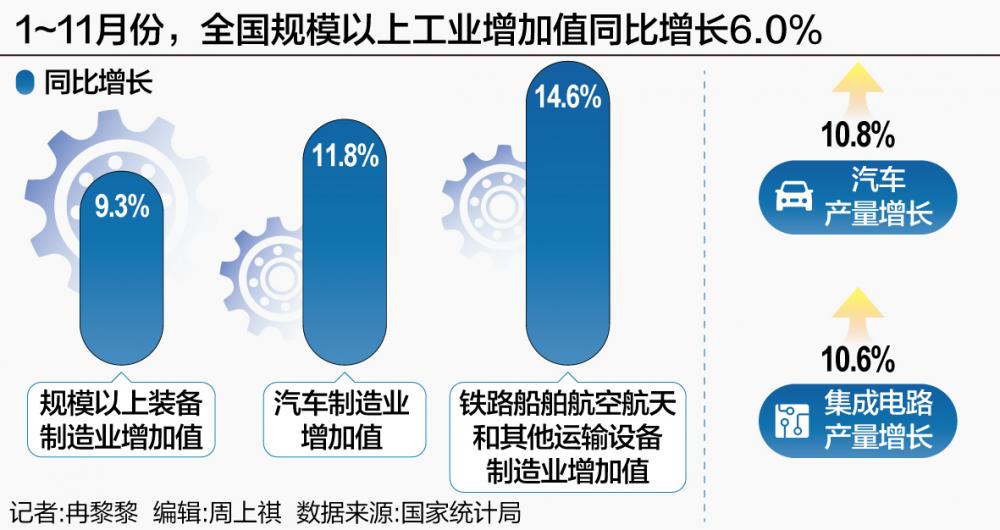
Core Viewpoint - In November, the industrial added value of enterprises above designated size in China experienced a year-on-year real growth of 4.8%, indicating a stable industrial production environment and ongoing industrial upgrading supported by new policies [1][2][5]. Group 1: Industrial Performance - The industrial added value increased by 0.44% month-on-month in November, with a cumulative year-on-year growth of 6.0% from January to November [5][9]. - The mining industry saw a year-on-year growth of 6.3%, manufacturing grew by 4.6%, and the electricity, heat, gas, and water production and supply industry increased by 4.3% in November [5][6]. - The growth rate of industrial added value in November decreased by 0.1 percentage points compared to October, while the month-on-month growth rate accelerated by 0.27 percentage points [6][9]. Group 2: High-tech and Equipment Manufacturing - The high-end development of the industrial sector is evident, with the added value of equipment manufacturing and high-tech manufacturing growing by 7.7% and 8.4% year-on-year, respectively [6][7]. - The cumulative added value of equipment manufacturing accounted for 36.4% and high-tech manufacturing for 16.9% of the total industrial added value [6][7]. - Notable product growth includes 3D printing equipment, industrial robots, and new energy vehicles, with year-on-year increases of 100.5%, 20.6%, and 17.0%, respectively [8]. Group 3: Market Demand and Policy Impact - Policies such as "two highs" and "two new" have effectively stimulated market demand, leading to increased production and supporting industrial growth [2][7]. - In the first eleven months, the added value of equipment manufacturing grew by 9.3%, while high-tech manufacturing increased by 9.2%, indicating strong demand in these sectors [7][9]. - The overall industrial production remains stable, with ongoing optimization and upgrading of industries, contributing to economic stability [2][9].
“实现全年预期目标有较好条件”(权威发布)
Ren Min Ri Bao· 2025-12-15 22:12
Core Viewpoint - The macroeconomic policies in November have shown positive effects, with a focus on strengthening domestic circulation, leading to stable economic growth and a favorable environment for achieving annual targets [1] Economic Performance - Industrial production maintained steady growth, with the industrial added value of large-scale enterprises increasing by 4.8% year-on-year in November, remaining stable compared to the previous month [2] - The service sector also saw growth, with a production index increase of 4.2%, particularly in information transmission and business services, which grew by 12.9% and 8.4% respectively [2] - Retail sales of consumer goods rose by 1.3% year-on-year in November, with service retail sales increasing by 5.4% from January to November, indicating a slight acceleration in growth [2] - Foreign trade showed resilience, with total goods imports and exports increasing by 4.1% year-on-year in November, a significant acceleration compared to the previous month [2] Employment and Prices - The urban unemployment rate remained stable at 5.1% in November, while consumer prices rose by 0.7% year-on-year, marking three consecutive months of increase [2] Energy Supply and Investment - Energy supply has been strengthened to meet winter demands, with industrial crude oil, natural gas, and electricity production increasing by 2.2%, 5.7%, and 2.7% respectively in November [3] - Investment in accommodation, catering, wholesale, and retail sectors grew by 7.1% each, and electricity and heat production and supply saw a 12.5% increase [3] New Production Capacity and Industrial Upgrades - The development of new productive forces has accelerated, with high-tech manufacturing value added increasing by 9.2% from January to November, and smart consumer equipment manufacturing growing by 7.6% [4] - Traditional industries are undergoing transformation, with biomass fuel processing value added rising by 15.6%, contributing to the growth of the petroleum processing industry [4] - The digital economy is also on the rise, with the value added of large-scale digital product manufacturing increasing by 9.3% [4] Consumption and Investment Potential - Consumption potential continues to be released, with retail sales of cultural and office supplies and communication equipment growing by 11.7% and 20.6% respectively in November [7] - Online retail sales of physical goods increased by 5.7%, accounting for 25.9% of total retail sales, indicating a shift towards new consumption models [7] - Fixed asset investment (excluding rural households) decreased by 2.6% year-on-year, but project investment excluding real estate development grew by 0.8% [7] - Investment potential remains significant, with ongoing measures to promote investment growth in various sectors, including education, healthcare, and public services [8]