房地产业

Search documents
结构性政策工具利率调降落地,监管上调融资保证金比例:政策双周报(0109-0203)-20260205
Huachuang Securities· 2026-02-05 06:48
1. Report Industry Investment Rating There is no information provided regarding the industry investment rating in the given content. 2. Core Viewpoints of the Report The report focuses on the policy trends and developments in multiple fields from January 9th to February 3rd, 2026, including macro - economic policies, fiscal policies, monetary policies, financial regulations, and real estate policies. The government is implementing a series of coordinated policies to promote economic development, stimulate consumption, and support key industries, while also strengthening financial supervision and risk prevention [1][2][3]. 3. Summary by Directory 3.1 Macro - Tone - Strengthen fiscal - financial coordination and deploy a package of policies to boost domestic demand. The State Council meeting emphasized the combination of fiscal and financial policies to guide social capital into consumption and investment. Policies such as loan interest subsidies for service providers and individuals were optimized [9][12]. - The National Development and Reform Commission allocated 93.6 billion yuan in ultra - long - term special treasury bonds to support equipment renewal, targeting about 4,500 projects in multiple fields and driving over 460 billion yuan in total investment [10][13]. - The Ministry of Commerce deployed key work for 2026, with the special consumption - boosting action as the top priority. The State Council issued a work plan to cultivate new growth points in service consumption [11][13]. 3.2 Fiscal Policy - Clarify the orientation of an active fiscal policy and optimize the tax structure. In 2026, a "hard - core" active fiscal policy will be implemented, and ultra - long - term special treasury bonds will continue to be used for "two important" and "two new" tasks. Tax system reform will be deepened [14]. - Multiple fiscal interest - subsidy policies were introduced to support equipment renewal and financing for small and medium - sized enterprises and service providers. The implementation period of the personal consumption loan interest - subsidy policy was extended to the end of 2026 [15]. - The export tax rebate for photovoltaic products was cancelled, and the export tax rebate rate for battery products was adjusted [15]. - Special bonds for clearing arrears will be issued as soon as possible, and the pilot of "self - review and self - issuance" of special bonds may be expanded [16][17]. 3.3 Monetary Policy - The central bank lowered the interest rates of structural policy tools on January 15th, and there is still room for reserve requirement ratio cuts and interest rate cuts this year [20][24]. - The central bank may create new tools to support non - bank liquidity, with reference to SRF and some temporary tools [21]. - The central bank's bond - buying volume in January increased to 100 billion yuan, and the bond - buying scale is affected by factors such as base money supply and bond market supply - demand [22]. - The construction of the Hong Kong offshore RMB market will be steadily promoted, including increasing the RMB business fund arrangement scale of the Hong Kong Monetary Authority from 100 billion yuan to 200 billion yuan [23]. 3.4 Financial Supervision - Financial regulatory authorities such as the Financial Regulatory Administration, the China Securities Regulatory Commission, and the central bank held their 2026 work meetings, emphasizing risk prevention and market stability [26]. - The Shanghai, Shenzhen, and Beijing stock exchanges raised the margin ratio for margin trading, aiming to promote the healthy development of the A - share market [27]. - The use of QDII quotas was regulated, and the first batch of commercial real - estate REITs was accepted by the CSRC [28]. - The CSRC issued guidelines for the performance comparison benchmarks of public funds, strengthening the benchmark's characterization and constraint functions [28][29]. 3.5 Real Estate Policy - The direction of urban renewal was clarified, aiming to build livable cities and accelerate the construction of a new real - estate development model [31]. - Tax incentives for housing were extended, and the minimum down - payment ratio for commercial housing loans was reduced from 50% to 30% [32]. - Projects on the real - estate "whitelist" may have their loans extended, and some real - estate enterprises no longer need to report "three red lines" data monthly [33].
龙光21只债券重组议案获通过 但有抵债资产被查封了
Xin Lang Cai Jing· 2026-02-04 16:56
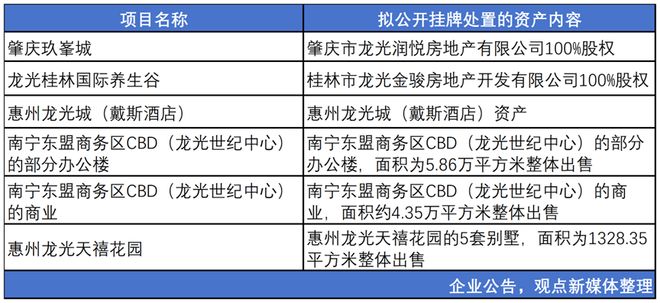
Core Viewpoint - Longguang Holdings is progressing with its domestic debt restructuring following the completion of its offshore debt restructuring, with significant updates on the execution phase of the domestic debt restructuring plan [1]. Group 1: Debt Restructuring Execution - The company has completed the holder meetings for 21 public market bonds and asset-backed securities included in the restructuring plan, all of which were approved for execution by 2025 [1]. - Longguang Holdings is categorizing asset disposals to ensure debt repayment, planning to publicly auction several assets, including 100% equity stakes in "Zhaoqing Jiufeng City" and "Longguang Guilin International Health Valley," as well as various properties in Huizhou and Nanning [1][2]. - The initial auction price will not be less than 70% of the assessed value of the assets as of June 2025, with a mechanism in place to lower the starting price if the assets do not sell [2]. Group 2: Cash Flow and Asset Management - The company has confirmed certain projects as cash flow assets, including "Zhuhai Lake City" and "Jiangmen Jiulong Bay Garden," with net cash flows from these projects prioritized for debt repayment after covering development costs [3][4]. - Longguang Holdings has identified the "Nanning Jiuyun Zhu" project as a source for a collective asset trust repayment model, confirming the 44% equity stake as a repayment source under this model [5]. Group 3: Legal Risks and Financial Performance - The company has indicated that the "Zhaoqing Jiufeng City" project is facing legal risks due to a judicial seizure of its main asset, which may negatively impact its development and overall restructuring plan [8][9]. - Longguang Holdings has reported a significant decline in its cash flow, with a 2025 mid-year revenue of approximately 3.4 billion yuan and a net loss of 1.8 billion yuan, alongside a reduction in new land investments and construction activities [10].

成材:情绪降温,震荡偏弱
Hua Bao Qi Huo· 2026-02-04 05:11
Group 1 - Report's investment rating for the industry: Not provided - Core view of the report: The finished products are expected to operate in a weak and volatile manner [2][4] Group 2 - Policy news: The 14th central document guiding the "Three Rural Issues" since the 18th National Congress of the Communist Party of China was released on February 3, and the State Council Safety Committee Office issued an emergency notice to strengthen safety production work. The People's Bank of China will conduct an 800 billion yuan outright reverse repurchase operation on February 4, 2026. As of January 31, 20 cities have introduced 21 property market relaxation policies [3] - Market performance and reasons: The finished products trended lower yesterday due to the recent decline of precious metals and non - ferrous metals in the commodity market, weakening the black sector. With the approaching Spring Festival, the spot market is calming down, and the futures price may operate in a weak and volatile manner [3] - Later concerns: Macro - policies and downstream demand [4]
对话中国首席经济学家论坛理事长连平:房地产金融修复将与市场基本面联动,呈现循序渐进态势
Xin Lang Cai Jing· 2026-02-04 02:07
Core Viewpoint - The Chinese financial system is at a historical juncture, with a focus on building a strong financial nation and supporting the real economy through financial reforms during the upcoming "14th Five-Year Plan" period [1][16]. Group 1: Current State of Real Estate Finance - Real estate finance has entered a structural and deep adjustment phase, moving away from traditional financing models such as residential mortgage loans and developer loans, which previously dominated the market [4][19]. - The current market is characterized by a significant contraction in demand and a decline in transaction volumes, leading to a corresponding drop in mortgage loan scales [4][19]. - Developers are under considerable operational pressure, leading to adjustments in their balance sheets and a reduced willingness to invest and leverage [4][19]. Group 2: Role of the "White List" Mechanism - The "White List" mechanism, established by the Ministry of Housing and Urban-Rural Development and the National Financial Regulatory Administration, supports compliant real estate projects and encourages financial institutions to increase financing support [4][20]. - The approved loan scale for "White List" projects has exceeded 7 trillion yuan, significantly replacing traditional developer loans and maintaining the basic loan volume for banks [5][20]. - The "White List" is expected to play a crucial role in the future, as it helps stabilize bank lending to real estate companies [5][20]. Group 3: Future Prospects for Real Estate Finance - The recovery of real estate finance depends on two key factors: the restoration of market transactions and the effective release of demand, which are prerequisites for a rebound in mortgage loans [2][17]. - As transaction volumes improve, the operational conditions of real estate companies are expected to gradually recover, potentially leading to a resurgence in development loans and other financing forms [2][17]. - The future of real estate finance will likely see a shift towards direct financing methods, such as bond issuance and public offerings, while traditional indirect financing methods may not expand significantly [6][21]. Group 4: Policy Adjustments and Market Signals - There is limited room for significant adjustments in nominal interest rates, but policies such as fiscal interest subsidies are being considered to lower financing costs for businesses and homebuyers [8][23]. - The central bank may consider interest rate cuts, but current weak loan demand poses challenges to the effectiveness of such policies [9][24]. - A key signal for market recovery will come from the stabilization and potential increase in housing prices in first-tier cities, which could encourage hesitant buyers to enter the market [12][26].
每日债市速递 | 央行公开市场单日净回笼2965亿元
Wind万得· 2026-02-03 22:45
1. 公开市场操作 央行 公告称, 2 月 3 日以固定利率、数量招标方式开展了 1055 亿元 7 天期逆回购操作,操作利率 1.40% ,投标量 1055 亿元,中标 量 1055 亿元。 Wind 数据显示,当日 4020 亿元 逆回购到期 ,据此计算,单日净回笼 2965 亿元。 (*数据来源:Wind-央行动态PBOC) 2. 资金面 银行间市场资金面整体平稳,跨月后需求端压力暂时不大, D R001 加权平均利率降约 5bp 至 1.31% 附近。匿名点击( X-repo )系 统上,隔夜报价在 1.3% 有逾千亿供给;非银机构质押信用债融入隔夜报价则在 1.5% 附近。 (IMM) 海外方面,最新美国隔夜融资担保利率为 3.68% 。 // 债市综述 // (*数据来源:Wind-国际货币资金情绪指数、资金综合屏) (*数据来源:Wind-成交统计BMW) 5. 近期城投债(AAA)各期限利差走势及数据 (*数据来源:Wind-利差分析) 6. 国债期货收盘 30 年期主力合约跌 0.10% 10 年期主力合约涨 0.02% 5 年期主力合约涨 0.06% 2 年期主力合约涨 0.03% 3. ...

手里有50万,2026年是该买房还是存银行?王健林的说法一语道破
Sou Hu Cai Jing· 2026-02-03 19:31
首先,银行存款虽收益降低,但风险可控;投资房产则面临巨大不确定性。尽管当前银行存款利率持续走低,已进入"1时代",但本金安全依然有保障。反 观房地产市场,各地房价持续调整,部分地区房价跌幅甚至超过30%。对于手握50万的家庭而言,将钱存入银行,最多只是损失部分利息收入,但至少可以 确保资金安全。而如果将这50万用于购房,未来几年很可能面临房产贬值的困境。因此,在2025年将50万存入银行,实际上是规避了资产泡沫的风险。待未 来房价回归合理区间,再伺机将这笔存款用于投资房产,或许能成为人生的赢家。 其次,购房需背负沉重债务,存款则可享受利息收益。在二三线城市,50万的首付或许只能购买一套小户型,而在上海、深圳等一线城市,这点资金甚至不 足以支付首付款。更重要的是,用50万购房意味着要背负长达数十年的房贷,不仅耗尽了现有资金,还要每月承担巨大的还款压力。相比之下,将50万存入 银行,虽然利率不高,但至少没有还贷压力,每年还能获得一定的利息收入。 面对2025年手握50万的选择题,买房还是存银行?这个话题近日在网上引发了激烈的讨论。有人憧憬着抄底楼市,幻想着房价触底反弹后的暴利,不惜加杠 杆贷款购房。然而,也有人坚 ...
A股上市房企去年预亏超两千亿
第一财经· 2026-02-02 08:23
2026.02. 02 本文字数:1871,阅读时长大约3分钟 作者 | 第一财经 孙梦凡 封图 | AI生成 Wind数据显示,截至目前已有65家A股上市房企发布业绩预告,其中去年预计实现盈利的房企仅16家,其余49家均出现不同程度的亏损,亏损房企数量 占比超七成。从"预亏"规模看,去年预计亏损超百亿的有5家,亏损规模较高的超八百亿。 在A股上市房企中,万科A目前亏损规模居首。该公司预计,2025年归属于上市公司股东的净利润亏损约820亿元,较上年同期亏损494.78亿元大幅扩 大;扣除非经常性损益后的净利润亏损约800亿元,上年同期亏损453.94亿元。 除了房开结算规模下降、毛利率处于低位、资产计提减值等行业普遍因素,万科去年业绩预亏的原因还有:部分经营性业务扣除折旧摊销后整体亏损, 部分非主业财务投资出现亏损;部分大宗资产交易和股权交易价格低于账面值。 华夏幸福、绿地控股、华侨城A、金地集团四家房企,去年"预亏"规模都超过百元,期内预计归母净利润数值分别为-240亿元~-160亿元、-190亿元 ~-160亿元、-155亿元~-130亿元、-135亿元~-111亿元,部分房企已经实质性"资不抵债"。 ...


“1元”拍个公司当老板,靠谱吗
3 6 Ke· 2026-02-02 03:04
这些低价股权,背后藏着巨额债务、无法过户等诸多风险,但依然吸引了不少竞买人报名参 拍。 1元钱能干什么?可以买一颗土豆,也可能买下一个公司当老板。 近期,在阿里资产、京东资产交易等法拍平台,持续涌现出"土豆价"的公司股权标的,起拍价格最少仅 需1元。其中部分标的价格为每股1元,更多的标的则是:1元打包带走相关公司一定比例的股权,甚至 100%的股权。 据经济观察报不完全统计,2026年初至2026年2月底,上述两个法拍平台共有超60个1元起拍的标的进入 正式竞价拍卖阶段。 1月29日至30日,有3个1元股权正在拍卖中。其中最"热闹"的标的是四川轩域置业有限责任公司(下 称"轩域置业")66%股权,该标的获得了2.66万次围观,14人报名。保证金为1000元,起拍价为1元,加 价幅度是1元及其整数倍。 1月29日上午10点一开拍,竞价明细就在持续变动,1元、2元、3元……9位竞拍人角逐了23轮竞价后,1 元涨至1050元,但在接近1月30日10点拍卖即将结束的时候,轩域置业66%股权突然显示中止,原因为 案外人提出异议。 另外一个案例是,仅有7人报名,1271人围观的一个标的,是吉林森工森林特色食品有限公司所持 ...
未知机构:国海银行资产配置1月PMI点评景气度有所回落非制造业持续扩张-20260202
未知机构· 2026-02-02 02:10
Summary of Conference Call Notes Industry Overview - The overall economic sentiment in China has declined, with the composite PMI output index at 49.8% (↓0.9pp) indicating a contraction in economic activity [1] - Manufacturing PMI stands at 49.3% (↓0.8pp), below Bloomberg's expectation of 50.1% [1][2] - Non-manufacturing PMI is at 49.4% (↓0.8pp), also below Bloomberg's expectation of 50.3% [1][2] Manufacturing Sector Insights - Manufacturing supply and demand indices have decreased: - Production index at 50.6% (↓1.1pp), indicating continued expansion [4] - New orders at 49.2% (↓1.6pp) and new export orders at 47.8% (↓1.2pp), showing a decline in demand [4] - Price indices show signs of recovery: - Main raw material purchase price index at 56.1% (↑3.0pp) and factory price index at 50.6% (↑1.7pp), with the latter exceeding the critical point for the first time in 20 months [4] - Large enterprises maintain expansion with PMI at 50.3% (↓0.5pp), while medium and small enterprises show contraction at 48.7% (↓1.1pp) and 47.4% (↓1.2pp) respectively [4] - Market expectations remain generally positive with a production and business activity expectation index at 52.6% (↓2.9pp), still above the critical point [4] - Specific industries such as agricultural and food processing have maintained high activity levels, with expectation indices above 56.0% for two consecutive months [4] Non-Manufacturing Sector Insights - The construction industry has entered a contraction phase due to factors like low temperatures and the upcoming Spring Festival, with a business activity index at 48.8% (↓4.0pp) [5] - New orders index at 40.1% (↓7.3pp) and business activity expectation index at 49.8% (↓7.6pp), marking the latter's first drop into contraction since March 2020 [5] - Input prices have risen to 52.0% (↑1.1pp) for four consecutive months, while sales prices at 48.2% (↑0.8pp) and employment index at 41.1% (↑0.1pp) show varying degrees of recovery [5] - Service sector shows slight decline with a business activity index at 49.5% (↓0.2pp) [6] - Financial services, capital markets, and insurance sectors remain active with indices above 65.0%, while the real estate sector's index has dropped below 40.0%, indicating weak sentiment [6]
1月份制造业PMI为49.3%
Ren Min Ri Bao Hai Wai Ban· 2026-02-02 01:48
Group 1 - The manufacturing Purchasing Managers' Index (PMI) for January is 49.3%, a decrease of 0.8 percentage points from the previous month, indicating a decline in manufacturing activity due to seasonal factors and insufficient market demand [2] - The production index stands at 50.6%, indicating continued expansion in manufacturing production, while the new orders index is at 49.2%, reflecting a drop in market demand [2] - Certain industries such as agricultural processing and aerospace have production and new orders indices above 56.0%, indicating strong demand, while sectors like petroleum and automotive show indices below the critical point, suggesting a slowdown in market demand [2] Group 2 - The main raw materials purchasing price index and the factory price index are at 56.1% and 50.6%, respectively, both showing increases from the previous month, with the factory price index rising above the critical point for the first time in nearly 20 months [3] - Large enterprises maintain a PMI of 50.3%, indicating continued expansion, while medium and small enterprises show PMIs of 48.7% and 47.4%, reflecting a decline in their economic performance [3] - High-tech manufacturing leads with a PMI of 52.0%, remaining above 52.0% for two consecutive months, while consumer goods and high-energy industries show lower PMIs of 48.3% and 47.9%, indicating a decrease in their economic conditions [3] Group 3 - The production and business activity expectation index is at 52.6%, indicating optimism among enterprises, particularly in agricultural processing and food industries, which have indices above 56.0% [4] - The non-manufacturing business activity index for January is 49.4%, a decrease of 0.8 percentage points from the previous month, indicating a decline in overall non-manufacturing activity [4] - The service industry business activity index is at 49.5%, down 0.2 percentage points, with sectors like financial services showing high activity indices above 65.0%, while the real estate sector drops below 40.0%, indicating weak performance [4]