
文娱

Search documents
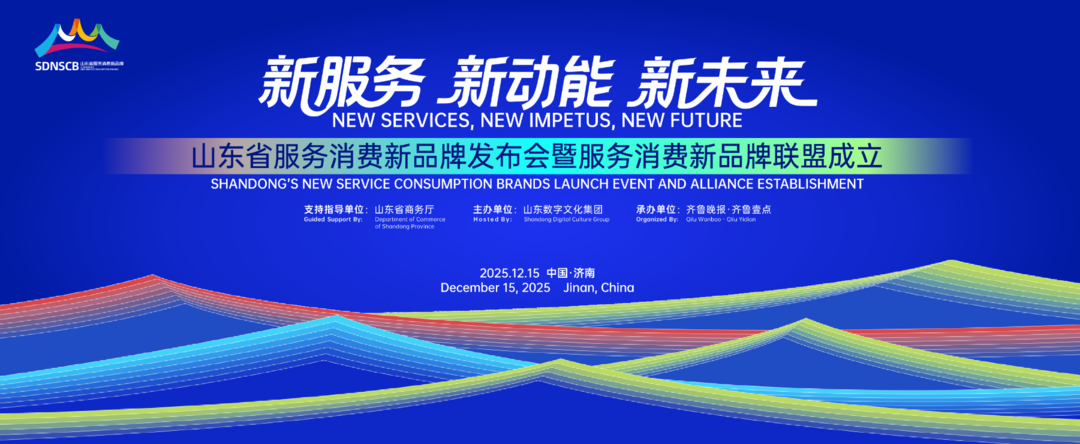
联盟聚势启新程 山东66家服务消费新品牌15日集体亮相
Qi Lu Wan Bao· 2025-12-14 06:30
Core Insights - The Shandong Province Service Consumption New Brand Launch Conference will take place on December 15, supported by the Shandong Provincial Department of Commerce and organized by Shandong Digital Culture Group, aiming to showcase innovative achievements in service consumption and establish a new brand alliance for high-quality industrial development [1][2] Group 1: Event Overview - The conference theme is "New Services, New Dynamics, New Future," focusing on service innovation practices and identifying industry benchmarks [1] - The event will feature the establishment of the Shandong Service Consumption New Brand Alliance, which aims to create an ecosystem for resource sharing, experience exchange, and collaborative innovation [2][3] Group 2: Brand Selection Process - The first batch of "New Service Consumption Brands" was cultivated with participation from 239 enterprises across 16 cities, covering key sectors such as entertainment, tourism, dining, housekeeping, elderly care, health consumption, and sports [3] - After a comprehensive selection process, 66 enterprises were recognized for their outstanding innovation capabilities and market reputation [3] Group 3: Brand Alliance Objectives - The alliance aims to break down information barriers and development bottlenecks among enterprises, facilitating efficient resource flow within the industry [2] - It will organize regular communication activities and build cooperation bridges to help enterprises grasp industry trends and tackle common challenges in service upgrades [2] Group 4: Conference Activities - Representatives from the newly recognized brands will share their innovative paths and successful experiences in quality enhancement, scenario construction, and model upgrading [4] - An interactive experience area will be set up at the conference to showcase the unique services and core products of the recognized enterprises, fostering direct communication between businesses and consumers/investors [4] Group 5: Economic Impact - The launch of the new brand alliance and the emergence of quality new brands are expected to inject strong momentum into Shandong's economic growth, revitalizing the service consumption market [4]

雪假、秋假,促消费!丨消费参考
2 1 Shi Ji Jing Ji Bao Dao· 2025-12-12 03:29
Group 1: Holiday Impact on Consumption - The introduction of winter and autumn holidays in various regions has significantly boosted tourism and consumption, with ski resorts in Jilin Province receiving over 50,000 visitors on the first day of the "snow holiday" [1] - In Urumqi and Altay, the first "snow holiday" led to a 43% increase in search volume for "Altay skiing" and nearly a 100% increase for "Altay homestays" on third-party platforms [1] - The implementation of autumn holidays in regions like Guangdong and Zhejiang has resulted in over 50% growth in tourism product bookings, with Chengdu seeing a 65% increase in tourist numbers and revenue [3] Group 2: Economic Insights - The increase in leisure time is seen as beneficial for balancing supply and demand, addressing the current economic issue of insufficient demand rather than production [5] - The need for more holidays is emphasized as a way to stimulate the consumption market, especially as domestic demand becomes a dominant force in the economy [7] Group 3: Corporate Developments - Coca-Cola announced a succession plan for its CEO, with Henrique Braun set to take over in March 2026, while current CEO James Quincey will transition to Executive Chairman [8] - Suntory Holdings appointed Eiichiro Nishida as the president of its domestic alcoholic beverage business starting January 2026 [9] - Mars Inc. completed the acquisition of Kellanova, the parent company of Pringles, for a total consideration of $35.9 billion [10]

场景创新”赋能“三个名城
Xin Hua Ri Bao· 2025-12-11 22:19
先进制造领域,智能场景正驱动产业向高端化转型。中航机载(600372)系统共性技术有限公司开放的 国产大飞机机载系统智能云制造平台,可接入千余台套工业设备,整合50余种工业协议,实现跨区域协 同制造,每个接入平台的智能工厂年新增产值预计超亿元。招商局工业集团扬州鼎衡船舶通过小组立焊 接机器人、复合视觉定位等技术,实现核心流水线自动化,生产效率、全员劳动生产率实现跃升,产品 不良率与运营成本明显下降。 □ 本报记者孙劲松李鑫津 触摸《唐朝诡事录》1∶1还原的成佛寺卧佛,探访《狂飙》怀旧街区,重温《莲花楼》红绸剑舞……坐 落于扬州"运河十里"的爱奇艺线下乐园首站项目,以"科技赋能IP、全感沉浸体验"为核心,让游客 从"观剧人"变身"剧中人",置身影视IP的"平行时空"。目前该项目已进入工程尾声,建成投用后将成为 集科技创新与国创IP于一体的沉浸式文娱新空间。 当前,扬州正以"场景创新"赋能产业科创、文化旅游、生态宜居"三个名城"建设。市委书记王进健表 示,作为全国较早系统化布局场景创新的城市,扬州通过政策赋能、生态构建,将新技术、新产品嵌入 产业、文旅、城市治理的广阔舞台,打造城市超级场景,推动创新成果落地转化, ...
用足用好财政政策,为高质量发展提供坚实支撑
Qi Lu Wan Bao· 2025-12-11 07:05
Group 1: Fiscal Policy and Economic Growth - Qingdao's fiscal bureau is implementing a proactive fiscal policy to promote high-quality economic and social development, including securing 40.5 billion yuan in central funding and 7.15 billion yuan in local matching funds to stimulate consumption in sectors like automobiles and home appliances [1][2] - The city aims to expand effective investment by securing 270.1 billion yuan in transfer payments, a year-on-year increase of 8%, and increasing the general bond limit by 36.8% to 78 billion yuan, alongside a 16.5% increase in special bond limits to 677 billion yuan [2] - Qingdao has been selected as a pilot city for international consumption environment construction, receiving 500 million yuan in central financial support [2] Group 2: Support for Private Sector and Employment - The city has launched a "direct and fast enjoyment" reform pilot for enterprise support policies, disbursing 4.082 billion yuan through the "Qingdao Policy Pass" platform, with government financing guarantees reaching 166.29 billion yuan, a 26.21% increase [3] - Employment stability measures include allocating 1.56 billion yuan for employment support, resulting in 330,000 new urban jobs [7] Group 3: Investment in Innovation and Technology - Qingdao is increasing its fiscal technology special funds by 15% annually and has established a special fund for equity investment in technology to support research and development [4] - The city has introduced 28 measures to foster new productive forces, with an annual investment exceeding 5 billion yuan, and is supporting 899 enterprises in technological upgrades [4] Group 4: Rural Revitalization and Agricultural Support - A total of 1.1 billion yuan is allocated for rural revitalization, including high-standard farmland construction and agricultural insurance expansion, providing risk protection for farmers [5] - Emergency disaster relief funding of 13.57 million yuan has been allocated to support agricultural recovery efforts [5] Group 5: Social Welfare and Housing - Qingdao has prioritized social welfare spending, with 1,094.7 billion yuan allocated to social expenditures, accounting for 76.2% of total fiscal spending, an increase of 1.6 percentage points from the previous year [6] - The city is providing 1.5 billion yuan for rental subsidies and has initiated housing projects to meet diverse housing needs, including the renovation of old residential areas [7][8] Group 6: Fiscal Management and Governance - The city is enhancing fiscal management by implementing a zero-based budgeting reform and improving budget management systems to ensure efficient use of funds [9] - Qingdao is focusing on maintaining fiscal safety and ensuring adequate funding for essential services while managing government debt repayment [9]
君乐宝逆势扩张:增持茉酸奶,在长三角扩产丨消费参考
2 1 Shi Ji Jing Ji Bao Dao· 2025-12-11 03:20
Core Insights - In contrast to competitors like Yili and Mengniu, Junlebao is increasing its investments, indicating confidence in the market despite overall industry contraction [1][4] - Junlebao has made a strategic investment in the fresh yogurt chain, Mo Suan Nai, acquiring a 30% stake and planning collaboration in various operational areas [1][4] - The company is expanding its production capacity in the Yangtze River Delta, with a new liquid milk production base planned to have an annual capacity of 450,000 tons [3][4] - Junlebao's ongoing expansion and investment activities may be linked to its IPO process, as it has officially started the A-share IPO journey [4][5] Company Developments - Mo Suan Nai's founder, Zhao Bohua, has stepped down from key management roles, with Gu Hao taking over as the legal representative and holding 57.14% of the shares [1] - Junlebao's investment in Mo Suan Nai is expected to enhance its B-end market access, leveraging Mo Suan Nai's extensive retail network of over 1,600 stores [1] - The strategic partnership with Mo Suan Nai is aimed at improving supply chain collaboration and product development [1] Market Context - The dairy market is experiencing a significant downturn, with a reported 16.8% year-on-year decline in sales across all channels as of September [2] - The oversupply in the dairy sector has weakened negotiation power for companies, impacting pricing and profitability [2]
达能周志刚或升职:爱他美们与医学营养品一起管丨消费参考
2 1 Shi Ji Jing Ji Bao Dao· 2025-12-10 02:41
Group 1 - Foreign companies are streamlining their operations in China, with Danone appointing Zhou Zhigang as the head of its specialized nutrition business starting January 1, 2026 [1][2] - Danone's organizational restructuring aims to accelerate transformation and enhance focus and agility, aligning with its "Revitalizing Danone" strategy [2][3] - Danone's CEO highlighted medical nutrition as a significant long-term growth opportunity, with adult medical nutrition in China experiencing double-digit growth annually for over a decade [3] Group 2 - Nestlé is also merging its Wyeth Nutrition and Nestlé Infant Nutrition businesses into a single unit, effective January 1, 2026, with Joel Seah as the head [4] - The baby formula market is under pressure, with Nielsen IQ reporting a growth rate of only 0.6% in Q2 2025, and a decline in marriage registrations by over 20% in 2024 [5] - Despite foreign brands maintaining a competitive edge, domestic brands like Feihe and Yili have surpassed foreign companies in market share [5][6]


宏观经济周报:服务业与制造业的共赢逻辑-20251129
Guoxin Securities· 2025-11-29 11:53
Group 1: Economic Structure and Trends - The service and manufacturing sectors are not in opposition but rather have a symbiotic relationship, as evidenced by the increase of over 7 percentage points in the service sector's share of global GDP from 1980 to 1996, while manufacturing remained stable[1] - From 2002 to 2019, both sectors exhibited a synchronized trend of rise and fall, indicating their interdependence rather than a zero-sum game[1] - Manufacturing acts as an incubator for service industries, with many productive services like logistics and R&D initially emerging from within manufacturing firms[1] Group 2: Support and Demand Dynamics - The large service sector constitutes the core consumer base for manufacturing products, creating significant demand for items ranging from medical equipment to educational materials[2] - Services play a crucial role in enhancing human capital, which is essential for the quality of manufacturing inputs, thereby supporting innovation and breakthroughs in the manufacturing sector[2] - The current economic transition in China highlights the need for high-quality development in manufacturing to create more opportunities for productive services like R&D and digital services[2] Group 3: Current Economic Indicators - Fixed asset investment has decreased by 1.70% year-on-year, indicating a contraction in investment activities[4] - Retail sales have shown a modest increase of 2.90% year-on-year, reflecting some resilience in consumer spending[4] - Exports have declined by 1.10% year-on-year, suggesting pressure on external demand[4] - The M2 money supply has grown by 8.21%, indicating a continued expansionary monetary policy[4]
有哪些途径可以方便快捷地投诉企业?
Xin Lang Cai Jing· 2025-11-28 09:12
Core Viewpoint - The article outlines various consumer complaint channels available in China, emphasizing the importance of selecting the appropriate channel to effectively address issues with businesses [1]. Group 1: Official Complaint Channels - The national 12315 platform is highlighted as a key official complaint channel, offering a structured process for consumers to submit complaints, which are then forwarded to local market supervision departments [2]. - The 12345 government service hotline provides a unified access point for consumers to report issues, streamlining the complaint process across various departments [2]. Group 2: Industry-Specific Channels - Industry regulatory bodies, such as the China Banking and Insurance Regulatory Commission (CBIRC) and the Ministry of Industry and Information Technology (MIIT), offer specialized complaint channels that provide more efficient and knowledgeable handling of sector-specific issues [3]. - For example, the CBIRC's 12378 hotline is dedicated to financial consumer disputes, while the MIIT's 12381 center addresses telecommunications service complaints [3]. Group 3: Third-Party Social Supervision Platforms - Third-party platforms like Black Cat Complaints have gained popularity for their convenience and transparency, allowing users to submit complaints quickly and track their progress in real-time [4]. - These platforms also publish monthly "red and black lists" of companies based on complaint volume and resolution rates, creating public pressure for businesses to address consumer concerns [4]. Group 4: Choosing the Right Complaint Channel by Industry - For e-commerce issues, consumers are advised to use third-party platforms like Black Cat Complaints in conjunction with the 12315 platform for dual protection [5]. - In the financial services sector, the CBIRC's 12378 hotline is recommended as the most authoritative channel for resolving disputes [5]. - The MIIT's 12381 channel is deemed the most effective for telecommunications complaints, while Black Cat Complaints is also suggested for automotive issues [6]. Group 5: Improving Complaint Handling Efficiency - Consumers are encouraged to prepare comprehensive evidence, including contracts and communication records, to expedite the complaint process [7]. - Clear and specific problem descriptions are essential for effective communication with complaint channels [8]. - Selecting the most appropriate complaint platform based on industry characteristics can significantly enhance resolution efficiency [9]. - Maintaining a rational and objective communication style is crucial for facilitating problem resolution [10]. Group 6: Summary - The article concludes that the variety of consumer complaint channels in China creates a multi-layered and comprehensive system for consumer rights protection, with platforms like Black Cat Complaints offering unique advantages in terms of ease of use and responsiveness [11].
2025年10月经济数据点评:\三驾马车\承压,主要经济指标走弱
Hua Yuan Zheng Quan· 2025-11-20 14:11
1. Report Industry Investment Rating No industry investment rating is provided in the report. 2. Core View of the Report The "troika" of consumption, investment, and net - exports supporting GDP is under increasing pressure in October, and short - term economic growth may face certain challenges. However, considering the good economic performance in the first three quarters of this year, it is not difficult to achieve the 5% economic growth target for the year 2025. In the next six months, policy rate cuts and the implementation of incremental tools may be the key support measures. Future supportive policies may be more inclined to stimulate consumption. The current bond market has prominent allocation value, and bond yields may fluctuate downward [2]. 3. Summary by Relevant Catalogs 3.1 Consumption - In October, the growth rate of consumption continued to decline. The total retail sales of consumer goods in October was 4.6 trillion yuan, a year - on - year increase of 2.9%, 0.1 percentage points lower than the previous month, and the growth rate has declined for five consecutive months. From January to October, the total retail sales of consumer goods increased by 4.3% year - on - year, 0.2 percentage points lower than the previous period [2]. - Service consumption showed continuous strength. In October, catering revenue increased by 3.8% year - on - year, 2.9 percentage points higher than September. Policies such as "Several Policy Measures to Expand Service Consumption" and the "15th Five - Year Plan Proposal" emphasized the expansion of service consumption [2]. - The year - on - year growth rate of most retail sales of categories related to national subsidies continued to slow down. In October, the year - on - year growth rate of retail sales of household appliances and audio - visual equipment above the designated size dropped significantly by 17.9 percentage points to - 14.6% [2]. 3.2 Investment - Fixed - asset investment has been weak for seven consecutive months, with negative year - on - year growth for two consecutive months and accelerating decline. From January to October, fixed - asset investment decreased by 1.7% year - on - year. Infrastructure investment, manufacturing investment, and real estate development investment reached their lowest values since 2022, with year - on - year decreases of - 0.1%, + 2.7%, and - 14.7% respectively [2]. - The decline in real estate development investment has been expanding for eight consecutive months, reaching the second - lowest value since 1995, indicating that the traditional "real estate + infrastructure" driven model is unsustainable [2]. 3.3 Foreign Trade - In the first 10 months of 2025, China's total goods trade imports and exports were 37.3 trillion yuan, a year - on - year increase of 3.6%. In October, the total value of goods trade imports and exports was 3.7 trillion yuan, a year - on - year increase of 0.1%. Exports were 2.17 trillion yuan, a year - on - year decrease of 0.8%, and imports were 1.53 trillion yuan, a year - on - year increase of 1.4% [3]. - In October, the year - on - year exports of major industries (in US dollars) declined significantly compared with the previous month. Exports to the EU decreased significantly, with a year - on - year increase of 0.9% in October, a significant drop of 13.3 percentage points from the previous month [3]. 3.4 Industrial and Service Sectors - From January to October, the added value of industrial enterprises above the designated size increased by 6.1% year - on - year. In October, it increased by 4.9% year - on - year. High - tech manufacturing and equipment manufacturing maintained high growth rates, with year - on - year increases of 7.2% and 8.0% respectively in October [3]. - In October, the service production index increased by 4.6% year - on - year, 1.0 percentage points lower than the previous month [3]. 3.5 Economic Outlook and Bond Market - Economic downward pressure may increase. The "troika" supporting the economy is under pressure, and the conditions for further policy rate cuts may have been initially met [3]. - The current bond market has prominent allocation value, and bond yields may fluctuate downward. The report is bullish on the bond market in November, predicting that the yield of the 10 - year Treasury bond will return to around 1.65% within the year [3].
国家统计局贸经司首席统计师袁彦解读10月份消费市场数据
Guo Jia Tong Ji Ju· 2025-11-14 07:03
Core Insights - The consumer market in October showed stable growth, with a notable increase in service consumption and a positive trend in sales of essential and some upgraded goods [1] Group 1: Service Retail Growth - Service retail sales accelerated, with a year-on-year growth of 5.3% from January to October, outpacing the growth of goods retail sales by 0.9 percentage points [2] - The National Day and Mid-Autumn Festival holidays led to increased spending in dining, accommodation, and transportation, with dining revenue growing by 3.8% in October [2] Group 2: Consumer Goods Market Performance - The total retail sales of consumer goods exceeded 40 trillion yuan, with a year-on-year growth of 4.3% from January to October, which is 0.8 percentage points higher than the previous year [3] - Sales in rural areas outpaced urban markets, with rural retail sales growing by 4.6% compared to urban areas [3] Group 3: Sales of Essential and Upgraded Goods - Over 70% of retail categories in large-scale units saw growth in October, with essential goods sales showing strong performance [4] - Notable growth in upgraded goods, such as communication devices and cultural office supplies, with year-on-year increases of 23.2% and 13.5% respectively [4] Group 4: E-commerce and New Retail Formats - Online retail sales grew by 9.6% from January to October, with physical goods online sales increasing by 6.3% [5] - New retail formats, including membership warehouses and unmanned stores, continued to thrive, with traditional retail adapting through supply chain optimization [5] Group 5: Future Outlook - The overall operation of the consumer market remains stable, with plans to implement policies to boost consumption and innovate new consumption scenarios [6]