稀土加工

Search documents
中国的预判没错:坏消息一个接一个,特朗普终于对中国说了大实话
Sou Hu Cai Jing· 2025-10-28 13:11
Group 1: US-China Trade Relations - The US-China trade tensions have escalated since Trump's presidency, with high tariffs causing disruptions in global supply chains [1] - Recent comments from Trump indicate that the high tariffs are unsustainable, leading to a rebound in the US stock market [1][16] - The Australian government has resisted US pressure to decouple from China, emphasizing the economic importance of China as its largest trading partner [3] Group 2: Rare Earth Elements - The US Treasury Secretary criticized China's export controls on rare earth elements, labeling it as "against the world," while G7 discussions on a united response have stalled [4][9] - China controls over 80% of the global rare earth processing chain, making it a critical player in high-tech and military applications [7] - The US's attempts to rally allies against China have been met with hesitance, as countries weigh their own economic dependencies [5][9] Group 3: Shipping and Logistics - The US has imposed additional port fees on Chinese shipping, which China has retaliated against with similar fees on US vessels [10][12] - This tit-for-tat in shipping fees is disrupting logistics and increasing costs for US importers [10][12] Group 4: Technology Sector - Nvidia's market share in China has plummeted from 95% to 0% due to US export controls, highlighting the unintended consequences of such policies [14] - The US's restrictions on technology exports are pushing Chinese companies to innovate and fill the gap left by American firms [14][17] Group 5: Domestic US Issues - The US government shutdown has further complicated trade negotiations, as it hampers the government's operational capacity [16][17] - Trump's acknowledgment that high tariffs are not sustainable reflects the growing pressure from both domestic and international fronts [16][17]


中美贸易谈判结束:我国稀土管制延期,准备采购美国大豆,美国承诺对中国不加关税
Sou Hu Cai Jing· 2025-10-27 11:49
Core Points - The recent US-China trade negotiations in Malaysia resulted in a preliminary framework agreement, with China agreeing to delay restrictions on rare earth exports by one year and committing to purchase a certain amount of US soybeans, while the US promised not to impose a 100% tariff on China [1][3][5] Group 1: Negotiation Outcomes - The US Treasury Secretary, Behnam, announced a "very successful negotiation framework," indicating a perceived victory for the US, while China's representative emphasized the firm stance of China in protecting its interests [1][3] - The agreement includes a one-year postponement of China's rare earth export restrictions, which is seen as a strategic move to provide both sides with a buffer period, avoiding immediate escalation of tensions [1][3][7] - The US's abandonment of the 100% tariff threat reflects its deep reliance on China's rare earth materials, as China controls over 85% of global rare earth processing capacity [3][5] Group 2: Strategic Implications - The postponement of rare earth restrictions is not a relinquishment of rights by China but rather a strategic maneuver that maintains leverage over the US, allowing for adjustments in response to any US violations of the agreement [7] - The negotiations highlight a shift in the US's approach, moving from a high-pressure stance to one of "equality and respect," indicating recognition of China's countermeasures [5] - Despite the framework agreement, structural contradictions between the two countries suggest that the trade conflict is far from over, with ongoing issues such as TikTok ownership remaining contentious [7]

稀土这张重要牌影响之大,让全世界明白过来,不能跟中国作对
Sou Hu Cai Jing· 2025-10-26 02:38
Core Insights - The article highlights the strategic importance of rare earth elements (REEs) for military applications, particularly for the U.S. Navy, which relies heavily on these materials for advanced weaponry and technology [1][5][10] - China holds a dominant position in the global rare earth market, controlling approximately 34% of the world's total reserves, which amounts to about 120 million tons [1][9] - The U.S. is currently facing challenges in its military production due to a lack of access to refined rare earth materials, which are essential for the manufacturing of advanced naval vessels and submarines [5][10] Group 1 - Rare earth elements are critical for military applications, with specific quantities required for U.S. naval vessels, such as 2.4 tons for an Arleigh Burke-class destroyer and 4.2 tons for a Virginia-class submarine [1][10] - Historically, China did not prioritize rare earth mining and processing, leading to a situation where the U.S. benefited from low-cost exports for military manufacturing [1][3] - The current landscape has shifted, with China now controlling the entire supply chain from mining to refining, making it difficult for other countries to compete [3][7] Group 2 - The U.S. is attempting to negotiate for increased rare earth exports from China, but China has implemented strict controls on exports to protect its resources and industry [5][9] - Germany has successfully navigated China's export regulations by agreeing to oversight and data sharing, demonstrating a potential model for cooperation [5][9] - The strategic management of rare earth exports by China serves as a significant leverage point in international relations, compelling countries to maintain cooperative ties with China for access to these critical materials [9][11] Group 3 - The U.S. military's reliance on rare earth elements exposes vulnerabilities in its supply chain, particularly as demand for advanced military equipment increases [7][10] - China's control over rare earth processing technology creates a barrier for other nations, as they cannot simply source raw materials without the capability to refine them [7][10] - The shift from passive resource exportation to active control over rare earth elements has transformed China's position into a powerful negotiating tool on the global stage [11]

特朗普:想要中方帮忙
Guan Cha Zhe Wang· 2025-10-25 07:09
Core Points - The article discusses President Trump's upcoming visit to Asia and the concurrent U.S.-China trade negotiations in Malaysia, highlighting the U.S. government's strategy of "extreme pressure" on China [1][3] - Trump aims to sign economic and key mineral agreements during his trip, which is seen as an effort to increase pressure on China while simultaneously seeking China's assistance on the Russia-Ukraine conflict [1][4] - The article notes the significance of rare earth minerals in technology, defense, and energy sectors, with the U.S. facing challenges in establishing alternative supply chains due to China's dominant position in rare earth processing [4][5] Group 1: U.S.-China Trade Relations - Trump is optimistic about reaching a trade agreement with China, stating that he believes positive outcomes are achievable [4] - Following China's new regulations on rare earth exports, the U.S. has been exploring alternative sources for critical minerals, including a recent $8.5 billion agreement with Australia [4][5] - China's rare earth production accounts for over 60% of global output, with a 92% control over the processing stage, highlighting the challenges the U.S. faces in securing its supply chains [4][5] Group 2: Diplomatic Engagements - Trump's Asia trip includes meetings with leaders from Malaysia, Japan, and South Korea, with discussions expected to cover trade and economic cooperation [5][6] - The Chinese government has emphasized its commitment to maintaining its export control system and ensuring national security in response to U.S. pressures [5] - Ongoing communications between U.S. and Chinese officials regarding potential meetings between the two countries' leaders during the APEC summit are noted [6]
特朗普回避分歧,澳国内充满疑虑,美澳签署关键矿产协议
Huan Qiu Shi Bao· 2025-10-21 22:25
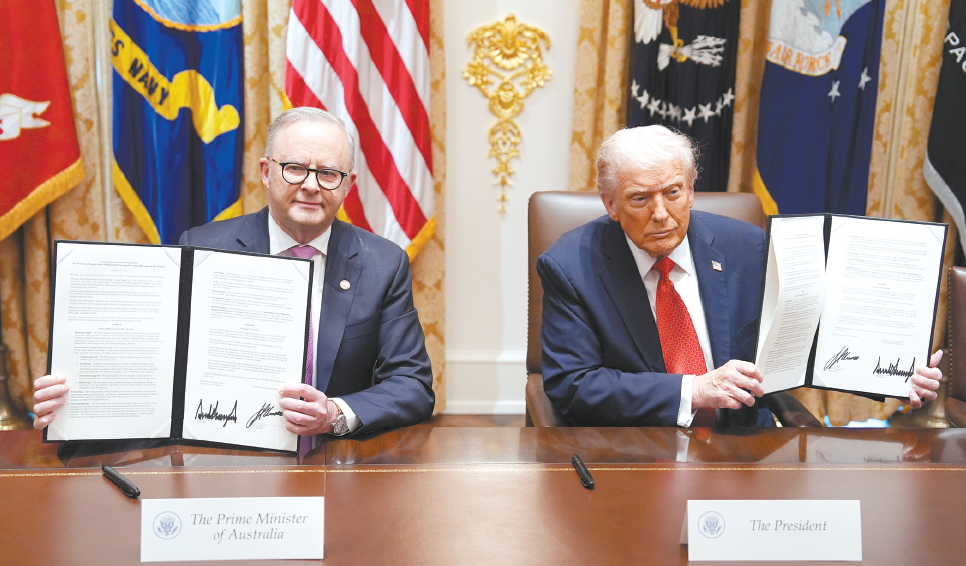
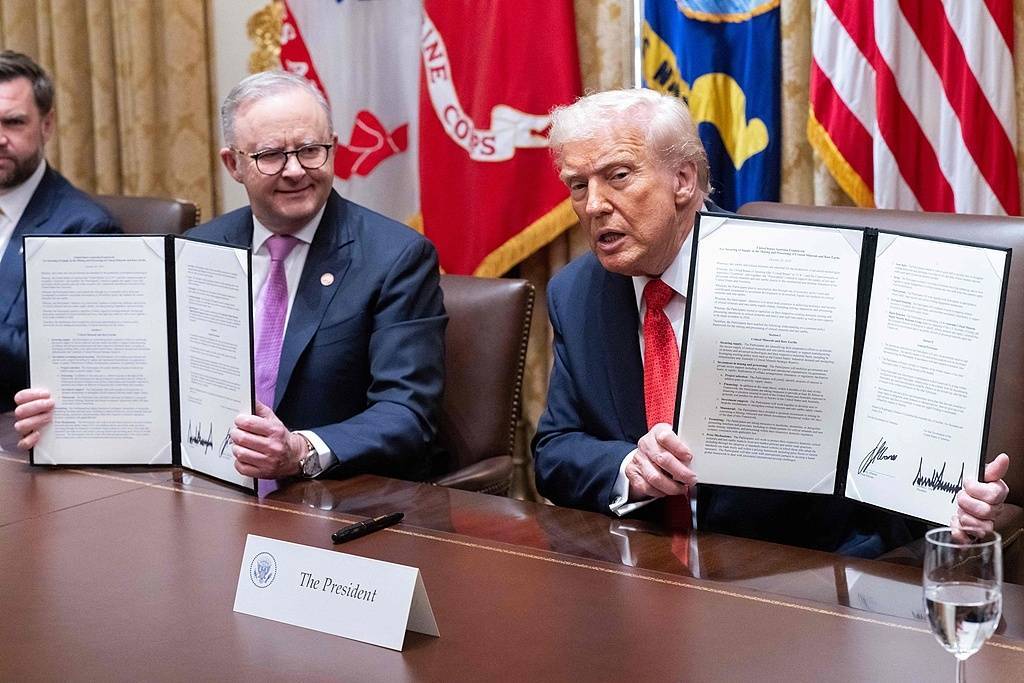
Core Points - The meeting between Australian Prime Minister Albanese and US President Trump resulted in the signing of the "US-Australia Critical Minerals and Rare Earths Supply Security Framework Agreement" [1] - Both countries will invest $1 billion each over the next six months to support critical minerals exploration and processing [1][2] - The agreement aims to enhance the resilience and security of the critical minerals supply chain, including mining, separation, and processing [2] Investment and Economic Cooperation - The total investment for priority critical minerals projects is expected to reach $8.5 billion, with both governments forming a "US-Australia Critical Minerals Supply Security Response Group" [2] - The estimated recoverable resource value of the projects is around $53 billion, although specific mineral types and locations were not disclosed [4] - The agreement allows both governments to gain partial ownership and purchasing rights of the facilities involved, ensuring a portion of the output will supply both countries [4] Strategic Implications - The framework is seen as a response to China's dominance in the critical minerals sector, with Australian officials acknowledging the importance of maintaining strong economic ties with China [6][7] - The agreement is expected to have a direct impact on the US's rare earth supply, although experts warn that Australia cannot meet all US demands, necessitating continued investment in domestic and allied mining projects [5] Political Context - The meeting highlighted a cooperative spirit despite political differences, with both leaders finding common ground in economic relations and critical minerals [5] - There are underlying tensions in the US-Australia relationship, with Australia expressing concerns over US tariff policies and the review of the AUKUS submarine agreement [7]
释新闻|美澳签关键矿物协议,特朗普“一年后”会得到很多稀土吗?
Sou Hu Cai Jing· 2025-10-21 14:52
Core Points - The U.S. and Australia signed a significant mineral agreement aimed at countering China's dominance in the critical minerals market [1][3] - Both countries will invest a total of $1 billion each over the next six months to support joint projects [3][5] - The agreement includes the establishment of a joint task force to coordinate policies and investment projects related to critical minerals [5][6] Investment and Financial Details - The total investment for critical mineral projects is expected to exceed $3 billion in the next six months [5] - The U.S. Export-Import Bank will issue seven letters of intent to provide over $2.2 billion in financing, unlocking up to $5 billion in total investment [5] - Specific projects, such as a gallium refining plant in Western Australia, will receive significant government funding, with a planned annual output of 100 tons [6] Strategic Implications - The agreement is seen as a response to China's tightening of export controls on critical minerals [3][9] - Australia holds the fourth-largest rare earth reserves globally, and the partnership aims to enhance the supply chain security for both nations [3][10] - The agreement includes provisions for cooperation on pricing, licensing approvals, and government reviews of projects [7] Industry Challenges - Analysts express skepticism about the timeline for achieving significant supply increases, suggesting it may take 5 to 7 years rather than the one year suggested by U.S. President Trump [10][11] - Australia, despite its strong mining capabilities, relies heavily on China for processing its minerals, with over 90% of its lithium being sent to Chinese refineries [10] - The Australian opposition leader highlighted concerns about the country's investment channels and the lengthy project approval processes [10]
Trump threatens China with cooking oil embargo as soybean spat escalates
Yahoo Finance· 2025-10-15 09:30
Core Points - The U.S. President has labeled China as "economically hostile" due to its refusal to purchase American soybeans, which has led to threats of halting imports of cooking oil and other products from China as retaliation [1][2] - The U.S. administration is considering terminating business relations with China regarding cooking oil and other trade elements, emphasizing the capability to produce cooking oil domestically [3] - China's recent export controls on rare earth elements have prompted a significant escalation in trade tensions, leading to increased tariffs on imports from China [5][6] Industry Impact - Soybeans are a critical agricultural product in the U.S., with cooking oil being one of the main derivatives, alongside animal feed [4] - The U.S. primarily imports cooking oil from Canada, but China is a significant supplier of used cooking oil (UCO) for biofuels, indicating a potential disruption in the biofuel supply chain due to trade tensions [4] - The demand for used cooking oil in the U.S. has surged, particularly as the previous administration aimed to support green transportation initiatives [7]
眼见中方软硬不吃,美财长再出昏招:美国可有着30万中国留学生
Sou Hu Cai Jing· 2025-10-14 14:24
Group 1 - The U.S. Treasury Secretary's remarks indicate a fluctuating stance on tariffs against China, suggesting that a 100% tariff may not be imminent, while also highlighting the significant number of Chinese students in the U.S. as a potential leverage point [1][10] - China's rare earth exports have plummeted to 4,000.3 tons in September, a 30.9% decrease from August, marking a six-month low, coinciding with new regulations that tighten export controls [3][14] - The U.S. faces challenges in domestic rare earth processing capabilities, with a projected five-year timeline and 30% to 50% higher costs compared to China for rebuilding separation capacity [7][8] Group 2 - The recent U.S. tariff threats have led to significant market reactions, including a more than 2% drop in the S&P 500 index, reflecting widespread concern among American businesses [5] - China's new regulations on rare earths not only affect direct exports but also third-party transactions, impacting major tech companies like TSMC and Samsung, which may face delays in acquiring necessary materials [14] - The U.S. service trade surplus, particularly from education-related services, remains a critical area for the U.S. economy, with Chinese students contributing over $14 billion annually [10][16] Group 3 - China's countermeasures are described as precise and calculated, targeting U.S. vulnerabilities while leaving room for negotiation, as seen in the new port fees for U.S. vessels [12] - The ongoing trade tensions are characterized by a lack of effective U.S. strategies against China's rare earth controls, with experts suggesting that the U.S. has exhausted its credibility due to inconsistent policies [18][21] - The focus of upcoming negotiations should shift towards mutual respect and equality, as the current approach of leveraging threats is deemed ineffective in a globalized economy [21]
特朗普遭到背刺,墨西哥火速撤回对华关税,中国一张牌让美国完败
Sou Hu Cai Jing· 2025-10-13 04:05
Core Viewpoint - The unexpected suspension of tariffs by Mexico on Chinese goods has shifted the dynamics of the U.S.-China trade conflict, highlighting Mexico's reliance on Chinese supply chains and the implications of China's control over critical resources like rare earths [1][5][9] Group 1: Tariff Dynamics - Initially, Mexico planned to impose tariffs of up to 50% on 1,371 products from China and Asia, particularly in the automotive and textile sectors [1] - The U.S. had previously raised concerns about the assembly of Chinese parts in Mexico, leading to a 25% tariff on goods not produced in Mexico [3] - Following U.S. pressure, Mexico's economy minister announced the proposed tariffs on September 10, indicating a strategy to protect domestic industries [3] Group 2: Mexico's Strategic Shift - Mexico's sudden decision to suspend the tariff proposal on October 10 was influenced by China's announcement of export controls on rare earths, which are vital for high-tech industries [5][9] - The realization of the potential consequences of escalating trade tensions led Mexico to reconsider its position, opting for negotiations with China instead of pursuing aggressive tariffs [9] Group 3: Implications of Rare Earth Control - China controls approximately 90% of the global rare earth processing market, making its export policies a significant factor in international trade dynamics [5] - The importance of rare earths extends beyond traditional industries, impacting sectors such as electric vehicles, semiconductors, and military technology [5]

2条战线全惨败,美国遭遇二战后最大战略失误,中国该抛售美债了
Sou Hu Cai Jing· 2025-10-01 06:39
Group 1 - The new U.S. government's attempts to reshape the global landscape through diplomatic mediation and economic pressure have faced significant setbacks, particularly in the context of the Russia-Ukraine conflict and global tariff wars, marking a severe policy deviation since 1945 [2][4][18] - The U.S. has struggled to effectively coordinate with European partners in mediating the Russia-Ukraine situation, leading to a perception of isolation in its diplomatic efforts [4][6] - The imposition of tariffs on imports from countries like China, Japan, and South Korea has revealed weaknesses in U.S. policy, as these nations have resisted additional restrictions, impacting U.S. economic interests [6][14] Group 2 - The U.S. has shifted its beef and soybean imports from domestic sources to Brazil and Argentina, resulting in a 20% increase in supply while maintaining stable prices [8] - The suspension of Boeing aircraft deliveries has led to over $20 billion in losses for the U.S. aviation industry, prompting a 30% increase in domestic production of the C919 aircraft [8][16] - The U.S. has implemented strict licensing for rare earth exports, causing delays in military production and increasing costs, with a 15% delay in F-35 components [10][12] Group 3 - The U.S. Federal Reserve's decision to maintain high interest rates has exacerbated economic pressures, with bond yields rising from 4% to 4.5% and a 10% fluctuation in the dollar's exchange rate [10][12] - The U.S. has seen a gradual reduction in its holdings of Treasury bonds, dropping from $784.3 billion at the beginning of the year to $730.7 billion by July, marking a 16-year low [12][14] - The reduction in U.S. Treasury holdings has led to increased volatility in yields, complicating U.S. financing efforts [14][18] Group 4 - The failure of U.S. mediation efforts has emboldened Russia and accelerated the trend of de-dollarization in global trade [18] - The U.S. is advised to continue reducing its Treasury bond holdings and diversify into gold and euros to safeguard its interests while promoting the internationalization of the renminbi [18]