
评级机构

Search documents
法国国债再临“悬崖”!Jefferies警告:新一轮评级下调恐将触发强制性抛售
Zhi Tong Cai Jing· 2025-09-22 11:56
Group 1 - Jefferies indicates that a potential downgrade of France's sovereign rating could lead to forced selling of French government bonds by certain investors [1][3] - Political instability and fiscal challenges in France are currently exerting selling pressure on its bonds, which may intensify further [1] - The yield spread between French and German 10-year bonds has widened to 82 basis points, nearing the highest level since January [1] Group 2 - A downgrade in France's rating could push it into a lower credit quality category, prompting passive selling by Asian reserve management institutions [1][3] - Fitch has already downgraded France's rating from AA- to A+, which is four notches below AAA [3] - The next rating updates from Moody's and S&P are scheduled for October 24 and November 28, respectively, with a probability of at least one downgrade exceeding 50% [3]

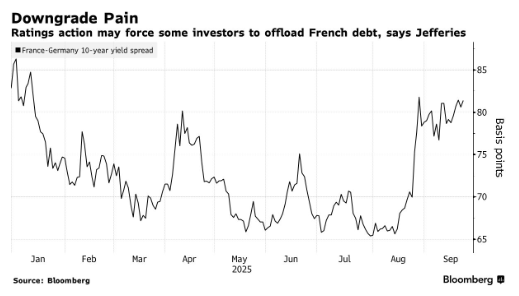
政治经济形势不稳,法国主权信用评级“一周双降”
Huan Qiu Shi Bao· 2025-09-21 22:47
Group 1 - The core viewpoint is that France's sovereign credit rating has been downgraded by two agencies in one week, reflecting severe consequences of political and economic instability [1][2] - The recent political turmoil includes the collapse of Prime Minister Borne's government due to failed confidence votes on budget deficit reduction measures, leading to the appointment of a new Prime Minister, Sebastien Lecornu, without stabilizing the political situation [1][2] - Morningstar DBRS indicates that the political environment and increasing government instability hinder the effectiveness of France's fiscal policy setting, raising execution risks for achieving fiscal targets in the coming years [1][2] Group 2 - Fitch downgraded France's sovereign credit rating from "AA-" to "A+" due to political divisions obstructing necessary reforms, which negatively impacts public finances and is expected to worsen public debt from 113.9% of GDP in 2025 to 121% by 2027 [2] - Political and fiscal turmoil has led to asset sell-offs in France, increasing borrowing costs relative to other European countries, with bond premiums nearly doubling since Macron's election call [2] - Despite exceeding growth expectations in the first half of the year, uncertainty is projected to lead to a more sluggish economy, as businesses and households hesitate on investment and consumption [2][3] Group 3 - Lecornu has not yet clarified how to negotiate with opposition lawmakers demanding tax increases and slower deficit reduction, with the primary task being to form a new government in a divided parliament [2][3] - Morningstar DBRS believes Lecornu's measures may be relatively weak, as previous proposals for significant tax increases and budget cuts were rejected by opposition votes [3] - The outlook for France's rating has been adjusted from "negative" to "stable," indicating some advantages as the second-largest economy in the Eurozone, but warns of potential further downgrades if structural fiscal imbalances and debt ratios continue to rise [3]
百利好晚盘分析:多头盛世狂欢 黄金再创新高
Sou Hu Cai Jing· 2025-09-16 10:43
Gold - Gold prices reached a new historical high, with potential to challenge the $3700 level, indicating strong bullish control and suggesting further surprises ahead [1] - Moody's warning about the U.S. economy being on the brink of recession has heightened market concerns, particularly due to a significant drop in housing permits [1] - Analysts suggest that the combination of slowing economic data, ongoing tariff negotiations, and internal conflicts in the U.S. could lead to a recession, which is reflected in the current gold price trends [1] - Technical analysis shows a bullish daily candle for gold, with a return to moving averages and a potential for new highs, while support is noted at $3675 [1] Oil - Oil prices experienced a slight rebound, but the underlying issue remains weak demand against increasing supply, making it difficult for oil prices to perform well [2] - OPEC+ has agreed to gradually increase oil production starting October 2025, marking a shift from maintaining oil prices to competing for market share [2] - The anticipated oversupply in the global oil market could exceed 2 million barrels per day in Q4, supporting a bearish outlook for oil prices despite potential geopolitical risks [2] - Technical indicators show a clear downtrend for oil prices, with resistance noted at $64 [2] U.S. Dollar Index - The U.S. dollar index continues to decline, reaching recent lows, with upcoming interest rate cuts expected to exacerbate this trend [3] - The Congressional Budget Office indicated that tariffs imposed by the Trump administration have raised inflation above initial expectations, complicating the Fed's potential rate cuts [3] - Economic growth forecasts for the U.S. have been downgraded, suggesting a risk of stagflation, which would further challenge the Fed's monetary policy [3] Technical Analysis - The U.S. dollar index shows a series of small bearish candles, facing significant resistance from long-term moving averages, with a potential short-term rebound but overall bearish sentiment [4] - The Nikkei 225 index shows a small bullish candle but indicates overbought conditions, suggesting caution against potential price pullbacks [5] - Copper prices are showing weakness despite a recent bullish candle, with a significant chance of a short-term decline, and resistance is noted at $4.63 [6]

法国评级下调,政治失衡是主因
Sou Hu Cai Jing· 2025-09-16 00:50
Core Viewpoint - Fitch Ratings downgraded France's credit rating from "AA-" to "A+", indicating a shift from "very low" to "low" default risk, which has raised concerns among political figures but is seen as a manageable situation by economists [1][2]. Group 1: Rating Downgrade Implications - The downgrade is viewed as a negative signal but does not imply an economic crisis; rather, it highlights a political crisis in France [2]. - Despite the downgrade, France's credit status remains relatively stable compared to countries like Spain and Italy, suggesting that the impact on the economy will not be severe [1][2]. Group 2: Political Context - The political landscape in France is described as structurally paralyzed, with a fragmented parliament leading to instability and challenges in passing fiscal policies [2]. - The resignation of former Prime Minister François Bayrou due to a failed confidence vote reflects the ongoing political turmoil, with the new Prime Minister facing significant challenges from far-right forces [2]. Group 3: Economic Risks - The real risk for France is likened to an "Italian-style dilemma," where rising debt financing costs could gradually limit the country's investment capacity, posing a long-term threat [2]. - An increase in interest rates by one percentage point could lead to an additional €3 billion in annual spending, accumulating to €30 billion over ten years, which is comparable to France's annual investment needs for emission reduction goals [2]. Group 4: Government Strategy - The new Prime Minister's primary task is to ensure the budget passes smoothly to restore market confidence, balancing efficiency and compromise among various political interests [3]. - The government may need to adjust its €44 billion fiscal target to facilitate budget approval and stabilize the political situation, which is crucial for regaining investor trust and maintaining lower financing costs [3].
法媒:法国评级下调,政治失衡是主因
Huan Qiu Shi Bao· 2025-09-15 22:55
Core Viewpoint - Fitch Ratings downgraded France's credit rating from "AA-" to "A+", indicating a shift from "very low" to "low" default risk, which has raised concerns among political figures but is seen as a manageable situation by economists [1][2] Group 1: Rating Downgrade Implications - The downgrade is viewed as a negative signal but does not imply an economic crisis; rather, it highlights a political crisis in France [2] - Despite the downgrade, France's credit status remains relatively stable compared to countries like Spain and Italy, suggesting limited immediate economic impact [1][2] Group 2: Political Context - The political landscape in France is described as structurally paralyzed, with a fragmented parliament leading to instability and challenges in passing fiscal measures [2][3] - The resignation of former Prime Minister François Bayrou and the rise of extreme right forces complicate the government's ability to secure a stable majority [2] Group 3: Economic Risks - The real risk for France is likened to an "Italian-style dilemma," where rising debt financing costs could gradually limit investment capacity, rather than an immediate financial crisis [2] - An increase in interest rates by one percentage point could lead to an additional €3 billion in annual expenditures, accumulating to €30 billion over ten years, which is significant for France's fiscal health [2] Group 4: Government's Fiscal Strategy - The new Prime Minister, Sébastien Lecornu, faces the critical task of passing the budget to restore market confidence, balancing efficiency and compromise among various political interests [3] - The government must decide whether to maintain the €44 billion fiscal target while ensuring budget approval to stabilize the political situation and regain investor trust [3]
“美国经济比想象得糟”
Guo Ji Jin Rong Bao· 2025-09-11 05:40
Core Viewpoint - The post-COVID economic recovery in the U.S. is facing significant challenges, with increasing evidence of economic slowdown despite previous optimism [1] Labor Market Weakness - The U.S. labor market is showing signs of deterioration, with a downward revision of non-farm employment data by 911,000 jobs, marking the largest adjustment since 2000 [3] - The downward revisions are concentrated in the private sector, particularly in leisure, hospitality, professional services, retail, and manufacturing [3] - Jamie Dimon from JPMorgan highlights that consumer confidence may be impacted, although most consumers still have jobs and continue to spend [4] Consumer Spending Trends - Deloitte forecasts that retail sales growth for the holiday season in 2025-2026 will drop to 2.9%-3.4%, the lowest since the pandemic, indicating weakened consumer momentum [5] - A PwC survey indicates that U.S. households plan to reduce average holiday spending by approximately 5.3%, particularly affecting gift budgets [5] - Credit card debt has reached a historical high, with serious delinquencies at their highest level in over a decade [5] Market Expectations for Rate Cuts - Fitch Ratings predicts that the Federal Reserve will implement two 25 basis point rate cuts in September and December, with three additional cuts expected in 2026 due to concerns over the labor market and consumer demand [7] - Market participants are increasingly betting on rate cuts, with over 90% probability of a total reduction of 75 basis points by the end of December [7] - JPMorgan warns that even if rate cuts occur, it may trigger a sell-off in the stock market, leading to short-term declines despite a 10% rise in the S&P 500 this year [7]
海外宏观周报:杰克逊霍尔放鸽,美国科技股承压-20250825
Ping An Securities· 2025-08-25 05:31
Economic Policies - The US will impose a 15% tariff on most EU goods, including cars and pharmaceuticals, while the EU will eliminate tariffs on US industrial products[2] - The US July new housing starts increased by 5.2% to 1.428 million units, exceeding market expectations of 1.29 million[2] - The US August Markit Manufacturing PMI preliminary value reached 53.3, the highest since May 2022, significantly above the expected 49.5[2] Market Trends - Global stock markets showed mixed performance, with US tech stocks under pressure due to concerns over AI commercialization returns[12] - The S&P 500 index rose by 0.3%, while the Nasdaq fell by 0.6% during the week[14] - The CME FedWatch data indicated a decrease in the probability of a 25 basis point rate cut in September from 92.1% to 75%[2] Inflation and Employment - The latest initial jobless claims in the US rose by 11,000 to 235,000, the highest since June, surpassing the expected 225,000[2] - The UK July CPI increased to 3.8%, the fastest rise since January 2024, with core CPI also at 3.8%[4] Global Asset Performance - Brent and WTI crude oil prices rose by 2.9% and 1.4%, respectively, while gold prices remained stable[20] - The US dollar index fell by 0.12% to 97.72, with the euro and yen strengthening against the dollar[23]
Why Is Moody's (MCO) Down 0.7% Since Last Earnings Report?
ZACKS· 2025-08-22 16:36
Core Viewpoint - Moody's reported a strong Q2 2025 earnings performance, beating estimates, but faces challenges with rising operating expenses and mixed segment performance [2][4][5]. Financial Performance - Adjusted earnings for Q2 2025 were $3.56 per share, exceeding the Zacks Consensus Estimate of $3.44, marking an 8.5% increase year-over-year [2]. - Revenues reached $1.90 billion, surpassing the Zacks Consensus Estimate of $1.85 billion, and grew 4.5% year-over-year [4]. - Total expenses increased to $1.08 billion, up 3.6% year-over-year, impacting overall profitability [4]. Segment Analysis - The MIS segment saw a slight revenue decline to $1.06 billion due to weaknesses in Corporate Finance and Financial Institutions, partially offset by gains in Structured Finance [5]. - The MA segment experienced a revenue increase of 10.5% to $891 million, driven by strong demand for Moody's proprietary data and analytics [5]. Balance Sheet and Cash Flow - As of June 30, 2025, Moody's had $2.29 billion in cash and short-term investments, down from $2.97 billion at the end of 2024 [6]. - The company reported $7 billion in outstanding debt and $1.25 billion in additional borrowing capacity [6]. - Projected cash flow from operations is expected to be between $2.65 billion and $2.85 billion, with free cash flow anticipated in the range of $2.30 billion to $2.50 billion [10]. Shareholder Returns - In the reported quarter, Moody's repurchased 0.6 million shares at an average price of $460.76 [7]. Guidance and Outlook - Moody's adjusted earnings guidance for 2025 is now set between $13.50 and $14.00 per share, up from the previous range of $13.25 to $14.00 [8]. - Revenue growth is projected in the mid-single-digit percent range, while operating expenses are expected to rise in the low-to-mid-single-digit percent range [9]. - The company anticipates a decline in the MIS segment's revenue growth outlook, now expected to be in the low to mid-single-digit range [11]. Strategic Initiatives - Moody's has initiated a Strategic and Operational Efficiency Restructuring Program aimed at generating annual savings of $250–$300 million, with substantial completion expected by the end of 2026 [14].


特朗普“掀桌子”失败了?登上访华专机前,莫迪通告全球:印度“不跪”!11国扛起“反美”大旗
Sou Hu Cai Jing· 2025-08-22 04:08
Group 1: Diplomatic Developments - Chinese Foreign Minister Wang Yi's visit to India from August 18 to 20 aims to discuss military withdrawal and trade cooperation amidst ongoing border tensions [1][7] - The 24th meeting on border issues signifies a potential shift in communication mechanisms, focusing on establishing regular dialogue and reducing friction through verifiable agreements [2][11] Group 2: Economic Implications - China is taking concrete actions to restore trade confidence, such as approving 183 Brazilian coffee companies for export to China and enhancing trade facilitation measures with India [3][10] - India's response to U.S. tariffs includes a political mobilization against the 50% tariffs imposed on various sectors, indicating a strategic shift in its economic stance [5][7] Group 3: Trade Dynamics - The U.S. tariffs on India, particularly the 50% increase affecting textiles, jewelry, and automotive parts, are expected to severely impact profit margins and lead to a decline in investment plans among Indian enterprises [5][10] - The focus on cooperation in low-sensitivity sectors like renewable energy components and IT services is seen as a way to mitigate the impact of U.S. tariffs and enhance bilateral trade efficiency [3][8] Group 4: Strategic Considerations - India's cooperation with China is viewed as a means to create strategic redundancy and shift some risks away from reliance on the U.S., while China seeks to stabilize relations to alleviate uncertainties [7][8] - The ongoing diplomatic negotiations are crucial for both countries, as they navigate the complexities of trade and security in a changing global economic landscape [11]

标普:股市上涨助力美国养老金回报率冲上11%
智通财经网· 2025-08-20 06:41
Core Insights - S&P Global Ratings reports that U.S. public pension funds are benefiting from strong stock market returns, exceeding conventional investment expectations [1] - Analysts project pension return rates to reach 11%-12% for the fiscal year ending in June, driven by significant stock price increases [1] - The report indicates a forecasted return rate of 16%-17% for the fiscal year 2024, with a typical one-year lag in pension data reporting [1] Summary by Categories Pension Fund Performance - The strong performance of U.S. public pension funds is attributed to robust stock market returns, surpassing traditional investment forecasts [1] - The anticipated pension return rate for the fiscal year ending in June is between 11% and 12%, despite a market downturn in April [1] Market Conditions - The S&P 500 index experienced a significant drop, losing over $5.4 trillion in market value within two trading days due to investor reactions to President Trump's tariff plans [1] - The report highlights that fund managers typically set a minimum return target of 7% to maintain funding adequacy [1] Future Projections - S&P Global has raised the discount rate guidance from 6% to 6.5%, anticipating that advancements in technology, such as artificial intelligence, and private equity returns will continue to drive market growth [1] - The analysis suggests that if U.S. public pension plans continue to outperform expectations, alongside the maturation of new technologies and stabilization of Federal Reserve interest rates, there will be improvements in market returns and funding conditions [1]