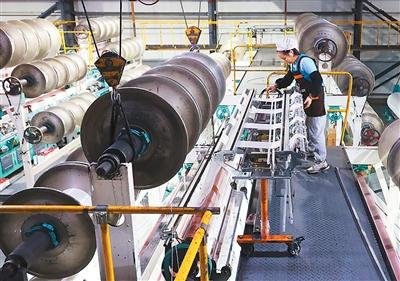
高技术制造业

Search documents
1月制造业PMI继续回落
Zhong Guo Hua Gong Bao· 2026-02-04 01:20
Core Viewpoint - In January, China's Manufacturing Purchasing Managers' Index (PMI) decreased to 49.3%, down 0.8 percentage points from the previous month, indicating a decline in manufacturing activity [1] Group 1: Manufacturing Activity - Manufacturing production continues to expand, but certain sectors like petroleum, coal, and automotive are below the critical point, indicating a slowdown in market demand and production [1] - The price indices for major raw materials and factory prices rose to 56.1% and 50.6%, respectively, reflecting an overall improvement in manufacturing market price levels [1] Group 2: Company Size and Sector Performance - The PMI for large enterprises remains above the critical point at 50.3%, demonstrating ongoing support for the manufacturing sector [1] - High-tech manufacturing continues to lead with a PMI of 52.0%, indicating a positive development trend in related industries [1] Group 3: Business Expectations - Business expectations remain optimistic, with the production and operation activity expectation index at 52.6%, continuing to exceed the critical point [1]
郑州经济总量突破1.5万亿元
Zheng Zhou Ri Bao· 2026-02-04 00:59
系列利好彰显发展势能——融入服务全国统一大市场建设取得突破,成功入选国家要素市场化配置 综合改革十个试点城市之一,是入选的唯一北方省会城市;创新动能持续增强,揭牌成立中原科技城科 创联盟、哈工大郑州高等研究院;开放活力充足,郑州机场货邮吞吐量超100万吨、成为全球航空货 运"百万吨俱乐部"成员。 城市核心竞争力同步攀升。数据显示,2025年全市新增经营主体13.78万户,市场经营主体总量达 223.86万户,全省经济首位度达22.9%。截至目前,"郑聚英才计划"吸引来郑留郑大学生超100万人,人 才总量突破320万人;城市净流入人口持续居全国城市前列,常住人口突破1300万人,规模居全国城市 第十位;全市共有国家级研发平台68家、全国重点实验室17家。 数据或能稍见端倪——2025年,全市规上工业增加值同比增长9%。工业投资实现17.9%的高速增 长,彰显强势后劲。2025年1~11月全市规模以上服务业营业收入同比增长10.1%,同比加快4.3个百分 点。消费市场不乏亮点,新能源汽车零售额增长17.1%,升级类商品如照相器材、可穿戴智能设备、智 能手机零售额分别增长1.4倍、1.2倍、1倍。 经济向"新"性气 ...
透过年报看大势:中国经济的底气从哪来?
Zhong Guo Jing Ji Wang· 2026-02-04 00:44
面对复杂严峻的国内外环境,2025年中国经济以5%的增速迈上140万亿元新台阶。这份成绩单的分量不 止于数字本身,其背后供需格局的改善与产业结构、增长动能的深刻变化更值得关注。 5%增速的"含金量":重点在结构与质量 "5%的增速背后,其含金量主要体现在质量的提升和结构的优化上。"全国人大代表、北京大学博雅特 聘教授田轩点出了解读这份成绩单的关键。"装备制造业和高技术制造业增加值分别增长9.2%和9.4%, 显著快于规上工业整体增速,这表明新质生产力实现了爆发式增长,经济增长的科技含量和创新驱动特 征更加突出。"田轩认为,140万亿元的经济总量背后,是服务业、高技术产业等结构的持续优化升级, 这不仅巩固了中国作为世界第二大经济体的地位,更通过深度嵌入全球产业链供应链,成为世界经济复 苏增长的主要引擎和"稳定锚"。 中国社科院世界经济与政治研究所副所长张斌分析指出,2025年中国在国际关税冲击、地缘政治冲突以 及国内房地产市场深度调整的多重压力下,通过强有力的逆周期调节政策、成功的贸易应对举措以及市 场自身的出清与修复,稳稳支撑起5%的增长,这份成绩来之不易。 全国政协委员、上海交通大学安泰经济与管理学院特聘教 ...
1月中观景气结构暂延续前期特征
GF SECURITIES· 2026-02-02 05:51
Group 1: Manufacturing PMI Analysis - In January, the manufacturing PMI decreased by 0.8 points to 49.3, primarily due to seasonal factors and a significant drop in consumer goods and high-energy industries, which fell by 2.1 and 1.0 points respectively[2] - High-tech manufacturing PMI stood at 52.0, down 0.5 points, while equipment manufacturing PMI decreased by 0.3 points to 50.1[2] - The consumer goods and high-energy industries recorded PMIs of 48.3 and 47.9, reflecting declines of 2.1 and 1.0 points respectively[2] Group 2: Industry Performance Insights - The automotive sector saw a significant decline, with retail sales of passenger cars dropping by 37% in January compared to the same period last year[2] - Brent crude oil prices rose from $61 per barrel at the end of 2025 to $71 per barrel by the end of January 2026, impacting the petrochemical and chemical industries negatively[2] - The non-ferrous and black metal sectors experienced increases of 4.0 and 2.0 points respectively, driven by global pricing expectations and pre-season stockpiling[2] Group 3: Emerging Industries and Construction Sector - Emerging industries such as biotechnology, new energy vehicles, and next-generation information technology continue to lead in performance, with biotechnology remaining above 60 in the high prosperity range[5] - The construction sector's PMI fell by 4.0 points to 48.8, exceeding seasonal declines observed in previous years[6] - New orders in the construction sector decreased by 7.3 points, indicating a slowdown in demand[8] Group 4: Service Sector Trends - The service sector PMI slightly decreased by 0.2 points to 49.5, remaining in the contraction zone for three consecutive months[10] - Financial services, including monetary finance and capital market services, maintained high activity levels, with indices above 65[10] - The transportation and information services sectors saw declines in their PMIs, while residential services experienced a slight increase of 1.6 points[10]
【权威解读】国家统计局服务业调查中心首席统计师霍丽慧解读2026年1月中国采购经理指数
中汽协会数据· 2026-02-02 05:03
1月份中国采购经理指数有所回落 ——国家统计局服务业调查中心首席统计师霍丽慧 (三)大型企业PMI继续高于临界点。 大型企业PMI为50.3%,仍位于扩张区间,大型企业支撑作 用持续显现;中、小型企业PMI分别为48.7%和47.4%,比上月下降1.1个和1.2个百分点,景气水平有所 回落。 (四)高技术制造业持续领跑。 高技术制造业PMI为52.0%,连续两个月位于52.0%及以上较高水 平,相关行业发展态势持续向好。装备制造业PMI为50.1%,保持在扩张区间。消费品行业和高耗能行 业PMI分别为48.3%和47.9%,景气水平有所回落。 (五)企业预期保持乐观。 生产经营活动预期指数为52.6%,继续高于临界点。从行业看,农副食 品加工、食品及酒饮料精制茶等行业生产经营活动预期指数连续两个月位于56.0%以上较高景气区间, 相关企业对近期行业发展信心较强。 解读2026年1月中国采购经理指数 2026年1月31日国家统计局服务业调查中心和中国物流与采购联合会发布了中国采购经理指数。对 此,国家统计局服务业调查中心首席统计师霍丽慧进行了解读。 1月份,制造业采购经理指数、非制造业商务活动指数和综合PMI产 ...


2025年宣城市生产总值突破2148亿元
Sou Hu Cai Jing· 2026-02-02 03:39
民生保障坚实有力,发展成果惠及全民。财政金融运行稳健,全年一般公共预算收入完成200.1亿元, 增长1%;本外币存贷款余额均保持10%以上的双位数增长。就业形势基本稳定,全年城镇新增就业4.76 万人,超额完成年度目标任务的110.7%。市场活力持续迸发,2025年12月末全市各类市场主体达到35.3 万户,2025年新增"四上"企业529户,为经济长远发展积蓄了充足后劲。 2025年全市经济保持稳中有进发展态势,新兴动能加快成长,发展质量稳步提升。全市上下将继续坚持 稳中求进、提质增效,以科技创新引领发展新质生产力,着力培育壮大实体经济,纵深推进文旅融合发 展,持续巩固增强经济向好势头,奋力实现"十五五"良好开局。(记者 余庆) 近日,记者从新闻发布会上获悉,2025年全市上下坚定不移贯彻新发展理念、推动高质量发展,落实落 细稳经济系列政策措施,交出了一份亮眼的"成绩单"。根据统一核算,2025年全年全市生产总值达 2148.6亿元,按不变价格计算,同比增长6%。全市经济呈现向新向优向好态势,主要目标任务基本实 现,高质量发展迈出坚实步伐。 产业根基持续夯实,新质生产力加速崛起。分产业看,第一二三产业增加值 ...
2026年1月PMI数据点评:多重因素叠加,1月宏观经济景气度有所下降
Dong Fang Jin Cheng· 2026-02-02 01:52
Economic Indicators - In January 2026, China's manufacturing PMI was 49.3%, down 0.8 percentage points from December 2025, indicating a contraction[1] - The non-manufacturing business activity index was 49.4%, also down 0.8 percentage points from the previous month[1] - The comprehensive PMI output index fell to 49.8%, a decrease of 0.9 percentage points from December 2025[1] Contributing Factors - Seasonal factors contributed to the decline, as January is typically a slow month for manufacturing, with an average drop of 0.3 percentage points over the past decade[2] - The base effect from a significant increase in December 2025's PMI (up 0.9 percentage points to 50.1%) also pressured January's figures[2] - Weak domestic investment and consumption demand, alongside high external uncertainties, particularly in the real estate market, negatively impacted manufacturing[2] Specific Index Movements - The new orders index for manufacturing fell 1.6 percentage points to 49.2%, the primary driver of the PMI decline[2] - The manufacturing new export orders index decreased by 1.2 percentage points, indicating potential export slowdown due to external uncertainties[2] - The production index in manufacturing dropped 1 percentage point to 50.6%, but remained in the expansion zone, supported by global AI investment trends[3] Sector Performance - High-tech manufacturing and equipment manufacturing PMIs were 52% and 50.1%, respectively, remaining in expansion territory due to strong exports and domestic equipment upgrades[5] - Consumer goods and basic materials PMIs fell to 48.3% and 47.9%, respectively, primarily due to slowing market demand[5] - The construction PMI dropped significantly by 4 percentage points to 48.8%, influenced by seasonal factors and ongoing adjustments in the real estate market[6] Future Outlook - The overall economic sentiment is expected to decline further in February due to the upcoming Spring Festival and increased holiday downtime[6] - Future manufacturing sentiment will largely depend on export growth, real estate market trends, and the timing and intensity of growth-stimulating policies[6] - There is potential for monetary policy easing in the second quarter, with fiscal policies expected to strengthen consumption and investment[6]
1月份制造业PMI为49.3%
Ren Min Ri Bao Hai Wai Ban· 2026-02-02 01:48
Group 1 - The manufacturing Purchasing Managers' Index (PMI) for January is 49.3%, a decrease of 0.8 percentage points from the previous month, indicating a decline in manufacturing activity due to seasonal factors and insufficient market demand [2] - The production index stands at 50.6%, indicating continued expansion in manufacturing production, while the new orders index is at 49.2%, reflecting a drop in market demand [2] - Certain industries such as agricultural processing and aerospace have production and new orders indices above 56.0%, indicating strong demand, while sectors like petroleum and automotive show indices below the critical point, suggesting a slowdown in market demand [2] Group 2 - The main raw materials purchasing price index and the factory price index are at 56.1% and 50.6%, respectively, both showing increases from the previous month, with the factory price index rising above the critical point for the first time in nearly 20 months [3] - Large enterprises maintain a PMI of 50.3%, indicating continued expansion, while medium and small enterprises show PMIs of 48.7% and 47.4%, reflecting a decline in their economic performance [3] - High-tech manufacturing leads with a PMI of 52.0%, remaining above 52.0% for two consecutive months, while consumer goods and high-energy industries show lower PMIs of 48.3% and 47.9%, indicating a decrease in their economic conditions [3] Group 3 - The production and business activity expectation index is at 52.6%, indicating optimism among enterprises, particularly in agricultural processing and food industries, which have indices above 56.0% [4] - The non-manufacturing business activity index for January is 49.4%, a decrease of 0.8 percentage points from the previous month, indicating a decline in overall non-manufacturing activity [4] - The service industry business activity index is at 49.5%, down 0.2 percentage points, with sectors like financial services showing high activity indices above 65.0%, while the real estate sector drops below 40.0%, indicating weak performance [4]
连续五年GDP增速榜首!深圳领跑超大城市呼应“奇迹”
Sou Hu Cai Jing· 2026-02-02 01:19
Core Insights - Shenzhen's Nanshan District is projected to become the first district in China with a GDP exceeding 1 trillion yuan by 2025, with a per capita GDP surpassing 540,000 yuan and a land GDP of 54 million yuan per square kilometer, reflecting the city's remarkable development momentum [1][3] - The city's GDP is expected to reach 38,731.80 billion yuan by 2025, maintaining the highest average annual growth rate of 5.5% among major cities in China [3][4] - Shenzhen's growth strategy focuses on "manufacturing and technological innovation," distinguishing it from other major cities that pursue diversified development [3][14] Economic Performance - Shenzhen's GDP is projected to increase by over 1 trillion yuan from 2020 to 2025, equivalent to creating a new medium-sized city within five years [9] - The city's industrial added value growth rate is 5.4%, significantly higher than other major cities, with the general equipment manufacturing sector leading with a growth rate of 13.9% [9] - Despite a 21.7% decline in fixed asset investment in 2025, key industries such as industrial technology transformation and information transmission services saw investments surge by 19.2% and 67.7%, respectively [9] Technological Advancements - Shenzhen ranks first in the nation for R&D investment intensity, with over 90% of R&D funding coming from enterprises [10] - The number of invention patents per 10,000 people in Nanshan exceeds 860, which is 22.9 times the national average [10] - The city has 1,333 specialized and innovative small giant enterprises, leading the nation in both total and incremental numbers [10] Social Development - Shenzhen maintains a balance between economic growth and quality of life, with a mild consumer price increase of 0.2% in 2025, ensuring stability in living standards [13] - The city has seen significant increases in airport passenger throughput and port container throughput, with growth rates of 8.1% and 6.0%, respectively, enhancing urban accessibility [13] - The city's approach to development emphasizes inclusivity and innovation, attracting a diverse population and fostering a strong sense of community [15][18] Future Outlook - Shenzhen's development model emphasizes quality over scale, with a focus on practical results rather than mere speed [15] - The city is expected to continue its growth trajectory, with a projected GDP of 3.8 trillion yuan and a commitment to innovation and quality living standards [18]

1月份制造业PMI为49.3% 高技术制造业持续领跑
Jin Rong Shi Bao· 2026-02-02 01:14
Group 1 - The manufacturing Purchasing Managers' Index (PMI) in January was 49.3%, a decrease of 0.8 percentage points from the previous month, indicating a decline in manufacturing activity due to seasonal factors and insufficient market demand [1] - The production index was at 50.6%, indicating continued expansion in manufacturing production, while the new orders index fell to 49.2%, reflecting a drop in market demand [1] - Industries such as agricultural processing and aerospace showed strong production and new orders indices above 56.0%, while sectors like petroleum and automotive experienced a slowdown with indices below the critical point [1] Group 2 - The price indices for major raw materials and factory prices rose to 56.1% and 50.6%, respectively, influenced by recent increases in commodity prices, marking an improvement in the overall price level in the manufacturing market [1] - The raw material inventory index decreased to 47.4%, indicating a continued reduction in the inventory of major raw materials in manufacturing [1] - High-tech manufacturing PMI was at 52.0%, maintaining a strong performance, while the equipment manufacturing PMI was at 50.1%, indicating expansion [2] Group 3 - Large enterprises maintained a PMI of 50.3%, indicating continued expansion, while small and medium-sized enterprises saw declines in their PMIs to 48.7% and 47.4%, respectively [2] - The production and business activity expectation index was at 52.6%, showing optimistic expectations among enterprises, particularly in the agricultural and food sectors [2] - Macroeconomic policies are expected to become more proactive, focusing on expanding domestic demand, with recent government initiatives aimed at stimulating consumption [3]