医药生物

Search documents
十年首现,沪指连续站稳关键位置!高盛:建议高配中国股票
Mei Ri Jing Ji Xin Wen· 2026-01-06 22:55
Market Overview - The A-share market opened strongly in 2026, with the Shanghai Composite Index surpassing 4000 points for the first time since 2016, closing above 4020 points for two consecutive trading days [1][2] - Analysts are optimistic about the market's ability to maintain this level, with many institutions predicting a potential upward trend towards 4500 points in the near future [3][21] Institutional Insights - Major brokerage firms have expressed bullish sentiments, with predictions for the Shanghai Composite Index to reach levels as high as 5000 points, reminiscent of the 2015 bull market [2][3] - Foreign investment banks like Goldman Sachs and JPMorgan have forecasted annual increases of 15% to 20% for Chinese stocks in 2026 and set target points for major indices [2][3] Sector Performance - The insurance sector has shown significant strength, with major companies like China Ping An and New China Life reaching historical highs, contributing to market stability at the 4000-point level [13][18] - The insurance sector's performance is attributed to its role as a stabilizing force in the market, benefiting from rising stock prices and favorable regulatory conditions [18][19] Fund Flows - Insurance companies have increased their equity investments significantly, with a reported 37.46 trillion yuan in total funds, marking a 16.5% year-on-year growth [19][20] - The influx of long-term capital from insurance funds is expected to enhance market stability and investor confidence, creating a positive feedback loop for further investment [19][22] Trading Activity - Margin trading has seen a gradual increase, with the total margin balance reaching 2.56 trillion yuan by January 2026, reflecting a steady recovery rather than a speculative surge [23][24] - The current trading environment is characterized by a cautious yet optimistic approach from investors, contrasting sharply with the rapid growth seen during the 2015 bull market [23][24]




Wind:2025年美股市场股权融资规模总计2018亿美元 增幅14.27%
智通财经网· 2026-01-06 22:53
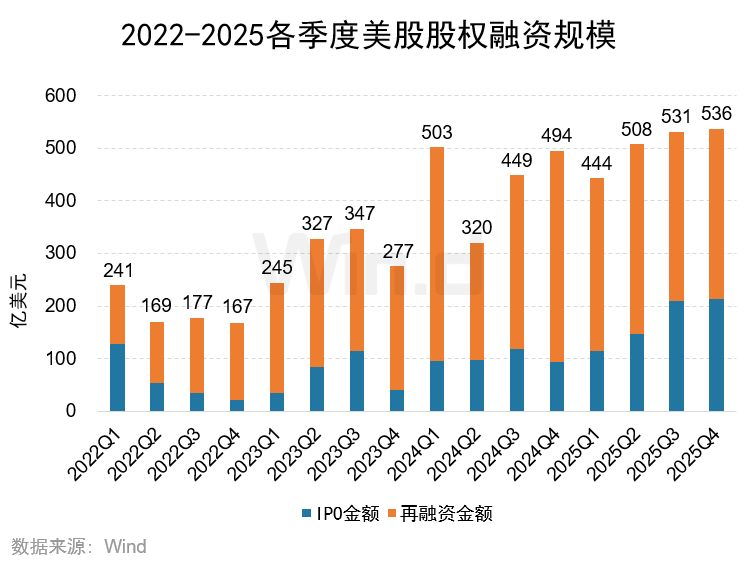
Core Insights - The US equity financing market in 2025 showed a significant recovery, with total financing reaching $201.8 billion, a 14.27% increase from $176.6 billion in 2024 [1][3][39] - Initial Public Offerings (IPOs) saw a notable rise, with 403 companies going public, raising $68.4 billion, marking a 67.95% increase compared to 2024 [1][14][30] - SPAC IPOs also surged, with 123 companies raising $23.4 billion, a dramatic increase of 153.75% from the previous year [1][33] - Chinese companies listed in the US primarily consisted of small to medium-sized enterprises, totaling 68 IPOs but raising only $1.1 billion, a decrease of 62.88% from 2024 [1][36] Equity Financing Overview - Total equity financing in the US market for 2025 was $201.8 billion, with IPOs contributing $68.4 billion (33.90%) and refinancings accounting for $133.4 billion (66.10%) [3][6] - The non-bank financial sector led in financing, raising $61.9 billion, followed by the pharmaceutical and biotechnology sector at $33.9 billion, and software services at $22.6 billion [9] IPO Market Trends - The IPO market in 2025 was dominated by the Nasdaq, with 313 companies raising $46.04 billion, representing 67.30% of the total IPO market [16] - The highest fundraising sector for IPOs was non-bank financials, raising $34.6 billion, followed by pharmaceuticals at $8 billion, and software services at $7.4 billion [18] - A total of 230 companies raised $1 billion or less in their IPOs, making up 57% of the total IPO count [27] Refinancing Trends - The refinancing market in 2025 totaled $133.4 billion, a slight decrease of 1.82% from 2024, with 912 refinancing events, an increase of 2.36% [39] - The Nasdaq led in refinancing events with 734 occurrences, raising $69.65 billion, while the NYSE had 125 events totaling $62.37 billion [43][45] - The non-bank financial sector was the top industry for refinancing, raising $27.3 billion, followed closely by pharmaceuticals at $25.9 billion [46] Underwriting Rankings - In the IPO underwriting space, Cantor Fitzgerald led with $6.484 billion from 34 deals, followed by Goldman Sachs with $6.354 billion from 36 deals, and Morgan Stanley with $5.956 billion from 35 deals [55][56] - For refinancing, J.P. Morgan topped the list with $21.098 billion from 91 deals, followed by Goldman Sachs with $16.393 billion from 73 deals [59][60]
2025年度美股承销排行榜
Wind万得· 2026-01-06 22:38
Core Viewpoint - The US equity financing market in 2025 showed a significant recovery, with both the number and scale of equity financing reaching a four-year high, totaling $201.8 billion, a 14.27% increase from $176.6 billion in 2024 [2]. Group 1: Financing Scale Trends - In 2025, the total equity financing scale in the US market was $201.8 billion, up 14.27% from $176.6 billion in 2024 [5]. - The IPO financing scale reached $68.4 billion, marking a 67.95% increase from the previous year [5]. - The refinancing scale totaled $133.4 billion, which is a slight decrease of 1.82% compared to 2024 [5]. Group 2: Financing Method Distribution - In 2025, IPO financing accounted for $68.4 billion, representing 33.90% of the total equity financing, while refinancing accounted for $133.4 billion, making up 66.10% [8]. Group 3: Industry Distribution of Financing Entities - The non-bank financial sector led in financing scale with $61.9 billion, followed by the pharmaceutical and biotechnology sector at $33.9 billion, and the software services sector at $22.6 billion [12]. - In terms of financing events, the pharmaceutical and biotechnology sector had the highest number with 354 events, followed by the non-bank financial sector with 212 events [15]. Group 4: IPO Trends - A total of 403 companies successfully went public in 2025, an increase of 131 from 2024, with total financing amounting to $68.4 billion [18]. - The Nasdaq remained the leading market for IPOs, with 313 companies listed, raising $46.04 billion, which is 67.30% of the total IPO market [20]. - The highest IPO financing was achieved by Medline, raising $6.265 billion [35]. Group 5: SPAC and Chinese Companies - In 2025, 123 SPACs were listed, a significant increase of 72 from 2024, raising $23.4 billion, up 153.75% [38]. - There were 68 Chinese companies that went public in the US, raising only $1.1 billion, a decrease of 62.88% from the previous year [41]. Group 6: Refinancing Trends - The total refinancing amount in 2025 was $133.4 billion, a decrease of 1.82%, with 912 refinancing events, an increase of 2.36% from 2024 [45]. - The Nasdaq led in refinancing events with 734 occurrences, raising $69.654 billion [49]. - The non-bank financial sector had the highest refinancing amount at $27.3 billion [52]. Group 7: Underwriting Rankings - Cantor Fitzgerald topped the IPO underwriting list with $6.484 billion, followed closely by Goldman Sachs at $6.354 billion and Morgan Stanley at $5.956 billion [61]. - In refinancing, JPMorgan led with $21.098 billion, followed by Goldman Sachs at $16.393 billion and Morgan Stanley at $12.876 billion [65].

盟科药业:股东盟科香港计划减持公司股份不超过1967万股
Mei Ri Jing Ji Xin Wen· 2026-01-06 14:10
每经AI快讯,盟科药业1月6日晚间发布公告称,公司于近日收到盟科香港出具的《关于股东减持计划 的告知函》,股东盟科香港计划根据市场情况,拟通过集中竞价交易和大宗交易方式减持其所持有的公 司股份合计不超过19,668,163股,即不超过公司总股本的3%。 每经头条(nbdtoutiao)——原指导价34.99万的宝马裸车价22.5万元,多家车企还补贴购置税!2026开 年车市火爆,销售从早到晚忙到没空吃饭 (记者 曾健辉) 免责声明:本文内容与数据仅供参考,不构成投资建议,使用前请核实。据此操作,风险自担。 ...

量化选股策略更新
Yin He Zheng Quan· 2026-01-06 12:51
Quantitative Models and Construction Methods National Enterprise Fundamental Factor Stock Selection Strategy - **Model Name**: National Enterprise Fundamental Factor Stock Selection Strategy [3] - **Model Construction Idea**: The strategy is based on fundamental factors tailored to national enterprises, considering both general and industry-specific factors [5][6] - **Model Construction Process**: - Define the sample pool using the CSI National Enterprise Index (000955.CSI) and stocks listed on the Beijing Stock Exchange for over six months with central or local state-owned enterprise attributes [3] - Classify industries into dividend-oriented and growth-oriented categories based on ZX third-level industry logic [3][4] - Select general factors such as ROE (TTM), operating cash ratio, labor productivity, asset-liability ratio, and dividend yield [5][6] - Incorporate industry-specific factors like ROIC, prepayment growth rate, inventory turnover rate, and capital expenditure/depreciation ratio for different industries [6][8] - Adjust factor weights based on industry characteristics, emphasizing dividend yield for dividend-oriented industries and reducing the weight of asset-liability ratio for growth-oriented industries [9] - Calculate scores using weighted averages of general and industry-specific factors, normalize the scores, and assign weights to stocks based on their scores [11] - Formula for stock weight: $$w_{i}={\frac{s c o r e_{i}^{3}}{\sum_{i=1}^{N}s c o r e_{i}^{3}}}$$ [11] - **Model Evaluation**: The strategy effectively captures the characteristics of national enterprises, balancing dividend stability and growth potential [5][6] Technology Theme Fundamental Factor Stock Selection Strategy - **Model Name**: Technology Theme Fundamental Factor Stock Selection Strategy [19] - **Model Construction Idea**: Focus on technology stocks with high R&D investment and strong growth potential, using fundamental factors to identify stocks in their growth and mature stages [20][23] - **Model Construction Process**: - Define the sample pool based on SW third-level industries and R&D investment criteria (R&D expenses > 5% of revenue or R&D personnel > 10% of total employees) [19][20] - Exclude stocks in the shock and decline stages based on cash flow lifecycle analysis [22][23] - Select general factors such as profitability, growth ability, technical level, supply chain concentration, and alpha factors [24][28] - Incorporate specific factors for growth and mature stages, such as management expense ratio, R&D expense ratio, accounts receivable turnover rate, and PB-ROE [24][28] - Adjust scores using R&D expense multipliers to emphasize high R&D industries [28][29] - Formula for stock weight: $$w e i g h t_{i}={\frac{s c o r e_{i}}{\sum_{i=1}^{50}s c o r e_{i}}}$$ [30] - **Model Evaluation**: The strategy highlights technology stocks with strong R&D capabilities and growth potential, effectively capturing industry-specific dynamics [24][28] Consumer Theme Fundamental Factor Stock Selection Strategy - **Model Name**: Consumer Theme Fundamental Factor Stock Selection Strategy [38] - **Model Construction Idea**: Focus on consumer stocks with direct-to-consumer business models, using fundamental factors to identify stocks with strong growth, profitability, and governance [38][39] - **Model Construction Process**: - Define the sample pool based on SW third-level industries, categorizing stocks into daily manufacturing, optional manufacturing, daily services, and optional services [38][39] - Select general factors such as growth-profitability-cash flow composite factor, operating cash flow ratio, ESG management score, and economic sensitivity [40][41] - Incorporate specific factors like market share, R&D expense ratio, accounts receivable turnover rate, and marketing expense ratio [40][41] - Adjust scores using PS (TTM) multipliers to emphasize stocks with lower price-to-sales ratios [46][47] - Formula for stock weight: $$w e l g h t_{i}={\frac{S c o r e_{i}^{a d j}}{\sum_{i=1}^{50}S c o r e_{i}^{a d j}}}$$ [48] - **Model Evaluation**: The strategy effectively identifies consumer stocks with strong fundamentals and growth potential, balancing profitability and governance [40][41] --- Model Backtesting Results National Enterprise Fundamental Factor Stock Selection Strategy - **Annualized Return**: 22.93% [12][15] - **Annualized Volatility**: 20.85% [15] - **Sharpe Ratio**: 1.0961 [15] - **Calmar Ratio**: 0.9963 [15] - **Maximum Drawdown**: -23.01% [15] Technology Theme Fundamental Factor Stock Selection Strategy - **Annualized Return**: 30.61% [31][34] - **Annualized Volatility**: 27.61% [34] - **Sharpe Ratio**: 1.1070 [34] - **Calmar Ratio**: 0.8962 [34] - **Maximum Drawdown**: -34.16% [34] Consumer Theme Fundamental Factor Stock Selection Strategy - **Annualized Return**: 24.86% [49][52] - **Annualized Volatility**: 22.99% [52] - **Sharpe Ratio**: 1.0825 [52] - **Calmar Ratio**: 1.0197 [52] - **Maximum Drawdown**: -24.38% [52]
【财闻联播】2026年我国将开展新一轮找矿行动!白银基金再度公告停牌
券商中国· 2026-01-06 12:03
Macro Dynamics - China has discovered 1,444.49 tons of gold, with plans for a new round of mineral exploration starting in 2026, aiming to enhance the exploration and development of strategic mineral resources [2] - The Ministry of Commerce emphasizes the need for a collaborative approach among government, enterprises, and consumers to promote green consumption policies effectively [3] - The 2026 National Civil Aviation Work Conference highlighted the progress in domestic aircraft development, including the certification of new models and international market expansion [4] Financial Institutions - Bank of America predicts that AI chip stocks will continue to rise, with Nvidia, Broadcom, and AMD identified as top picks as the global semiconductor market is expected to exceed $1 trillion, with a projected 30% year-on-year sales growth in 2026 [7] Market Data - The Shanghai Composite Index reached a ten-year high with a 1.5% increase, and the total trading volume in the Shanghai and Shenzhen markets exceeded 2.8 trillion yuan, marking a significant increase in market activity [8] - As of January 5, the financing balance on the Shanghai Stock Exchange was reported at 1,277.036 billion yuan, reflecting an increase of 8.24 billion yuan from the previous trading day [9] - The Hong Kong Hang Seng Index rose by 1.38%, with significant gains in the brokerage and metals sectors [10] Company Dynamics - WuXi AppTec announced that shareholders controlled by the actual controller have reduced their holdings by 59.6751 million shares, accounting for 2% of the total share capital [12] - Jia Mei Packaging's stock surged by 230% from December 17, 2025, to January 6, 2026, leading to a temporary suspension for price verification [13] - Samsung Electronics is expected to see a 160% year-on-year increase in operating profit for Q4 2025, driven by a surge in demand for storage chips due to the AI boom [14] - Alibaba's AI model for early pancreatic cancer screening has successfully identified cases that may have been missed, showcasing the potential of AI in healthcare [18] - Aerospace company Hangtian Huanyu anticipates that its commercial space revenue will account for less than 15% of total revenue in 2025, with a slight net profit growth of 0.56% year-on-year [19]





大红包!2025年深市公司分红超5000亿元,创业板公司展现出更强增长活力
Jin Rong Jie· 2026-01-06 11:33
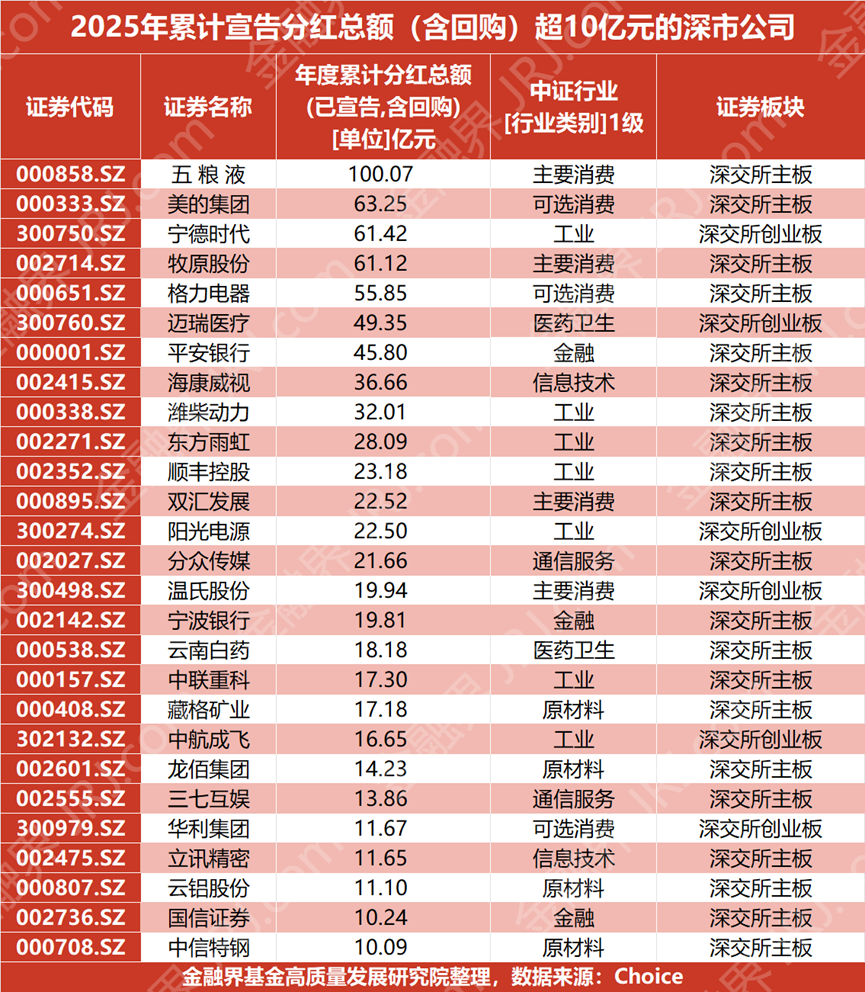
Core Insights - The total cash dividends of companies listed on the Shenzhen Stock Exchange (SZSE) are projected to exceed 500 billion yuan in 2025, reaching 547.56 billion yuan, indicating a stable high level of cash returns to investors [1] - Since the start of the 14th Five-Year Plan, cumulative dividends from SZSE companies have surpassed 2 trillion yuan, reflecting a solid market ecosystem that favors regular and substantial dividends [1] Summary by Category Dividend Scale and Growth - The dividend scale remains robust, consistently maintaining above the 500 billion yuan threshold [1] - In 2025, 533 companies on the SZSE implemented interim dividends totaling approximately 132.93 billion yuan, representing a growth of over 25% compared to the previous year [1] Attracting Long-term Investment - Stable high returns have attracted long-term capital investments, with 166 companies in the SZSE offering dividend yields exceeding 1%, and 108 companies yielding over 1.34%, particularly appealing to insurance and pension funds [1] Performance of Different Boards - While mainboard companies continue to dominate total dividend amounts, companies on the ChiNext board have shown stronger growth, with 945 companies increasing their total dividends by 8.41% year-on-year to 137.45 billion yuan [1] Industry Highlights - Leading companies in the consumer and financial sectors have set examples with significant dividend distributions, such as Wuliangye's interim dividend of 10.01 billion yuan and Gree Electric's distribution of 5.585 billion yuan [1] - In key future-oriented sectors, notable dividend cases have emerged from advanced manufacturing (CITIC Special Steel, Weichai Power), digital economy (Yilian Network, GoerTek), and green low-carbon sectors (CATL, Longyuan Power) [2] High Dividend Companies - In 2025, 28 companies on the SZSE announced total dividends exceeding 1 billion yuan, with Wuliangye leading at over 10 billion yuan, followed by Midea Group, CATL, and Muyuan Foods, each exceeding 6 billion yuan [3] - The distribution of these high-dividend companies is primarily in the consumer, industrial, and discretionary sectors, with notable representation from the pharmaceutical and information technology sectors [4]






多点开花,科创50指数涨近2%,科创50ETF易方达(588080)等产品受市场关注
Sou Hu Cai Jing· 2026-01-06 11:20
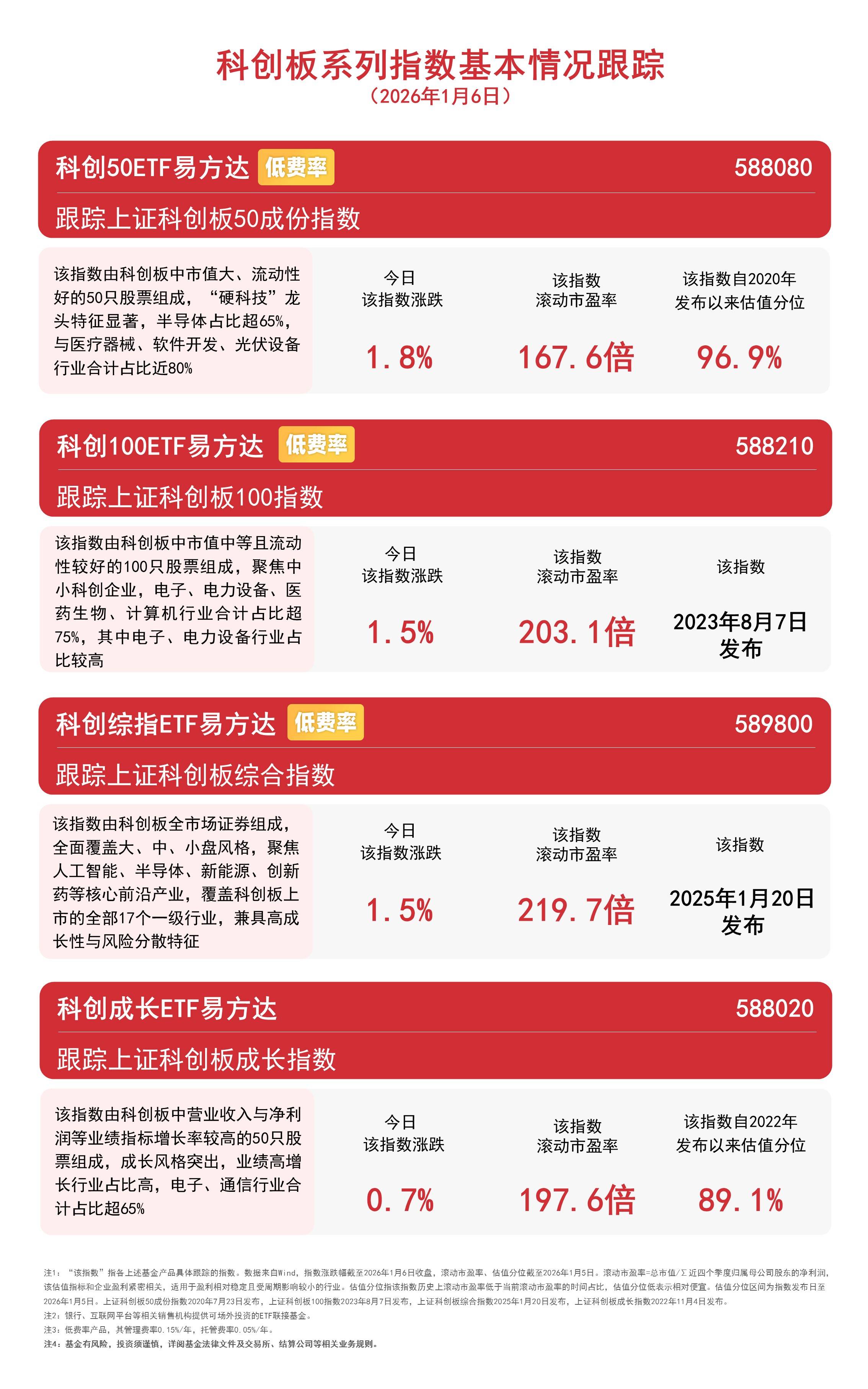
Group 1 - The core viewpoint of the news highlights a significant rise in technology-related stocks, particularly in commercial aerospace, brain-computer interface concepts, photovoltaic, chips, and semiconductor sectors, with the STAR Market indices showing positive performance [1] - The STAR 50 Index increased by 1.8%, while the STAR 100 Index and STAR Composite Index both rose by 1.5%, and the STAR Growth Index saw a 0.7% increase [1] - According to Wind data, the E Fund STAR 50 ETF (588080) experienced a net inflow of nearly 300 million yuan over two consecutive trading days [1] Group 2 - China Galaxy Securities anticipates that the reform policy expectations will strengthen in the first year of the 14th Five-Year Plan, with factors such as the upward trend of the RMB exchange rate supporting liquidity and boosting market confidence [1] - The report emphasizes the importance of focusing on technology leaders with performance realization capabilities under the logic of profit recovery [1]
1月6日医疗健康(980016)指数涨0.88%,成份股华大智造(688114)领涨
Sou Hu Cai Jing· 2026-01-06 10:56
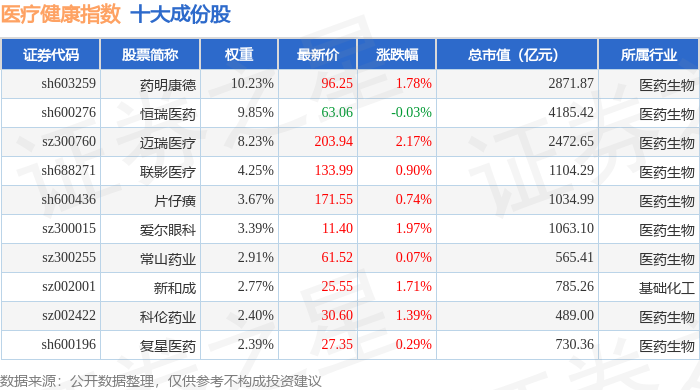
Core Viewpoint - The Medical Health Index (980016) closed at 6354.84 points, up 0.88%, with a trading volume of 29.705 billion yuan and a turnover rate of 1.0% on January 6 [1] Group 1: Index Performance - On the same day, 38 of the index's constituent stocks rose, with BGI Genomics leading with a 6.95% increase, while 11 stocks fell, with Zai Lab leading the decline at 3.72% [1] - The top ten constituent stocks of the Medical Health Index are detailed, with WuXi AppTec holding the highest weight at 10.23% and a latest price of 96.25 yuan, showing a 1.78% increase [1] Group 2: Market Capitalization - The total market capitalization of WuXi AppTec is approximately 287.187 billion yuan, while the highest market cap among the top ten is held by Hengrui Medicine at 418.542 billion yuan [1] - The market capitalization of the top ten stocks ranges from 489 million yuan for Kelun Pharmaceutical to 418.542 billion yuan for Hengrui Medicine [1] Group 3: Capital Flow - The net outflow of main funds from the constituent stocks totaled 471 million yuan, while retail investors saw a net inflow of 200 million yuan [1] - Detailed capital flow shows that WuXi AppTec had a net inflow of 180 million yuan from main funds, while Yeye Eye Care experienced a net outflow of 157 million yuan from retail investors [2]





主力资金 | 尾盘主力资金大幅出逃2股
Zheng Quan Shi Bao· 2026-01-06 09:59
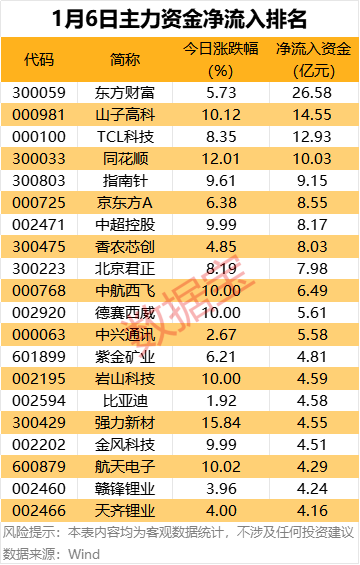
Core Viewpoint - The A-share market continues to show strong performance, with the Shanghai Composite Index achieving a 13-day winning streak, reaching its highest level since July 2015. However, there was a net outflow of main funds totaling 17.668 billion yuan across the market [2]. Group 1: Industry Performance - All major industry sectors saw gains, with notable increases in insurance, energy metals, chemical fertilizers, securities, and small metals. The beauty and personal care sector was the only one to decline [2]. - Among the 13 industries with net inflows, non-ferrous metals, non-bank financials, automotive, and computer sectors had net inflows of 3.423 billion yuan, 2.185 billion yuan, 1.477 billion yuan, and 1.064 billion yuan respectively. Other sectors like banking, oil and petrochemicals, electronics, and public utilities also saw inflows exceeding 100 million yuan [2]. Group 2: Individual Stock Performance - A total of 54 stocks experienced net inflows exceeding 200 million yuan, with 10 stocks seeing inflows over 600 million yuan. Notably, Dongfang Caifu had a net inflow of 2.658 billion yuan, while Shanzhi Gaoke saw 1.455 billion yuan [3][4]. - The top stocks with significant net inflows included: - Dongfang Caifu: 5.73% increase, 2.658 billion yuan net inflow - Shanzhi Gaoke: 10.12% increase, 1.455 billion yuan net inflow - TCL Technology: 8.35% increase, 1.293 billion yuan net inflow - Tonghuashun: 12.01% increase, 1.003 billion yuan net inflow - Zhinan Zhen: 9.61% increase, 915 million yuan net inflow [4]. Group 3: Net Outflow Analysis - A total of 63 stocks experienced net outflows exceeding 200 million yuan, with notable outflows from Zhongji Xuchuang, Xinyi Sheng, and Tianji Shares, each exceeding 1 billion yuan [5][6]. - The stocks with the highest net outflows included: - Zhongji Xuchuang: -2.93% change, 2.647 billion yuan net outflow - Xinyi Sheng: -2.13% change, 2.277 billion yuan net outflow - Tianji Shares: 0.35% change, 1.281 billion yuan net outflow [6]. Group 4: Tail-End Fund Movement - At the end of the trading day, the main funds saw a net inflow of 1.805 billion yuan, with significant inflows in the computer, non-bank financial, and national defense industries, each exceeding 400 million yuan [7]. - Individual stocks with notable tail-end inflows included: - Dongfang Caifu: 5.73% increase, 508.907 million yuan net inflow - Liou Shares: 6.94% increase, 271.545 million yuan net inflow - Tonghuashun: 12.01% increase, 233.563 million yuan net inflow [8].