房地产业

Search documents
宏观经济宏观周报:高频指标连续两周超季节性上升-20250824
Guoxin Securities· 2025-08-24 13:20
Economic Growth Indicators - The Guosen High-Frequency Macro Diffusion Index A maintained a positive value, while Index B continued to rise, indicating ongoing economic growth momentum[1] - The standardized Index B increased by 0.3, outperforming historical averages, suggesting improved domestic economic dynamics[1] - Consumer sector performance showed a recovery, while investment and real estate sectors remained stable[1] Price Tracking and Inflation - Food prices are expected to rise by approximately 0.5% month-on-month in August, while non-food prices are projected to remain flat, leading to an overall CPI increase of about 0.1%[2] - The CPI year-on-year is anticipated to decline to -0.3%[2] - The PPI is expected to rise by 0.4% month-on-month in August, with a year-on-year increase to -2.5%[2] Asset Price Predictions - Current domestic interest rates are considered low, while the Shanghai Composite Index is viewed as high, indicating potential downward pressure on the index and upward pressure on the ten-year government bond yield[1] - The predicted ten-year government bond yield for the week of August 29, 2025, is 2.49%, while the Shanghai Composite Index is forecasted to be 3,206.20[19]
应验李嘉诚所言!手握两套房的家庭,或将遇到3个结果
Sou Hu Cai Jing· 2025-08-23 18:47
Group 1 - The core viewpoint is that the real estate market is experiencing significant declines in property values, with predictions of further drops in the coming years, indicating a shift from a seller's market to a buyer's market [1][3][4] - Property prices in major cities like Shanghai and Beijing have seen drastic reductions, with some areas experiencing price halving, and forecasts suggest a potential additional decline of 20%-25% by the end of 2025 [1][3] - The increase in housing supply, coupled with new property tax regulations, has contributed to the current market conditions, leading to a surplus of listings and decreased buyer interest [1][4] Group 2 - The second-hand housing market is facing challenges, with a significant number of properties listed for sale but few buyers, resulting in sellers having to lower prices substantially to attract interest [3][4] - The costs associated with owning property are rising, including property taxes, maintenance fees, and utilities, which are straining homeowners financially [4][6] - The financial burden of mortgage payments is increasing, especially for those who secured loans at higher interest rates in previous years, leading to difficulties in managing monthly expenses [4][6] Group 3 - Strategies for homeowners to navigate the current real estate challenges include selling properties that are less desirable, such as those in suburban areas or older buildings, and considering rental options to offset costs [6][7] - Optimizing asset allocation by selling less valuable properties and investing in high-quality assets in prime locations is recommended to maintain value [6][7] - Utilizing tax policies to reduce holding costs, such as taking advantage of exemptions and proper rental registrations, can help alleviate some financial pressures [7]


低利率环境与房地产“止跌回稳”|宏观经济
清华金融评论· 2025-08-23 09:54
Core Viewpoint - China is gradually entering a low-interest-rate environment, which typically leads to asset price bubbles; however, Japan's experience suggests that the effectiveness of low-interest policies in stabilizing the real estate market depends on the speed of interest rate cuts, financial institution support, and fiscal policy coordination [2][3]. Group 1: Causes of Low-Interest Rate Environment - The global low-interest-rate environment is influenced by factors such as declining birth rates in developed economies, aging populations, and changes in risk preferences among investors, which have led to increased demand for safe assets [5][6][8]. - In China, the transition to a low-interest-rate environment is driven by technological advancements reaching their peak and a demographic shift towards negative population growth, with a decrease of 850,000 in 2022 and projected declines in subsequent years [7][8]. Group 2: Comparison of Low-Interest Rate Policies in Japan and the U.S. - Japan's approach to stabilizing its real estate market post-bubble involved solely lowering interest rates without significant fiscal intervention, resulting in a prolonged decline in property prices from 1991 to 2013 [12][13]. - In contrast, the U.S. implemented a comprehensive strategy during the 2008 financial crisis, including aggressive interest rate cuts, government takeovers of key financial institutions, and large-scale asset purchase programs, which quickly stabilized housing prices [14][15]. Group 3: Implications for China's Real Estate Market - The effectiveness of low-interest-rate policies in China for achieving "stop falling and stabilize" in the real estate market remains uncertain, as recent rate cuts have not significantly impacted asset prices or market stability [3][10]. - The comparison with Japan and the U.S. highlights the importance of a multifaceted approach, including fiscal measures and support for financial institutions, to avoid the pitfalls experienced by Japan [11][12].

最近在恐惧中度过
Sou Hu Cai Jing· 2025-08-22 15:07
Core Viewpoint - The current stock market rally is primarily driven by government fiscal expansion rather than improvements in the fundamental economy, leading to concerns about sustainability and potential adjustments in the near future [1][2][4]. Group 1: Market Dynamics - The stock market's rise this year is attributed to significant government intervention, with an estimated 3.5 trillion yuan injected into A-shares and Hong Kong stocks through various channels [2]. - Institutional confidence has increased following government investments, prompting further buying activity, while retail investors are still hesitant to enter the market [2][5]. - The current market sentiment is cautious, with many retail investors recalling past experiences of buying at market peaks and facing losses [4][5]. Group 2: Economic Indicators - Despite the stock market's performance, key economic indicators such as GDP growth and employment have not shown significant improvement compared to last year, leading to skepticism about the market's upward trajectory [1][4]. - The government has increased the fiscal deficit rate from 3% to 4%, with net financing of government bonds reaching 8.9 trillion yuan in the first seven months, indicating a need for careful fiscal management moving forward [8]. Group 3: Future Outlook - The sustainability of the stock market rally is contingent on continued government support and retail investor participation; without these, a market correction may be imminent [6][8]. - The government's focus on investing in projects with future returns suggests a cautious approach to fiscal spending, which could impact market dynamics if not aligned with corporate profitability [7][8].
滨江集团出资80000万元成立杭州滨德房地产开发有限公司,持股100%
Jin Rong Jie· 2025-08-21 23:12
Group 1 - Hangzhou Binjiang Real Estate Group Co., Ltd. has invested 800 million RMB to establish Hangzhou Binde Real Estate Development Co., Ltd. with 100% ownership [1] - Hangzhou Binde Real Estate Development Co., Ltd. was established on July 29, 2025, with a registered capital of 800 million RMB [1] - The company is located in Hangzhou and is involved in the real estate industry, specifically in real estate development and operation [1]

又有一线城市落地“商转公”,广州称最快一月内办结
Di Yi Cai Jing· 2025-08-21 13:50
Core Viewpoint - The implementation of the "commercial loan to provident fund loan" policy in Guangzhou aims to lower mortgage costs, effectively releasing social consumption potential and stimulating economic growth [1][2]. Group 1: Policy Implementation - The Guangzhou Housing Provident Fund Management Center has officially implemented the "commercial loan to provident fund loan" policy, following Shenzhen as another first-tier city to adopt this measure [1]. - The policy allows individuals who have contributed to the housing provident fund for over 60 months and meet specific criteria to convert their commercial loans to provident fund loans [1]. Group 2: Loan Details - The loan amount is calculated based on 70% of the lower value between the purchase price and the appraised value of the property, with the loan term not exceeding 30 years [1]. - A dynamic adjustment mechanism is established, which activates the "commercial loan to provident fund loan" when the personal loan ratio is below 75%, and implements control measures when it reaches 85% or above [1]. Group 3: Market Impact - The policy is expected to reduce monthly mortgage payments, alleviating financial burdens on families and improving their quality of life [2]. - The initiative is viewed as a significant policy highlight in the current real estate market, with positive feedback from the market [2]. - Since the beginning of 2023, nearly 20 cities have supported or optimized the "commercial loan to provident fund loan" policy, primarily in second and third-tier cities [2].
LPR连续三个月维持不变,不敢降息背后的原因
Sou Hu Cai Jing· 2025-08-21 03:32
Core Viewpoint - The People's Bank of China (PBOC) has maintained the Loan Prime Rate (LPR) at 3.0% for one year and 3.5% for five years, reflecting a cautious approach amid calls for market stimulus, influenced by global capital flows and the Federal Reserve's policies [1][2]. Group 1: Reasons for Not Lowering Interest Rates - The current net interest margin for commercial banks has compressed to a historical low of 1.42%, indicating that banks earn only 1.42 yuan for every 100 yuan loaned, which poses systemic risks if LPR is lowered [3]. - The Federal Reserve's hawkish stance is a significant constraint, with a 93% probability of a 25 basis point rate cut in September, yet the Fed has maintained its rate at 4.25%-4.5%, leading to a 274 basis point inversion in the 10-year treasury yield between China and the U.S. [5][6]. - Economic fundamentals provide implicit support, with a GDP growth of 5.4% in the first half of the year and a weighted average loan interest rate dropping to a historical low of 3.2%, suggesting that further rate cuts may not be necessary [7]. Group 2: Impact of Global Capital Flows - The inverted interest rate differential of 274 basis points incentivizes foreign capital to withdraw from Chinese bonds, resulting in a net sell-off of 68 billion yuan in July, which increases financing costs for real estate companies [11]. - Currency fluctuations linked to LPR adjustments can indirectly raise mortgage costs for consumers, as a depreciation of the yuan can increase the hidden costs of purchasing property [13]. - The dynamics of LPR stability and expectations of Federal Reserve rate cuts illustrate the complex interplay of global interest rates, requiring the industry to navigate external pressures while stimulating domestic demand [10].
北京万通新发展集团股份有限公司关于投资者说明会召开情况的公告
Shang Hai Zheng Quan Bao· 2025-08-20 20:39
Summary of Key Points Core Viewpoint The company, Beijing Wantong New Development Group Co., Ltd., held an investor briefing on August 20, 2025, to discuss the acquisition of Beijing Shudao Information Technology Co., Ltd. (Shudao Technology) and address investor concerns regarding the transaction and the company's strategic transformation towards digital technology. Group 1: Acquisition Details - The acquisition of Shudao Technology has been approved by the company's board, and the signing of the investment and equity acquisition agreements has been completed [2][4]. - The company has already made the second payment of the acquisition price, and the industrial and commercial changes related to the capital increase are in progress [3][4]. - Shudao Technology is expected to deliver 62.98% of its equity to Wantong Development within this year [8]. Group 2: Product and Market Position - Shudao Technology is one of the few domestic companies capable of independently designing and mass-producing PCIe 5.0 chips, with expectations to begin gradual mass supply by Q4 2025 [3][19]. - The PCIe 5.0 chip market is currently dominated by foreign manufacturers, and Shudao Technology aims to provide customized high-speed interconnect chip solutions that are cost-effective and secure [19][20]. - The company has signed contracts worth 147.91 million yuan (including tax) with Shudao Technology, with confirmed revenue of 28.55 million yuan and an order backlog of 119.36 million yuan [6]. Group 3: Financial and Operational Impact - The acquisition is expected to enhance the company's strategic transformation, moving from traditional real estate to the digital technology sector, which has strong growth potential [15][20]. - The company maintains a low debt ratio and stable cash flow, ensuring that the acquisition will not impose significant operational pressure [6][15]. - The projected revenues for Shudao Technology from 2025 to 2027 are 63.50 million yuan, 290.78 million yuan, and 538.40 million yuan, respectively, with performance commitments set at 80 million yuan, 500 million yuan, and 1 billion yuan [14]. Group 4: Management and Integration Strategy - Post-acquisition, Shudao Technology will operate as a subsidiary under Wantong Development, with plans for integration while maintaining its operational independence [17][20]. - The company has not yet established a specific equity incentive plan for Shudao Technology's management and core team, but it aims to leverage its resources to support the subsidiary's growth [17][20]. - The company assures that the recent detention of its actual controller will not affect the acquisition process or the company's operations [13][15].

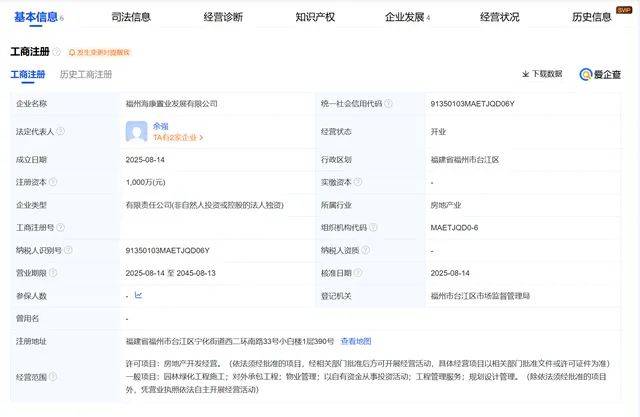
【关注】福州海康置业注册成立,将开发市中心45.44亩新盘!
Sou Hu Cai Jing· 2025-08-20 20:05
Core Insights - Fuzhou Haikang Real Estate Development Co., Ltd. was established on August 14, 2025, with a registered capital of 10 million RMB [1][2] - The company is a wholly-owned subsidiary of Fuzhou Haiyue Construction Development Co., Ltd. [4] - The company is involved in real estate development and management, including landscaping, engineering contracting, and investment activities [2] Company Information - The company is registered in Taijiang District, Fuzhou, Fujian Province [2] - The business scope includes real estate development, landscaping engineering, property management, and project management services [2] - The company is currently in an operational status [2] Project Details - The "Ningjin New Garden" project, for which Fuzhou Haikang Real Estate is the legal entity, was approved for filing on August 19, 2025 [5] - The project is located on land parcel 2025-16, which was acquired by Fuzhou Haiyue Construction Development Co., Ltd. for 882 million RMB, with a floor price of 7,914.79 RMB per square meter [7] - The land area for the project is 30,290 square meters (approximately 45.44 acres) with specific planning indicators including a building density of 35% and a green space rate of over 30% [10] Location and Amenities - The project site is strategically located near the intersection of two metro lines, enhancing accessibility to key areas [11] - The surrounding area includes established commercial centers and quality educational institutions, contributing to a favorable living environment [11]
每日债市速递 | 财政部公布多项数据
Wind万得· 2025-08-19 23:00
Group 1: Open Market Operations - The central bank announced a 7-day reverse repurchase operation on August 19, with a fixed rate and quantity tendering of 580.3 billion yuan at an interest rate of 1.40%, with the same amount being the winning bid [1] - On the same day, 114.6 billion yuan of reverse repos matured, resulting in a net injection of 465.7 billion yuan [1] Group 2: Funding Conditions - The interbank market maintained a slight tightening trend, with the overnight repo weighted average rate initially exceeding 1.50% but later falling back to around 1.47% [3] - The latest overnight financing rate in the U.S. was reported at 4.36% [3] Group 3: Interbank Certificates of Deposit - The latest transaction rate for one-year interbank certificates of deposit among major banks was around 1.67%, showing little change from the previous day [7] Group 4: Bond Market Overview - The yields on major interbank bonds mostly declined [9] - Government bond futures closed collectively higher, with the 30-year main contract rising by 0.23%, the 10-year by 0.03%, the 5-year by 0.07%, and the 2-year by 0.03% [13] Group 5: Fiscal Data - From January to July, the national general public budget revenue was 1,358.39 billion yuan, a year-on-year increase of 0.1%, while tax revenue was 1,109.33 billion yuan, a decrease of 0.3% [14] - Non-tax revenue increased by 2% to 249.06 billion yuan, with stamp duty revenue rising by 20.7% to 25.59 billion yuan, and securities transaction stamp duty increasing by 62.5% to 9.36 billion yuan [14] Group 6: Local Government Bonds - Guangdong Province plans to issue offshore RMB local government bonds in Macau, with an expected issuance scale of 2.5 billion yuan [14] Group 7: Credit Ratings - S&P Global Ratings confirmed the U.S. sovereign credit rating at "AA+/A-1+" with a stable outlook, projecting that the net general government debt will approach 100% of GDP [15]