存储

Search documents
存储产业链扩产潮涌 多家公司积极布局
Zheng Quan Ri Bao· 2026-01-12 14:04
12月30日,备受关注的我国DRAM(动态随机存取存储器)产业龙头企业长鑫科技集团股份有限公 司(以下简称"长鑫科技")公开披露了首次公开发行股票并在科创板上市招股说明书,该公司拟募资 295亿元。其中,75亿元拟用于存储器晶圆制造量产线技术升级改造项目,130亿元拟用于DRAM存储器 技术升级项目,90亿元拟用于DRAM前瞻技术研究与开发项目。 转自:证券日报网 本报记者 丁蓉 当下,全球存储器市场迎来"超级周期",产业链上下游亦同步吹响扩产号角。中关村物联网产业联 盟副秘书长袁帅在接受《证券日报》记者采访时表示:"存储产业链掀起的扩产潮,本质上是人工智能 技术爆发引发的结构性需求与产业升级迫切性的集中释放。人工智能技术发展对高端存储产品的需求呈 现指数级增长,不仅为存储产业提供了广阔的市场前景,更推动企业加速技术升级,从制程微缩到先进 封装,从架构优化再到产品创新,这直接关系到产业链企业在人工智能时代的市场竞争力。" 产业链企业积极建设产能 1月9日,国内先进封测领军企业通富微电子股份有限公司(以下简称"通富微电")发布2026年度向 特定对象发行A股股票预案,拟募资不超44亿元。其中,8亿元拟用于存储芯 ...

AI日报丨报告称2026年中国科技巨头指数将首超美股七巨头,英特尔股价大涨超10%
美股研究社· 2026-01-12 13:52
Group 1 - The article emphasizes the rapid development of artificial intelligence (AI) technology, which is creating extensive opportunities in various sectors [3] - Shanghai is focusing on "AI + manufacturing" as a key strategy to drive growth in the next decade, with initiatives aimed at enhancing industrialization through innovative conferences and collaborations [5] - Tsinghua University has developed an AI-driven high-throughput drug virtual screening platform, DrugCLIP, which significantly accelerates new drug screening by a million times and aims to collaborate with industry partners for drug discovery [6] Group 2 - A report indicates that by 2026, the Chinese technology giant index is expected to surpass the profitability of the "seven giants" of the US stock market for the first time since 2022, reflecting a positive outlook for AI-related companies in China [8] - The storage market has entered a "super bull market" phase, with prices expected to rise by 40%-50% in Q4 2025 and Q1 2026, driven by increasing demand from AI and server capacities [9] - Intel's stock surged over 10% following a meeting between its CEO and former President Trump, resulting in a significant increase in the value of the US government's investment in Intel [11]



万润科技:公司全资子公司深圳万润存储科技有限公司承建的先进存储模组制造项目已投产
Zheng Quan Ri Bao Wang· 2026-01-12 11:11
Core Viewpoint - Wanrun Technology's subsidiary has commenced production of an advanced storage module manufacturing project, enhancing product consistency and reliability [1] Group 1: Project Details - The project features a cleanroom production facility rated at 100,000 levels, which improves product consistency and reliability [1] - Advanced production testing equipment has been acquired, including 3D automatic solder paste inspection and optical inspection systems, ensuring defect-free surface mount quality [1] - A comprehensive one-stop intelligent testing system has been established, integrating card opening, high-temperature aging, and performance testing to ensure product stability and reliability [1] Group 2: Market Strategy - The company is actively seizing opportunities in the storage industry, collaborating to expand customer base and secure orders [1] - There is a strong focus on driving revenue growth and enhancing profitability within the storage segment [1] - The company aims to strengthen its core business in the new generation of information technology [1]

江波龙(301308) - 2026年1月8日投资者关系活动记录表
2026-01-12 10:28
Group 1: Product Innovations - The mSSD product utilizes Wafer-level System-in-Package (SiP) technology, integrating multiple components into a single package, which significantly reduces manufacturing costs by eliminating several SMT processes [3] - mSSD offers a compact design that meets low power consumption requirements while maintaining performance levels comparable to traditional SSDs, indicating a broad market potential [3] - The UFS4.1 product is positioned as a high-end storage solution for Tier 1 customers, with limited global competition in chip-level development, enhancing its market prospects [3] Group 2: Market Trends and Demand - The current storage upcycle is expected to be driven by increased demand for SSDs from cloud service providers due to AI technology applications and a shortage of HDD supply [3] - The transition from HDD to SSD by cloud service providers is anticipated to significantly boost NAND Flash demand, although capacity expansion may lag behind this demand [3] - Future capital expenditure increases from manufacturers may have limited impact on output growth in 2026 due to the inherent delays in capacity construction [3] Group 3: Investor Relations Activity - The investor relations activity took place on January 8, 2026, with participation from several investment firms, indicating strong interest in the company's developments [2] - The meeting was led by the Investor Relations Manager and a Senior Supervisor, highlighting the company's commitment to transparent communication with investors [2] - No undisclosed significant information was involved in this activity, ensuring compliance with disclosure regulations [3]
A股超3800股上涨 139股涨停 商业航天多股爆发 中国卫星创历史新高
2 1 Shi Ji Jing Ji Bao Dao· 2026-01-12 05:14
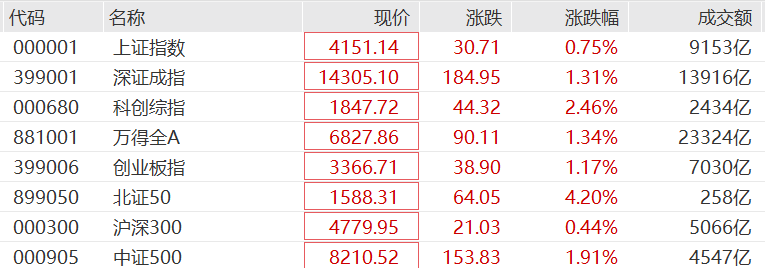
Market Overview - On January 12, A-shares saw a collective rise in the three major indices, with the Shanghai Composite Index up 0.75%, the Shenzhen Component Index up 1.31%, and the ChiNext Index up 1.17% [1] - The market's half-day trading volume exceeded 2.3 trillion yuan, an increase of over 478.1 billion yuan compared to the previous day [1] Stock Performance - The Shanghai Composite Index closed at 4151.14, with a rise of 30.71 points [2] - The Shenzhen Component Index reached 14305.10, increasing by 184.95 points [2] - The ChiNext Index was at 3366.71, up by 38.90 points [2] - Over 3800 stocks in the market rose, with 139 stocks hitting the daily limit up [1] Sector Performance - AI applications, commercial aerospace, photovoltaic, and retail sectors showed significant gains, while oil and gas, as well as coal sectors, experienced declines [2] - Notable stocks in the photovoltaic sector included Oriental Sunrise, Jiejia Weichuang, and Maiwei Shares, which saw increases of 16.08%, 12.71%, and 11.36% respectively [5] Lithium and Precious Metals - Lithium carbonate futures hit a high of 156,100 yuan per ton, marking a new peak since September 2023, with major lithium mining stocks also rising significantly [3] - Gold prices reached over $4600 per ounce, with a nearly 2% increase, and domestic gold jewelry prices also rose, leading to a collective rise in A-share gold stocks [3] Commercial Aerospace - The commercial aerospace sector remained active, with companies like China Satellite and Goldwind Technology seeing significant stock price increases [4] - China submitted an application for an additional 203,000 satellites, indicating a growing focus on satellite technology [4] AI Applications - AI application stocks surged, with companies like Worth Buying and Guangyun Technology hitting the daily limit up [7] - A significant breakthrough in AI-driven drug screening was reported by Tsinghua University, further boosting interest in AI-related stocks [7] Storage Market - The storage market is experiencing a price surge, with expectations of a 40-50% increase in prices by Q1 2026 due to rising demand from AI and server capacities [8] - Companies like Fudan Microelectronics and Aerospace Intelligence saw stock price increases of over 10% [8] Technology Sector Outlook - Recent reports suggest that China's technology sector is poised for significant growth, with expectations of surpassing the profitability of major US tech giants by 2026 [9]

A股超3800股上涨,139股涨停,商业航天多股爆发,中国卫星创历史新高
2 1 Shi Ji Jing Ji Bao Dao· 2026-01-12 04:17
Market Overview - On January 12, A-shares saw a collective rise in the three major indices, with the Shanghai Composite Index up by 0.75%, the Shenzhen Component Index up by 1.31%, and the ChiNext Index up by 1.17% [1] - The market's half-day trading volume exceeded 2.3 trillion yuan, an increase of over 478.1 billion yuan compared to the previous day [1] - More than 3,800 stocks in the market rose, with 139 stocks hitting the daily limit [1] Index Performance - Shanghai Composite Index: 4,151.14, up 30.71 points (0.75%), trading volume of 915.3 billion yuan [2] - Shenzhen Component Index: 14,305.10, up 184.95 points (1.31%), trading volume of 1,391.6 billion yuan [2] - ChiNext Index: 3,366.71, up 38.90 points (1.17%), trading volume of 703 billion yuan [2] - The overall A-share market index (Wande All A) rose by 1.34% with a trading volume of 23,324 billion yuan [2] Sector Performance - AI applications, commercial aerospace, photovoltaic, and retail sectors saw significant gains, while oil and gas, as well as coal sectors, experienced declines [2] Notable Stocks - Tianpu Co., Ltd. (605255) faced a one-day limit down due to an investigation by the China Securities Regulatory Commission [3] - Lithium carbonate futures hit a new high of 156,100 yuan per ton, leading to significant gains in lithium mining stocks [3] - Gold prices surged, with spot gold exceeding $4,600, resulting in a collective rise in A-share gold stocks [3] Commercial Aerospace - The commercial aerospace sector showed renewed activity, with several stocks hitting consecutive limits [4] - China Satellite (600118) reached a historical high, with a market capitalization of 137.9 billion yuan [4] - Recent satellite applications submitted by China included an additional 203,000 satellites, indicating growth in the sector [4] Photovoltaic Sector - The photovoltaic sector was active, particularly in perovskite battery and space photovoltaic technologies, with several companies showing significant price increases [5] - Companies like Dongfang Risen (300118) and Jiejia Weichuang (300724) led the gains in this sector [5] AI Applications - AI applications saw a broad increase, with notable gains in GEO and AI medical sectors, leading to multiple stocks hitting their daily limits [7] - A significant research breakthrough from Tsinghua University in AI-driven drug screening was reported, contributing to the sector's momentum [7] Storage Market - The storage sector is experiencing a price surge, with expectations of a further increase of 40-50% in Q1 2026 [8][9] - The current market is described as entering a "super bull market," surpassing historical highs due to increased demand from AI and server capacity [8]
A股超3800股上涨,139股涨停,商业航天多股爆发,中国卫星创历史新高
21世纪经济报道· 2026-01-12 04:09
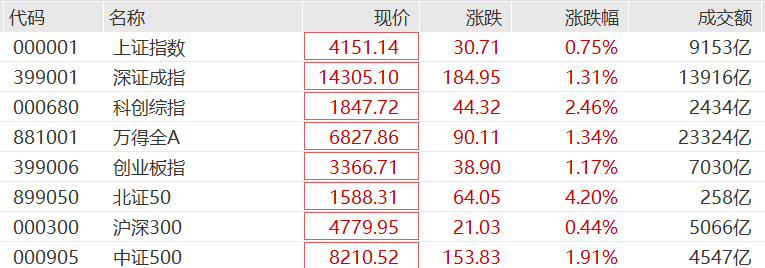
记者丨 张嘉钰 编辑丨江佩佩 1月12日,A股三大指数集体拉升,截至午盘,沪指涨0.75%,深成指涨1.31%。创业板指涨 1.17%。 市场半日成交额超2.3万亿元,较上日此时放量超4781亿。 全市场超3800只个股上涨, 其中139只个股涨停。 从板块来看,AI应用、商业航天、光伏、 零售 等概念涨幅居前,油气、煤炭等方向跌幅居 前。 热门个股中,1月12日,2025年大牛股天普股份一字跌停,消息面上,天普股份被证监会立案 调查。 贵金属早盘,现货黄金首次站上4600美元大关,涨幅近2%,新年首月累涨280美元。截至发 稿,仍涨超1%。纽约期金早盘也突破了4610美元/盎司。 国内品牌金饰价格同步上扬,周生 生足金饰品报1429元/克,较1月10日1410元/克涨19元/克。 受此影响,A股黄金股集体拉升, 晓程科技涨超6%,山东黄金涨超2%。 | 代码 | 名称 | 现价 | 涨跌 | 涨跌幅 | 成交额 | | --- | --- | --- | --- | --- | --- | | 000001 | 上证指数 | 4151.14 | 30.71 | 0.75% | 9153亿 | | 39900 ...

1月12日早餐 | DeepSeek或发布新模型;我国新增20万颗卫星申请
Xuan Gu Bao· 2026-01-12 00:14
Group 1: Market Overview - The S&P 500 index rose by 0.65%, reaching a new high, while the Nasdaq 100 increased by 1% [1] - Non-farm payroll data showed mixed results, reinforcing market expectations for the Federal Reserve to maintain interest rates in January [3] - The dollar has appreciated for four consecutive days, reaching a one-month high [4] Group 2: Technology and AI Developments - Walmart and Alphabet have partnered to launch AI-supported shopping features on Gemini, marking a significant step in the integration of AI with e-commerce [24] - DeepSeek plans to release its next-generation AI model, DeepSeek V4, in February, which is expected to outperform existing models in programming capabilities [26] - SanDisk has proposed a "100% cash prepayment" model for SSD supply agreements, indicating a severe supply-demand imbalance in the storage market [25] Group 3: Industry-Specific News - The Chinese government has initiated a three-year action plan to support the transformation and upgrading of advanced manufacturing, focusing on AI and innovative products [11] - The domestic civil drone market is projected to grow significantly, with an estimated market size of approximately 146.8 billion yuan by 2024 [27] - The China Securities Regulatory Commission has increased the whistleblower reward for securities and futures violations to a maximum of 1 million yuan [10] Group 4: Company Announcements - Defu Technology plans to acquire at least 51% of Huiru Technology, which specializes in high-performance electrolytic copper foil [29] - YTO Express intends to acquire 100% of Wanjia Gaoke for 305 million yuan [29] - AirNexis will pay 108 million USD upfront and up to 955 million USD in milestone payments for a licensing agreement with Haise Science [29]



早报 | “死了么”APP突然爆火;特朗普被曝正考虑多个干涉伊朗方案;马斯克称3年内机器人将超越顶尖医生;演员闫学晶发文致歉
虎嗅APP· 2026-01-12 00:10
Group 1 - The U.S. government is considering multiple intervention options in Iran, including military strikes and deploying a carrier strike group to the region [2][3] - The Federal Communications Commission (FCC) has approved SpaceX's plan to deploy an additional 7,500 Starlink satellites, increasing its total to 15,000, which will enhance global internet services [4] - SpaceX's satellite upgrades will allow operations across five frequency bands and improve network capacity, supporting next-generation mobile communication services with speeds up to 1 Gbps [4] Group 2 - The app "Did I Die?" has seen a price increase from 1 yuan to 8 yuan after gaining popularity, with the developers planning to enhance features and ensure sustainable development [9][10] - San Francisco's Sam's Club has reported a surge in sales of a down jacket priced at 499 yuan, which has a filling weight of 400 grams, indicating strong consumer demand [11][12] - China has applied for over 200,000 satellite frequency resources, indicating a strategic national interest in satellite technology and positioning itself to compete with companies like SpaceX [13] Group 3 - SanDisk plans to raise enterprise-level NAND prices by over 100% in March and is requiring full cash prepayment from customers, reflecting a supply-demand imbalance in the storage market [14] - Semiconductor company Zhongwei plans to reduce its shareholding by up to 2% due to tax-related needs after the chairman renounced U.S. citizenship to regain Chinese nationality [15][16] - The stock of Guosheng Technology will resume trading on January 12 after a period of abnormal fluctuations, with a cumulative increase of 370.20% during the suspension [28]


华尔街见闻早餐FM-Radio | 2026年1月12日
Sou Hu Cai Jing· 2026-01-11 23:03
Market Overview - The S&P 500 rose by 0.6%, reaching a new high, while the Nasdaq 100 increased by 1% amid mixed non-farm employment data and pending decisions on Trump tariffs [1] - Intel shares surged over 10% following a meeting between its CEO and Trump, while Oracle's stock rose nearly 5% [1] - The non-farm report strengthened expectations for the Federal Reserve to maintain interest rates in January, leading to a 4.39 basis point increase in the 2-year Treasury yield [1] - The dollar experienced a four-day rise, reaching a one-month high, with the USD/JPY pair briefly surpassing 158 [1] Cryptocurrency and Commodities - Bitcoin fell below $90,000 after a strong initial rise earlier in the week, ending the week roughly flat [2] - Spot gold prices increased by 0.7%, surpassing $4,500, with a weekly gain of over 4% [2] - Spot silver rose by 3.8%, with a weekly increase of 10% [2] - WTI crude oil saw a brief rise of 2.3% before settling at a 0.6% increase due to geopolitical tensions involving Iran and Trump [2] Company News - SpaceX received approval to deploy an additional 7,500 Starlink satellites, bringing the total to 15,000, aimed at enhancing global internet services [22] - SanDisk announced a price increase and a requirement for full cash prepayment from customers to secure supply, reflecting the high demand for storage devices driven by AI infrastructure [37][38] - Oracle's stock performance is under scrutiny as some investors express skepticism about its current investments and market positioning [33] Industry Insights - The military-industrial sector is gaining attention due to geopolitical tensions, with defense spending expected to rise globally [24] - The drone market is experiencing significant growth, with projections indicating that China's civil drone market could reach approximately 400 billion yuan by 2030 [34] - The rare earth market is seeing price increases driven by strategic stockpiling amid geopolitical concerns, with the establishment of a new price index for rare earth products [35] - The lithium extraction industry is poised for growth following technological breakthroughs in lithium separation processes, which could reshape the global lithium supply landscape [39][40]